Monthly Archives: May 2011

Handmade Ice Cream

Hi, my name is Mel, and I am a gadget-ophobe.

Well, I guess that is not strictly true, I just don’t see the point of most of them. I suppose this comes partly from the make-do-and-mend attitude I have retained since my uni days, when all I had was a block of knives, a mixing bowl, a wooden spoon and a balloon whisk. Anything else I had to improvise with a wine bottle (useful as a blender and a rolling pin!), or whatever else was to hand.

Obviously, I have got many more of the basics now, which allows me to do much more, but I still have not been suckered by many of the more ‘faddish’ gadgets, such as a breadmaker, or ice cream machine. I enjoy making bread, and take great pleasure from trying to get a tight round, or a nice airy foccacia.

I have never really attempted ice cream before now though, because I was under the impression it was difficult. It was also not easy to find a recipe that did not involve the instructions to “place all of the ingredients into an ice-cream machine”.

Stages of hand made ice cream

Stage 1: an hour in the freezer, before whisking

Anyway, a bit of hunting around, and a lucky episode of Masterchef Australia left me a bit more encouraged try to make my own, especially since they recommend a custard base, and I do like a good custard. Because I wanted something to serve with rhubarb, I chose to flavour this one with ginger.

Here is how I did it:

Ingredients

5 Egg Yolks

100 g Sugar

400 ml Double cream

400 ml Milk

50 g Stem Ginger

1 Tbsp Syrup from the ginger jar

Making Custard

Finely chop the ginger, and add that to the milk and the cream in a pan. heat to just below boiling point.Set aside to steep for 20 minutes. Pass the liquid through a sieve to remove the pieces of ginger, but set them aside though, because you will use some later. Bring the liquid back up to boiling point.

In general, for flavoured custards, you add the flavouring to the milk – you also do this with the vanilla pod if you are making custard to go with your apple pie. So, if you want to make mint ice cream, and the essence to the milk, add cocoa or melted chocolate for chocolate ice cream and so on.

In a separate bowl, beat the egg yolks and the sugar together until they thicken quite a bit. Now for the tricky bit (or so they tell you). Very slowly at first, add the warm milk to the egg mixture. I do this by adding a little, and making sure it is whisked in before I add more. Once you have combined a fair amount, you can add the rest of the liquid much faster.

Once the egg and cream  is combined, returned to the heat and heat gently. Do not allow it to boil, or it will curdle. The custard will thicken, and when it leaves a line on the back of your wooden spoon then it is thick enough. Remove from the heat.

Stages of Ice Cream Making

Stage 2: Not much further than stage 1

The Ice Cream Bit

The custard needs to cool completely before you try to freeze it (not least for energy efficiency of the freezer!). You can either set it aside to cool, or a better way is to put it in a bowl, which is sitting in some ice in another bowl (or the sink) and stir it to dissipate the heat faster.

Once the custard is cold, then you need to put it in the freezer. Most sources I read said that you should put it in a bowl for this stage. Unfortunately, I didn’t read that until after I had frozen it, so I put it in an ice cream tub (recycled, of course). As long as the custard does not fill more than 3/4 of the vessel, it will be fine.

In order to make ice cream, er, creamy, you need to try to keep the ice crystals from getting too big. To do this, put it in the freezer for an hour, then take it out and whisk it. Repeat this process until you have a smooth, thick ice cream.For this recipe, I found it took four times to create the smoothness required.

Because I like ginger, I stirred in some of the chopped ginger from the custard making at the last stage of the whisk and freeze cycle. You could also add anything that you like at this stage – nuts, mint chips, chocolate chips, fruit.
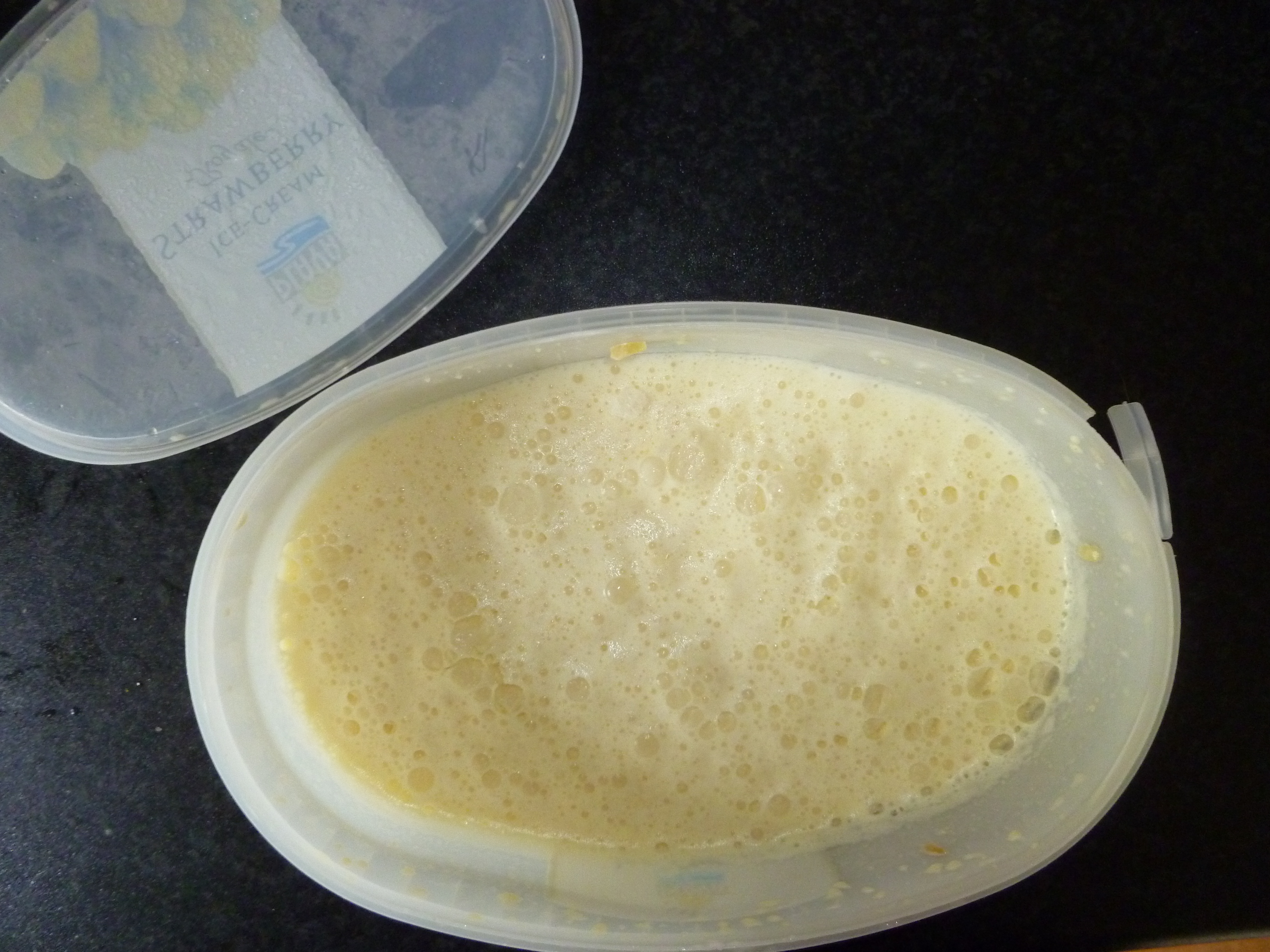
Stages of Ice Cram Making

Stage 4: Thick, and after adding the ginger

The ice cream should last a few weeks in the freezer (in theory!), just don’t forget to take it out of the freezer about 10-15 minutes before you want to serve it.

I served mine with the aforementioned poached rhubarb, and some meringue. Well, I needed to use up those egg whites somehow!

Poached rhubarb, stem ginger ice cream & meringue

The finished product

Leave a comment

Filed under Feast

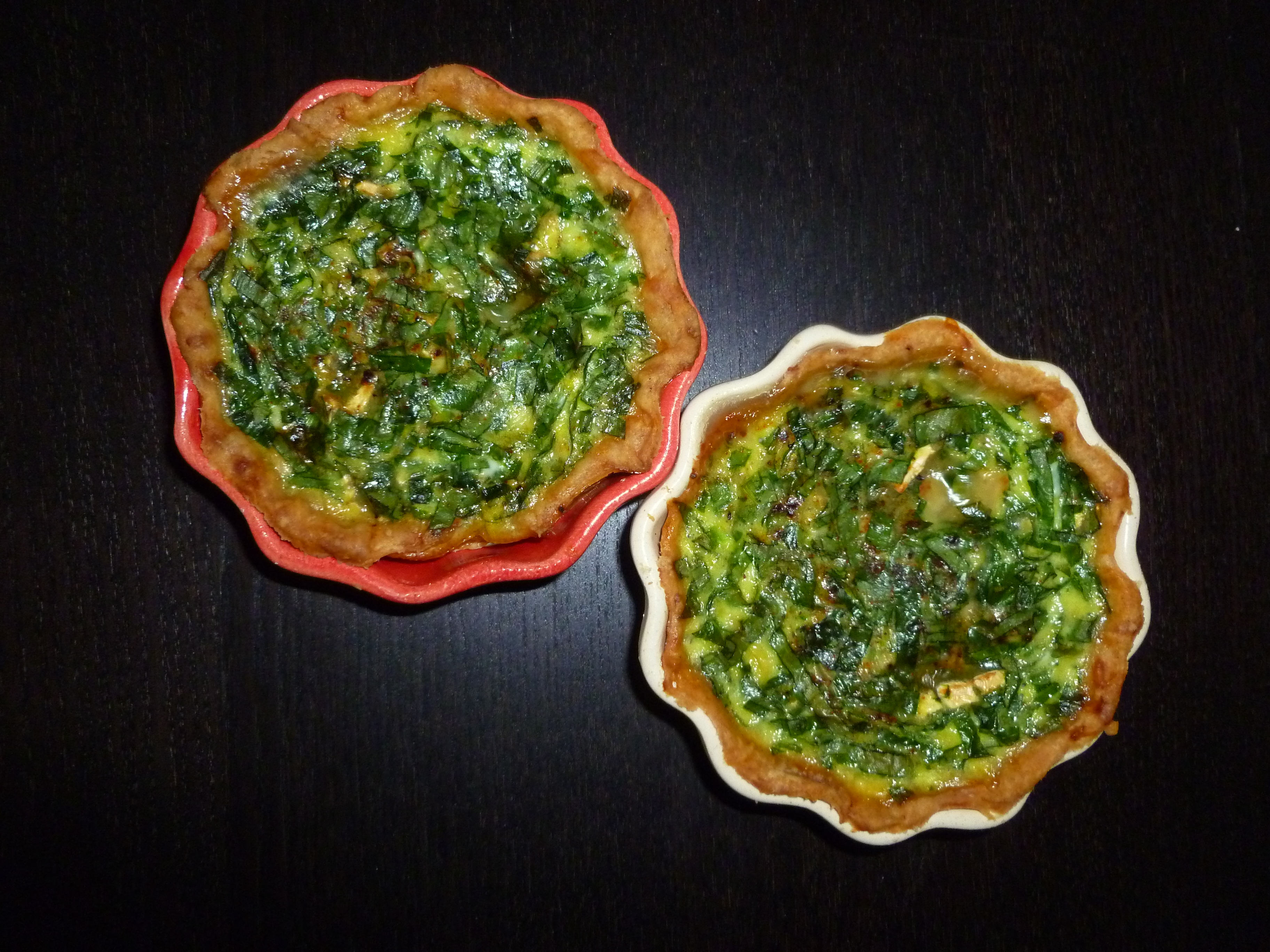
Wild Garlic Tarts

Wild Garlic Tarts

Wild Garlic Tarts  

Wild Garlic – it is more than likely available in a wood near you right now. It looks quite innocuous, and is easy to walk past. However, walk on it, and there will be no mistaking the smell of garlic.

I love the stuff, and have it in soups, salads, as pesto, I use it as a pot herb, and anything else that I can think of. You can eat the leaves, bulbs and the flowers (although it should be noted that in many places digging up the entire plant is illegal, so only use the flowers and leaves), and all of them have that distinctly garlic taste.

Of course, there are a few basic guidelines to stick to when foraging, and don’t take the whole patch. Apart from needing to leave some for next year’s crop, wild garlic does not keep all that well, lasting about a week in the fridge. And it bruises easily, which only speeds up the deterioration.

One word of caution is that it is possible to confuse the leaves with lily of the valley early in the season, but there really can be no confusion once you smell the plant. If it doesn’t smell of garlic, just don’t eat it!

I had invited a couple of friends over to dinner, and happened to have had a foraging session the day before. I also collected nettles and other wild greens, but these can sometimes be a little ‘niche’ for most people. I thought introducing them to the delights of wild garlic would be an easy and very tasty way in.

As  this was to be a starter, I decided that little tartlets were the way to go. Plus, I had been given some beautiful little individual tart dishes that I wanted to try out.

With savoury tarts, I often prefer cheese pastry. Back in Britain, then only a good cheddar would do for this pastry, but now I live in the Netherlands, and I am not prepared to pay a small fortune for cheddar in a country that prides itself on making its own cheese. I have not necessarily bought  into the fact that Dutch cheeses are the best in the World, but there are enough specialty shops that you can find a good, tasty cheese. For a good cheddar substitute I usually use a piquant belegen boerenkaas (literally ‘sharp mature farmer’s cheese’, which is often unpasteurised).

These are great served with a salad (you can even use foraged leaves if you like), and a fruity dressing. I used home-made blackberry vinaigrette, but balsamic or raspberry would do equally well.

The recipe below is enough for 6 tartlets. If you have fewer people, then both the pastry and the filling will keep in the fridge for up to a week (although the pastry must be tightly wrapped, or just freeze it and thaw before use).

Recip: Wild Garlic Tarts

Ingredients

For the pastry

75 g butter

175 g plain flour (or a mix of half white and half wholemeal plain flour)

50 g of a tasty cheese, such as mature cheddar or piquant belegen boerenkaas

1/2 tsp dry mustard powder

Good pinch of cayenne pepper

For the tart filling

50-100 g wild garlic leaves, cut to a chiffonade

100 g good camembert, finely chopped (any well-flavoured rinsed-rind soft cheese would be good in this dish)

3 eggs

100 ml cream or milk

Freshly grated nutmeg

Paprika

Method

Firstly, make the pastry. I have had very little success in getting good results from using a food processor to form the dough. If you find this easy, combine the ingredients in a food processor, then add cold water to form the dough.

I rub the butter, mustard powder and the flour together by hand. For this I use cold butter, and often have cold hands, so I’m not working the dough too much. You can achieve cold hands by dint of poor circulation, or running them under a cold tap for a few minutes before working the dough.

Once the mixture looks like fine breadcrumbs, I add the cheese and the cayenne. I don’t add salt, because the cheese should contain enough. Then I combine the lot with just enough cold water to form a dough.

The pastry needs to rest in the fridge for at least half an hour, but I often go and do something else, then get back to it when I have finished.

Roll out the pastry thinly, and put into the greased tartlet tins. You can also make one large quiche with this recipe. If making individual tarts, I find it easier to cut out smaller discs from the pastry, using a side plate as a template, then gently transfer the thin pastry to the tart tins, and cut to size. Pastry will shrink when you cook it, so it  is better to be generous. You can always trim it later, but you can’t unshrink it.

Blind bake in a hot oven at 180°C. To blind bake, I cover the pastry with rice in greaseproof paper, you can also use beans or ceramic beads. Once rice has been baked in this way, you can no longer cook it normally, so I keep mine in a jar to recycle for every blind bake.

Once the base of the pastry is dry (usually 10 mins) remove the blind bake and put back in the oven until the pastry has browned slightly, and is crisp.

Meanwhile, make the tart filling, by lightly beating the egg and cream, then adding the wild garlic leaves, cheese, paprika nutmeg and mixing well. Season to taste.

When the tart cases are out of the oven, allow to cool slightly, and fill with the filling. Return to the oven, and bake for 15 minutes, or until the topping has just set (could be up to half an hour if making a large quiche).

Serve warm or cold.

1 Comment

Filed under Found

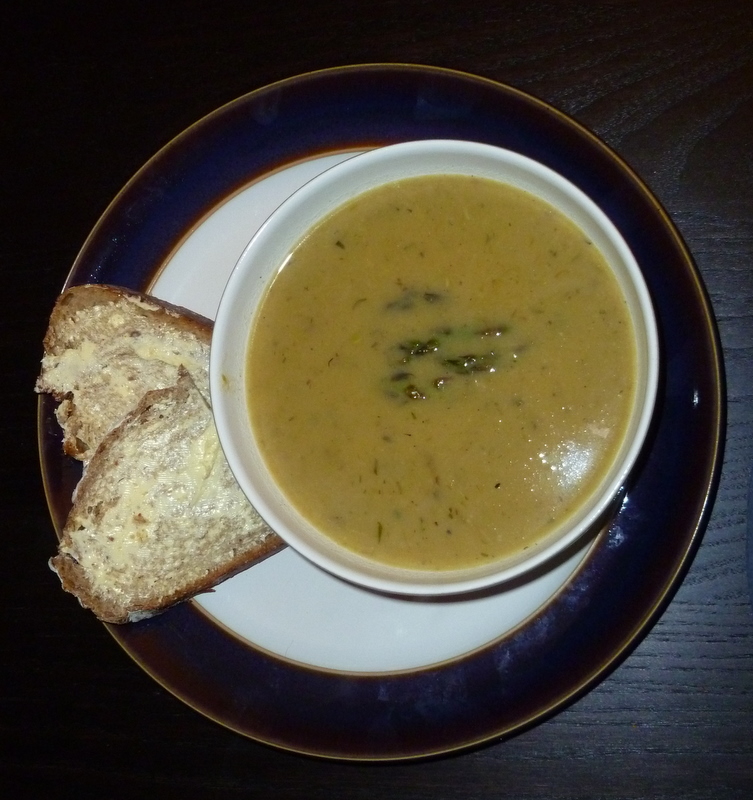
Asparagus Soup

As a child, I didn’t eat many vegetables. As an adult, I eat many more, and I love to eat seasonally. This is why you will probably often hear me saying that such-and-such a vegetable is my favourite. It would probably be more accurate to say that such-and-such a vegetable is my favourite right now.

At the moment we are into the asparagus season, and it is cheap and plentiful. And right now, asparagus is my favourite vegetable.I eat it with eggs, in salads, on its own with butter, in risottos – you name it.

In general, the bottom end of the stalk becomes tough and woody, so it is best to cut, or snap it off. I really hate throwing food away, especially something as tasty as asparagus. So,  I decided to try to use these woody stalky bits up.

Soup is the obvious answer. First, I tried to blend it in a food processor, but this just resulted in smaller woody bits in the soup. I also have a food mill, and one day I tried it through that, and it turned out that the low tech version was the best, since the woody bits are not passed through the mill. I really recommend these – I picked mine up for a tenner back in the UK, and I use it weekly.

This year I planted my own asparagus, and freshly cut asparagus should not have the woody stalky bits. I wonder if this soup will continue to feature in my spring repertoire? I hope so, it really is good!

The following recipe varies in amounts, depending on how many stalks you have been saving in the fridge. The stalks will keep for up to 10 days (depending on age when you bought them, and the width of the stalks), so you can save them up from a couple of bunches to get a good amount, if you like.

Recipe: Asparagus Soup

Ingredients

1 chopped onion

1 tbsp olive oil

Asparagus stalk ends

Chicken or vegetable stock

Thyme

Crème fraiche (cream or milk would also work)

Method

Sweat the onion and thyme in the olive oil, until the onion is fairly soft, but not coloured.

Add the asparagus to the pan, and cook until it has turned a vibrant green

Add the stock. You need to allow enough stock to cover the vegetables in the pot by a couple of cm.

Bring to the boil, then simmer until the stalks are tender to the point of a knife. The time for this can be anything from 5 minutes for the really thin stalks, up to 20 minutes for the later season asparagus.

Take off the heat and allow to cool for 5-10 minutes. Then, pass through the food mill into a clean pan.

Add a little crème fraiche. Again, the amount you add will depend on the amount of soup that you have. Season with salt and pepper.

This soup can be served hot or cold, especially if you are having a really warm spring/ summer, like the one that we are having now.

If you are serving it cold, add a little water to thin it, allow to cool completely, then refrigerate for an hour or two. Garnish it with croutons, cooked asparagus tips, small dice of cucumber (seeded and peeled), or some of all three. A little chervil can be chopped and stirred through, or used as a garnish as well. Check for seasoning before serving, as cold soup can often need more seasoning that its hot counterpart.

If you want to serve it hot, warm the soup gently, without boiling. The soup can be made ahead of time, and warmed through at a convenient time. Garnish with cooked asparagus tips, chervil, or a dollop or swirl of the crème fraiche. Serve with buttered brown, rye or sourdough bread. I prefer bread, as opposed to toast with the hot version of this soup.

Leave a comment

Filed under Feast