Monthly Archives: June 2013

Flower Sour

elderflowers

Sweet Little Flowers

Well the elders are in bloom again, and hedgerows all over froth and foam with the delicate white unbrels, almost like the spring tides coming in. This year is a bit later than ususal, due to the length of the Northern hemisphere winter, but now the sunshine has returned, and naure is more than making up for her long sleep.

I love this time of the year, and stock up on elderflowers for cordialsugar, and champagne. All of it delicious, and making the most of the best of the season’s forage.

Elder is really abundant where I live, so there is always plenty to go around during the flowering and fruiting seasons; for us foragers and for the birds.

Elderflowers are not just for the sweet things in life, they are also great in salads, and I have heard of sauces to go with meat. An elderflower sauce is on my list of Things I Want To Experiment With. Like most food bloggers, I guess, I have several such lists – electronically, on paper and in my head. A colleague of mine recently found them in some notes I had taken as part of a work trip, and seemed surprised that I would also be making lists of flavours in between meetings.

As well as the flavours that exist on my lists, or go around in my head, I have a number of different or unusual flavours in my kitchen. For example, I am never without vinegars of all kinds of flavours – raspberry, blackberry, tarragon, rosemary; I even have coconut vinegar since a Filipina friend introduced me to it when she kindly gave me her adobo recipe.

For me, then, it wasn’t too much of a stretch to think that elderflower vinegar would be a great way to keep hold of the elderflower season for just a little bit longer, but without all the sugar.

Try to pick elderflowers on a dry day, in the morning. There will be more pollen and nectar in them, which makes the flavour more intense.

This vinegar is good with salads. I am currently embarking on the 5:2 regimen, because my need to develop great food for this blog was beginning to have a toll on my waistline. I have found that the addition of a few herbs to some of this vinegar is a good way to dress a slad without the need for oil.

You can make marinades with it, and even a couple of drops in some water gives a nice flavour, that is not too sweet.

Elderflower Vinegar

Not So Sweet Little Flowers

Recipe: Elderflower Vinegar

Ingredients

40 g elderflowers

500 ml white wine vinegar

Method

Try to pick the flowers in the morning after a dry spell, in order to maximise the pollen and the flavour.

Remove the elderflowers from the stalks by pulling a fork through the stalks in the diretion of the flowers. You don’t have to be too fussy, as long as you have removed the largest stalks.

Steep the elderflowers in the vinegar, in a non-metallic container or bowl. Cover with a tea towel, and set aside for a few days.

Whenever you remember, give the flowers a stir.

After three days to a week, your vinegar should have reached the strength of flavour that you want.

Bottle up into sterilised bottles. This vinegar will keep well in a cupboard. I cannot resist this fragrant flavour, so the trouble is making it last!

7 Comments

Filed under Found

A Teambuilding Triumph

Dora's Kitchen

Team Build Differently

I was less than thrilled when I heard we had a team building thing as part of the staff Coming Back Week, where all the staff from all of the offices get together for strategy work, training and other discussions. I quickly changed my mind, when I heard about what we were doing.

Ingrdient Boxes, ready to go at Dora's Kitchen

What a Greeting

When you work for an organisation that campaigns to make food fairer, you don’t get to experience team building exercises  like yomping miles through a forest, or trying to get two people from A to B over a 2 m high obstacle with two bits of rope and a plank of wood. No, luckily for us; we get to cook.

Elizabeth of Dora's KItchen

The Warmest of Welcomes

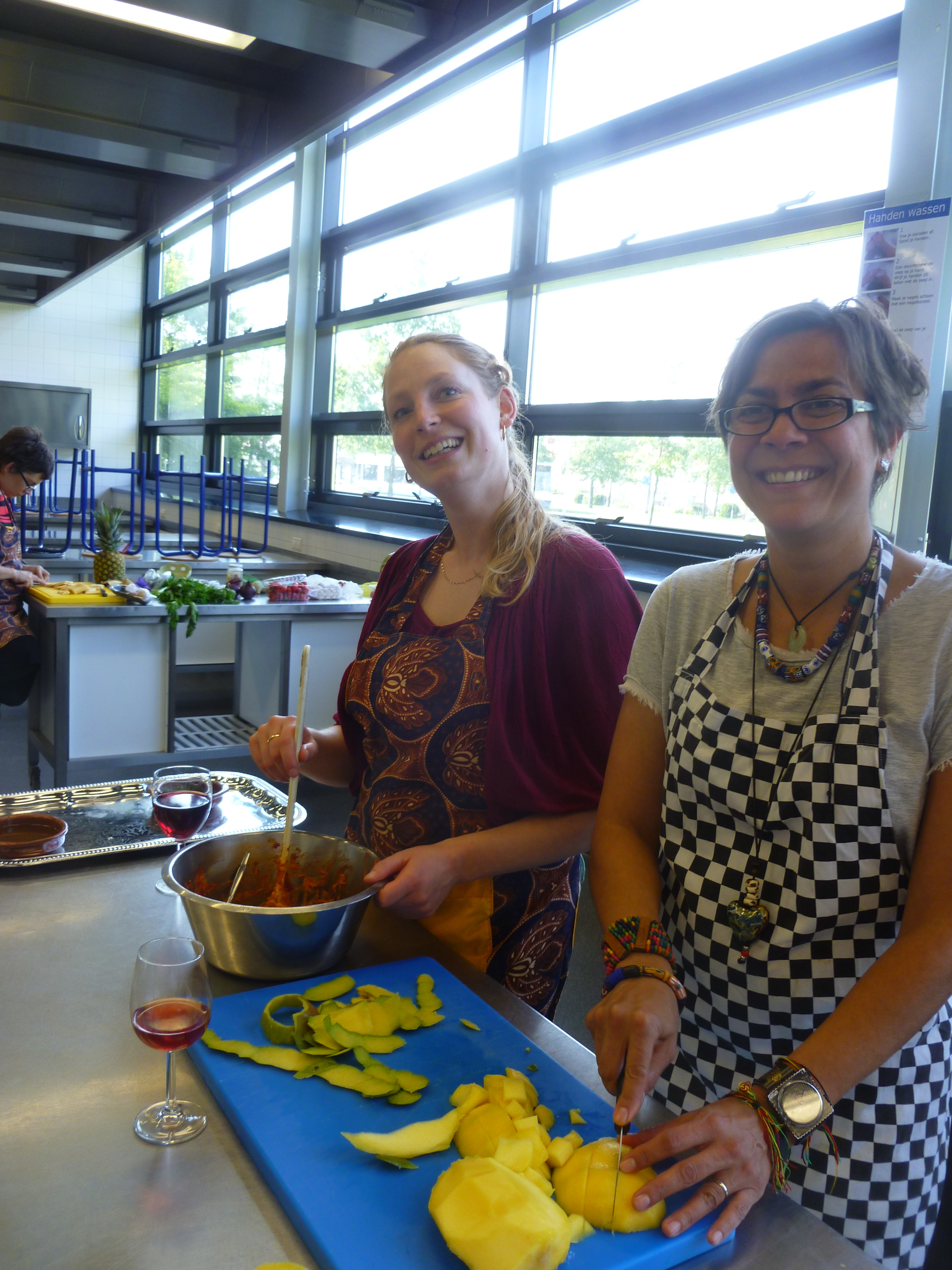
We were going to experience Surinamese cooking. We were ushered in by Elizabeth of Dora’s Kitchen, who greeted us all with a big smile, a plate of tasty snacks and some delicious fruit drinks. Their motto is “Anders Koken”, which translates as “Cook Different”, and this was my first attempt at Surinamese dishes, my first ever cookery class, and it was certainly a different team building exercise. I think they lived up to their motto.

Team Building at Dora's Kitchen

And They’re Off!

After setting the tone for the day, we were divided into smaller teams, and found out what we would be cooking. The choices were Peanut Butter Soup, Bacaljauw moksi alesi (salt cod with coconut rice), Fruit Punch, Spicy Baked Aubergines, and little pastries (I didn’t catch what these were called). I have to say, I was a little sceptical, at the sound of some of the dishes, especially Peanut Butter Soup.

Preparing backaljauw

The Fish Dish

I was in one of the teams tasked with making the bacaljauw. This was more about team building than I had anticipated, because the recipe was a little baffling in parts. At first, I suspected that this was because it had been mangled by an online translation engine, but then I came to the conclusion it was to encourage us to work together to work out what it meant.

Making a pot a steamer

Finding Food Solutions

Team members were swapped around after a little while, but the work carried on.

Making Peanut Butter Soup

Stirring it Up Amongst Colleagues

It was interesting to learn about some new techniques, and from the buzz in the room, it seems that the rest of my work mates thought so too.

Making Fruit Punch

Punchy – The Fruit, Not My Work Mates

Despite the seeming chaos, it all came together pretty well in the end. We managed to produce dishes that the Surinamese teachers were pleased with.

All the best fruit and vegetables

Yes! We Have No Bananas (these are plantain)

Although the teachers were all very keen that the Madame Jeanette peppers (they are a bit like Scotch Bonnets) didn’t go into any of the dishes too soon. All spicy food over here is toned down for the “Dutch palate”. I find it really funny that a nation who got very rich on trading spices around the World don’t appreciate the heat of many of the dishes that people make with them.

making Cassava Balls

The Finishing Touches

The best part was that we got to sit down together and eat the fruits of our labour. I loved the event, I thought that it is a great way to get an organisation to come together and share an experience.

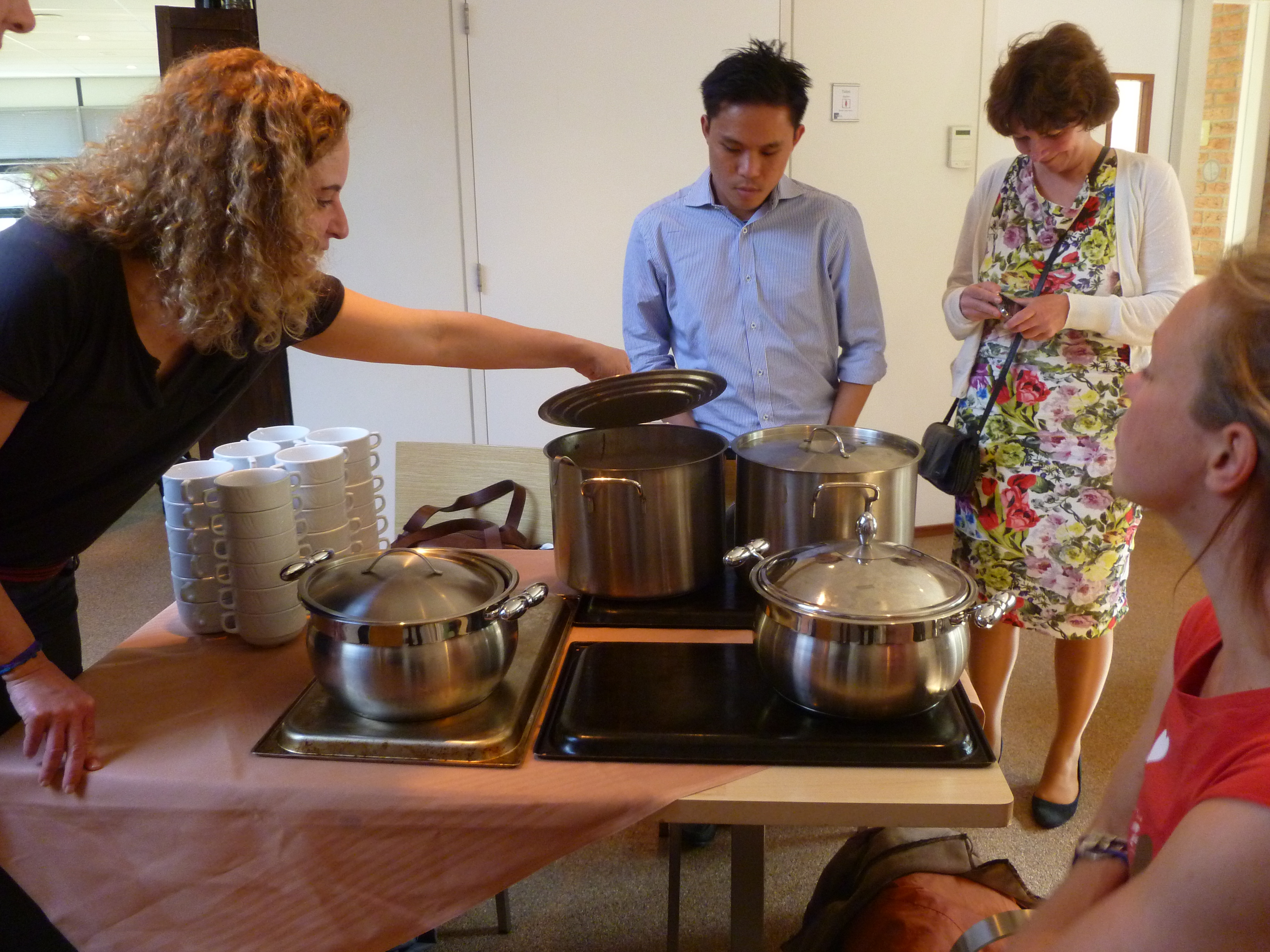
The finished Products

The Finished Products

And it turns out that everything was delicious, too. Even the Peanut Butter Soup – who knew?

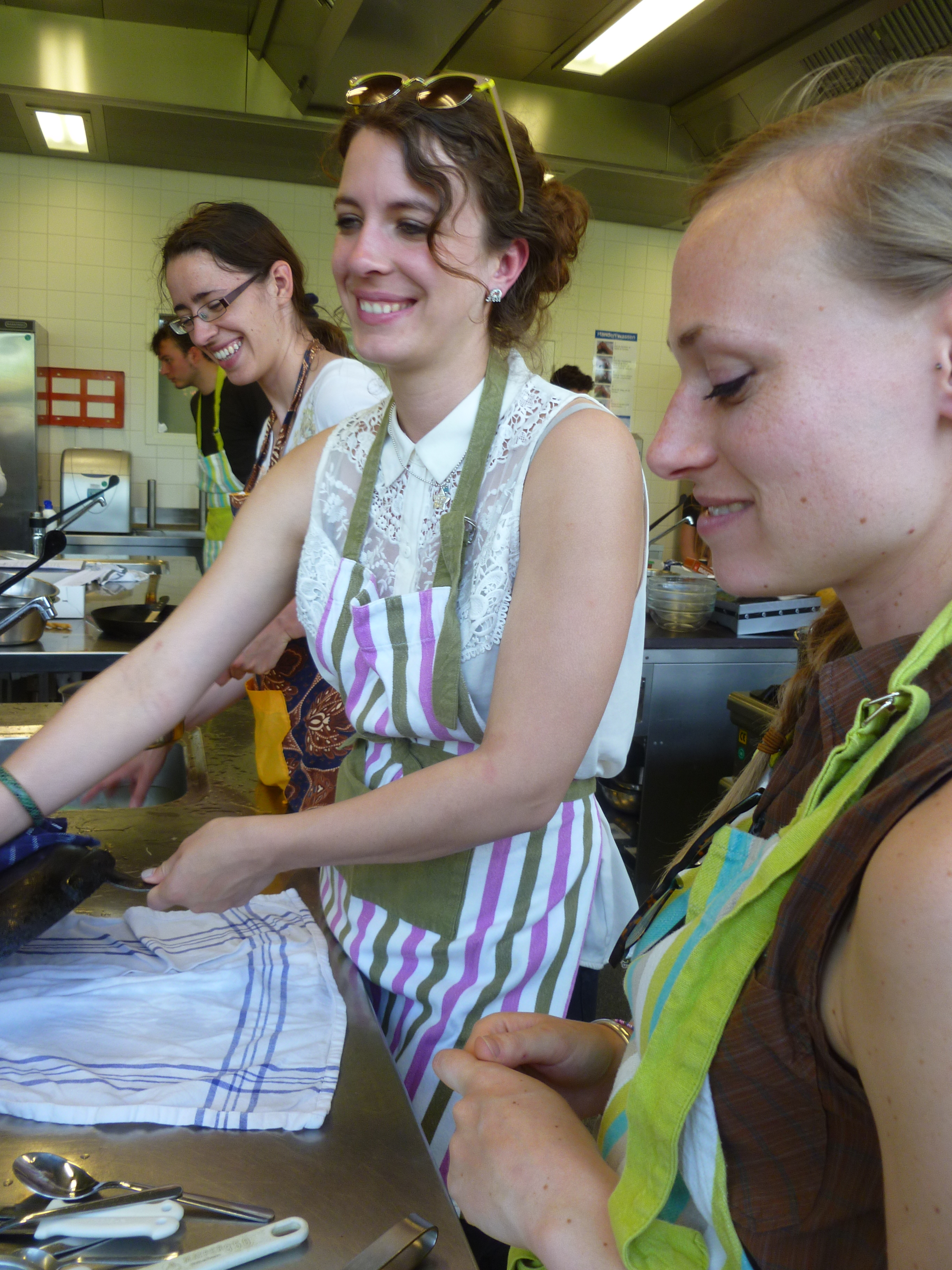
The Washing Up!

The Washing Up!

If you are responsible for organising a team building exercise, and you like your colleagues, then I’d recommend giving a cookery workshop a go. Obviously, please don’t try this at home if you work with people who should not be in a confined space with sharp knives!

2 Comments

Filed under Fed

A Picnic on Public Transport

Asparagus and Potato Tart

Tarted Up Leftovers

The Big Guy and I are seasoned travellers. If you live in a different country from either of your families, you have to get used to the rhythm of packing, transport, and departure times. Where we can, we take the train; it has a much better rhythm – with a continuity of movement, both in terms of the motion of the carriages, and because there is no hanging about in a departure lounge, or being forced through an array of harshly lit shops. The train gets you where you need to be without fuss; you have space to sit comfortably and to move around.

One of the things that we haven’t got the rhythm of is taking our own food. Although, I do know exactly where all the best places to buy food along the journey are. We have recently returned from one such trip abroad, although this time, we had a leg of the journey on a coach. It was OK, but I will be glad if they ever sort out the troubles on trains run by a certain rail company, which has been unable to run for far too long now.

We decided that we should be better prepared for this journey. Since our usual rhythm was interrupted, I could not guarantee getting to my favourite pit stops. I also had a few ingredients in the fridge that wouldn’t last until we returned. So, the obvious choice was to make something to take with us. A picnic, of sorts.

I had a little of the salad, some cream and some eggs that needed using up from the dinner I made for friends, and a few last sprigs of chervil. As so often happens, the day before I was leaving I woke up and knew that these would be perfect in a tart, with some goat’s cheese. We could have some for dinner that evening, and then we could take the rest as a picnic for the coach the next day.

Like many of the best laid plans, the idea for a nice goat cheese went a bit awry. It was a bank holiday, and none of the usual shops were open, so I had to dispatch the Big Guy to the supermarket. Unfortunately, all they had in the way of goat cheese was some presliced stuff, that could have been any generic cheese. It certainly never has the tang of goat that I was looking for in this dish. Fortunately, he returned with some sharp, crumbly feta instead. This was a much better option, it needed to match the asparagus.

The tart was tasty, filling and survived the journey. So did the salad we had with it, because we dressed it en route from a small jar. This is my top tip for picnic salads – if you dress it before you travel, the salad will cook in the acid, and you will be left with a container full of flaccid disappointment.

Cheese Please blog badgeFour Seasons Food Challenge Chez Foti & Delicieux

I know I have entered my dishes into a lot of blog hops lately, but I couldn’t resist entering this recipe into the inaugural Cheese Please Challenge, hosted by Fromage Homage. Then I heard about the inaugural Four Seasons Food, dreamed up by Anneli at Delicieux and Louisa at Chez Foti. This dish is so apt for both.

This was my perfect public transport picnic, and I didn’t waste anything in my fridge. I’d love to hear what appears on your picnic blanket, or even coach seat when you make food for on the go.

Recipe: Asparagus and Potato Tart

Ingredients

For the Pastry: 

100 g plain flour

50 g cold salted butter

Really good grinding of black pepper

1 egg yolk

For the Filling:

100 ml cream

4 eggs

small bunch chervil, very finely chopped

100 g of leftover asparagus salad, or 3-4 small salad potatoes and 5 asparagus spears cooked until just tender, and cut into 5 cm chunks

2 spring onions, sliced finely

90 g feta cheese

Method

Season the flour. I wanted this pastry to taste peppery, the rest of the tart can hold its own. Don’t be afraid of adding  more pepper than you think.

Rub the cold butter (it needs to be fridge temperature) into the seasoned flour until you have a breadcrumb consistency. Add the egg yolk and bring together into a dough. If you need to, you can add a little bit of cold milk to make it all come together. Add a splash at a time.

Form a disc with the dough, and cover it with cling film or foil, and leave it to rest in the fridge for 20 minutes to an hour.

Heat the oven to 200°C. Roll the pastry out thinly on a floured surface. Carefully line a greased flan case with the pastry, and press into the sides or fluting with a small offcut of pastry in a ball, to avoid any tears or holes, you don’t want the filling to leak and burn on the bottom.

Prick the bottom of the pastry all over with a fork. Line the pastry with greaseproof paper, and add a good layer of blind bake – this can be ceramic beans, dried beans or rice – to give some weight help keep it flat and thin. Bake in the oven for 15-20 minutes, or until the pastry looks dry and is beginning to brown on the sides. Remove the blind bake, and put back in the oven to allow the pastry to cook all over to a light golden colour.

While the pastry is browning, whisk together the cream, eggs, and chervil.

Once the tart case is cooked, remove and turn the oven down to 180°C.

Pick the salad over to remove any leftover capers and cornichons. Scatter the rest over the tart case, so that you get pretty even cover. Then scatter over the spring onions and crumble the feta around, again, so that the coverage is quite even.

Pour the eggs and cream over the rest of the filling, shaking the case a little, to ensure even distribution. Return it to the oven and bake for a further 30-40 minutes, or until the centre is just set, but still has a little wobble if you shake it.

As with all quiches, this is great served hot or cold, but if you want to serve it warm, let it rest for about 10 minutes after it comes out of the oven, so that the filling does not ooze all over the plate.

10 Comments

Filed under Feast