Category Archives: Feast

Beans, Beans are good for your …Burgers!

Bulgur & Bean Veggie Burger

Barbecues – Not Just for Carnivores

You may have gathered by now that I like to barbecue. We don’t have a fancy grill or gas burner, and rely on simple charcoal. I don’t really see the point in lighting up a barbie if it is only going to be the two of us, so I tend to supersize mine, and invite loads of people. I’m pretty well-practiced at it now, and can happily cope with 20-30 guests.

We fill a baby bath with ice, for the drinks to chill in, and I set about making the things that will go onto it, with various salads, and dips. There are a few things that must feature – ribs, sausages, vegetable skewers, and of course burgers. I make my own meat burgers, and I don’t leave out veggie friends.

BBQ used as heat for guests

Burn All The Things

Of course, as is tradition, I do all the prep work, and step back to let the Big Guy get the glory, as he (and often a few other grill kings/ queens) ‘caramelises’ my food.

I am not a fan of fake meats. I know that they have saved many a vegetarian at a barbecue, but they just aren’t for me. These vegan burgers are not pretending to be meaty, I think that their flavour and texture is good enough to speak for themselves. And they are great in a bun!

The recipe is a good basis for a veggie burger. From here, you can change the spice mix, substitute coriander for the parsley, use fresh chilli instead of the cayenne pepper, or add nuts or some other vegetables to the mix. I have made a few variations myself. I’d love to hear your variations, and maybe steal them give them a try.

These burgers keep well in the fridge or freezer, and you can cook them in a frying pan too, if you don’t have enough people round light the barbecue.

You may have noticed that a lot of my recipes have been veggie or vegan lately. This is because a friend recently cycled the Dunwich Dynamo, and I agreed to “sponsor” him by signing up to reduce my carbon through Do-Nation. This is a great way of getting people to do a few simple green actions for a short period of time, to see how they get on. It is also a lovely way to help people to feel involved in supporting your event without asking them to donate money, which can be a little awkward in these straightened times. The actions themselves are not too difficult to achieve, and it may get a few people to continue to do them, after all it is supposed to take 30 days to form a habit, so after 2 months it may be second nature.

Peter managed to smash the carbon target that he set himself at the start. I chose the Veg Out option. I really don’t eat all that much meat, so for two months, I have pledged to cut it even further, and also to go vegan a couple of days a week.

The Dunwich Dynamo took place over the weekend, and so far reports are that my friend is very happy, and a little sore, but I expect that there will be no lasting problems. Congratulations Pete, on getting your friends to take some small carbon friendly actions, and for the epic ride!
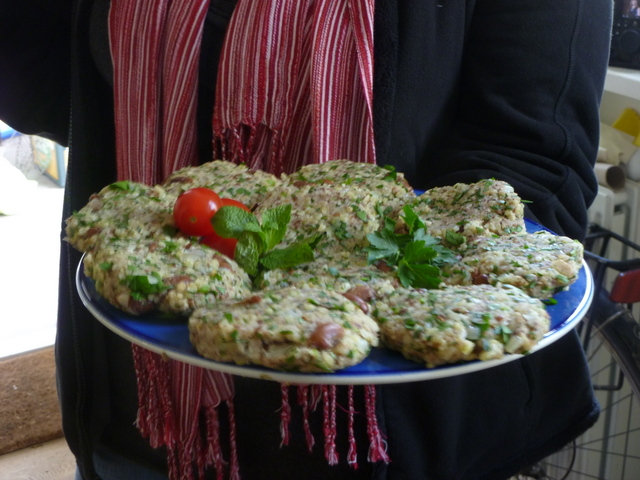
Bulgur & Bean Burgers Ready to Grill

Grill Ready

Ingredients

200 g dried beans, or one can. I usually use kidney or brown beans here, but the variety is really up to you.

1 onion, finely chopped

2 cloves garlic, finely chopped

1 tsp cumin seeds

½ tsp cayenne pepper

100 g bulgur wheat

400 ml vegetable stock

1 tbsp soy sauce

Good bunch of parsley, finely chopped

Method

If you are using dried beans, soak them for a few hours. Drain then bring them to the boil in fresh, unsalted water. Cook until they are tender. You’ll probably need at least 40 mins for this, but it depends on the age of the beans. Don’t be tempted to salt the beans, or you will make the skins tough.

If you are using tinned beans, drain and rinse them, and heat them in fresh, unsalted water.

It is best to work with warm ingredients, as they bind a bit better, so try to get all the ingredients cooked at roughly the same time. If you are using dried beans, they will need to be started first, if you are using tinned, they should be warmed through as you come to the end of the bulgur preparation.

In a dry pan, toast the cumin seeds until they give off their characteristic scent. Keep them moving, as they will catch quickly. Once they are done, remove immediately to a mortar or a spice grinder.

Add a little oil to the warm pan, and sweat the onion on a gentle heat. You don’t want to colour the onion.

Meanwhile, grind up the cumin, and add the cayenne and garlic, and grind up to a paste. Add to the translucent onion, and fry until the aroma begins to waft.

Add the bulgur and stir to coat all of the grains in the onion and spice and oil. Add the stock, and bring to the boil. Reduce the heat, cover and simmer until the stock has been absorbed.

When the beans are done, drain, but don’t discard the cooking water. If the burger mix is too crumbly, you can add a bit of this to help it to bind.

Mix the soy, beans and parsley into the bulgur mix. Use the stalks of the herb too, as they pack loads of flavour. Set aside about a quarter of the mixture, and then pulse the rest in a blender until it is comes together. You want it to be sticky, but not a paste.

Add the reserved mixture from earlier, for texture and stir well.

Make patties by rolling lumps into balls in your hands, and then flattening on a board to make the burger. They will look surprisingly round. This is normal.

Chill for at least an hour before you grill them, to help them retain their shape. Grill or fry on either side over low coals. Preferably on a summer’s day. You may be able to make great burgers, but you can’t control the weather!

9 Comments

Filed under Feast

A Box of Delight

Foodie Pen Pal Parcel

Full of Western Promise

Exactly two Fridays ago, I had to chase the postie down the road for this. My doorbell is broken. He didn’t knock the door, instead shoving one of those really irritating “we-called-when-you-were-out-now-you’ll-have-to-schlep-to-a-post-office-across-town” cards through the door. Luckily for me, I had been waiting in for this, so I was able to spring into action when I heard the letterbox.

This my first Foodie Penpal Parcel. I had been seeing people all over Twitter talk about this, but thought that it was probably only for people in the same country. I was glad to discover that Carol Anne at Rock Salt had taken the idea from Lean Green Bean and was coordinating this blog swap for the whole of Europe. I am really glad it is so inclusive. There are also groups across a lot of the World, so you can probably find one and join in. You don’t even need to have your own blog; readers are welcome too, and many of the penpals will be happy to host a guest post on their site for readers to write about what they got.

I was matched with LoopyLou, and got The Lone Gourmet as the person to send me a parcel. Such a coincidence that both my matches were called Louise, and one also used to live in the Netherlands. I’m not sure if these matches are planned or random, but I enjoyed the synchronicity of it all, anyway.

I got a little carried away with the weight on my parcel, then realised it would have cost a King’s ransom to post from over here (this is a great tip for next time; jars are really heavy). I was heading back to the UK for Mum’s birthday, so I decided to post it over there. Through a series of coincidences and holidays, my parcel ended up being hand-delivered by my sister, and finally ended up in Lou’s greenhouse at the beginning of this week, in good time for the reveal day, but probably not in time for her to have used any of the ingredients. If you want to see what I got for Lou, head over to her blog.

Foodie Pen Pal Parcel Contents

So Many Possibilities!

Louise at the Lone Gourmet was very kind and sent me things that she knows I can’t get over here. It was a real taste of home. A lot of thought went into this, and I’m really grateful to her for taking the time to source some typical English fayre.

Firstly, I got some Earl Grey tea. Of course, you can buy what the Dutch call Earl Grey over here, but every British expat knows that you can’t get a good builder’s-strength cuppa in continental Europe, and so tea is always something on the list of things that you ask other people to bring over when they come. I also love the packaging for this product – it comes in a paper cup which you can use to hold your precious brew. I love this idea. Multiple-use packaging really appeals to the Womble in me.

I also got a sachet of organic tikka masala mix, the most classic of the curry dishes for the British palate. It has a chicken recipe on the back, which I intend to try. But, I do think that this also has potential as a spice rub for white fish. I am going to halve the mixture, and do a little experimentation with this.

Saddleworth Cheese Co. Lancashire Cheese

Coronation Cheese

Louise got me some lovely Lancashire Cheese, which is quite local to her. The eagle-eyed amongst you may notice that it has a picture of a moustachioed Martin Platt from Coronation Street on the front. Apparently, like Blur’s Alex James, this is what he did when he left the Street, although I gather he is much less of a bore about it all. It’s a good cheese – a crumbly texture and slightly sharp.

Snacks from my Penpal

Testing, 1,2..

I had a snack of a little to test it when I opened the box (well, it would have been rude not to really), and then I used it in a tart with probably the last asparagus of the season. I will blog the recipe for this in the next couple of days.

JD Gross Dark Chocolate with Orange Pieces

Testing Will Power

Finally, I got some extraordinarily good chocolate. I have managed to stick to only having eaten a single square so far, since I needed to open it to take a picture (honest, Gov), but I have had to hide it from the Big Guy. I think that this should be saved for a special chocolate mousse or something else that will do it justice.

Thank you so much Louise, for this wonderful box, and to Carol Anne for organising this lovely treat.

It has been so nice to browse through the two penpal blogs, find other new blogs, and get to know my penpals, not to mention the fun I’ve had thinking about the box I was going to send, and the ingredients that I received.

Here’s the rough outline of how it works:

  • All interested parties in the UK and Europe – bloggers and blog readers alike – sign up by the form available at the bottom of this post
  • Participants are matched on the 5th of the month
  • Penpals send thoughtful, food related parcels, on or before the 20th of the month. The parcel must include something hand written – a note explaining the box’s contents, a recipe card, whatever you like. The price limit for the boxes is £10 – this is a limit, the point is not the cost, but the thought (no, really!)
  • Penpals open their boxes and rejoice!
  • At the end of the month, everyone blogs about their box, or writes a guest blog post if they are usually a blog reader and not writer. Everyone reads one another’s posts and rejoices some more. Posts are made available on Lindsay’s blog so we can all find each other easily

7 Comments

Filed under Feast

A Very British Affair

Salmon Fishcakes with tabbouleh, sauce grib-ish and a green salad

A Succulent Summer Plate

This past week, I have been in the UK again, mostly for my Mum’s birthday. We had a lovely weekend, starting with a bracing walk around the old English towns of Burnham on Sea and Weston Super Mare. Unfortunately, we also went on days when almost the entirety of both towns were closed, probably due to the weather. We still managed to have some lovely fish and chips, and an ice cream. And a poke around the end-of-pier arcades, but that really was mostly to get out of the wind for a bit.

Last week, I also noticed that Liz Knight of Forage was going to be doing a family forage at the Tudor Farmhouse Market  in Clearwell in the Forest of Dean. As that is pretty close to where my parents are, and it is a beautiful place to go, I cheekily asked if they would take a family with grown up kids. When they kindly agreed, I had a plan for Sunday too.  We enjoyed a short walk around the grounds of the hotel, and picked up loads of delicious treats, and all of us learned about things that we didn’t know were edible. There were also local food producers and a folk duo playing live.

As you know from yesterday’s post, Liz has been very helpful over Twitter, so it was lovely to meet her in person. She is so enthusiastic and knowledgeable, as well as being great with all the kids that came. She kept everyone engaged on the walk. There were bread and syrup making demonstrations afterwards, using our bounty. Liz runs a number of foraging walks and classes, so you could look out for them, I guarantee that you will learn a lot.

We also had a barbecue for Mum’s friends and family. I was happy to lend a hand with home-made burgers, salads, and dips. Many of them will appear here soon, but I have so many things to post that they may be over the course of a few weeks.

The important thing is that she enjoyed herself, and there were actually few leftovers. This is a good thing, but you do know how I love using up leftovers. My dad had baked a salmon, and there were a few new potatoes that we had cooked up in their skins, in water with a few mint leaves in it. We served these simply in butter. What better way to use these ingredients up than to have fishcakes?

No Waste Food Challenge by Turquoise Lemons

This is also my entry to this Month’s No Waste Food Challenge, hosted by Turquoise Lemons. For June, Kate is challenging us to produce a recipe using leftovers of any kind. This entire meal was to use up the leftovers from the barbecue, with only the addition of freshly cut herbs for the fishcakes, so it definitely qualifies.

I served the fishcakes with tabbouleh, sauce grib-ish, and a fresh salad. A perfect way to round up a birthday weekend. And at last the sun had arrived, so we ate this meal in the garden.

Prepared Salmon Fish Cakes

Pat-a-Fishcake

Recipe: Baked Salmon

Ingredients

1 whole salmon*, gutted and cleaned.

4-5 sprigs tarragon

Small bunch flat leaf parsley

Cucumber, sliced

Butter, softened enough to be able to brush on the delicate fish

Method

Check that the salmon will fit into your oven, on a baking sheet. If you are having problems, then you can remove the head or the tail, or both. I like to leave the head on if I can, the cheek meat is the cook’s treat.

Pre-heat the oven. Dad just says a low oven. I would suggest that this is no higher than 160°C.

Place the herbs and the cucumber in the cavity of the fish, and season to taste.

Brush the fish with butter, then wrap it in foil, as you would for cooking en papillotte (the parcel making starts at 2.16). Place the parcel on the baking sheet, and cook in the oven until the fish is just done. Exact times will depend on the size of your fish. As a guide, our fish was 1.3 kg and took about 40 mins in a low gas oven.

This gives a lovely, moist fish, that is delicious hot or cold, served on the bone.

Recipe: Salmon Fishcakes

As this is intended to use leftovers, this is more a guideline than a recipe, so I have listed the ingredients, but not the amounts, use up what you have.

New potatoes, boiled, or leftover mashed potatoes

Cooked salmon

Cream Cheese

Parsley, finely chopped

Method

The next day, I had about 7-8 new potatoes (not the really tiny ones). I peeled them, then heated them up in the remainder of the butter. New potatoes are not the best kind to use for mash, but when they were warm, they mashed really well. I added a scant tablespoonful of cream cheese to help bind it. Horseradish cream would also have been great, but my Dad won’t eat that.

Remove skin and any bones from the salmon, and flake it into large chunks.

Mix the mashed potato, fish and herbs, until they are well combined. Form into patties by rolling balls in your hands, then flattening and shaping on a chopping board.

I had worried that the new potatoes wouldn’t mash too well, so I was going to coat them in breadcrumbs to help. As this wasn’t needed, I decided just to fry them in a little oil until they were browned on both sides.

These fishcakes will keep in the fridge for a few days, and they also freeze well.

*When sourcing a salmon, due to recent overfishing, it is better to get a farmed  one. Fish farming can have serious environmental issues, particularly where the fish are fed other fish by-products and are routinely fed antibiotics (mostly required in overcrowded nets). In order to avoid this, please look for organic farms, that feed a plant-based diet. This is what the Marine Conservation Society have to say on the issue.

NB: This is not a sponsored post, I mention Forage and the Tudor Farmhouse because I really enjoyed the experience.

2 Comments

Filed under Feast

What A Difference A Day Makes

Herby Bread Dumplings

Seems so inappropriate now, but I was eating this on Monday!

Wow, what a difference from the wintry weather we were having at the beginning of the week to what seems to be the height of summer today! This recipe is much more suited to the beginning of the week than now, it had to be said, but this is what I have for you, and as this month’s entry to the No Waste Food Challenge at Turquoise Lemons.

Her challenge for May is bread, which is brilliant, as most people end up with the odd stale crust or half a loaf here and there. I look forward to seeing what everyone else comes up with. I certainly got quite excited by this, as the possibilities are endless.

I thought I would get the opportunity to make a treacle tart with breadcrumbs, but have not really had the urge for heavy puddings.

This week I have eaten Caesar-style salad with crunchy bread croutons, which I made the quick way, by frying them off in a little oil and butter (for the flavour, you understand) but this is not the easy method, as you need to watch them like a hawk, because they will catch easily.

A little later in the year, when one can rely on really ripe tomatoes, I would have entered Panzella, which is one of my favourite lazy leftover suppers. Similarly, I make a number of cold soups that use bread to thicken them. Probably my favourite of these would be Ajo Blanco – made with almonds, bread and grapes. It sounds wrong, but it is actually really very good indeed.

I have also made bread as a way to use up some bits and bobs – such as a loaf stuffed with a pepper glut I found myself with, as well as various bits and pieces on focaccia.

Despite my comment when Kate first issued the bread challenge, I found myself with two things: some stew, and most of a dog-eared baguette left over from a picnic. It was cold, and so I decided to play around with dumplings

Us Brits are more familiar with the stodgy, suet variety. I have never really liked these dumplings, to be honest. Especially if you don’t flavour them with herbs, but even if you do I find them unappealing.

Many European cultures make the suety-bullet kind of dumplings, but they also make a lot of dumplings with bread. You can find varieties from Germany, and across most of Eastern Europe and the Balkans.

If you do a quick search on google, all of the recipes there recommend that you boil these little blighters in salted water. I did this for the stew, and they were everything I used to hate about dumplings; stodgy, claggy, bland, boring. I almost relegated this to the “experiment too far” category, never to be blogged about.

However, I had made quite a few of them, and you know I never throw anything away, especially if it is edible. I knew that I would be meeting them again at some point later on.

Last weekend, was huge. As well as the Rollende Keukens, we also went to Logical Progression – an old school all nighter, which was brilliant. It also meant that I knew I would need easy, but filling food for the following Monday. I thought ahead, and made our favourite fall back soup – Smoky Root Vegetable Soup. It was a good idea, come Monday, with all the socialising, and some serious gardening achieved over the weekend, I was too tired to cook.

Those remaining dumplings were beckoning from the fridge. I knew I had to use them, and so I decided that they would have to go in the soup. Normally, it is thick enough without the addition of bread, but I wasn’t going to waste them, so I thinned the soup with some stock I had in the fridge, which I had defrosted earlier in the week, but only used a little of. I guess I added about 300 ml in the end.

I decided to experiment, and fried half the dumplings in a little oil with a knob of butter (I needed these to taste of something). The other half I cooked through in the soup.

What a revelation both of these methods were! They were both lighter, and tastier. I guess that the addition of stock as a cooking liquor is a really important one. So for dumplings, like the weather, a day (or two) really can make all the difference.

Recipe: Herby Bread Dumplings

Ingredients

250 ml milk

Bay leaf

250 g stale bread (you can leave the crusts on)

2 cloves garlic, finely chopped

4-5 sprigs thyme, leaves only

2 long stalks of fresh rosemary, leaves only

Bunch of flat leaved parsley

Method

You can adjust the herbs to go with the dish you are going to have them with, these happened to go with my stew. The garlic is also optional, if it won’t go with your stew/broth then leave it out.

A small onion, chopped

A little oil for frying

An Egg

Heat the milk up with the bay leaf until it reaches boiling point. Meanwhile, tear the bread into chunks. When bubbles start to appear at the sides of the milk pan, take it off the heat, and remove the bay leaf. Pour over the bread, and mix it up a bit. Leave aside for half an hour to soak up the milk.

Finely chop all of the herbs, including the parsley stalks, which you need for the flavour they will lend.

Sweat the onion in a little oil, and take it to the point where it is just beginning to colour. Please don’t allow it to go  anything darker than a light golden colour, or it will lend an overpowering bitter taste to your final dish.

Add the herbs and the garlic, but remove from the heat. You want to add the onion mixture when it is cool, or you will scramble the egg later.

Add the onion and herbs to the bread, and mix really well. The bread is quite dense at this point, and you want to make sure that you get an even distribution of the herbs.

If the bread mixture is cool to the touch, add the egg, and mix it in well. If your dumpling mixture seems really wet, roll a very small piece into a ball and put in some water. If it breaks up, add some more breadcrumbs.

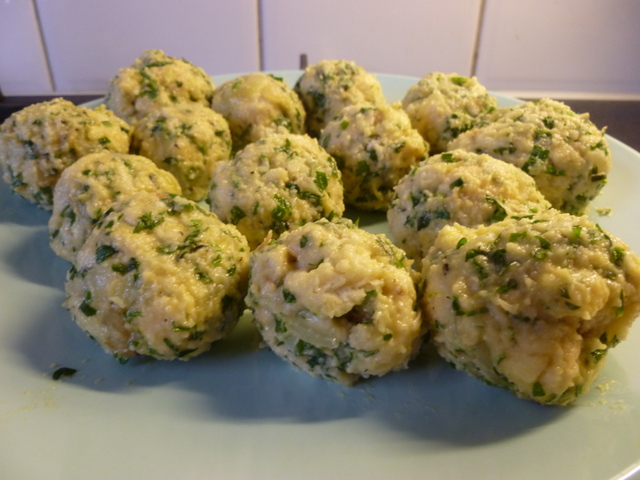
Raw Dumplings

To Poach or Fry – Make Your Choice

Roll all of the mixture into balls, and refrigerate for about half an hour.

Cook these in a flavourful stock, or add to a stew – although you will need to make the stew more watery than you would be used to, so that the dumplings can absorb the extra and the flavour. Either way, they need about 20 minutes, and will all be floating when they are done.

Or you can boil them in salted water for 20 minutes, then drain  them. Dry them well, and fry them in a little oil and butter before adding them to your dish.

Much better than just plain boiled.

Turquoise Lemon's No Waste Food Challenge

Leave a comment

Filed under Feast

Cherry Cripes – My First Guest Post

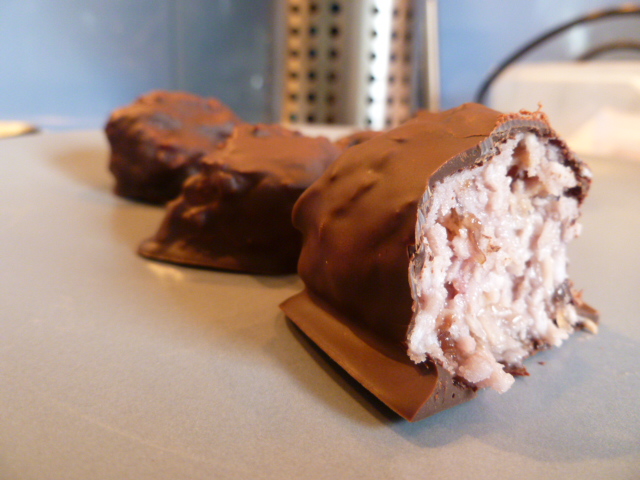
Cherry Cripes

Cherry Cripes, a Bit Like the Cadbury's Version, Only Available Outside of Australia

I was offered my first ever guest post recently by my friend who has had to pop back to her native Australia. I have been thinking of trying to recreate a chocolate bar that I fell in love with there, so I thought it would be a great opportunity to do so.  Please go and have a look at her blog, she is funny and a great cook as well. Add to the fact that she was a quarter finalist in Masterchef, then you know that her food is worth checking out. She blogs at Average Baker. She is being modest, she is not at all average – in either cooking or in blogging.

Anyway, it turns out that getting Cherry Ripes right, especially before the cherry season is upon us, is pretty difficult, and took me several attempts. It would also not have been possible if it weren’t for Divalicious, who recently did a post on homemade “Bounty” bars, and this really helped me out with the right texture and taste for the bars. I have linked to Diva before, for the delicious aubergine, tomato and sumac salad that she does. In case you weren’t aware, she has changed her blog name to Divalicious Recipes in the City, so now she can be found here.

I may have another go at these little bars, using real cherries and cherry compote, when I can get hold of them, but for now, this is my best attempt at Cherry Cripes, and you can read all about it here. Please do have a look, and let me know what you think. Yes, even my Aussie friends….!

8 Comments

Filed under Feast

Progressions on a Theme

Duck & Mushroom Risotto

Woodland Flavours

Today I stripped the carcass, separating the meat from the bones and the skin. Of course, these will become stock, but I have something specific planned for this, of which more later. I also found an escapee clove of garlic, nestled in the back of the cavity. Roasted garlic is so good, there was no way that I was going to let that go, and it will only add to the flavour of today’s dish.

So, to a risotto, but this time I wanted to develop the flavour with earthy base notes of woodland and wild mushrooms, building the flavour layers as I went, instead of making a simple white risotto, and adding the flavour at the end.

You can dry your own mushrooms or buy them. If you were going to buy them, I would suggest porcini mushrooms. I was lucky, the Big Guy’s sister had been out in the woods and taken the trouble of gathering and drying the most amazing chanterelles and trompettes des mort. I got a jar full as a present, and I love them. I love that someone has taken the care to go and forage for them and preserve them, and I really love that she also knew that I would love some of them.

Dried mushrooms, particularly of the chanterelle variety, have a really deep, almost woody quality,and I knew that they would be perfect with this duck, and would help layer the flavours, as I could soak them, then add the soaking liquor to the stock.

Then I started thinking about red wine, but decided that a better match would be sherry. I only had the Pedro Ximénez that we bought for the sherry trifle, so I knew I couldn’t use a lot of it, for fear of making it too sweet. But it all builds up.

This has all the earthy richness that I wanted, given that the weather has taken a turn for the colder, despite it being spring.

Recipe: Duck and Mushroom Risotto

Ingredients

10 g dried mushrooms

400 ml boiling water

A little oil for frying

1 medium onion, finely chopped

Bay leaf

1 garlic clove, crushed

1 roasted garlic clove, mashed

4-5 sprigs thyme

200 g arborio rice

Splash Pedro Ximénez

500 ml chicken stock

150 g chestnut mushrooms, sliced

200 g cooked duck meat

2 knobs butter (to be used separately)

75 g Parmesan cheese, grated

Small bunch flat leaf parsley, roughly chopped

Method

Soak the dried mushrooms in the boiling water, and set aside while you prepare the rest of the vegetables.

Sweat the onion in a little oil, until translucent. Add both types of garlic and the thyme and bay, and allow them to sweat together.

Meanwhile, drain, and squeeze out the dried mushrooms, but do not discard the water that they were soaking in. Roughly chop the rehydrated mushrooms, and add them to the sweating vegetables.

Carefully pour the liquid that the mushrooms had been soaking in to the chicken stock, and warm them both on the hob. No matter how carefully the mushrooms were cleaned before drying, there will probably still be a bit of grit or debris in them. When you add the mushroom stock to the chicken stock, don’t pour the grit in. It is easy to see, and is heavier than the stock, so it is easily to avoid if you pour the stock in carefully, and maybe leave the last few ml, which will have the most grit in it.

Add the rice, then follow the method for the basic risotto. You will be developing some big, earthy mushroom flavours, by adding the rehydrating mushrooms, and using the mushroom stock. However, the duck can take it.

So, while the risotto is cooking down, fry the sliced chestnut mushrooms over a low heat with a little more thyme, and a little salt.

When you feel that the rice is nearly ready, add the duck meat, and the now cooked mushrooms with the last half ladle of the stock that you need. This will heat the meat without it going tough, and will help to bring the flavour of the chestnut mushrooms into the dish.

Once the last lot of stock has been absorbed, add a knob of butter and the parmesan, then season with a little salt and a lot of pepper. Finally, stir through the parsley, and serve with a peppery salad.

Not only is this risotto a great way to use up leftovers, but it is really earthy, with the mushrooms and the duck packing a real punch. Leftovers done like this really are not humble, and nor should they be.

Leave a comment

Filed under Feast, Found

Gravy, Gravy, Give Me a Meal for Two

Vegetables, Gravy & Polenta

It’s All Gravy

I read an article online somewhere (but can no longer remember where) about food waste, and was shocked that loads of people in the comments were saying that they hated leftovers, and even the thought of leftovers. On further reading, these people were just reheating their old meal. This has a place for some meals, especially if you take the leftovers to work for a cheap lunch. I have done this many times, but only for certain things – some foods just taste horrible when reheated in the  microwave.

To me, the whole point of leftovers is actually what might be termed “upcycling” in other areas that use waste. I have mentioned before that I am not fond of the term “food waste”, when describing bits and bobs of perfectly edible food. Once you stop seeing leftovers as the same tired (or even stale) meal from dinners past, and start seeing leftover food as ingredients it’s like opening a gate to a whole new world of delicious dinners. This is where you can really let your creativity flow – the trick is actually to get  meal that is a reminder of that lovely supper, but is different enough to maintain interest, and keep you excited about the ingredient. After all, it is this kind of thinking that has led to a number of delectable pie fillings, moussaka, or shepherds pie, not to mention numerous soups, and stir fries!

I love gravy. I always make mine from scratch, and it is an invaluable way to stretch out leftovers. The gravy I made for the duck was actually with rabbit stock (I may also have mentioned that I like to make stock too…), which was actually more meaty than I had anticipated. I think I will use chicken stock for making gravy to go with a duck in the future.

It was still great gravy, and I have been plotting the best use of this. Because of the glaze, the gravy had already got a hint of Asian spice, so I was thinking along the lines of chinese flavours. Having eaten meat yesterday, I wanted the dish today to be mostly plant based. For some reason, I fancied pak choi as well. Then I had it – it was close enough to pak choi in oyster sauce, and so I decided  I was going to do something like this. I knew that the gravy would be great in a dish like this, and would be a lovely balance for the iron tang of the greens.

I also have a thing about polenta. I love it with any dish with a sauce to mop up. I often have it instead of mashed potatoes to accompany stews and casseroles. And it is so easy. I made up a wet polenta, which should have a similar consistency to mash, but it holds gravy better in delicious pools, cuddled by the fluffy maize. If you do not share my joy in cornmeal, this dish would also be great with rice.

Of course, making polenta means that you can fry any leftovers up the next day until a golden crust has formed. Then you can eat it with a tomato based ragu; or a few mushrooms in garlic; or some shredded duck; or some herbs and tomatoes; or…well, I think you  get the picture.

Recipe: Asian Inspired Gravy and Greens

Ingredients

A little oil or duck fat for frying

1 onion, sliced

1 leek, sliced

100 g mushrooms, sliced

2 cloves garlic, crushed

Pinch chilli flakes

1 medium carrot, sliced

Pak choi – ½ large or 2 baby ones

2 star anise

200 ml gravy

Water to cover

150 g polenta

700 ml boiling water

75 g grated cheese (eg piquant belegen or mature cheddar)

Method

Prepare the vegetables. Cook the onion in the oil, on a medium heat, until they are translucent. Add the leek and the mushrooms, and cook until the mushrooms look done to you. You don’t want the leeks to catch, so you will need to stir the veg.

I like my carrots to retain their crunch, so I don’t ike them to sweat for too long. If you are like me, add them now. If you like them softer add them with the onion at the start of cooking.

Add the garlic and chilli, and cook until the scent hits you, them pour in the gravy, star anise and any water that is necessary to cover the vegetables. Reduce the heat to a simmer.

Start with 700 ml of boiling water in a deep saucepan. Shake the polenta into the water, and whisk to combine. If you do it the other way around, you will get lumpy polenta, and it won’t cook through properly. I often use stock to add flavour to the polenta, bu the gravy was rich enough to carry it in this case, so water was fine.

As you whisk the polenta will thicken, and start to sputter. You can turn the heat down a little at this point, and allow it to cook through for 5-10 minutes, whisking occasionally.

As the polenta is sputtering away, cut the pak choi in half or quarters lengthways. You want the stalks to remain attached to each other, so it retains it’s shape. Add it to the gravy mixture, and push it under the liquid, so that it wilts.

When the polenta is cooked, add the cheese, and a fair bit of pepper, and stir it in thoroughly.

Serve the polenta so it forms a sort of well on the plate, with the gravy and vegetables on top.

Leave a comment

Filed under Feast

Cor, Love a Roast Duck

Roast Duck with a Marmalade Glaze

Marmaduck

This week, I am posting the series of posts that I failed to prepare properly before I went away on the permaculture course. I am going to document a roast duck, that fed the Big Guy and I for a week, over the course of this week. This will make me look like much more of a carnivore than I really am, because of the lamb I ate at Easter. But you can expect a number of salad and vegetable related posts to follow, I promise

As you know, I  had some marmalade left that I couldn’t sell, and have been plotting its use. As well as the flapjacks, I have been ruminating on making a meat glaze.

I have seen marmalade based glazes for ham, and chicken wings, but neither of these really hits the spot for me. Also, I didn’t want to have to strain the orangey bits from the marmalade because, having taken the trouble to hand cut them and cook them, I didn’t see the point in wasting them. So, I thought about this some more. Suddenly, I remembered duck a l’orange, that classic dish so popular in the 70s – the decade where everything was brown and orange, from the wallpaper to the food. This had to be the way forward, after all, centuries of French cooks (and a decade of British dinner parties) can’t be wrong.

Duck always makes me think of asian flavours, like star anise and ginger. In many Northern European languages, the orange translates as the Chinese apple, so I knew that this fusion would also be welcome. So I ruminated some more, and finally decided upon this recipe.

I also have a number of meals with leftovers (that may, in turn create other meals in a some kind of recipe tumblr) that will follow this, so there was really no other choice than to use a whole duck. The leftover meals will feature a logical progression in coming posts.

So, we bought an organic, free range whole duck. Disappointingly, it was minus the giblets. I like the giblets, and they really contribute to a stock – indeed, you can get a twofer on stock if you have giblets, as you can make a quick stock with them, then have a slower cooked one with the bones later on. This would have made an amazing gravy. Why don’t they do this any more? If you are going to eat meat, I think that you should eat all of the animal, it shouldn’t have to die for the best cuts only. Plus, you know, duck liver on toast would have been nice.

The duck did come with a lot of quills under the skin. Since the skin was to hold the glaze, and considering how long I had been thinking about it, I wanted nothing to spoil my enjoyment of the crisp, glazed skin. So, the quills had to go. I turned myself cross-eyed trying to remove them all. There is probably a really easy technique to doing this, and if you know what it is, please let me know in the comments.

The disadvantage of the way I come up with recipes is that I often decide to make things without having attempted the techniques that underly them. It is the same with this recipe – I have never cooked a duck before. Not being one to be beaten by a little lack of technique, I turned to the internet. There I found the Hungry Mouse. She has a beautifully illustrated step by step guide to slow roasting a duck, with an alternative glaze. As soon as I saw it, I knew that this was the way I was going to cook my duck. Essentially, the slow roasting and turning will sort of confit the duck, which may have made an interesting take on rillettes, but not this time.

Anyway, this all worked out in the end, because by the time I’d finished cogitating, and had done my research, bought the bird, and plucked it properly, it turned out it was my birthday weekend, St Patrick’s day, and the last matched in the 6 Nations, so I decided to cook up a storm for the Big Guy and I before it all kicked off for the weekend. A friend also popped by, and she ended up staying for a three course dinner. And very welcome she was, too.

Recipe: Marmalade Glazed Duck

Ingredients

1 medium duck

½ orange, cut into quarters

Few sprigs of thyme

3 garlic cloves, left whole

For the Glaze:

3 tbsp marmalade (orange will also do, but I had clementine)

1 tbsp Cointreau

Juice of ½ an orange

1 tsp ground ginger

2 star anise

Small pinch dried chili flakes

For the Gravy:

Juices from the roasting tray – making sure you have removed as much of the fat as possible. Keep the fat in a jar, you will definitely need this later.

2 tbsp plain flour

Small glass of red wine

500 ml stock. Duck stock would be good, if you managed to snaffle some giblets. I used rabbit stock, which was surprisingly meaty.

Method

Cook the duck according to Hungry Mouse’s very-easy-to-follow directions and photos. The only thing I did differently was that I stuffed the bird with some aromatics (orange, thyme, garlic), which you shouldn’t pack in too tightly, it is important that air can circulate around the cavity. And I didn’t truss the legs up. The butcher (not my usual one) had “kindly” lopped off all the bits that don’t have a lot of meat on them, including everything below the bird’s drumstick, and the wing tips. Most people would appreciate this, but for me this was just even less to go in the stock pot. It also meant that there was nothing to truss or tuck up, so I didn’t.

The glaze is very easy to make, put all of the ingredients into a pan, and melt them on a low heat. Let them simmer for five minutes, then remove from the heat and allow the spices to steep in the liquid.

Once the bird has been cooking for four hours (and you have turned it, as per the directions), and you have removed the last of the fat, then glaze it with the spiced marmalade mixture. While you are doing this, turn your oven up to maximum and let it come up to temperature.

I used a pastry brush, and made sure I had glazed all of the skin, including the parsons nose. Keep brushing over the bird until there is no more glaze left.

Put the bird back into the oven, for 5-10 minutes, while the oven is high. I was also roasting some potatoes in some of the duck fat. To ensure that I was crisping the duck, not burning the potatoes, I put the potatoes on a low shelf and the duck on a higher one. When the duck was done, I turned the oven back down, put the potatoes on the top shelf and added a rhubarb and apple crumble, which we had with ice cream for dessert. Of course, this bit is optional.

Allow the bird to rest. It is really important to rest meat, it makes it a lot juicier, and relaxed meat is less likely to be tough. For steaks and cuts of meat, a good rule of thumb is to rest it in a warm place for half of the cooking time. Obviously, this doesn’t apply to a joint that you have cooked for four hours. Unless you want to eat the bird cold, in which case, go right ahead. Instead, I covered it with tin foil and a couple of tea towels then I set it aside for the time it took me to make a gravy, and for us to eat our starter (wild garlic salad with quails egg, and ramson pesto – which will feature in a salad post soon).

Make the gravy while the bird rests. First, heat up the stock in a pan.

Even removing as much of the fat as you can, you will still have enough to make the beginnings of a roux. Stir the flour into the fat and roasting pan juices. Put the roasting tin on the heat, and cook the flour out for a minute or two, stirring, so it doesn’t catch.This is so that your gravy doesn’t taste like raw flour later.

Deglaze the pan using the red wine. You will need the heat fairly high, and you will need to poke at all the stuck on meaty bits, so that they come away from the bottom of the dish.

If you want to be cheffy, or don’t want any lumps in your gravy, then strain the deglazed juices through a sieve. I usually just use a whisk to combine the fat and flour, so I don’t get huge lumps, and don’t bother to sieve it. Either way, add it to the stock, and continue to heat while you eat your starter, to allow the gravy to thicken

Roast Duck, Kale, Vichy Carrots & Roast Potatoes

Dinner is Served!

I served this with some braised kale, vichy carrots, and potatoes roasted in the duck fat. It was definitely a good match for the glaze, which made really crispy skin, even though the meat was falling off the bone. A really good start to a busy weekend.

4 Comments

Filed under Feast

Spring Lamb Soup

Spring Lamb Soup

Lovely, Lovely Leftovers!

So yesterday I promised you a great recipe for the leftovers from my Bulgarian-ish  lamb. I’m not going to disappoint you, and neither will this soup. Once you have already made the lamb, it really is very minimal effort to make.

This sort of thing is really the best way to use up leftovers – minimal effort, but just different enough that it is not just a repeat of the meal from the day before. Oh, and delicious, of course!

You will use up the vegetable sauce, and the meat, and add bits of your own. If you don’t like chicory, then you can use baby gem lettuce in the same way instead. I might be nice to add a thinly sliced spring onion with the peas, or instead of the peas. If you don’t have parsley, you can try mint. that’s the other great thing about dishes like this, they really are completely adjustable to what you like and what you have in the cupboard.

Recipe: Spring Lamb Soup

Ingredients

150 g Puy lentils

4 heads chicory, the forced kind

A little oil for frying

200 g broad beans (podded weight)

1 l vegetable sauce leftover from Bulgarian-ish Lamb

200 g cooked lamb

100 g peas, shelled or frozen

2-3 drops Worcestershire Sauce

Small bunch parsley, finely chopped

Method

Cook the puy lentils in plenty of water, until they are almost done. Don’t salt the water, it makes their skins tough. Drain when they have reached this stage.

Meanwhile, halve the chicory, or cut it into quarters if it is large, but it is really better to get smaller ones. Heat the oil in a frying pan. When the oil has warmed, add the chicory, flat side down at first, and cook for a minute or two until the leaves start to colour, then flip them over to colour on the other side. Remove from the heat when they are coloured on both sides.

Cook the broad beans in boiling, unsalted water for three minutes, then drain them and double pod them. I think the reason that people think that they don’t like broad beans is because no-one has taken the trouble to double pod them. It isn’t all that much effort, and the results really are worth it. Unless you have the tiny baby beans, in which case they are fine just as they are.

Heat up the vegetable sauce, add the lentils, lamb and the chicory, and cook for five minutes. Add the beans and the peas and cook for a further minute. Season with a little Worcestershire sauce. Stir through the chopped parsley, and serve with crusty bread.

The whole meal takes less than 20 minutes to prepare, and what could be better, tastier, or easier than that?

1 Comment

Filed under Feast

Bulgarian(ish) Lamb

Bulgarianish Lamb

Lovely Lamb to End Lent

Lamb is traditional for Easter dinner in many cultures.

My American friend was already bringing a ham, that she baked according to a cherished recipe from her grandmother, to our international feast. It was delicious, and really well cooked, in a delicious sauce, some of which is sitting in my fridge, waiting for me to come up with a way to use it.

A baked ham for Easter is traditional in both the US and in Sweden.

However, I have a tendency to continue to invite people to dinners, and I would be horrified if people were to go away hungry (often resulting in us eating a lot of leftovers, but that is really no trouble). True to form, I had invited more people than I had told my friend about, and I wanted to make sure that we all had enough to eat. So I fell back on some more traditions and made a lamb dish.

A few years ago, the Big Guy and I had the pleasure of a trip to Plovdiv in Bulgaria. A friend of a friend had recommended the Puldin restaurant, and we had eaten an excellent meal there. My memory was that it was also pretty reasonably priced, despite what the Lonely Planet says, but I can’t really say for sure anymore. Either way, if you go to the beautiful, historic town of Plovdiv, I recommend this restaurant. The settings are gorgeous, and the series of rooms are both sumptuous and adorned with lovely art, frescoes and even a Roman wall in the room where we ate.

For some reason, my memory of this meal was stirred by trying to think of a different way to serve lamb, so that it would not overpower the ham. My memory is that I had a lamb dish that may (or may not) have been called St George’s Lamb. I may not remember the exact name, but I certainly remember the dish. The meat was meltingly tender, and came cooked with carrots and peas. Interestingly, it had been cooked in white wine, which really cut through the fatty richness of the meat. The vegetables had been added near the end of cooking, so they still retained a nice crunch. It was a truly remarkable dish.

Unfortunately, the Puldin does not seem to have a website (or at least not using our alphabet – they use the cyrillic alphabet in Bulgaria), so I have been unable to check if they still carry the dish to see if I got the name right , or go from a description on a menu. But that memory of a dish was the perfect thing to go on a plate that will star a baked ham, for a hungry person, so I decided to have a go at an approximation anyway.

There are a few Bulgarian lamb dishes on the web, but none really seemed to resemble the dish I had eaten in Puldin. I was pretty much on my own, so I decided to dive in and do my best in any case. I did find these two recipes, which I used as inspiration.

This is what I came up with

Recipe: Bulgarianish Lamb

Ingredients

1.5 kg leg of lamb, bone in – I found some lovely organic Texel lamb,

For the Marinade:

1 l water

400 ml white wine. I used an Auxerrois from Limburg, so it was local, and fruity enough to balance the lamb.

½ unwaxed lemon, sliced

50 ml tarragon or white wine vinegar

3 dried or 5 fresh bay leaves

2 tsp dried oregano

Freshly ground black pepper

For the sauce:

Salt

4 tbsp oil

4-5 cloves garlic

3 carrots

150 g cherry tomatoes

3 medium potatoes

4 sticks celery

1 small onion

1 tbsp tomato puree

Little cold water to make a thin paste

1 tbsp plain flour

Method

Pour the marinade ingredients over the lamb, and allow to marinate overnight. If the lamb is large, turn the meat regularly in the marinade.

Dry the lamb on kitchen paper, keeping the marinade aside for later.

Cook the whole garlic cloves in the oil. Remove them when they start to colour, and set aside. Be really careful not to allow the garlic to burn, you want a nice brown colour, but no black. Burnt garlic is bitter, and you do not want it in the sauce.

Salt the meat and brown the meat well on all sides. Be careful, it will spit, even if you have dried it well.

Soften the vegetables in the same oil, including the garlic used earlier. Meanwhile, remove the peel from the slices of lemon from the marinade, and make a thinner paste with the tomato puree and cold water.

Add the flour, and the tomato paste to the vegetables, and cook through for a couple of minutes. Don’t be tempted to skip this step, or the sauce will taste of raw flour. Add the lemon pulp to the pan, you can leave it on top of the vegetables, no need to stir it in.

Return the leg of lamb onto the top of the vegetables, and pour over the retained marinade. Bring to the boil, skimming off any scum that forms. Simmer on a low heat for up to three hours. You want the meat to be really tender and falling off the bone, but not overcooked, which will dry it out, despite being cooked in liquid.

Once it is done, allow the meat to rest in a warm place.

Pass the vegetables and the cooking liquid through a food mill (or you can blend them) to make the sauce. Remove the bay leaves before you pass them through the food mill, you don’t want to grind them, it will render your sauce inedible.

There will be quite a lot of sauce. Put it back on the hob in a clean pan, and reduce it by about a third. Taste at this point, and season with salt, pepper and some lemon juice, if required. The sauce should have a bit of a citrus kick to cut through the richness of the lamb.

Serve slices of the lamb, along with whatever veg you like, and allow your guests to pour the sauce over, as they choose.

You will have quite a lot of sauce left, and the bone of course, as well as some of the meat. Make stock with the bone, to be used on future lamb dishes (it is particularly distinctive, so may not be suitable for multiple meats, as is chicken and beef stock.

Don’t throw out the rest of the leftovers, I have a great recipe that will help you use them all up (of course!).

2 Comments

Filed under Feast, Fed