Monthly Archives: December 2011

Sing A Song of Six Quince

Quinces

A bit like large, hairy pears

The quince is an odd fruit. Part of the rose family, with a hard, fuzzy fruit that is easy to overlook if you don’t know what it is. It is often possible to forage the quince, as they do occur in the odd hedgerow, and a few lucky people grow them, or know someone else that does.

This is another of those things that I really hope to find out and about. The flowers are really beautiful, so they are often planted in municipal areas. I have heard rumour of one in a local park, although I have not found it myself. You also have to be pretty quick if you are to get there before the parakeets that live wild here.

However, I have found them on my local market. A basket full caught my eye, and I felt a rush of excitement, as I hurried closer to see whether or not I was in luck, or if they were just large conference pears. Luckily for me, my first glance was right, and I went home happily clutching a bag full of kweepeers, as they are called here.

I have cooked with them before, having baked them in a similar way to apples, but I have always wanted to try my hand at making membrillo. I first had some on a holiday to Barcelona, where it is served with sharp manchego cheese, and its sweetness and texture really are the perfect foil for this cheese. I have also used it with pâté on crackers, where it finds another worthy partnership.

I looked around for a good recipe, and Nigel Slater had a good one on the BBC site. When I read this, my first thought was that I could maximise the quince output by making jelly too. This appeals to the tight-fisted food waste geek in me – I really hate throwing stuff away, so any recipe where I can save scraps or cooking liquor to make something else out of is off to a good start already!

The quince might be an odd-looking fruit, but its perfume  is quite something. As I peeled and cored them, as per the instructions, my kitchen was filled with a gorgeous smell, very similar to ripe raspberries. As they cook, you get hints of their rosaceous origins as well.

One thing that cooked quince is famed for is its beautiful deep red colour, so imagine the panic I had when I cooked the fruit when they were still a pale off white colour, and the cooking liquor was pretty beige.
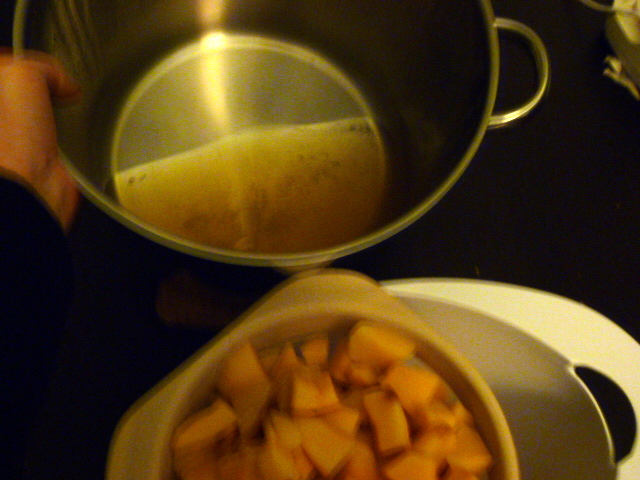
Part cooked quince

Taste the rainbow?

A while ago, I had promised a friend a session in nostalgia and jam making, so she headed round after work, and we got down to make the jelly. The first lot I made was with the cooking liquor that was drained from the fruit. Since the membrillo recipe says to peel and core the quinces, and this contains a good deal of pectin, this is also perfect for jelly. I boiled these up in some more water, and re-used the vanilla pod in it too. The strained liquor made yet more jelly.

Making jelly is really a question of proportion. For every 600 ml of liquid, you need 400 g of sugar. You can play around with this proportion a little, and I have reduced the amount of sugar for some fruits. However, the quince is a relatively unknown quantity for me, so I stuck with the tried and tested ratio.

We boiled it up to a nice rolling boil, and let it cook off for 10 minutes. These days I have taken the guess-work out of jam making by investing in a sugar thermometer. When the thermometer reaches 104.5°C, you know that you are done. I still like to check, since the first time I used a thermometer, the jelly I was making turned out a bit runny, because I had taken it off the heat the second it reached temperature. Also, it was good to show my friend the low tech way of seeing if your jam has reached setting point.

The Fridge Test is the old-fashioned way to ensure the setting point is reached. You put a plate in the fridge to cool. Drop a little jam on the plate and leave for a minute. If the jam wrinkles when you run your finger through it, then it has reached setting point. If it doesn’t wrinkle, stick the plate back in the fridge, leave the jam to cook, and try again in a few minutes.

When you have reached the setting point, take the jam off the heat and pour into hot, sterilised jars. Fill  them almost to the top, cover with waxed paper discs (wax side down) and seal with a hot, sterilised airtight lid.

As you can see from the picture, my worry that the final product would be beige was unfounded. They don’t tell you this in the recipes, but the quince does not take on its customary red until quite near the end of  the cooking process.
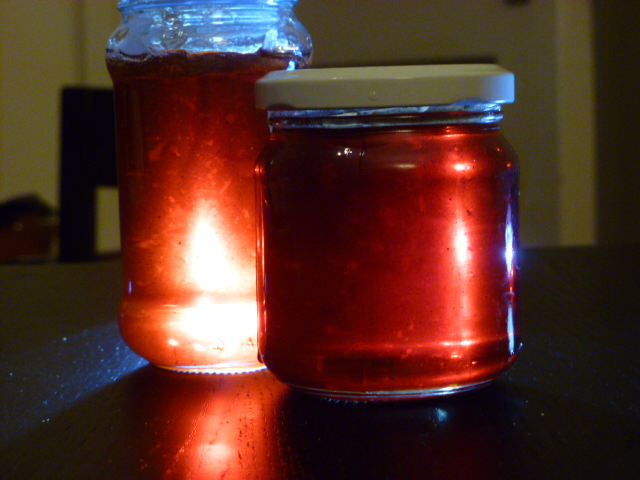
Quince Jelly

Not beige

Today I made the membrillo, as per the recipe. This too takes its time to reach the right colour, but when it does, it is a really thick paste, and has a grainy texture. I poured it into a roasting tin, but you could also use a swiss roll tin if you like it thinner.

I baked it in a low oven, but I should note that it still wasn’t entirely set, so I put it back in on low for a while.

Membrillo

The membrillo paste before it went in the oven

I cut this into two. The one half I have wrapped in greaseproof paper, and foil, and I will keep it somewhere cool and dark until it is required. The other half, I shall cut into squares, sprinkle in caster sugar and serve as a sweet at my upcoming party.

Leave a comment

Filed under Feast

Pumpkin, Bacon and Swiss Chard Soup

Bacon Pumkin & Swiss Chard Soup

A soup for this season – warm and velvety

It is that time of year when my cooking is populated with soups. They are great for using up slightly too tough or slightly too old vegetables. And in the Netherlands, it is practically compulsory to have soup and a sandwich for lunch, whatever the weather outside. I am likely to be making quite a few more before the winter is out.

This year, I lost my young pumpkin plants to something, most likely slug-shaped. However, the chard has been going strong for a while now. As I would ordinarily be feasting on my own pumpkins, I have decided that it is not really cheating to add this to the ‘Farmed’ category.

I like my soups quite chunky, and my greens slightly underdone – having been subjected to many an overboiled brassica in my youth. You may prefer to pre cook or even use frozen greens in this soup, and chop or blend them a bit finer. This soup keeps very well in the fridge, and should also freeze well, although I have not tried it.

This soup is easily adaptable for vegetarians, just omit the bacon, and fry the onion in olive oil. I would suggest that you add slightly more smoked paprika at the end instead of the bacon.

Recipe: Pumkin, Bacon & Swiss Chard Soup

Ingredients

450 g pumpkin

A pinch dried chilli flakes

2-3 cloves garlic

2 tsp lemon thyme leaves, plus stalks

1 medium onion, finely chopped

500 ml stock (veg or chicken)

200 g Swiss chard (spinach would also work well, or maybe a savoy cabbage – it needs to be an iron-rich green vegetable)

200 g bacon, diced

80 ml white wine (optional)

Nutmeg and smoked paprika to taste

Method

Heat the oven to 180°C. Cut the pumpkin in half or quarters, depending on the size and type of your pumpkin. Essentially, it has to fit in a roasting tin. You should leave the skin on. Sprinkle with a little oil (any type except your best olive oil) and season with salt, pepper, and the dried chilli. Rub the thyme sprigs over the pumpkin, and tuck the stalks into the dish as well. It may seem like a pain, but it will save you having to remove the stalks from the soup later. Put the garlic cloves inside or between the pumpkin. No need to remove the papery cover, this will come off much easier when the garlic has been roasted.

Roast the pumpkin in the oven, until the flesh is dry, and it comes away from the skin easily. The time this takes will depend on which type of pumpkin that you use.

Roasting the pumpkin concentrates the flavour a bit. If you don’t have an oven, like many people who I know, you can still use the pumpkin without roasting. just add the thyme to the pot when you sweat the onion, and the pumpkin and the chilli flakes when you add the (now chopped, not roasted) garlic. You will also need to let the pumpkin simmer for longer, until it is tender. Obviously, peel the pumpkin before you add it. No one likes a soup full of skin.

While the pumpkin is cooking, prepare the other vegetables and the bacon. I like the stalks of the chard, but they take much longer to cook than the leaves, so I cut the stalks out, and kept them separate to the leaves. You may decide not to use them, or use spinach. Up to you. Whatever you use needs to be chopped up. How fine you want it is also up to you. I sliced the stalks thinly and the leaves a bit thicker.

Fry the bacon in a deep saucepan. I don’t bother using oil, as the bacon will render its own fat pretty quickly – just keep it moving so that it doesn’t burn.With a slotted spoon, drain the bacon onto kitchen paper, but be sure to retain the fat.

Sweat the onion in some of the bacon fat (you may not need it all). If you are making this a veggie soup, sweat the onion in a little oil. Either way, don’t let it colour.

Add the garlic from the roasting pan, which should slip easily from their skins now. No need to chop them. Add the wine at this point, if you are using it. A glug is fine. Let it cook off and absorb into the onions.

Add the smoked paprika. I usually use about a teaspoon, but this will depend on your taste, and whether or not you are using bacon. Let it cook off briefly while you remove the skin from the pumpkin. This should come off easily with a spoon. Break it into rough lumps, and add to the pan with the onion. Allow it to cook briefly, and take on a paprika coating.

Add the stock, and bring to the boil. Cover and simmer for 5 minutes.

I blended the soup at this stage, but if you prefer a less chunky soup, then you could also blend it after you have added the chard. After the soup was well blended, and smooth, I brought it back to a simmer, and grated in some nutmeg, until it tasted like there was enough in there.

Then I added the stalks of the chard, covered and let it simmer for about 5 minutes before I added the leaves, and allowed them to wilt. If you use spinach, or just the leaves of chard, then this bit will be shorter. If you are using savoy cabbage, I suggest parboiling it a little first before you add it to the soup.

Add the bacon back to the soup, and adjust seasoning to taste.

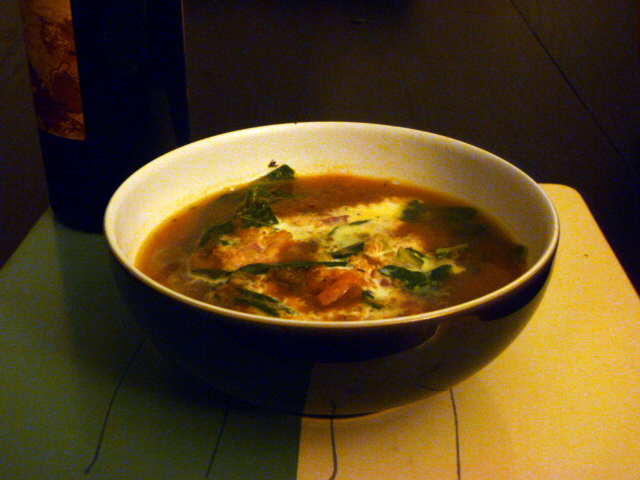
I served this with a swirl of double cream. You can leave this out if you like, because it is a smooth and unctuous soup without it.

Leave a comment

Filed under Farmed

Smoky Winter Root Soup

Smoky Winter Root Soup

A Winter’s Tale

I have been making this soup for years – since I was a student. I have made it so often that I stopped even thinking about needing a recipe for it, and now it is just easy and instinctive. I still make it a lot, because it is the Big Guy’s favourite now too.

I thought that originally it was a New Covent Garden Food Company recipe, but I have double checked both the books of theirs that I have, and it is not there. If this was your soup recipe initially, I am sorry that I am unable to credit you properly, but it is a much-loved and much-cooked dish.

As with all my soups, the amounts vary a lot, although I do tend to stick to only the ingredients listed for this particular one. I wrote the following out for a friend, after we had it on our weekend in the countryside. These amounts here should serve 4 people, or you can keep it in the fridge. It is even better warmed up the next day. It is a hearty and filling meal.

Recipe: Smoky Winter Root Soup

Ingredients

200g bacon, cubed. I can buy little lardons over here very easily. If you are using actual bacon, it is better to get streaky/ back bacon for this. Smoked bacon also works really well

1 onion, finely chopped

3 medium carrots, diced

500g potatoes, diced

1 green chilli, deseeded & finely chopped

1 can/jar sweetcorn

Splash of milk/ soy milk

Method

First prepare the vegetables. You want the onion pieces quite small and the chilli pieces as fine as you can get them. The carrot and the onion pieces should be about 2cm square.

Fry the bacon in a large saucepan over a low heat, so that the fat renders but does not burn. When the bacon is cooked, and slightly crisp, remove from the pan with a slotted spoon, so that you keep the fat. Drain on kitchen paper, and set aside. The amount of fat from bacon will depend on the type and quality of bacon used. You want to fry off the vegetables in the fat, so pour off any excess, but keep enough to coat the vegetables.

Add all of the chopped vegetables, except the chilli to the pan, and fry until the onion has turned translucent. You will need to stir the pan occasionally. Meanwhile boil a kettle with about a litre of water. Once the onion has softened, but the vegetables have not coloured, add the chilli, and cook for a minute or so.

Add the boiling water to just cover the vegetables, bring back to the boil, then turn the heat down to a simmer and cook until the potatoes are tender. The amount of time this will take depends on the variety of potato used, and how big your dice are. For me, it usually takes about 10 minutes, because I chop the veg fairly small. Test with a knife, until you are happy. I don’t really mind if the carrots retain some crunch, so I only ever test the potato.

Once the vegetables are cooked, drain the tin of sweetcorn, and add the kernels to the soup, along with the cooked bacon. Season with pepper. You will not need to add salt, as the soup will get plenty of salt from the bacon, and the cheese. Allow to heat through for a few minutes. Add a little milk, and warm through.

You can make it with varying amounts of the ingredients, just make sure that the amount of carrots balances well with the white vegetables, so that it still has some colour.

Serve with crusty bread, and sprinkled with some grated, sharp cheese, such  as Mature Cheddar or Piquant Boerenkaas

The soup keeps well in the fridge for up to 5 days. It will freeze, but if you want to freeze it, then don’t add the milk before you do so, rather, warm the soup through, then add the milk before serving.

I will add a photo of this soon, as we have it frequently, I just have not got one at the time of writing this post!

1 Comment

Filed under Feast

Treasure Chestnuts

Sweet Chestnut jam

The sweetest of chestnuts

I really love sweet chestnuts. Seasonal, run-up-to-christmas, eat-with-game, things-that-help-make-sprouts-bearable, isn’t-it-brilliant-when-you-find-a-tree-of-them-in-a-park-(though-really-infrequent-in-a-country-with-few-hedgerows), lovely chestnuts. I like to find them in the wild for all to take advantage of, I like to cook with them, I like to thicken soups with them, I have never eaten them in marron glacé form, but I expect they are also lovely.

I haven’t found any in any great quantity while foraging over here. You might be much luckier than I am, or just get them at your local market. I bought some very cheap ones, but the reason why they were so cheap was that they were a little past their best, and a number contained insect larvae (probably moths), which is the same as if I had foraged them anyway! I had to go and get some slightly less cheap ones from my local greengrocer’s. Still, it was nice to watch the jays pick through the discarded ones this morning, as I made the jam.

Serve peeled chestnuts at a party, and people think that you have gone to a lot of trouble for them. And the fact is, they would be  right too. I always go into it thinking that it will be a quick job, and always forget how fiddly the damn things are.

Today, I spent a good few hours peeling chestnuts. I suspect this is because I am a little bit too anally retentive about removing the skin from all the folds of the nut.  I also spent a considerable time online trying to find ways to speed up the process. I did come across this video from the people at badgerset.  I think this method has a lot of potential, but it will take practice to recognise how long is enough boiling time. For the record, I found that my chestnuts needed much longer in the boiling water to allow the skin to detach. I guess I need more practice. And possibly a decent pair of pliers. One brilliant thing about this method, is that you get to see the ones that have insect larvae in before you eat them.

After I had done all that peeling, I made Melissa’s Chestnut Jam, from the River Cottage Preserves book, by Pam Corbin. I have had my eye on this jam for a little while, not least because Pam recommends them to be eaten with meringue. I usually have a glut of egg whites around, due to my fondness for egg-based sauces and real custard (As a Brit who loves her puddings, vla does not really cut it for me). We are having are christmas minced pie and mulled wine party soon, so I will make the meringues for these, and I will serve them with this jam. I also gave a jar to my friend, for her recent birthday. She has been hankering for egg-free chocolate mousse for a little while, so I hope this jam will be a fitting accompaniment for the one that I made her.

A few things to note about this jam. Firstly, do not try to blend too many chestnuts at a time – they quickly clog up the food processor, and take quite a lot of mixing in to avoid lumps. I didn’t manage it. It would probably be easier to blend them all together at once, with a little cooking liquor,  in a bowl, using a stick blender. I am a little gadget-averse, and won’t buy one on the grounds that I have a food processor, so why have two things to do the same job? Seems my tight attitude has not paid off in this case. I also used to  whip meringues by hand, until one time I broke my collarbone, so had to ask the Big Guy to whip them for a party we had. The next day, he came home with an electric whisk, saying that it would have saved him a couple of hours of his life, that he will never see again.

The chestnuts and the cooking liquor form quite a thick paste. Being much more used to fruit jams, I was very worried that this would not be liquid enough to form a jam. I was wrong, when it is added to the sugar syrup, it quickly liquefies. Do not be tempted to add more than the recommended 100 ml of the cooking liquor to the chestnuts when blending them.

My top tip for this jam is not to cook it if you have children or animals in the vicinity. Pam mentions that it sputters, but not how much, and it is very, very sticky. I have spent ages trying to remove it from the splashback, random bits of kitchen work top and my utensils pot. I also recommend wearing a long-sleeved top when you cook this. Those little splashes hurt.

The jam also sets quite quickly off the heat, so probably keep it on the lowest simmer when you fill the jars, so that the rest remains liquid enough to pour into the rest of them.

It is very nice, and not too sweet, although I think I will up the amount of brandy in the next batch I try. So, try it with meringues, chocolate mousse, or even on toast with some chocolate spread, if you are feeling lazy.

1 Comment

Filed under Feast, Found

Mareike’s Mayan Egg-Free Mousse

Some people should not eat raw eggs. I am sure if you are one of those people, then you know who you are, but for the record,those people are usually young children, the elderly, pregnant women, and those with certain allergies and medical conditions.

Bet it doesn’t stop you craving a nice chocolate mousse from time to time though does it?

My friend falls into one of the above categories. She had mentioned that she would love some chocolate mousse, but didn’t want to risk the eggs. We discussed using cream instead. As it was her birthday recently, I decided that I would make her some, and also write up the recipe for her, along with some variations she could try.

This is what I wrote for her. It will serve about 5 people.

Recipe: Egg-Free Chocolate Mousse

Ingredients

160 g Green & Black’s Mayan Gold chocolate

400 ml whipping cream

Grated zest of 1 orange

Candied orange peel to garnish

Method

In a saucepan, heat about 100 ml of the cream to just under boiling point. When bubbles appear at the sides of the pan, the cream is warm enough. Try not to boil the cream.

Chop the chocolate into small pieces (or you could use chocolate chips). Pour the warmed cream over the chocolate, and stir until it melts and there are no lumps in it.

Whip the rest of the cream to stiff peaks. fold in the melted chocolate and stir through the orange zest. At this point, you can divide into individual glasses, or just add to one serving bowl. Chill in the fridge for at least 2 hours (or more if you need to make this in advance).

Before serving, garnish with the candied peel, or a couple of fresh twists of orange zest.

Variations

You can use different flavoured chocolate. I just used Mayan Gold here because I like it. Don’t use chocolate bars with nuts or other large lumps – these are better added later. I also know people who melt Mars Bars or Milky Ways (using the microwave and a splash of milk) instead of chocolate.

If you use the really high cocoa chocolate, your mousse may be bitter. You can balance this a little with some sugar (caster or icing) added into the cream for whipping.

You can spice the cream instead of using flavoured chocolate. Add the spices to the cream that you are going to heat up. Bring the cream to almost boiling point, set aside and allow to steep for 20 minutes, then bring it back up to boiling point again. Don’t forget to remove any whole spices before you pour the cream on the chocolate. Use whatever spices you like. Cinnamon, nutmeg, cardamom all go well, but play around a little.

You can use coffee (or some teas might also work, depending on the type of chocolate) instead of the warmed cream to melt the chocolate.

You can add alcohol or flavoured syrups (like you can get to flavour coffee). Add these to the whipping cream and not the chocolate, though. Otherwise you risk setting the chocolate, so you won’t be able to mix it into the cream.

Fold through orange zest, nuts, candied peel, or fruit at the end, before you chill it, if you like.

This chocolate mousse is very good with chestnut jam. I am sorry that it didn’t last long enough for some photos!

5 Comments

Filed under Feast