Tag Archives: Simple

A Soup for Summer

Summer Vegetable Nage

Summer Soup A-Swimming

For the past two years I have been experimenting with poaching. I have poached chicken, fish and even lamb. I love the tenderness that poaching lends meat, and it makes it really difficult (though not impossible) to  over cook.

The basis of a really good poached dish is the poaching liquid itself. This can be really simple, such as using water and maybe a few drops of vinegar when poaching eggs. More commonly, the poaching liquor, or nage is used to impart flavour and herbal notes to the thing you are poaching.

Nage comes from the French verb nager: to swim. The basis is a really good stock, and probably adding extra vegetables, which are then discarded.

Lately, nage has come to mean a delicate broth that gets served with the dish, but that can hold its own on the plate. The vegetables that were added for flavour are usually still removed. I hate wasting perfectly good food like this, and have been thinking that the basis of a poaching nage would make a delicious soup in its own right.

I had a vegetarian friend coming to dinner, the weather was stuffy, and I had broad beans, peas and herbs reaching their peak in the garden. I decided that I would experiment. The peas and beans should impart their soft sweet taste of summer, and the other vegetables needed a little bite. Unless you have few teeth, soft mushy vegetables are not pleasant, and certainly not what I wanted to represent a light summer soup. I served this dish as a delicate starter.

One of the herbs that I have in my garden is chervil. This delicate herb is often quite difficult to find in shops or markets in the Netherlands and the UK, but it really easy to grow, in the garden or on a windowsill. It has a delicate aniseed flavour but it really can add a lot to a salad, soup, fish or chicken dish, and will add a lot to a herb sauce. I really recommend that you have a go at growing this delightful little herb.
Herbs on a Saturday Challenge badge

Because I have used chervil and parsley in the soup, I am entering it in the June Herbs on Saturday, hosted by Karen Burns Booth at Lavender and Lovage. I really feel that this summery dish really captures the light herbal notes that are perfect for June.

The lemon zest trick was inspired by Nathan Outlaw, I think, but I’m not really sure where it came from. Don’t miss out that step though, it is important.

This soup really needs a good stock. You won’t be able to make it with a powder or a stock cube, it will be far too salty, and will also take away from the light herb flavours. Luckily, using the trimmings from the vegetables from this dish and a cabbage leaf or two, you can make a really good stock to use as the basis of the dish, with no waste. You definitely won’t regret it.

Recipe: Summer Vegetable and Herb Nage

Ingredients

Juice and zest of a lemon

700 ml of good quality vegetable stock (no cubes please)

100 g peas, shelled weight

200 g broad beans, shelled weight

2 shallots, finely chopped

4 summer carrots, finely chopped

1 bulb florence fennel, tough outer leaves removed and finely chopped

4 sprigs chervil, finely chopped (including stalks)

Small bunch curly leaf parsley, finely chopped (including stalks)

Any fronds from the fennel, finely chopped.

Salt to season

Method

Cook the lemon zest in a dry pan until you can smell the essential oils have been released. You will need to keep stirring, to help prevent burning.

Add the stock to the pan, and bring it to boiling point. Then lower the heat and simmer it for five minutes. Take it off the heat, and let it cool.

Cook the beans and the peas in unsalted boiling water. You can use the same pan, if you like, but the peas will need to go in after the beans have been cooking for a couple of minutes. Please take care not to over cook the vegetables. They really only need minutes, although the exact time will depend on their size. You will definitely not need longer than five minutes, even for large beans.

When cooked, drain the vegetables, and run them under a cold tap, or add to an ice bath to stop them cooking any further. Double-pod any broad beans bigger than half a centimetre in length. I know that this can seem like a hassle, but it really is necessary, and will give a much better balance of flavour overall.

When the stock is completely cold, add the lemon juice.

The next stages are very quick, so as not to overcook the vegetables, so please make sure that you have done all the chopping, don’t be tempted to continue chopping stuff while something  else cooks.

Soften the shallots for a minute or two on a low heat. You don’t really want the flavour of your best extra virgin olive oil here, so use a light olive oil, or sunflower oil. Be very careful, shallots can catch quickly, and you don’t want them to even start to colour. Keep stirring them.

Add the carrot and the fennel to the shallot, and sweat them all off for a minute, again, not allowing them to colour.

Add the cold stock, and bring it up to boiling point. Reduce to a simmer, and cook until the vegetables just begin to soften. This will take no longer than five minutes, as the vegetable pieces should be quite small.

Taste and season with a little salt if you need to. You don’t need pepper for this dish, it will totally change the delicate balance of the flavours.

Add the peas and beans, and simmer for about a minute to allow them to warm, but not really cook more.

Finally, stir through the chopped herbs and serve this light, refreshing summer soup immediately.

6 Comments

Filed under Farmed

A Very British Affair

Salmon Fishcakes with tabbouleh, sauce grib-ish and a green salad

A Succulent Summer Plate

This past week, I have been in the UK again, mostly for my Mum’s birthday. We had a lovely weekend, starting with a bracing walk around the old English towns of Burnham on Sea and Weston Super Mare. Unfortunately, we also went on days when almost the entirety of both towns were closed, probably due to the weather. We still managed to have some lovely fish and chips, and an ice cream. And a poke around the end-of-pier arcades, but that really was mostly to get out of the wind for a bit.

Last week, I also noticed that Liz Knight of Forage was going to be doing a family forage at the Tudor Farmhouse Market  in Clearwell in the Forest of Dean. As that is pretty close to where my parents are, and it is a beautiful place to go, I cheekily asked if they would take a family with grown up kids. When they kindly agreed, I had a plan for Sunday too.  We enjoyed a short walk around the grounds of the hotel, and picked up loads of delicious treats, and all of us learned about things that we didn’t know were edible. There were also local food producers and a folk duo playing live.

As you know from yesterday’s post, Liz has been very helpful over Twitter, so it was lovely to meet her in person. She is so enthusiastic and knowledgeable, as well as being great with all the kids that came. She kept everyone engaged on the walk. There were bread and syrup making demonstrations afterwards, using our bounty. Liz runs a number of foraging walks and classes, so you could look out for them, I guarantee that you will learn a lot.

We also had a barbecue for Mum’s friends and family. I was happy to lend a hand with home-made burgers, salads, and dips. Many of them will appear here soon, but I have so many things to post that they may be over the course of a few weeks.

The important thing is that she enjoyed herself, and there were actually few leftovers. This is a good thing, but you do know how I love using up leftovers. My dad had baked a salmon, and there were a few new potatoes that we had cooked up in their skins, in water with a few mint leaves in it. We served these simply in butter. What better way to use these ingredients up than to have fishcakes?

No Waste Food Challenge by Turquoise Lemons

This is also my entry to this Month’s No Waste Food Challenge, hosted by Turquoise Lemons. For June, Kate is challenging us to produce a recipe using leftovers of any kind. This entire meal was to use up the leftovers from the barbecue, with only the addition of freshly cut herbs for the fishcakes, so it definitely qualifies.

I served the fishcakes with tabbouleh, sauce grib-ish, and a fresh salad. A perfect way to round up a birthday weekend. And at last the sun had arrived, so we ate this meal in the garden.

Prepared Salmon Fish Cakes

Pat-a-Fishcake

Recipe: Baked Salmon

Ingredients

1 whole salmon*, gutted and cleaned.

4-5 sprigs tarragon

Small bunch flat leaf parsley

Cucumber, sliced

Butter, softened enough to be able to brush on the delicate fish

Method

Check that the salmon will fit into your oven, on a baking sheet. If you are having problems, then you can remove the head or the tail, or both. I like to leave the head on if I can, the cheek meat is the cook’s treat.

Pre-heat the oven. Dad just says a low oven. I would suggest that this is no higher than 160°C.

Place the herbs and the cucumber in the cavity of the fish, and season to taste.

Brush the fish with butter, then wrap it in foil, as you would for cooking en papillotte (the parcel making starts at 2.16). Place the parcel on the baking sheet, and cook in the oven until the fish is just done. Exact times will depend on the size of your fish. As a guide, our fish was 1.3 kg and took about 40 mins in a low gas oven.

This gives a lovely, moist fish, that is delicious hot or cold, served on the bone.

Recipe: Salmon Fishcakes

As this is intended to use leftovers, this is more a guideline than a recipe, so I have listed the ingredients, but not the amounts, use up what you have.

New potatoes, boiled, or leftover mashed potatoes

Cooked salmon

Cream Cheese

Parsley, finely chopped

Method

The next day, I had about 7-8 new potatoes (not the really tiny ones). I peeled them, then heated them up in the remainder of the butter. New potatoes are not the best kind to use for mash, but when they were warm, they mashed really well. I added a scant tablespoonful of cream cheese to help bind it. Horseradish cream would also have been great, but my Dad won’t eat that.

Remove skin and any bones from the salmon, and flake it into large chunks.

Mix the mashed potato, fish and herbs, until they are well combined. Form into patties by rolling balls in your hands, then flattening and shaping on a chopping board.

I had worried that the new potatoes wouldn’t mash too well, so I was going to coat them in breadcrumbs to help. As this wasn’t needed, I decided just to fry them in a little oil until they were browned on both sides.

These fishcakes will keep in the fridge for a few days, and they also freeze well.

*When sourcing a salmon, due to recent overfishing, it is better to get a farmed  one. Fish farming can have serious environmental issues, particularly where the fish are fed other fish by-products and are routinely fed antibiotics (mostly required in overcrowded nets). In order to avoid this, please look for organic farms, that feed a plant-based diet. This is what the Marine Conservation Society have to say on the issue.

NB: This is not a sponsored post, I mention Forage and the Tudor Farmhouse because I really enjoyed the experience.

2 Comments

Filed under Feast

A Test of My Nettle!

Edible hedgerow

An Edible Hedgerow

I love nettles – in tea, as plant food, in pesto.My favourite thing to do is to eat them as a vegetable,briefly wilted with chopped shallot that has been softened in butter. One of my favourite foods, made even better that they are in plentiful supply.

There are loads of good things about nettles: they are high in protein, and fibre, and rich in iron and vitamins A and K; they are a brilliant wildlife habitat; you are highly unlikely to get into trouble for picking them (although people might think that you are a little bit mad); and you get a double hit on them (in the wild), as you can pick them in the spring, and again in autumn. They are also really easy to identify.

As well as following some basic foraging rules, you will also need long sleeves and rubber gloves if you don’t want to get stung!

Flowering nettle

Too Late for this Nettle

If you are going for the wild variety, we are drawing towards the end of the first flush for this year. When the flower heads appear, almost like catkins (see above), the nettles will develop calcium carbonate crystals in the leaves, which are unpleasant to eat. However, if you strim back nettles, then they will grow fresh and you can eat them again. If you look carefully, you should still find some that are yet to flower, so just pick those.

Picking the nettle tips

Taking the Tips!

Because of the aforementioned abundance of wildlife, and the fact that even the tallest dog can’t reach, only pick the tips and the first two leaf bracts after them. These leaves won’t be tough, as some of the older leaves might.

I was originally going to enter this recipe into  Simple and in Season, for May, but the recipe needed a bit more testing. The first version I did was a bit mushy, so I didn’t make it. I am entering it for this month instead. Ren Behan at Fabulicious Food runs this challenge, and this month it is being hosted by Laura at How to Cook Good Food.

I love to entertain, and I also love to forage. I don’t often combine the two (unless it is booze) because I often think that people might not like the idea. However, I was having a vegan friend over for dinner, so many of my fall-back staples were off the menu. I had some freshly picked nettles, and I saw that Carl Legge had tweeted a link to his nettle gnocchi recipe. I was inspired, but couldn’t use the recipe, because he uses an egg as a binder. Instead, I have played with this a bit. I have to admit that I did not add enough flour to the first recipe, which was why it didn’t hold its shape. I apologise to my friends who had this as a starter that day, but I have improved on it now, to give the recipe below.

Jo's Version of Mr Potato Head

Soggy Gnocchi Disappointment: an Impressionist View

To make up for the gnocchi, Jo entertained us all with her food faces. This was a stray potato, with her partner as a size comparison.

Nettles go well with tomato sauces, but I decided that I was going to use a really simple pasta sauce (not at all traditional for gnocchi, but it went really well) of oil, chilli flakes and garlic.

This recipe is a good introduction to foraging, if you have always fancied giving it a go, but not dared so far. Nettles are easily accessible, and much tastier than you might think.

Nettle Gnocchi and Salad

Nourishing Nettles

Recipe: Vegan Nettle Gnocchi

Ingredients

200 g nettle tops, washed well in cold water

500 g floury potatoes. You want a variety that makes good mash

300 g plain flour, plus more for dusting

1 tbsp hemp oil (optional)

Salt

Pepper

You can also add spices to the dough, if you like, nutmeg is particularly good.

For the pasta sauce:

4 tbsp extra virgin olive oil

2 cloves of garlic, finely sliced

Pinch of dried pepper flakes

Method

Firstly, remove the nettle stalks and discard.

Put the potatoes, with their skins on, in plenty of cold water and boil until they are just done and you can pierce to the middle. This should help stop them getting waterlogged, but only if they don’t overcook.Allow to cool slightly, then peel and mash them, preferably in a potato ricer or food mill, if you have one.

Add the nettles to boiling water and cook off briefly, the exact time will depend on the age of your nettles. Drain them, but don’t discard the cooking liquid. This is nettle tea, which is refreshing and all sorts of  good for you. You can drink it hot or cold, and it keeps well in the fridge.

Nettles retain more water than spinach, so use the back of a spoon and press them quite hard to get the liquid out of the leaves. Chop them roughly and mix well with the mashed potato, hemp oil, some salt and pepper, and any spices you are using.

An idea of how the  dough should look

The Dough Should Hold its Form Really Well

The exact amount of flour that you need will depend on the nettle and potato mix on the day. Initially, I used way too little, and the gnocchi were soggy. The best way around this is to tip the potato and nettle mix onto a floured surface, then add the flour, a little at a time and mix in well. You want to form a quite stiff dough, then knead it well. If you are unsure if there is enough flour, drop a test piece into some boiling water and cook for a couple of minutes. If it retains its shape, you have enough.

Bite sized gnocchi pieces

Bite Sized

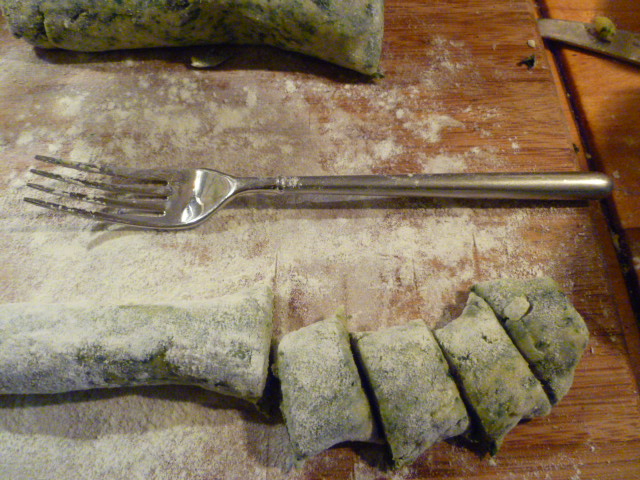
Cut the dough into four. Flour your surface , and roll each piece of dough into a sausage 2-3 cm  in diameter. Cut these into 2-3 cm pieces. It is traditional to press a fork into each small piece to score it. The reason often given for this is so that a sauce can sit in the grooves. This is a great tip for a thicker sauce, like a tomato sauce or a ragù, but not really necessary for the sauce I used. I did it anyway, for aesthetics.

Marking grooves in the gnocchi to hold a sauce

Get Into the Groove

Get a fairly large pan of salted water to a rapid boil, and then drop the gnocchi in. They will take literally minutes to cook, so don’t be tempted to go and check e-mail or something similar.

The Finished Nettle Gnocchi

The Finished Product

For the sauce, gently heat the oil and garlic until the garlic starts to brown. Then add the chilli flakes. This sauce will take about the same time as the gnocchi, which will be cooked when they float. Drain, toss in the sauce, and serve immediately.
13 Comments

Filed under Found

We Need to Talk About Salad

Wild Garlic & Qualis Egg Salad With Wild Garlic Pesto

Salad as Celebration

I have been neglectful of my salad posts and chat of late, which I undertook to do as part of the 52 Week Salad Challenge that was issued by Michelle at Veg Plotting. This is not to say that I have not been diligently sowing, foraging and eating at least one salad a week, but I have been away a lot of late, and even without internet for a lot of it (and enjoyed it, actually!) so I haven’t really had the time to tweet and post about it in time for the monthly Salad Days round up that Michelle takes such care over every month.

To make amends, I am doing a bit of a salad round up in time for this week’s Salad Days, and I look forward to reading all of the links and the discussions from all of the others who are joining in with the challenge on Friday.

Where to start then? The last time I blogged specifically for the challenge (as opposed to cheekily tagging it onto other posts), I had been finding and eating the weeds in my garden.

Clockwise from right: Hairy Bittercress, Wood Sorrel, Chickweed

Salad as Weeding

Clockwise from right: hairy bittercress, wood sorrel*, chickweed.

The weeds have continued to form a part of my salads, but since then, the hedgerows have burst forth, and there has been plenty to eat, from there and from my garden.

Wild Garlic

Salad as Wild Food

We have been eating hedgerow staples, such as the carpets of wild garlic (pictured, in my favourite spot), sorrel*, jack in the hedge (aka garlic mustard), and nettles. all of these have appeared in a variety of tarts, salads, fritters and as side dishes in their own right.

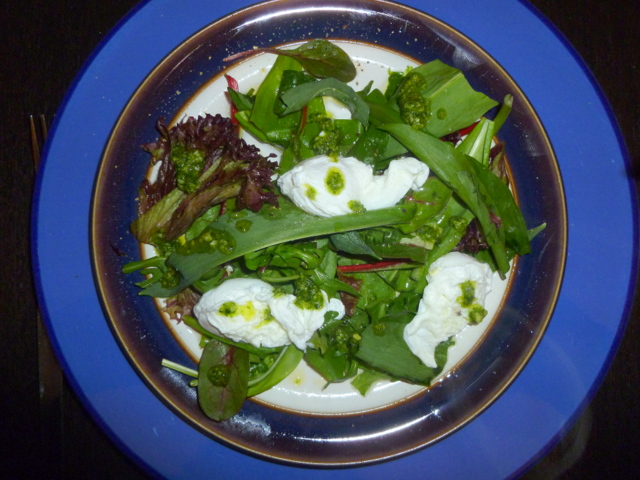
The first of these was the wild garlic. For my celebratory birthday meal, back in March, I made a starter of poached quails egg on a bed of salad, including wild garlic leaves. I dressed this with a really lovely wild garlic pesto, which used hazelnuts instead of the ubiquitous pine nuts. The quail’s eggs are slightly richer, and much smaller than hen’s eggs, and the soft yolks were a perfect foil to the pesto.

At the permaculture course I was eating a variety of the salads that they grew there, as well as a number of edible flowers, including nasturtium, herb flowers, those from the various brassicas that had been allowed to go to seed, and borage. If you have never eaten a borage flower, I suggest you give them a go, they are surprising, they taste almost like cucumber, and are a lovely bite to have in a salad. I also found some very old borage seed this year, which I have given a go. I was given this packet of seeds years ago, so I have lost nothing if they don’t come up, and if they do, they will form part of the new polyveg system I am putting in place this year. Hopefully, it will seed itself and attract bees as well as looking beautiful and being really tasty. Apparently, it is a good pot herb to. If the seeds are too old to germinate, then I’ll get some for next year in any case.

Duck Salad

Salad as a Project

I have already told you about the duck salad I made as part of my duck week. On the 2nd week of April, we held our first barbecue of the year, by way of a baby shower for my friend. It was flipping freezing, but it was dry, and a good time was had by all. I made my go-to barbecue salad of radish, cucumber, feta, parsley and mint. This is based on a quick and easy dish by Nigel Slater. I was very proud to be able to feed my guests with homegrown parsley and radishes in this salad. It went down so well, I didn’t manage to get any pictures.

Things are continuing apace in the garden. I have been eating lots of rocket and cut and come agains, as well as the odd leaf chicory. Because of my desire to embark on a polyveg system, I have also been sowing a number of other salad things this year. I have multiple lettuces, beets, and turnips for some tasty salads, well as a number of herbs. I have also discovered that you can eat poached egg plants, so I’m going to give them a go. Inspired by all the people following the Salad Challenge, I’m also giving a few new leaves a go – notably some of the chinese greens, and shiso. I also got hold of some morning glory, which features in Japanese cuisine quite a lot, I think. I am hoping this is the right one, as I really enjoyed it in soups and salads when I was over there a couple of years ago.

Although I love foraging, I would love to be able to grow sorrel in my garden. To date, I have been unsuccessful, although the partially shady conditions are more favourable for me growing sorrel than tomatoes (which I can manage). I have tried for the past three years to no avail. Do any of you have any tips? I don’t even think I have seen any germination. Do you pre-soak? I have been using the same packet, and suspect that it may all be sterile, but any other ideas will be gratefully received. I hate to see seeds go to waste as much as I do food!

Garden Salad with Caesar Dressing

Salad as Supper

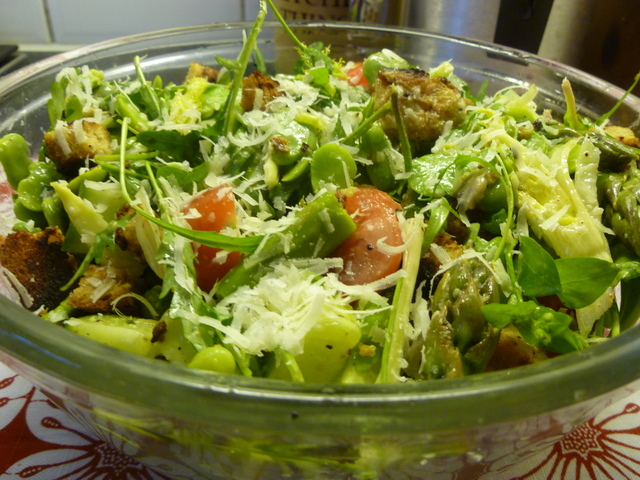
Tonight’s effort was garden leaves and some of the aforementioned weeds (all my own), with a mix of tomatoes, cucumber, broad beans and asparagus (sadly not my own, mine aren’t ready yet, and the asparagus won’t be available this year) in a caesar dressing. I cannot really call this a caesar salad though, since it didn’t have any romaine lettuce, which I planted a bit late, and haven’t even made decent baby gems yet. I ate it with a potato salad and a soft-boiled egg, and it really hit the spot – satisfying, yet cool for the hottest day of the year so far.

One of the great benefits of growing-your-own is the tops off the broad beans. Mine are almost ready, although the cold spell put them back somewhat. You can hopefully expect them in a salad post very soon.

* Please note that neither wood sorrel or sorrel should be eaten in large quantities, due to containing oxalic acid, which can inhibit calcium uptake by the body. They can aggravate kidney stones, gout, rheumatism, arthritis and hyperacidity, so should be avoided by people with those conditions. The amount of oxalic acid does reduce with cooking, but wood sorrel would wilt to nothing at all, as the leaves are not very big in the first place.

1 Comment

Filed under Farmed, Found

A Stock From Scraps

Vegetable Stock

The Basis of Many, Many Meals

Today’s recipe was inspired by a request from a friend who reads Edible Things. It is great to hear from people, so if you have any requests, let me know, and I can blog about those too.

If you have a recipe you’d like to see, or something to inspire, please feel free to get in touch or find me on twitter.

Anyway, my friend asked about how to make vegetable stock, particularly in reference to making stock from scraps. Obviously, she has come to exactly the right place. I never throw anything out if I can help it. I was accused of being from the 1950s when I admitted to an acquaintance that I make my own stock. He doesn’t know what flavour he is missing out on!

In my freezer, there is an entire drawer given over to scraps and offcuts of one kind or another.  I keep them separate in bags or freezer containers (for the meat products), ready to be used later. I routinely keep and freeze the stalks and outer leaves of cabbage; the tough outer leaves of fennel; carrot tops and peel; the tops of leeks; and the root and tip of onions that I have chopped for other dishes, and the stalks of any herbs where I have only needed to use the leaves.I would probably also keep the gnarly bits at the bottom of a head of celery too, if it weren’t for the fact that I have guinea pigs that eat them.

Frozen Food Trimmings

Stock Drawer

Currently there are also apple cores, lemon and orange zests, bones from a chicken, pork fat and rind, and a whole load of vegetable offcuts and peels. There will be a use for all of these in various stocks, jellies, sauces, or something.

I actually don’t like the term food waste when talking about unloved offcuts and trimming. There is so much you can do with them, up to and including composting, which I also do, but only when I have got the maximum value from them first.

Obviously, I know that most people do not have the freezer space or the geekiness to save stuff like I do, but if you do nothing else with your “waste”, do give stock a go. I guarantee that it really easy, and will really improve the flavour of soups, stews, sauces and gravies.

I make a number of different stocks, so I bag my veggies separately, because  I don’t want cabbage in a chicken stock, for example. If you have limited space, put them all into the same bag and chop them up a little. If you have no freezer space at all, you can make a quick stock using scraps, and supplementing it with the odd celery stick or whatever. The finished stock will keep in the fridge for a couple of weeks, in an airtight container, so you can still add it to dishes (NB it will be shorter for meat stock), and have great-tasting stock.

You can pretty much use what you want in a stock. I know that some people use potato peelings in stock, although I personally don’t like the flavour it lends. Some people also choose to put the papery onion skins in, although this will mostly impart a yellow colour, so again, I tend not to bother. Similarly, beetroot tops and peel can be used, but it will both colour and flavour the stock.

I have used pumpkin, pea pods, lettuce that looks as though it is going over, the ends of aubergine, tomato skins, mushroom trimmings,asparagus ends, the leaves of celariac,  beets and carrots at different times. As long as you wash the vegetables thoroughly before freezing, or putting straight into the stock pot, it really is up to you, and experimentation is the key for your tastes, and the dishes that you cook with.

There are a few vegetables that you cannot use the leaves from, and this includes rhubarb (which are a vegetable, but used as a fruit), aubergine and parsnip leaves. I have used the vines of tomatoes, but not the leaves.

The basis for most stock is the triumvirate of celery, carrot and onion (or leek – they are the same family).This is the basis of both meat and vegetarian stocks. It is really a question of balance. In the recipe below, I have outlined the rough proportions that I used. For vegetable stock, I try to use a cabbage (or broccoli stalks, or chard or something similar) in my veg stocks, because it gives a depth of flavour.

As you get more used to scrap stock, you will also develop a sense of the proportions of each that you want. I can do it by eye now. It does not take long to gain confidence in this technique. And believe me, you will really be glad that you gave it a go.

Basic Stock Amount, by eye

An Eyeful

You also don’t have to wait until you have the same amounts as I do. You can make stock with the ends of one leek, the peel and tops from one carrot and a single cabbage leaf, if that is all you have. Really, nothing is set in stone for this, the ingredients are down to what you have.

Recipe: Vegetable Stock

Ingredients

250 g leek/onion trimmings(frozen weight)

150 g carrot peel

2 celery stalks, (it weighed about 150 g)

50 g herb stalks, including mint, parsley & thyme (if making meat stock, I would most likely leave out the mint stalks)

50 g cabbage stalks & leaves

100 g fennel leaves

2 dried bay leaves. I have a bay tree, so I usually use fresh bay, if you are doing so, double the amount given in your recipe

10 or so peppercorns

3 cloves

pinch salt

You can also use other spices. It will depend on what you want to use the stock for. I use pepper and cloves for a generic stock, but if I wanted an asian one, I would add cinnamon and star anise. But, when I want to make a pho, or something, I take my generic stock and add the spices at the time. Again, this is a matter of your own taste.

2½ l cold water (or enough to just cover the vegetables that you have, although bear in mind that they will float)

Method

I  use a very large saucepan for making stock (my stockpot), but even if you have an average sized one, you will need a well-fitting lid for it.

Put all of the vegetable trimmings in the pan. I chuck them in from frozen, having washed them before I froze them. You can also put fresh ones in, it doesn’t matter. Cover the vegetables with cold water, and put the lid on the pan.

Stock ingredients with water to cover

Put a Lid On It

Bring the water up to the boil, then turn it down to a gentle simmer. Keep the lid on the pan while it simmers.

A Simmer Plate

My Simmer Plate

I have a simmer plate, which I like to use, because I can turn the hob down to the lowest setting, and it distributes the heat more evenly across the pan. They are not essential though, so  don’t worry if you don’t have one. Let it simmer for about an hour (longer for meat stocks, depending on the size of the bone that you have).

Allow it to cool with the vegetables still in it, then strain the liquid. This is your stock. If you are still reluctant to throw away your vegetables, you can take a little of the stock and the veg, and blend it up, and you have the very tasty basis of a soup that you can either eat like that, or add more things to for bulk. Every aspect of making stock is about taste, not waste. If you are making meat stocks, obviously, you should remove the bones before you do this.

The stock can be used as is. If you have limited freezer space, you can boil the stock to reduce it by half, which will concentrate the flavour. Don’t use a lid on your pan for this stage.

I measure off half litres and put them in into individual containers (usually take away ones are fine, they stack and they have lids), which I label and freeze. I find that this is a convenient amount to use in most recipes.

They are easily defrosted on a worktop, or if you are less organised, you can heat them in a microwave or a pan ready for immediate use.

If you don’t have a lot of space, concentrate the stock, you can freeze them in ice cube trays, then transfer them to a bag once frozen.

Whichever way you freeze it, don’t forget to label, as there is nothing more irritating than forgetting them in the freezer, then scratching your head a few weeks later when you find them again.

So there you go; cheap, practically effortless, and really tasty stock, that you know is right for you. It doesn’t contain any hidden ingredients, so you know it will be suitable for your friends with special dietary requirements or preferences. And you have the basis for many soups, dishes, sauces and whatever you like really. This stock of scraps is really much, much more than the sum of its parts!

Update: I have entered this post into Turquoise Lemon’s No Waste Food Challenge, which is all about fennel for the month of April

Turquioise Lemon's No Waste Food Challenge

14 Comments

Filed under Feast

A Meal From the Vaguest of Memories

Lebanese Influenced Chickpea & Lemon Curry

Simple, Wholesome, Made up Fare

Since I am so keen on recycling, I thought that I would give you a third-hand recipe this time. The idea for this recipe came from my desire to cook more Middle Eastern food. I was browsing around, when I remembered a recipe that was attributed to an amazing Lebanese woman where I used to work, but was actually cooked for me by a former manager at a team building dinner we had to go to. She didn’t give me the recipe, but the idea was probably the best thing that I learned from her!

I really enjoyed the dish, but only had a vague memory of the flavours. When I found myself with a lot of spinach (after telling the market stall holder I wanted two handfuls of spinach, before I looked at his hands),  and having my memory jogged  while I was looking up Middle Eastern food and seeing all the chickpeas in the dishes, I decided that I was going to try to recreate that meal.

This is what I came up with, which is as close as I can get to a vaguely remembered flavour of a meal I ate over a year ago. I have no idea if it is authentic, or even close to the dish that I tried. But what I have managed is a really easy vegan supper dish that is bright with really fresh flavours. Another bonus is that it is also pretty cheap to make too.

I try always to use dried chickpeas, because I think that the taste and texture are superior to the tinned ones. In this dish they are the stars of the show, so I think that it really is worth the effort. If you want to make a large batch up, they freeze really well, so you can cook up loads, and freeze them in batches for another time. Not for this recipe though, because you will need some of the cooking liquor for this dish.

Recipe: Lebanese Inspired Chickpea and Lemon Stew

Ingredients

200 g dried chickpeas or one tin.

1 large onion, chopped

3 fat cloves garlic, crushed to a paste with the flat of a knife

Little oil for frying

2 tsp cumin

1 tsp coriander seed

Good pinch chilli  flakes ( a chopped fresh red chilli would also work here, but I only had dried)

Zest & juice of 2 lemons

150 g baby spinach

Method

If you are using dried chickpeas, soak them in cold water for a couple of hours. Place them in a saucepan, and cover with plenty of cold water. Do not salt them, it makes the skin tough, and it is better to salt the final dish, so you get better balance.Bring them to the boil, then cover and simmer until they are just tender. Drain them, but reserve the cooking liquid. This is important, you will need it later.

Toast the cumin and coriander seed in  dry pan. I used the one I was going to cook the rest of the ingredients in, because I am averse to washing up. Grind them with a pestle and mortar until quite fine.

Add the oil to the warm pan, and sweat the onion until it is translucent. Add the garlic, chilli, and the ground spices for a few minutes until the heat from the chilli hits you.

If you are using tinned chickpeas, drain them, but reserve the tinned liquid as well. Put the drained chickpeas into the pan, and let them cook for a couple of minutes with the spiced onion mixture.

Add the juice and zest of two lemons. Be careful not to get any pips in the dish. I got a stray one, and it was a really unpleasant mouthful after I bit through it. If you like, you can add a lemon shell or two, as it cooks to give an extra lemon hit. Pour the reserved cooking water into the pan to just cover the chickpeas. With the tinned chickpeas, add half water from the tap and half from the tin.

Leave to simmer for a further 15 minutes, by which time the liquid in the pan will have reduced, so that it is still fairly liquid, but more soupy and glossy. If you use the lemon shells, remove them at this point. Taste for seasoning, and add salt and pepper as needed. Add the spinach, and cook until it has wilted.

I served this with some brown basmati rice, but I think that it would also be great with bulgur wheat, some crusty bread or even as a side dish.

2 Comments

Filed under Feast

A Pho for Tết

Vietnamese Pho

Pho what a lovely soup!

Yesterday was the Lunar New Year, which is celebrated by the Chinese, Korean, Bhutanese and Vietnamese cultures. It marks the first new moon of the first  lunar month. There will have been celebrations wherever there are communities of these cultures. They are also traditionally times for family, so there is even more reason to celebrate.

What better way to kick start my own New Year’s Resolutions than to jump right in at Lunar New Year and have a go at some asian food? I have eaten a lot of Chinese and Vietnamese food, so I thought that this is where I shoud start on this quest. Never one to make things easy for myself, I decided to have a go at Hom Bao (steamed buns) from scratch, but that will feature in my next post.

Because the Hom Bao would take up a lot of time, I decided to go simple with the Vietnamese dish. Pho in one kind or another is a staple dish, and it seems that every Vietnamese household has a recipe. I can’t say how authentic this is, but this is my version.

I chose Pho because it has lovely clean flavours, but also because it is a versatile recipe that is easy to adapt to local ingredients. The fact that I was ready to go with some chicken stock may also have helped in the decision, but I can’t say for certain!

Feel free to adapt the recipe below. Obviously, I used a meat stock, which gives the soup a big umami hit.  I have made a version of this soup with different vegetables and with beef stock before. The essential ingredients are the noodles, the chilli, the coriander, the lime and the asian spices and seasonings, to be honest. Use what you have, use stuff from the garden, or from the bottom of the fridge. You will still end up with a really tasty and filling soup. The amounts given here will serve 2.

If you celebrated yesterday, Vietnamese style, chúc mừng năm mới!

Recipe: Vietnamese Pho

Ingredients

500 ml decent chicken stock. Rich, homemade stock if you can – it isn’t hard to do, and the results will be worth it. If you really, absolutely must, use the stock you can buy from the chiller cabinet, don’t try this with a stock cube.

1 cinnamon stick

2 star anise

5 cm root ginger, cut in half lengthways

1 red chilli, cut on a diagonal. Use whatever strength of chilli you can handle. If you really don’t like spicy food, don’t use a whole chilli, but you need at least a little.

Roots or stems of a small bunch of coriander

2 tbsp fish sauce (nước mắm)

3 tbsp Tamari Soy

Juice ½ lime

100g shitake mushrooms

50 g oyster mushrooms

2 servings rice noodles

20 g bean sprouts

½ red pepper (paprika)

2 carrots

A few mange touts

2 Spring onions

Some coriander leaves

Some mint leaves (if you can get vietnamese mint, so much the better), cut into a chiffonade.

Lime juice,  and pepper to season

Method

Add the cinnamon, star anise, ginger, chilli, fish sauce, soy and lime to the stock, and heat it gently. If you have coriander roots, scrape them clean, then press them with the flat of a knife to flatten them before adding to the soup. If you only have coriander stalks, cut them very finely, them add to the soup. Allow to simmer for 5-10 minutes, while you thinly slice the mushrooms. Add these to the soup and continue to simmer.

Meanwhile, julienne the carrot and the red pepper, so that the pieces are all of equal size. if you can get them really thin, you won’t need to cook them later. Halve the mange tout, and thinly slice the spring onion, both on the diagonal.

Cook the noodles according to the packet instructions, then drain and refresh under the cold tap. Divide the noodles between two deep bowls. Add some bean sprouts over the top of the noodles, and the spring onions and mange touts over that.

Remove the spices and ginger from the soup. If you have sliced up the vegetables into fine matchsticks, there is no need to cook them, so add them to the deep bowls. If you have not managed such small vegetables, then add them into the soup and cook for a minute or two.

Season to taste. The most important seasoning here will be the lime juice, which will balance the saltiness of the fish and tamari sauces. You may need a little or a lot, so it is important to tase before and during its addition.

Ladle the soup over the noodles. It is important that it is steaming hot, but not boiling. Sprinkle over the corander and mint, and serve immediately with chopsticks and a spoon.

2 Comments

Filed under Feast

Perusing the Prahran Market, Melbourne

Prahran Market Stalls

Plenty

I do love a good food market. On our recent trip to Australia, we found ourselves in the Prahran market in Melbourne. It is the oldest market in Australia, although, of course, other markets are available.

The stalls heave with fruits and vegetables. There are butchers and fishmongers, organic stalls and delis, cafés and street food. There are specialist stalls for wine, coffee, tea, chocolate, ice cream, pasta, asian products, you name it.

If it weren’t for the Big Guy’s relatively low capacity for putting up with my geekery (well, we did manage to stay here a good couple of hours, so perhaps that is a little harsh…), I could stay in a place like this all day, wandering around, sampling the produce, chatting to people, and planning meals from all the things I found.

Instead, we purchased some items for a good lunch, and some more of the lovely summer fruits that were in season. These included some small pears, the name of which I forgot to note down, but they were delicious. Really sweet, and not at all grainy, like larger pears can sometimes be.

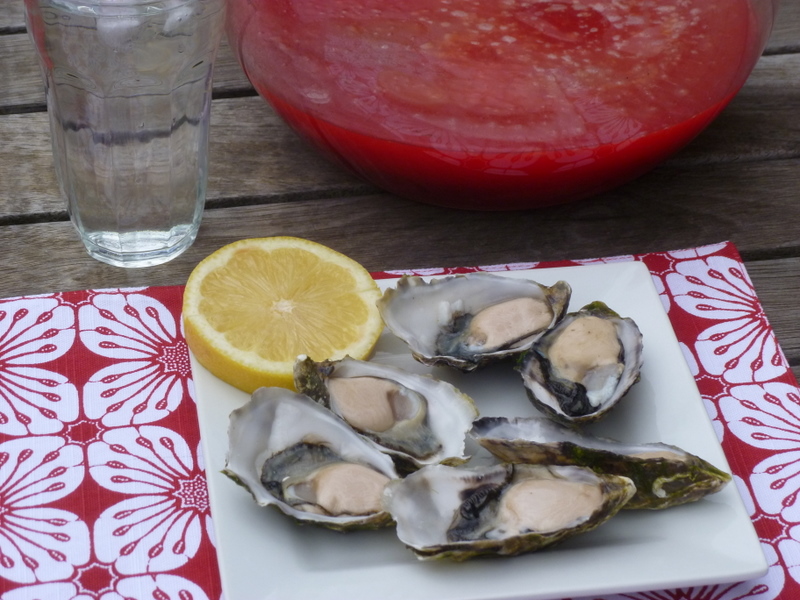
Pacific Oysters from Prahran Markets

A Well-Earned Breakfast

We also picked up a dozen Native Oysters. I first tried oysters about ten years ago, when I shared a dozen with a boy I was trying to impress (this was about a year before I met the Big Guy). My love of oysters has lasted far longer than that particular infatuation!

I enjoy oysters from all over the globe, especially when I happen to find some on a beach forage. But Native Oysters are really the best, as they are creamier and meatier than their North Sea counterpart. I prefer them raw as opposed to grilled with a topping, like in Oysters Rockerfeller, or Kilpatrick. I just feel that this is gilding the lily, and something this good does not really need embellishment further than a squeeze of lemon, or a splash of champagne, if you want to push the boat out!

I have already mentioned the importance of checking out your seafood before you buy it. Our oceans are a precious resource, and currently, they are being exploited horribly, with no real eye to the future of fish stocks, or the fishing industry itself. Damaging catch methods are putting species at risk, as well as destroying the habitat where they live and breed, and catching fish and sea mammals that were not the intended catch, meaning that they are thrown back, often dead or dying. It is so important to make sure that you are not adding to the problem and supporting these practices by eating unsustainably harvested fish.

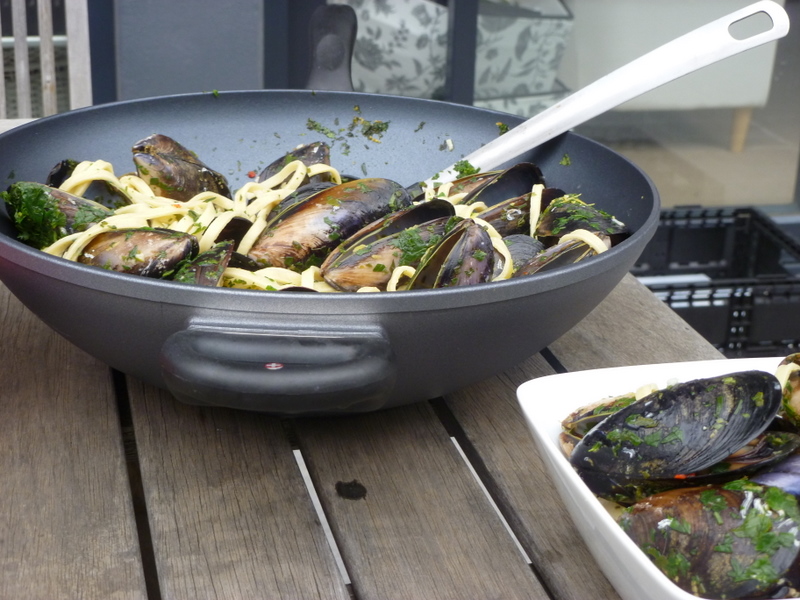
Luckily, like a lot of shellfish (but not all), the oysters are sustainably managed and harvested.  As are the Blue Mussels that we also picked up, along with the rest of the ingredients for this tasty little lunch:

Mussels with Pasta

Market Dinner

Recipe: Mussels Pasta

Ingredients

1 kg mussels

Glass of white wine

1 garlic clove, minced with a little salt

1 red chilli, deseeded and finely chopped

A little oil for frying

Juice and zest of one lemon

Bunch chervil, finely chopped

Bunch tarragon, leaves removed from stalks and finely chopped

Bunch parsley, finely chopped

2 serves linguine, fresh from the Pasta Shop, if you are in Melbourne

Method

Prepare the mussels. Remove the “beard”, which is the green fibrous stuff at the pointy end, it will come away if you tug it. Of course, with any shellfish, you need to be sure that you are getting them alive. If any of the shells are cracked, then discard them. I hate waste, but not even I will mess with this one, because dead mussels decay quickly, and you risk a nasty case of food poisoning. If any of the shells are open, give them a sharp tap on the counter. If they do not close,  then discard them. Give them all a good rinse, to eliminate any grit, but don’t leave them soaking in fresh water, because they may die.

Prepare the herbs, lemon, chilli and garlic. If you have dried pasta, you will need to get this going now, and cook according to packet instructions. Get it to the point where it has five minutes left to cook before you move onto the mussels.

We got fresh pasta from the Pasta Shop in the market, if you are using fresh pasta, just get the pot of salted water on a rolling boil. It is fine to cheat, and boil the water in a kettle beforehand.

Heat a little oil in a large pan, and fry the garlic and chilli in it for a couple of minutes, until the scent fills the air. Add the mussels, wine lemon juice, herbs and zest to the pan. Cover and allow to cook.

If you are using fresh pasta, then add it to the boiling water now.

When the pasta (either variety) is finished, drain, but keep some of the cooking water. Add the pasta to the mussels, which should mostly all be open by now. Give it a good stir around for a minute or two on the hob. If the mixture is dry, add some of the pasta water, although I would try to avoid this if possible. The liquor in the pan is aniseedy and soupy from the herbs, and you risk diluting its delicate flavour.

Have a quick check for any mussels that have not opened. There is  some debate as to whether these are safe to eat, but I really think that the risk is not worth it. I recommend that you discard any unopened mussels.

Serve in deep bowls, making sure that you get a good ladleful of the herby juice in each bowl.

2 Comments

Filed under Feast, Fed

Charming Cherries

Cherry Clafoutis

Clafoutis

We are back from the lovely land of Australia. We had a fabulous time, and lots of great foodie experiences, leaving me with quite a few posts to catch up on, which will appear here in the next few days.

I have always wanted to have a go at making a clafoutis, and what better opportunity than when you can find large, plump and a deep, deep red cherries? Again, this is a summer dish at it’s best, and the riper you can get the cherries the better.

Clafoutis can also be made with any ripe fresh fruits, although apparently the proper name for those without cherries should be flaugnarde.

Whatever your fruit, and whatever you call it, this is a great way to use up a glut of fruit, as long as they are really ripe.

Traditionally, the clafoutis is served lukewarm, which makes sense when it is the height of summer, as you don’t want a hot pudding for a warm, sticky evening. However, if you want to use winter fruits, like apples or pears, I see no reason that you can’t serve this warm, possibly with a nice custard.

I made this for a friend who is lactose intolerant, so I used soy milk, but you can use whatever you like here.

I hope that you have a go at this dish, it really is so easy, but looks very impressive. Your friends and loved ones will appreciate you for it.

Recipe: Cherry Clafoutis

Ingredients

50 g plain flour

2 eggs

150 ml milk

Pinch of salt

Seeds of half a vanilla pod

Cherries – enough to cover an ovenproof dish or cake tin in a single layer

Method

Heat the oven to 220 °C.

Mix all of the ingredients, except the cherries, into a thinnish batter. Some recipes also call for a little sugar (in the region of a couple of tablespoons). You can add this too, if you want, but I thought that the cherries I was using were quite sweet enough for the whole dish, so I didn’t use any. Leave the batter aside to rest while you prepare the cherries.

The original Limousin dish left the stones in the cherries, which, it is said, impart an almond flavour. I didn’t try this way, because it is a little unseemly to be spitting out cherry pips when you are in company. Instead, I halved and stoned the cherries, then laid them out, flat side down in a baking dish, until the bottom was covered in one layer of cherries.

My friend only had a spring-form cake tin, which I lined with baking parchment as a precaution against spills, which was entirely unnecessary, as it turned out, so just use a cake tin, or any largish baking dish you have to hand.

Tip the batter in and around the cherries. At this stage, it should not cover the cherries over completely, but will almost do so. Don’t worry, they will rise to the top again as the dish cooks.

Put in the oven for about 20 minutes, or until the batter looks cooked across the pudding. You want it light and airy, though, not crispy, although slightly crispy edges are almost inevitable.

Dust with a little icing sugar while still warm, and leave to cool before serving. The Big Guy and I had a little natural yoghurt with ours, but my friend eschewed the yoghurt, and ate it au naturel. It is very good either way.

2 Comments

Filed under Feast

Aussie Christmas dinner

Moreton Bay Bugs & Thai Salad

Alternative Christmas Dinner

We are in Australia. Posting may be sporadic, but I do want to do my Christmas dinner, and custard based recipes. I may well leave the acceptable way with sprouts post, that I have not really written yet, to next Christmas now!

Anyway, this year we are having Christmas by ourselves in Cairns. An Aussie Christmas has to have seafood, and should also include a barbecue somewhere in the proceedings. We were very lucky indeed, and also had access to a pool and an entire rainforest to ourselves, since no one else was about. All in all, it was a pretty brilliant day.

We were lucky enough to get hold of some Moreton Bay Bugs, which are actually a kind of slipper lobster. Most Moreton Bay Bugs are caught as by-catch from the prawn and scallop fishing industries, both of which are trawled for. Trawling is a highly destructive practice, resulting in a lot of unintended species netted (bycatch) and destruction of the sea bed. The Australian Marine Conservation Society urges you to ‘Think Twice‘ before eating them, largely as a result of the catch method involved. We found a fish market that claimed that they were sustainably caught. It is possible to scuba dive for these, as it is for scallops, but these are very difficult to find.

Moreton Bay Bugs

Green Bugs

Anyway, if you do get them, you need green (uncooked) bugs if you want to barbecue them. They cannot live long out of water, and spoil much quicker than crabs or lobster, so this may not be easy. Never reheat them, so if all you can get is cooked, just eat them cold.

In North Queensland, fresh (and ripe!) tropical fruits are sold all over the place. They are cheap and plentiful. I had been thinking that mango, papaya, chili and lime would be perfect partners for the sweetness of the bugs, which naturally leads you to Thai flavours. They typically use green papaya, and I only had ripe, but I made do with what I had.

I hope that I am not one for boasting, but the result was really good. I was very proud of our tasty little Christmas Dinner.

I have given the recipe below, but if you cannot find Moreton Bay Bugs, you could substitute with scallops, langoustines, or even lobster if you are feeling decadent! Just please check out how they are caught, and try to get sustainably caught and managed fish where you can – the ocean is an important source of food for us, and keeps a lot of communities going, but only if we look after it well. Something which is sadly not happening too much these days.Your local Marine Conservation Society can help  give you an idea of fish stocks and some sustainably managed areas (although their system is not perfect). If you don’t have this, then organisations like Greenpeace can tell you which species to avoid altogether.

If you can’t or won’t get any of these, just have the salad – it is really tasty on its own.

Recipe: Moreton Bay Bugs and Vietnamese Salad

Ingredients

Moreton Bay Bugs – 3 per person

For the salad dressing:

1 small hot chilli (eg bird’s eye)

2 cloves garlic

4 tbsp lime juice

4 tbsp fish sauce (nam pla)

1 tbsp soft brown sugar

1 tbsp coriander stalks

1 tbsp mint leaves

For the salad:

Mixed salad leaves

Asparagus

Cucumber

Beansprouts

Coriander leaves

Mint leaves

Papaya

Chopped, unsalted peanuts

For the noodles:

1 pack noodles

1 spring onion

chopped chilli

lime vinaigrette

Method

Make the salad dressing. Mix the lime, fish sauce and the sugar, until the sugar has dissolved. Mince the garlic using your knife, deseed the chilli (or leave them in if you like things really hot) and chop it finely. Chop the coriander stalks and mint leaves as finely as you can. Add all of these to the lime mix, and taste for balance, you may need to add a touch more lime or chilli, to your taste. Set aside for the flavours to develop.

A short period of time in the freezer should be enough to kill the bugs humanely. Slice the bugs in half, lengthways, with a sharp knife. You will then need to clean the digestive tract and the head.

Make the salad, by mixing up the salad leaves, a good bunch of coriander, a handful of mint leaves, and julienned cucumber and papaya. Wash the beansprouts well, before adding them, and blanch the asparagus, and cut the stalks into 3-4 pieces, on the angle. I would also have added grated carrot, but we managed to lose the carrots somewhere between the shop and home, so no carrots for us.  Mix together well, and set aside.

Oil the flesh of the bugs, with a squeeze of lime, and place on a hot barbecue, flesh side down for about 8 minutes. Then flip them to colour the shells. They are done when the flesh becomes opaque.

Meanwhile, make the noodles according to the manufacturer’s instructions. Thinly slice the spring onion and the chilli and add to the vinaigrette. I had a very simple lime vinaigrette left over from the previous day’s lunch, but you can make up your own with 1 part lime juice to 3 parts olive oil. Leave the chilli and the onion to macerate to take the raw edge off them. When the noodles are cooked, drain, and pour over the vinaigrette, and mix well, so that the noodles don’t stick.

When everything is cooked, dress the salad with the dressing you made earlier, and toss together well. Plate up the noodles and the salad, and sprinkle with chopped, unsalted peanuts. Serve with the warm bugs, and a cold glass of wine. Next to a pool in the tropics, by preference.

4 Comments

Filed under Feast