New Year Food Resolutions

Sydney Harbour Bridge New year 2012

Happy New Year!

I am not really one for making New Year’s resolutions. In fact, I don’t think I can remember the last time I made any. However, I often decide that I should start to do more of this or more of that in my foodie life. So, I decided to make some food-related New Year’s resolutions, as it will be a useful way to record my thoughts, and interesting to see if I actually manage them.

So, in no particular order, in 2012 I would like to:

  1. Grow Better: I already grow a lot of food, but this year I resolve to try to be more organised in the garden, so that my stuff  gets sown on time, and I actually manage to reach the holy grail of good successional planting.
  2. Go on a permaculture course, hopefully to help me with number 1
  3. I am going to investigate more asian and middle eastern food. I was lucky enough to get a book of recipes from the Philippines, from a friend of mine, but I want to understand more about Thai, Vietnamese, Philippines, Indonesian, Malay, Chinese, Japanese, Lebanese, Afghani, and many other cuisines from these regions.
  4. I am going to source and try to grow Morning Glory to help me with number 3, but I will be otherwise adapting the recipes to use ingredients that I can source locally.
  5. I am going to cook bread more regularly. I love making bread, and actually a lot of it can be quite easy. I have made some wonderful English muffins that don’t require a lot of proving, and make the perfect brunches. I  have made spelt bread that takes two hours from the time you tip the flour into the bowl to the time you take it out of the oven. With just a little planning, bread baking need not be an arduous chore, and it need not take hours and a lot of kneading. Expect this to appear on these pages sometime soon.
  6. I would love 2012 to be the year I manage to source half a well-reared beast, and butcher it myself. However, I would need to go in with friends on this venture, so I may also need to find some friends with a large freezer!
  7. I want to continue on my adventures in brewing. Elderflower champagne is a must for this year, but I also want to try my hand at beer from scratch, and many other things. I also intend to brew me some interesting vinegars this year, from start to finish.
  8. I am absolutely going to eat at Heston Blumenthal’s Dinner, but would also really love to give Michael Caines’ Gidleigh Park, Matt Moran’s Aria, Marcus Wareing at the Berkley, Ron Blaauw, La Rive, Marius, and Ciel Bleu a go. I intend to go back to Texture, which I thoroughly recommend if you are looking for a high-end London restaurant. I also want to start blogging about them here.

There are many other things I want to dabble with. I am currently being persuaded by friends to get into supper clubs, which I would love to try, but I am really scared of doing, but who knows, maybe 2012 will be the year when I pluck up my courage. However, the above list seems to be enough to be getting on with.

So have you made any New Year’s food resolutions? What are they?

4 Comments

Filed under Uncategorized

Baked, Glazed Ham and Crunchy Christmas Crackling

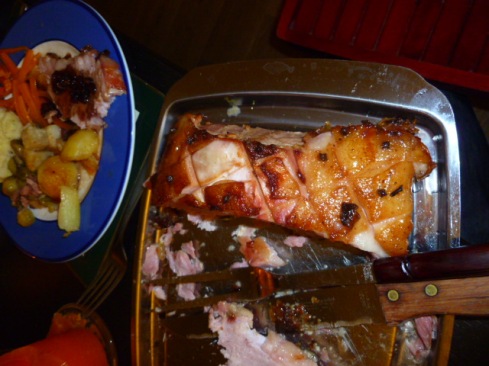
Glazed Ham

A great roast!

The Swedes are a very traditional bunch at Christmas, and everything must take place in a particular order. They celebrate on Christmas eve, which starts with a bowl of Risgrynsgröt, which is essentially sloppy rice pudding with no sugar in. The celebrations do not start until their annual Disney clip show, Kalle Anka och hans vänner önskar God Jul: “Donald Duck and his friends wish you a Merry Christmas.”, has finished. This was originally made in 1958, and they Swedified it, taking off Walt Disney’s narration, and adding a Swedish guy. They show it every year at 3pm, and woe betide you if you choose to call in the middle of it! They show the same clips, in the same order, every year, and no-one talks during it at all. I understand that they tried to change some of the clips one year, but so many people wrote in to complain that they have never dared try that again. I am not the only non-Swede to have been baffled by their absolute enthrallment by this programme.

After Kalle Anke, they have their Christmas meal. This is as traditional and not-to-be-messed-with as old Kalle and his clip show. As well as inlagd sill (which must be eaten with a beer), they always, always have a baked ham, served cold, meatballs, Prinskorv, and very little in the way of vegetables (unless you count beetroot in one of the herring dishes).

In the UK it has become traditional to have a turkey or a goose, roasted in the oven at Christmas, served alongside a number of cooked veg, often with the much-loathed Brussels sprouts as an accompaniment. We probably have loads of things that the Big Guy finds odd too – I remember his reaction the first year he got crackers, he loved all of that, and just could not stop giggling at the rubbish cracker jokes. I am not as aware of our idiosyncrasies in this regard, but if he wants to go on about them, he should probably start his own blog!

The great thing about having a non-traditional Christmas dinner, especially when it is not actually Christmas day, is that you can mix it up a bit, and dispense with some things altogether. A number of my guests enjoy my hot roast dinners, but I don’t really like turkey or goose (although I recently had wild goose, and loved that, I find domestic geese just too fatty for my taste), so I decided that a mix of the traditions was the way forward, and settled on a baked ham, with the traditional roasted and cooked veggies on the side, including an acceptable way with sprouts.
The roast and the trimmings

Served with all the trimmings

I had intended to do a gammon, but due to a bit of a loss in translation, I got a nice piece of what I suspect was raw back bacon instead. Never mind, I have a lovely butcher, and so next time I want one, I know what to ask for. This, folks, is one of the many benefits of using a butcher over buying meat from a supermarket. On top of this, we swapped tips on how I was going to cook it, and also what sauce to use. Please support local butchers, it really is a case of use them or lose them right now, as more of them lose out to the supermarkets. It would be a shame to lose their knowledge, miss out on some useful banter, or even improve your  language skills (not guaranteed if you and your butcher have the same mother tongue, but you could be surprised)

I originally got this recipe from the Dairy Book of Home Cookery which was produced by the Milk Marketing Board, and you used to have to buy it from your milkman (remember them?). It has been published since 1972, and is practically an institution, almost as entrenched in British households as stopping everything for Kalle Anke is in Sweden.

We are currently on holiday in Australia, and so due to travelling, I have not been able to get this post finished before Christmas. I decided to publish it anyway, as it is a great roast dinner and a good celebratory meal, whatever you are celebrating.

This was to feed 8 adults and one small child, but you can adjust your ham/ gammon according to how many people that you have to feed, and how much you want for lovely leftovers.

Recipe: Baked, Glazed Ham & Crackling

Ingredients

2.1 kg raw ham or gammon, skin on. I got mine vacuum packed, but this may not be possible.

Cloves

100g muscovado sugar or donker basterdsuiker

200 ml apple juice or cider

1 tbsp Worcestershire Sauce

1 tsp English mustard powder

Method

If you have a large gammon, you need to soak it for at least 12 hours, with several changes of water, to remove the salt.

Next, you will need to boil the ham. If you have ham like mine, or you have access to a vacuum packer, I recommend boiling it sealed. This will require less boiling, and will help keep the finished ham moist. If you are boiling it this way, you will need an hour. If you are not using a vacuum seal, then boil it for up to 2 hours, in plain water. You will definitely not need to add salt for this one. I usually add onion, carrots, celery and bay, to make a lot of stock. Either way you cook the ham, it must remain covered with water, so place a plate over it, and use weights, if necessary. Check regularly throughout the boil to see if the water may need to be topped up. If you do need a top-up, use boiling water from the kettle, don’t add cold and reduce the water temperature.

When the ham has finished boiling, take it out of the water. If it is vacuum sealed, then be careful to retain the stock that will have been made within the plastic. If you have boiled it plain, then keep the boiling stock, but remove the vegetables. Either way, you will have a lovely, rich, gelatinous stock, which is great with bean dishes, stews and soups. Leave it to cool, and remove the fat, but please don’t throw it away!

Next, remove the skin. Try to keep a thin layer of the fat on the ham, because this will help with the glaze. You also need some of the fat on the skin, if you want your crackling to be lovely and crisp.

Score the skin, but don’t cut it all the way through, if possible. You want a block of the skin, which can be carved up later. Rub a fair bit of salt, and herbs or spices into the skin – I used fennel seeds, but cumin, rosemary, lemon zest, jerk seasoning, or a garam masala would all be equally good. You could rub with a little bit of olive oil first, to make sure the seasoning sticks, but this is not entirely necessary. Do make sure you rub the salt and spies into the slashes as well.

Place the skin in a roasting tray and put it in an oven at 180°C. Start to check after 20 minutes and remove when the skin has formed crisp crackling. This can be made ahead of time and warmed through when you want to serve it.

When the crackling is in the oven, carefully score the fat on the ham, taking care not to slash the flesh. You want to score lines going one way, then turn it 90 degrees, , and score in lines again, so that you end up with a diamond pattern over the ham. Stick a clove through the fat, and anchor in the meat on alternate diamonds.

The rest of the ingredients will make up the glaze. Put them all in a saucepan, and warm through until the sugar has melted. It should be quite viscous, which makes it easier to glaze the whole ham with, without too much running over the sides.

Spread all of the glaze over the ham. Make sure that it is covering all the fat, and don’t worry if some of it dribbles down the sides of the meat, it all adds to the flavour.

Bake the ham at 180°C for 40 minutes to an hour, depending on the thickness of the meat. If you have a meat thermometer, you want to keep the meat at 80°C, which will keep the meat moist. I don’t have one of these, so I judge it by sticking a skewer in the thickest part of the meat, and seeing if it is warm. The temperature thing was a tip from my butcher, so rather than waste the advice, I thought I would share it here.

Baste the ham with the glaze at least twice throughout the baking process, to maximise the flavours and to use up that delicious glaze.

Serve it with the crackling, some cooked veggies (including roast potatoes), and a thick sauce made from chopped shallot, port wine, ground cloves, and muscovado sugar.

This is a real treat and great for any celebration. As you won’t have been able to read this for Christmas, I would like to wish you a very happy and prosperous New Year.

Carvery

A Proper Carve Up

(c) J. Caspar 2011

Leave a comment

Filed under Feast

Aussie Christmas dinner

Moreton Bay Bugs & Thai Salad

Alternative Christmas Dinner

We are in Australia. Posting may be sporadic, but I do want to do my Christmas dinner, and custard based recipes. I may well leave the acceptable way with sprouts post, that I have not really written yet, to next Christmas now!

Anyway, this year we are having Christmas by ourselves in Cairns. An Aussie Christmas has to have seafood, and should also include a barbecue somewhere in the proceedings. We were very lucky indeed, and also had access to a pool and an entire rainforest to ourselves, since no one else was about. All in all, it was a pretty brilliant day.

We were lucky enough to get hold of some Moreton Bay Bugs, which are actually a kind of slipper lobster. Most Moreton Bay Bugs are caught as by-catch from the prawn and scallop fishing industries, both of which are trawled for. Trawling is a highly destructive practice, resulting in a lot of unintended species netted (bycatch) and destruction of the sea bed. The Australian Marine Conservation Society urges you to ‘Think Twice‘ before eating them, largely as a result of the catch method involved. We found a fish market that claimed that they were sustainably caught. It is possible to scuba dive for these, as it is for scallops, but these are very difficult to find.

Moreton Bay Bugs

Green Bugs

Anyway, if you do get them, you need green (uncooked) bugs if you want to barbecue them. They cannot live long out of water, and spoil much quicker than crabs or lobster, so this may not be easy. Never reheat them, so if all you can get is cooked, just eat them cold.

In North Queensland, fresh (and ripe!) tropical fruits are sold all over the place. They are cheap and plentiful. I had been thinking that mango, papaya, chili and lime would be perfect partners for the sweetness of the bugs, which naturally leads you to Thai flavours. They typically use green papaya, and I only had ripe, but I made do with what I had.

I hope that I am not one for boasting, but the result was really good. I was very proud of our tasty little Christmas Dinner.

I have given the recipe below, but if you cannot find Moreton Bay Bugs, you could substitute with scallops, langoustines, or even lobster if you are feeling decadent! Just please check out how they are caught, and try to get sustainably caught and managed fish where you can – the ocean is an important source of food for us, and keeps a lot of communities going, but only if we look after it well. Something which is sadly not happening too much these days.Your local Marine Conservation Society can help  give you an idea of fish stocks and some sustainably managed areas (although their system is not perfect). If you don’t have this, then organisations like Greenpeace can tell you which species to avoid altogether.

If you can’t or won’t get any of these, just have the salad – it is really tasty on its own.

Recipe: Moreton Bay Bugs and Vietnamese Salad

Ingredients

Moreton Bay Bugs – 3 per person

For the salad dressing:

1 small hot chilli (eg bird’s eye)

2 cloves garlic

4 tbsp lime juice

4 tbsp fish sauce (nam pla)

1 tbsp soft brown sugar

1 tbsp coriander stalks

1 tbsp mint leaves

For the salad:

Mixed salad leaves

Asparagus

Cucumber

Beansprouts

Coriander leaves

Mint leaves

Papaya

Chopped, unsalted peanuts

For the noodles:

1 pack noodles

1 spring onion

chopped chilli

lime vinaigrette

Method

Make the salad dressing. Mix the lime, fish sauce and the sugar, until the sugar has dissolved. Mince the garlic using your knife, deseed the chilli (or leave them in if you like things really hot) and chop it finely. Chop the coriander stalks and mint leaves as finely as you can. Add all of these to the lime mix, and taste for balance, you may need to add a touch more lime or chilli, to your taste. Set aside for the flavours to develop.

A short period of time in the freezer should be enough to kill the bugs humanely. Slice the bugs in half, lengthways, with a sharp knife. You will then need to clean the digestive tract and the head.

Make the salad, by mixing up the salad leaves, a good bunch of coriander, a handful of mint leaves, and julienned cucumber and papaya. Wash the beansprouts well, before adding them, and blanch the asparagus, and cut the stalks into 3-4 pieces, on the angle. I would also have added grated carrot, but we managed to lose the carrots somewhere between the shop and home, so no carrots for us.  Mix together well, and set aside.

Oil the flesh of the bugs, with a squeeze of lime, and place on a hot barbecue, flesh side down for about 8 minutes. Then flip them to colour the shells. They are done when the flesh becomes opaque.

Meanwhile, make the noodles according to the manufacturer’s instructions. Thinly slice the spring onion and the chilli and add to the vinaigrette. I had a very simple lime vinaigrette left over from the previous day’s lunch, but you can make up your own with 1 part lime juice to 3 parts olive oil. Leave the chilli and the onion to macerate to take the raw edge off them. When the noodles are cooked, drain, and pour over the vinaigrette, and mix well, so that the noodles don’t stick.

When everything is cooked, dress the salad with the dressing you made earlier, and toss together well. Plate up the noodles and the salad, and sprinkle with chopped, unsalted peanuts. Serve with the warm bugs, and a cold glass of wine. Next to a pool in the tropics, by preference.

4 Comments

Filed under Feast

Swedish Starters

Inlagd Sill

Swedish sill

So, the Sunday after the Mince Pie and Mulled Wine party saw me once again cooking for friends. This time, it was an international Christmas Dinner, at which we had guests from Australia, Germany, the Netherlands, the UK and the USA. However, the dinner itself was an amalgam of British and Swedish traditions, so I guess we had the best of both.

Traditionally, Swedes are pescatarian in nature, particularly when it comes to starters. I am sure that you have heard of the notorious Surströmming, which is the fermented variety, reputedly so smelly that you have to eat it outside. I have never had the pleasure, myself, so I am unable to report what it is like.

They also love all manner of fish eggs from actual caviar, through Löjrom (from the Vendace, or Cisco), to the particularly nasty Kalles Kaviar, which is about as far from caviar as you can get, and is available in an Ikea near you, you lucky people. Can you tell that I am not a fan of fish eggs?

Much more acceptable is their unfermented ways with herring, or sill as it is known. A really traditional starter, especially at Christmas is inlagd sill. You can also get this in various form from Ikea, but it is much, much nicer to make your own. It is basically herring that has been stored in a sweet pickling solution. I made the traditional version, but you can also make it with dill or mustard within the solution, and the Swede in your life would still be happy.

As with most fish dishes, they like to serve this with sour cream and finely chopped red onion. You can choose if you would like to have this with waxy potatoes, cooked with dill in the same way that Brits add mint to the boiling water; or with wholemeal toast or knäckebröd (a hard bread like Ryvita). We used up the last of the pink fir apple potatoes from our garden.

Recipe: Soused Herring

Ingredients

8 herring fillets (I had to cheat and buy Maatjes Herring, because there was no raw herring to be had when I needed it, I gave the fillets a good rinse, and we were good to go)

100 ml ättiksprit (strong pickling vinegar) or cider vinegar

160 g sugar

2 red onions

4 carrots

2 bay leaves

15 peppercorns

Method

Cut one onion in half, and slice thinly. Slice up 2 of the carrots as well.

In a non-reactive saucepan (e.g. ceramic, stainless steel, preserving pan), put the sugar, chopped onion and carrots, bay, peppercorns and the vinegar. Bring to the boil, then set aside to allow it to cool completely.

When it is completely cold, strain it off, reserving the vinegar to use on the herring. Don’t throw away the vegetables, they are really tasty. One of our guests doesn’t eat fish, so we gave him some of these on top of a toasted goat cheese. I have to admit that I scarfed up all the carrots from the sieve, as they were so good. The rest I had as a pickle with the bubble and squeak I made with the Christmas Dinner leftovers.

Chop each herring fillet into 3-4 pieces, depending on the size. Chop the remaining onion and carrots as before. In a sterilised jar, layer the fish pieces, the onion and the carrot, then pour over the vinegar. Seal the jar, and leave for 24 hours or the flavour to develop.

This method of pickling will keep the herring for about 3 weeks. Please keep it in the fridge once opened.

5 Comments

Filed under Feast

Mince Pies

And so we finally come to the stars of the party, my mince pies. If they weren’t, I would have had to call it a Mulled Wine and Some Snacks Party,and  to be quite honest, I’m not really sure it would have had the same draw.

Mince Pies are a traditional British Christmas snack. My best friend refuses to eat them, due to an early childhood disappointment when he discovered that they did not contain mincemeat, but rather that they had fruits and spices inside. Originally, they actually did contain spiced meat, which was a way of disguising the fact that by the middle of winter, the meat was not at its freshest. They also contained some dried fruits.

Mince pies have existed since about the 13th Century, when crusaders brought back the idea of mixing spice with meat from their trips to win the hearts and minds of the residents of the Middle East. They were considered symbolic of garish Catholic Idolatry by the professional miserablist Oliver Cromwell, but apparently it is quite difficult to come between us Brits and our little Christmas pies, so he was not successful in his attempts to ban them. Again, quite lucky for me and my themed parties.

There is something to be said for the traditional ritual of baking these little treats that I find really restful, but exciting at the same time, as it heralds the start of my Christmas celebrations.

I had made some Pear and Ginger Mincemeat back in September, which I got out. You can just use mincemeat to fill your pies, but I like to fiddle some more, for a more luxurious pie. To ordinary fruit mince, I would add nuts and port, and let them soak for a few hours. As this mince had ginger wine in, I let this one soak in a little brandy, although I did add more nuts, for some crunch.

I had invited some people to the party that are vegan, and so I made up a batch of the Vegan Shortcrust Pastry. Some people prefer puff pastry in their mince pies, but I really think this is pastry overkill. Shortcrust is traditional, and for me it is the best way to get the right balance of pastry to filling.

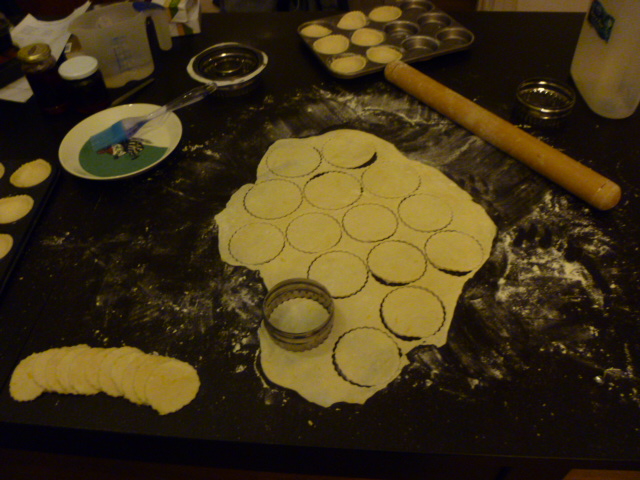
The best bit about making these pies is getting the right mix of the circles between base and lid, so as to maximise the number of them you can cut from a single roll of the pastry.

Making mince pies

Terrific Tessellation

Firstly, you need to get the right size of circle for your tins. I use muffin trays, because I like the added depth that you can get than with ordinary tart trays. Whichever you choose, you need to cut out 2 sizes of circles for the base and the lid. The base should be about 2 cm larger than the diameter of the “hole” in your tray – this is to allow the pastry to sink into the tray, and to come right up the side. The lid should be about the same diameter as the hole. If you are going to use pastry cutters, then choose the size down from the base. I have also used a variety of glasses, and find a wine glass and a shot glass is also fine to use.

Roll out your pastry thinly. If you can 2-3 mm is ideal. Cut out the same number of base and lids. You will be likely to need to collect up the offcuts and re-roll these. If there is any left over, you can make a pasty with your mincemeat, or fill it with currants, a little sugar and some lemon zest and make an eccles cake.

Grease the tart or muffin trays well using butter or olive oil, and put the oven on at 180°C. Then gently put the bases into the trays, and press down with a little offcut pastry.

Add a heaped teaspoon of the mincemeat into each base. It needs to be generous, but not too full, otherwise your pie will burst in the oven.

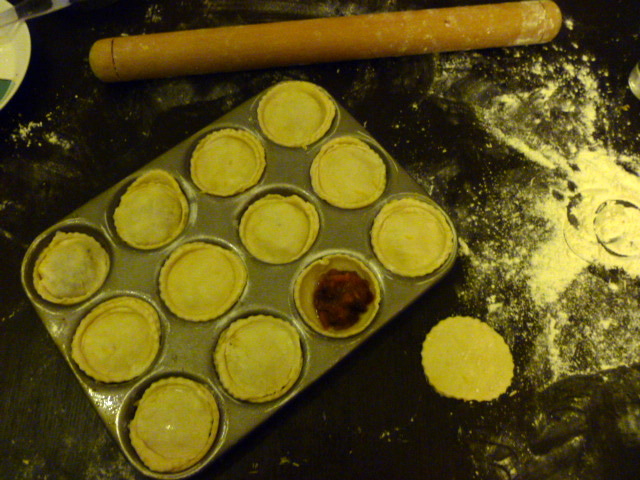
Take the lid, and brush round the rim of one side with a little water (if you are not making this for vegans, then you can use egg wash or milk). Place the lid, watered side down, over the pie. You will need to seal the pie, which I do by placing a glass that is slightly smaller than the diameter of the lid over the lid, and pressing it down to seal he base and the lid together.

Filled pies

Pies – filled and sealed

Brush with a little water and place into the oven for 20 minutes, or until the pastry is a golden brown.

Serve the pies warm with a little icing sugar sprinkled over the top. You can make these in advance, and warm then through in a low oven before serving.

Mince Pies

Mmm Mince Pies

Great on their own, or with cream. Best served with a glass of mulled wine!

4 Comments

Filed under Feast

Mulling it Over

No Mince Pie and Mulled Wine party would be complete without some mulled wine. This spiced wine is traditionally flavoured with the Christmassy flavours of nutmeg, cinnamon and cloves.

I think the practice of spicing and warming wine is pretty international, and many European countries have a version of it, calling it Glühwein, Glögg, or Vin fiert. In the UK, we are also quite prone to mulling cider in a similar way, which is fantastic after a day in the cold. One of my friends brought some cider too, so everyone got to try out the traditional taste of the West Country.

The recipe for red and white wine is essentially the same, and don’t let either of them boil.

Recipe: Mulled Wine

Ingredients

1 orange (mulled red wine)

½ Orange and ½ Lemon (mulled white wine)

Cloves

Cinnamon stick

Grated nutmeg

100 g lichte basterdsuiker or soft brown sugar per 2 bottles of wine

Method

Stud the citrus fruit with the cloves. If you are mulling red wine, then halve the orange before you do so.

Put all of the ingredients in a saucepan, and heat gently until the sugar has dissolved. Don’t let the wine boil.

If you have time (and no thirsty guests already) you can allow the spices to steep for a few hours, and reheat before serving. It will also be fine if you serve it warm, straight away.

Bay leaves are also an interesting addition to mulled white whine, so bung a couple of them in as you heat it.

3 Comments

Filed under Fermented

Making Meringues

I am sure that you may have noticed by now that I use a lot of egg yolks – in stuff like custards, mayonnaises, pasta, pastry and sauces. This leaves me with a lot of egg whites to use up.  Since I hate waste, I try always to use them, which invariably means making macaroons, and meringues. I need to expand this repertoire, so expect to see consommés and more stir fries appearing here soon. If you have other suggestions for using up egg whites (although not the egg-white omelette, please, some things are a step too far, even for me!) feel free to leave them in the comments.

I had originally intended to make advocaat, in keeping with the Anglo-Dutch theme for my party, but I ran out of time. However, this time, the advocaat was actually the by-product of the intention to make meringues, instead of the usual situation where I have a load of egg whites left over from something else. No one missed the advocaat, anyway!

Since I make them so much, I thought that I would share my technique here. I haven’t given a recipe, as it will depend on how many egg whites you have and to some extent how old they are.

Start by heating the oven to 110°C. Then measure out  45 g sugar for each egg white. I like to use raw cane sugar, but you can also use caster, granulated or icing sugar. I have also seen sugar solution, but that seems to be for Italian or Swiss style meringues, and I tend to stick with French. It is possible to use soft brown sugar, but be aware that this makes it very hard to get a crisp, dry meringue. I think this technique may be best left alone or, if you insist, only use it to top lemon meringue pie.

Put the egg whites in a very clean bowl. There must be no fat or detergent in it. If you are unsure, wipe it with the cut side of a lemon (or other citrus), which will act as a degreaser. If the bowl has any fat, it may affect the ability of the eggs to maintain the air that you are about to whip into them. The same goes if there are any traces of egg yolk, so be careful when separating the egg, too. Note that the fresher the egg, the less likely that the egg yolk is to break when you separate it.

Next, whip the egg whites until they form stiff peaks. This is when the egg whites look drier, the whisk or a spoon will create peaks when you remove it from the mixture, and if you are brave, you can upend the bowl and the egg white will not slide out. I would advise using an electric whisk if you don’t want it to take you hours.

Egg Whites at the Stiff Peak stage

The stiff peak - sadly lacking in many ski resorts this year

Then, a tablespoon at a time, add the sugar and whisk in thoroughly before you add the next spoonful. The egg white will stiffen further, as you add the sugar. At this stage, you are beating to incorporate the sugar, not to add any further air, so it won’t increase in volume.

Egg Whites plus half the required sugar

About half way through - stiffer and peakier, but not more voluminous

Keep adding the sugar, and whipping, a tablespoon at a time. Eventually, the mixture will become really stiff, to the point of being really hard to work,  and will look shiny. This is when you stop adding sugar. Because I use cane sugar, I find I need less than the stated 45 g per egg white. If you are using caster or icing sugar, you may find that you need to use all of it. This is also fine.

Finished Meringue mix

The final product - glossy, thick and much harder to beat

Don’t add more sugar than needed to get to this stiff consistency (or than the 45 g, whichever happens to come first), otherwise your meringues will leach sugar. This does not really affect the taste, but it does give them a rather unattractive look. A bit like a tree that is leaching sap.

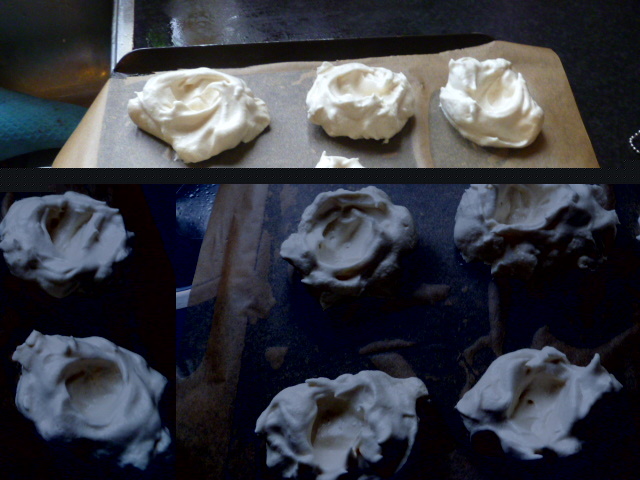
Now your meringue is ready to be shaped. You need to line a baking sheet with some greaseproof paper. You can stick it down with oil or by dabbing a bit of the meringue in each corner and the centre of the paper and using this as glue to stick it to the baking sheet. Once the baking sheet is ready, you need to choose what shape and size you are going to have your meringue. You may wish to have it as a pavlova, in which case you need to shape one large disc, with slightly elevated sides, to hold the fruit in. I normally go for individual ones, because these are better for parties or for sharing. Most commonly, I will get two spoons and shape individual quenelles, which can then be stuck together with cream and fruit in a sandwich. However, I wanted to fill these with Chestnut Jam, so I decided that mini versions of the pavlova-style would be better suited to the task.

Some people would use a piping bag for that, but I lack the finesse, and the piping bags, so I made do with shaping them with two spoons. You can try either, I think both are just as good. I made them vaguely circular, like a nest.

Meringue nests

Not sure what I did here, but you get the meringue nest picture

Then it is ready to go in the oven. Bake the meringues for up to 1 ½ hours (but check after 1). If you have made one large pavlova style meringue, you will need longer – check after 1 ½, and leave in the oven up to 2 hours.

A Meringue nest

Meringue nest - a better view

The idea is not really that the meringue cooks, more that it dries out. You need to check that it is no longer soggy to the touch, and that it generates a hollow sound when tapped very gently on the base.It will have darkened a little, even if you use icing sugar. Mine are generally more golden than off-white, because the unrefined sugar I use is a light brown.

When you get the hollow sound, it is done. If it is at all possible, turn off the oven, but leave the meringue in there to continue to dry overnight. This will give the best result, but it will be OK if you leave it to cool outside the confines of the oven.

Once it is done, fill it with fruit, cream, fruit and cream, jam, or serve it with ice cream, mash it up with fruit and cream to make Eton Mess – whatever you like, really.

2 Comments

Filed under Feast

World’s Easiest Chocolate Truffles

Easy Chocolate Truffles

Easy and Delicious

I have to start this post with a warning. These truffles will not last. Not because they are made from anything particularly perishable, but because people will not believe that you made them, because they are so good. This is what my party guests said to me the other day. Of course, I liked this so much; I thought I would reproduce their words.

Warnings aside, these little chocolates are at the least difficult end of the chocolatier’s scale. If you watch any TV programmes where they make desserts, the chefs will always tell you that chocolate work is demanding, exact and delicate. The only thing that is true of these very basic truffles is that you have to be exact about the amounts that you use, otherwise you will end up with the basis for a nice chocolate sauce, but it will not be thick enough for the ganache that is required. There is no heating things up to precise temperatures, as you have to when tempering chocolate; no delicate curls or swirling effects; no allowing things to set so you can complete the next stage; really none of the complex stuff that you see the likes of Eric Lanlard or Adriano Zumba would have you believe is part of every pâtissier’s daily life.

So, these little treats would not be elegant enough to grace the shelves of a Belgian chocolatier, or a Parisian Pâtissier, or even your local Thornton’s, now I mention it. But if you make them for guests, or as a present, they will go down a treat. Because they do represent something into which you have invested love, and time, anyone you make these for will be more spoilt than the guests at the ambassador’s party!

Recipe: Chocolate Truffles

Ingredients

225 g of the best chocolate that you can get hold of. I think (although this is, as yet, untested) that this is the secret to these truffles. It doesn’t matter if it is plain, milk or white, just good quality.

175 ml of double cream. It is important that you measure this as accurately as you can. If your measuring jug is not accurate enough, either double the amount you make, so you need 350 ml of cream, or weigh it. Although not precise, you can use 1g to = 1 ml, just dont add all the cream at once.

Cocoa powder / icing sugar/chopped nuts for dusting.

Method

In a pan, slowly bring the cream up to boiling point (where small bubbles form around the edge of the pan) but do not allow it to boil.

Cream at boiling point

Note -bubbles, not boiling

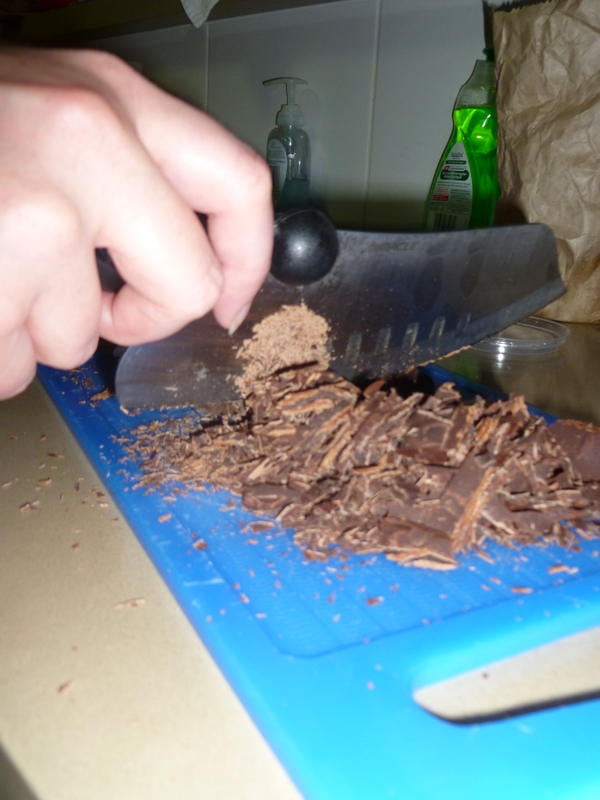
Meanwhile chop the chocolate up into small pieces.

Finely Chopped Chocolate

The finer you can chop it, the smoother the truffles will be

Pour the warm cream into the chocolate. The cream should melt the chocolate, but it should still be pretty thick. Stir the chocolate to make sure there are no lumps. This is your ganache.

Chocolate Ganache

Ganache – cooling

You may need slightly less cream in milk and white chocolate, to form a thick ganache, so pour it in slowly. You can always add a little more cream, but you cannot take it away if you have added too much, so caution here is advisable.

Leave the ganache to cool and thicken. This will take at least 1 ½ hours, but if you wish, you can speed this up slightly by placing the bowl to sit in a sink of cold water. It is very important that you do not allow any water to get into your ganache, as this will affect the thickness and the way it sets. Do not refrigerate to speed up the cooling. This will make your ganache too hard to work with. Plus putting hot things into a fridge is not very efficient, as the fridge then has to work much harder to maintain a constant temperature.

Ganache at the right thickness

This is about the right consistency for shaping

Once you have a thick ganache, spoon out small amounts, and roll gently into balls. Try to keep your hands cold, so that you don’t melt the chocolate too much. You can do this by running them in cold water, between each ball. Alternatively, you can shape them into quenelles, by using two teaspoons to mould them. If you have a little melon baller, you could also shape them with that too.

Once you have your shaped truffles, prepare a saucer with some cocoa powder, icing sugar, or finely chopped nuts. Or have saucers with some of each if you want variety. Gently roll the truffles on the saucer until they have a fine coating of your choice.

These are the finished truffles, which you can either plate up and put out for guests, or put in a pretty box to give out as presents. I promise you, people will be really impressed.

Variations

Just like Mareike’s Mayan Chocolate Mousse, varieties are very easy to make.

Use different flavours of chocolate, although avoid any with large nuts or lumps

Spice or flavour the cream, using spices, flavoured syrups for coffee, extracts (e.g. vanilla or flower extracts – I would not use “essence” which is usually artificial) ginger, vanilla, or a little alcohol of your choice

Once the ganache is made add a little chopped dried fruit or nuts for variety

Roll in flavoured sugars to coat

5 Comments

Filed under Feast

Kruidnoten – Christmas Cookies

Kruidnoten

Kruidnoten – really tasty christmas treats

Dutch and Flemish children do not have to wait for Christmas to celebrate. On the 5th December, the Netherlands celebrate Sinterklaas, when St Nicholas visits them and fills their shoes with sweets and biscuits.

One of the traditional biscuits that are given out at this time of year are Kruidnoten. These are little aniseed – flavoured biscuits, that are given to children, and also appear on your saucer whenever you order a coffee in December.

I really like them, and wanted to try my hand at doing some myself. the recent Mince Pie Party seemed like the perfect place to start, and my guests wouldn’t have to wait until Christmas either. As a bonus, these biscuits are vegan, as they contain no butter. Much older recipes do use honey, but these days stroop is a great alternative.That link is in Dutch, but stroop is basically a viscous sugar syrup, often the by-product of refining sugars. It is widely available in the Netherlands and often used on pancakes.

If you cannot get stroop where you are, golden syrup is also perfectly acceptable.

I got the recipe that I used from here. I have translated it below, and adapted it very slightly, to make it wholly vegan.

Recipe: Kruidnoten

Ingredients

200 g plain flour

1/2 tsp baking powder

Pinch salt

150 g stroop or golden syrup

2 tsp speculaas spice. This is widely available in the Netherlands. If you are not in the Netherlands and fancy trying these, you can mix up your own – I will give the proportions at the end of this recipe.

1 tsp ground aniseed (I grind mine fresh when I need it in a pestle and mortar)

Method

Preheat the oven to 160°C

Mix the flour, baking powder, spices, and salt in a bowl. Then make a well in the centre.

Add the stroop to the well, and stir in the flour. It should form a firm dough, but if it doesn’t, add a little more stroop or some water. I found that I needed a little of both, for this amount of flour.

Brush a baking sheet with oil.

Break off small chunks of dough, and roll them into balls. Press them into the baking tray, so that the base is flat. You will need to have well floured hands, and if the mixture gets a little sticky, roll it in a little flour as well.

Bake for about 15 minutes until the biscuits are browned. They should still be a little soft at this point, because they harden as they cool.

Recipe: Speculaas Spice

According to mijnreceptenbook.com speculaas spices can be made up yourself in the following proportions:

50 g ground cinnamon

15 g ground (or finely grated) nutmeg

10 g ground cloves

10 g ground ginger

5 g ground pepper

5 g ground aniseed

This mix will kep well in an airtight jar. If you want to make this up, you could reduce the amount of  each spice proportionately, or make up the lot, and try it in gingerbread, cakes and other recipes that call for either ground ginger or ground cinnamon to ring the changes.

1 Comment

Filed under Feast

Old-Fashioned Gingerbread

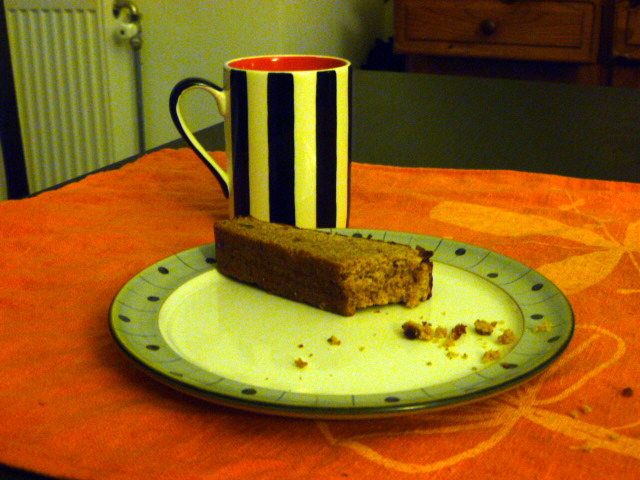
Sticky Gingerbread

Old fashioned gingerbread – sticky, not crunchy

On Friday, we had our annual mince pie and mulled wine party. I have been so busy baking for this that I have not had much time to write these recipes up, nor to publish the older posts. I managed to wipe out all of the photos, and have not taken good records, so it is a little time-consuming to go back through all my archives and find the right pictures. I also had an international Christmas dinner for other friends yesterday. I have a lot to write up.   They will all be up soon, I’m  sure!

This year, I decided to try to make some other nibbles from English and Dutch traditions, most of which will appear here in the next few days.

I wanted to make gingerbread, the old-fashioned kind that is dense and soft – not biscuity, like the sort that you make gingerbread men with.

The basic idea is that you make a syrupy sponge, and then let it sit for a couple of days, so that it acquires the dense, sticky texture that I desired.

Of course, you can’t decorate them like you can with gingerbread men, but since this was an adult party, then I don’t suppose any of my guests minded.

I have been making this recipe for years, but there are many very similar ones that I have seen in cook books.

Recipe: Old-Fashioned Gingerbread

Ingredients

280 g plain flour

1 tsp bicarbonate of soda

1 tsp ground ginger

1 tsp ground cinnamon

Pinch of salt

170 g softened unsalted butter. I use the pat of butter that I keep in a butter dish out of the fridge

90 g lichte basterdsuiker, or soft brown sugar

220 g golden syrup. I get this from home, but if you are in the Netherlands, and cannot get golden syrup, then I am pretty sure the stroop that you can buy to eat with pancakes will be fine instead.

1 egg

200 ml milk

4 balls of preserved stem ginger

2-3 tbsp ginger syrup (from the preserved ginger jar)

Method

Set your oven to 180°C

Mix the dry ingredients together. I don’t often bother to sieve ingredients when baking, although many recipes will call for it. It has never really affected anything that I bake. If you are in the sieving camp, then do so by all means.

In a separate bowl, beat the sugar and the butter together. I used an electric hand whisk, but if you have Popeye arms (or would like them) then a wooden spoon will do just as well. The mixture needs to be fluffy and several shades lighter than when you started.

Beat in the golden syrup, and the ginger syrup until it is thoroughly combined. When trying to get the golden syrup out of the tin, use a hot spoon (just hold it in hot water for a few seconds), if you don’t want to spend way too long waiting as the syrup drips sloooooowly from your spoon to the mixture below. If you are using stroop, then this is a little runnier than golden syrup, and comes in a handy squeezy bottle, so you shouldn’t have this problem.

Add the egg, and a tablespoonful of the flour mix (which should stop the batter from separating) and beat until it is all well combined.

Mix the flour in really well, then beat in the milk. You should get a really thick batter.

Finely chop the ginger, and stir it through the batter.

Pour into a square cake tin, about 20cm across. the bottom must be lined with greaseproof paper, and the sides well buttered (or brushed with oil). If you only have a round one, this is also fine, but I like to serve flat slices, for aesthetic purposes.

Because I hate waste, and don’t have children, I use a spatula to ensure that I get all of the batter into the tin, and scrape the bowl and the remains off the whisk. I did allow myself a tiny bit from the spatula after I had as much in the tin as I could physically get. It was a good job I waited too, the golden syrup makes this batter as moreish as crack.

Bake it in the oven for about 40 mins, or until a skewer pushed into the centre comes out clean. Leave it in the tin until it is cool enough to handle, then put it on a wire cooling rack.

You can eat it like this, when it is spongy and cakey. Better still, wrap it in greasproof paper and store it in an airtight container for 4-5 days, whereupon it will be sticky and dark and lovely. This is really good with a nice, proper cup of tea. People who enjoy Pickwick need not apply!

Leave a comment

Filed under Feast