Tag Archives: No Oven Required

A Stock From Scraps

Vegetable Stock

The Basis of Many, Many Meals

Today’s recipe was inspired by a request from a friend who reads Edible Things. It is great to hear from people, so if you have any requests, let me know, and I can blog about those too.

If you have a recipe you’d like to see, or something to inspire, please feel free to get in touch or find me on twitter.

Anyway, my friend asked about how to make vegetable stock, particularly in reference to making stock from scraps. Obviously, she has come to exactly the right place. I never throw anything out if I can help it. I was accused of being from the 1950s when I admitted to an acquaintance that I make my own stock. He doesn’t know what flavour he is missing out on!

In my freezer, there is an entire drawer given over to scraps and offcuts of one kind or another.  I keep them separate in bags or freezer containers (for the meat products), ready to be used later. I routinely keep and freeze the stalks and outer leaves of cabbage; the tough outer leaves of fennel; carrot tops and peel; the tops of leeks; and the root and tip of onions that I have chopped for other dishes, and the stalks of any herbs where I have only needed to use the leaves.I would probably also keep the gnarly bits at the bottom of a head of celery too, if it weren’t for the fact that I have guinea pigs that eat them.

Frozen Food Trimmings

Stock Drawer

Currently there are also apple cores, lemon and orange zests, bones from a chicken, pork fat and rind, and a whole load of vegetable offcuts and peels. There will be a use for all of these in various stocks, jellies, sauces, or something.

I actually don’t like the term food waste when talking about unloved offcuts and trimming. There is so much you can do with them, up to and including composting, which I also do, but only when I have got the maximum value from them first.

Obviously, I know that most people do not have the freezer space or the geekiness to save stuff like I do, but if you do nothing else with your “waste”, do give stock a go. I guarantee that it really easy, and will really improve the flavour of soups, stews, sauces and gravies.

I make a number of different stocks, so I bag my veggies separately, because  I don’t want cabbage in a chicken stock, for example. If you have limited space, put them all into the same bag and chop them up a little. If you have no freezer space at all, you can make a quick stock using scraps, and supplementing it with the odd celery stick or whatever. The finished stock will keep in the fridge for a couple of weeks, in an airtight container, so you can still add it to dishes (NB it will be shorter for meat stock), and have great-tasting stock.

You can pretty much use what you want in a stock. I know that some people use potato peelings in stock, although I personally don’t like the flavour it lends. Some people also choose to put the papery onion skins in, although this will mostly impart a yellow colour, so again, I tend not to bother. Similarly, beetroot tops and peel can be used, but it will both colour and flavour the stock.

I have used pumpkin, pea pods, lettuce that looks as though it is going over, the ends of aubergine, tomato skins, mushroom trimmings,asparagus ends, the leaves of celariac,  beets and carrots at different times. As long as you wash the vegetables thoroughly before freezing, or putting straight into the stock pot, it really is up to you, and experimentation is the key for your tastes, and the dishes that you cook with.

There are a few vegetables that you cannot use the leaves from, and this includes rhubarb (which are a vegetable, but used as a fruit), aubergine and parsnip leaves. I have used the vines of tomatoes, but not the leaves.

The basis for most stock is the triumvirate of celery, carrot and onion (or leek – they are the same family).This is the basis of both meat and vegetarian stocks. It is really a question of balance. In the recipe below, I have outlined the rough proportions that I used. For vegetable stock, I try to use a cabbage (or broccoli stalks, or chard or something similar) in my veg stocks, because it gives a depth of flavour.

As you get more used to scrap stock, you will also develop a sense of the proportions of each that you want. I can do it by eye now. It does not take long to gain confidence in this technique. And believe me, you will really be glad that you gave it a go.

Basic Stock Amount, by eye

An Eyeful

You also don’t have to wait until you have the same amounts as I do. You can make stock with the ends of one leek, the peel and tops from one carrot and a single cabbage leaf, if that is all you have. Really, nothing is set in stone for this, the ingredients are down to what you have.

Recipe: Vegetable Stock

Ingredients

250 g leek/onion trimmings(frozen weight)

150 g carrot peel

2 celery stalks, (it weighed about 150 g)

50 g herb stalks, including mint, parsley & thyme (if making meat stock, I would most likely leave out the mint stalks)

50 g cabbage stalks & leaves

100 g fennel leaves

2 dried bay leaves. I have a bay tree, so I usually use fresh bay, if you are doing so, double the amount given in your recipe

10 or so peppercorns

3 cloves

pinch salt

You can also use other spices. It will depend on what you want to use the stock for. I use pepper and cloves for a generic stock, but if I wanted an asian one, I would add cinnamon and star anise. But, when I want to make a pho, or something, I take my generic stock and add the spices at the time. Again, this is a matter of your own taste.

2½ l cold water (or enough to just cover the vegetables that you have, although bear in mind that they will float)

Method

I  use a very large saucepan for making stock (my stockpot), but even if you have an average sized one, you will need a well-fitting lid for it.

Put all of the vegetable trimmings in the pan. I chuck them in from frozen, having washed them before I froze them. You can also put fresh ones in, it doesn’t matter. Cover the vegetables with cold water, and put the lid on the pan.

Stock ingredients with water to cover

Put a Lid On It

Bring the water up to the boil, then turn it down to a gentle simmer. Keep the lid on the pan while it simmers.

A Simmer Plate

My Simmer Plate

I have a simmer plate, which I like to use, because I can turn the hob down to the lowest setting, and it distributes the heat more evenly across the pan. They are not essential though, so  don’t worry if you don’t have one. Let it simmer for about an hour (longer for meat stocks, depending on the size of the bone that you have).

Allow it to cool with the vegetables still in it, then strain the liquid. This is your stock. If you are still reluctant to throw away your vegetables, you can take a little of the stock and the veg, and blend it up, and you have the very tasty basis of a soup that you can either eat like that, or add more things to for bulk. Every aspect of making stock is about taste, not waste. If you are making meat stocks, obviously, you should remove the bones before you do this.

The stock can be used as is. If you have limited freezer space, you can boil the stock to reduce it by half, which will concentrate the flavour. Don’t use a lid on your pan for this stage.

I measure off half litres and put them in into individual containers (usually take away ones are fine, they stack and they have lids), which I label and freeze. I find that this is a convenient amount to use in most recipes.

They are easily defrosted on a worktop, or if you are less organised, you can heat them in a microwave or a pan ready for immediate use.

If you don’t have a lot of space, concentrate the stock, you can freeze them in ice cube trays, then transfer them to a bag once frozen.

Whichever way you freeze it, don’t forget to label, as there is nothing more irritating than forgetting them in the freezer, then scratching your head a few weeks later when you find them again.

So there you go; cheap, practically effortless, and really tasty stock, that you know is right for you. It doesn’t contain any hidden ingredients, so you know it will be suitable for your friends with special dietary requirements or preferences. And you have the basis for many soups, dishes, sauces and whatever you like really. This stock of scraps is really much, much more than the sum of its parts!

Update: I have entered this post into Turquoise Lemon’s No Waste Food Challenge, which is all about fennel for the month of April

Turquioise Lemon's No Waste Food Challenge

14 Comments

Filed under Feast

Tabouleh or not Tabouleh?

That is the question.

Winter Vegetable Tabouleh

Salad as Substantial

The snow caught me out last week. I knew it was coming towards the end of the week, but it arrived a few days early, was preceded by a very hard frost, and caught me on the hop. I hadn’t harvested my salad greens, and they have been under a really good coating of snow ever since. I did manage to get the solitary fennel bulb that I had left, and had that in a risotto, so it didn’t make a salad.

I had also not got round to sowing microgreens, although I have now corrected that. I am waiting on radish, rocket, basil, chervil and beetroot to sprout and grow their first true leaves.

Sprouted Chickpea Bread

Salad as Bread

My poor planning left me with no other choice but to go for sprouted seeds. I put a sprouting mix (which looked like it contained chickpeas, aduki beans and lentils), and some separate chickpeas to work. I followed many of the other bloggers, who have been sprouting seeds for weeks now. Inspired by Joanna, who commented on the blog of Gilly in Ariege, I made bread with the chickpeas, and then added the mix to a sandwich that I made with it. I hope to share the bread recipe, but it needs a bit of work first.

Sprouted Salad Sandwich

Salad as a Sandwich

As last week was all about the sprouts, this week has been filled with thoughts of using flat leaf parsley. I have two pots that I sowed last year, which live on my windowsill, so that I always have access to parsley. The cold weather left me wanting, and with a desire for something more substantial than sprouted seeds.

I kept coming back to the idea of a tabouleh. They should be really leafy, and vibrant with flat leaf parsley, fine bulgur wheat, tomatoes and onions. Most commonly found as part of a mezze, it cleanses the palate, and is a fresh and light dish.

I already knew that I was going to make a lot of changes, because I wanted a more substantial dish, I didn’t have enough parsley to make it the star, and tomatoes are not in season. In addition to all of this, I had some pumpkin and an aubergine to use up, so the focus shifted to a more winter-based dish.

The dish still had the vibrancy from the parsley, but it also had bulk from using larger bulgur wheat, and winter warmth from using cooked vegetables and the spice. But, is it tabouleh?

Ingredients

Half a small pumpkin

Few sprigs of thyme

2 Garlic cloves

Small pinch of chilli flakes

Vegetable oil for roasting and frying

Aubergine

150 g Bulgur wheat

300 ml Vegetable stock

2 tbsp Lemon juice

Zest of ½ a lemon, finely grated

Extra virgin olive oil

½ tsp Sumac

Large bunch of flat leaf parsley, stalks removed & roughly chopped

Peel & deseed the pumpkin, and chop it into small dice. Put it into an oven proof dish, sprinkle with chilli flakes, thyme leaves and salt and pepper, and a splash of oil, along with a garlic clove still in its paper. Give it a good toss around, so that the oil and chilli can coat the pumpkin. Stick it into an oven at 180°C and leave it to roast until the rest of the ingredients are ready.

Chop the aubergine into small dice, of a similar size to the pumpkin. Heat a little oil in a frying pan. When the pan is hot, add the aubergine and cook until it is brown. You may need to add a little oil, as it is quite absorbent, but it will release liquid again as it cooks, so don’t add too much. You want this to fry, not braise. Don’t have the heat too high for this stage, let it fry gently.

Meanwhile, heat up the stock. When it is boiling, pour it over the bulgur wheat. The stock should cover the wheat by about a centimetre. Cover the bowl over, and set aside for about 15 minutes, During which time the bulgur will cook and absorb the stock.

Finely mince the second clove of garlic. You will need this a bit later.

Make a citrus vinaigrette with the lemon juice and the extra virgin olive oil. I always start with the lemon juice, and then slowly pour in the oil, whisking constantly to form an emulsion. I taste it regularly to see when I have a good balance between oil and citrus. Add salt and pepper to taste, and pour some over the bulgur wheat. Set aside for another 10 minutes, so the bulgur can take on the vinaigrette flavour.

Don’t worry if you have a bit of dressing left over, it keeps well in the fridge in a sealed jam jar. You could use it on next week’s salad challenge!

While the bulgur wheat is soaking up the vinaigrette, add the minced garlic to the aubergine, which should be nicely browned by now. The garlic will not take that long to cook, and will give the aubergine flavour.

Stir the aubergine and the pumpkin into the bulgur wheat, with a half teaspoon of sumac, the lemon zest, and the roasted garlic, which you should now be able to squeeze from its papery jacket. Stir through the parsley, and serve immediately.

I served mine with some sautéed mushrooms and leeks. It might not strictly be a salad, and it is definitely not a traditional tabouleh, but it was warm and satisfying, which was just what I needed tonight.

7 Comments

Filed under Farmed

A Meal From the Vaguest of Memories

Lebanese Influenced Chickpea & Lemon Curry

Simple, Wholesome, Made up Fare

Since I am so keen on recycling, I thought that I would give you a third-hand recipe this time. The idea for this recipe came from my desire to cook more Middle Eastern food. I was browsing around, when I remembered a recipe that was attributed to an amazing Lebanese woman where I used to work, but was actually cooked for me by a former manager at a team building dinner we had to go to. She didn’t give me the recipe, but the idea was probably the best thing that I learned from her!

I really enjoyed the dish, but only had a vague memory of the flavours. When I found myself with a lot of spinach (after telling the market stall holder I wanted two handfuls of spinach, before I looked at his hands),  and having my memory jogged  while I was looking up Middle Eastern food and seeing all the chickpeas in the dishes, I decided that I was going to try to recreate that meal.

This is what I came up with, which is as close as I can get to a vaguely remembered flavour of a meal I ate over a year ago. I have no idea if it is authentic, or even close to the dish that I tried. But what I have managed is a really easy vegan supper dish that is bright with really fresh flavours. Another bonus is that it is also pretty cheap to make too.

I try always to use dried chickpeas, because I think that the taste and texture are superior to the tinned ones. In this dish they are the stars of the show, so I think that it really is worth the effort. If you want to make a large batch up, they freeze really well, so you can cook up loads, and freeze them in batches for another time. Not for this recipe though, because you will need some of the cooking liquor for this dish.

Recipe: Lebanese Inspired Chickpea and Lemon Stew

Ingredients

200 g dried chickpeas or one tin.

1 large onion, chopped

3 fat cloves garlic, crushed to a paste with the flat of a knife

Little oil for frying

2 tsp cumin

1 tsp coriander seed

Good pinch chilli  flakes ( a chopped fresh red chilli would also work here, but I only had dried)

Zest & juice of 2 lemons

150 g baby spinach

Method

If you are using dried chickpeas, soak them in cold water for a couple of hours. Place them in a saucepan, and cover with plenty of cold water. Do not salt them, it makes the skin tough, and it is better to salt the final dish, so you get better balance.Bring them to the boil, then cover and simmer until they are just tender. Drain them, but reserve the cooking liquid. This is important, you will need it later.

Toast the cumin and coriander seed in  dry pan. I used the one I was going to cook the rest of the ingredients in, because I am averse to washing up. Grind them with a pestle and mortar until quite fine.

Add the oil to the warm pan, and sweat the onion until it is translucent. Add the garlic, chilli, and the ground spices for a few minutes until the heat from the chilli hits you.

If you are using tinned chickpeas, drain them, but reserve the tinned liquid as well. Put the drained chickpeas into the pan, and let them cook for a couple of minutes with the spiced onion mixture.

Add the juice and zest of two lemons. Be careful not to get any pips in the dish. I got a stray one, and it was a really unpleasant mouthful after I bit through it. If you like, you can add a lemon shell or two, as it cooks to give an extra lemon hit. Pour the reserved cooking water into the pan to just cover the chickpeas. With the tinned chickpeas, add half water from the tap and half from the tin.

Leave to simmer for a further 15 minutes, by which time the liquid in the pan will have reduced, so that it is still fairly liquid, but more soupy and glossy. If you use the lemon shells, remove them at this point. Taste for seasoning, and add salt and pepper as needed. Add the spinach, and cook until it has wilted.

I served this with some brown basmati rice, but I think that it would also be great with bulgur wheat, some crusty bread or even as a side dish.

2 Comments

Filed under Feast

Bun’s the Word for Chinese New Year

Dragon in China

Lóng Nián Kuài Lè Happy Year of the Dragon

(c) M. Medeiros 2010

Monday was Chinese New Year, so I decided that I would cook Chinese food. The Lunar New Year is the most part of the most important festival in the Chinese calendar, Chūn Jié (Spring Festival). Anyone who has Chinatown in a part of their city will know what a great party it is. It started on Monday, and will go on until the 15th day of the Lunar Calendar, when it will end with the  Festival of Lanterns.

The Chinese have a number of traditional foods for their Lunar New Year celebrations. They like to eat noodles, which must remain uncut for longevity. I cheated a bit and decided that the noodles in the Pho would have to do for this. It was eaten for the same meal, so it counts, right?

They also eat chicken, to represent good fortune, and shiitake mushrooms to fulfill wishes. I had some shredded chicken in the fridge that I had stripped from chicken carcasses that I used for stock, and I had to get some shiitake mushrooms for the pho anyway, so I wanted to use these as the basis for my Chinese meal.

I know that I am going on about it a bit, but we were lucky enough to sample some amazing Chinese food in Sydney. Some of which I blogged about, but a lot of which I didn’t. My recent experience led me to recall the vegan yum cha at Bodhi, where the Hom Bao (steamed buns) were incredible.

Hom Bao would also help me hit some more New Year’s Resolutions;  make more asian food, and bake more bread. Given that I coud also use up leftovers, there were really few other options for my first chinese meal of the year.

So, I threw myself right in at the deep end, and decided to make two fillings for Hom Bao, made two ways.  One was meaty, and used the chicken, and the other was vegetarian. It would have been vegan, but vegetarian oyster sauce has milk protein in it apparently. Who knew?

I am not going to lie, these buns are not a trivial undertaking, and involve several techniques. However, the results are really worth it, with a casing of sweet, soft dough, and rich savoury fillings.

Next time, I will make sure that I have some guests to share them with.

Recipe: Hom Bao

Ingredients

For the bun starter:

1 sachet dry active yeast

4 tbsp plain flour

4 tbsp warm (not hot, you need to be able to comfortably put a finger in it) water

1 tsp caster sugar

For the bun dough:

110 ml lukewarm water – if you can’t measure this accurately in a jug, weigh it (110 g)

200 g plain flour

2 tbsp caster sugar

1 tbsp vegetable oil (not one with a strong flavour)

¼ tsp salt

½ tsp baking Powder

For the Chicken Filling:

100 g cooked chicken, shredded

½ small onion, finely chopped

1 garlic clove, finely chopped

A little vegetable oil for frying

2 spring onions, sliced thinly

1 tbsp soy sauce

½ tsp sugar

For the Mushroom Filling:

½ small onion, finely chopped

1 garlic clove, finely chopped

A little vegetable oil for frying

2 cm lump root ginger

½ leek

100 g shiitake mushrooms, or mix of shiitake & oyster mushrooms, roughly chopped.

1 tsp chinese five spice powder

1 tbsp vegetarian oyster sauce (or make your own, and you can make it vegan)

1 tbsp soy sauce

1 tbsp mirin (rice wine)

Method

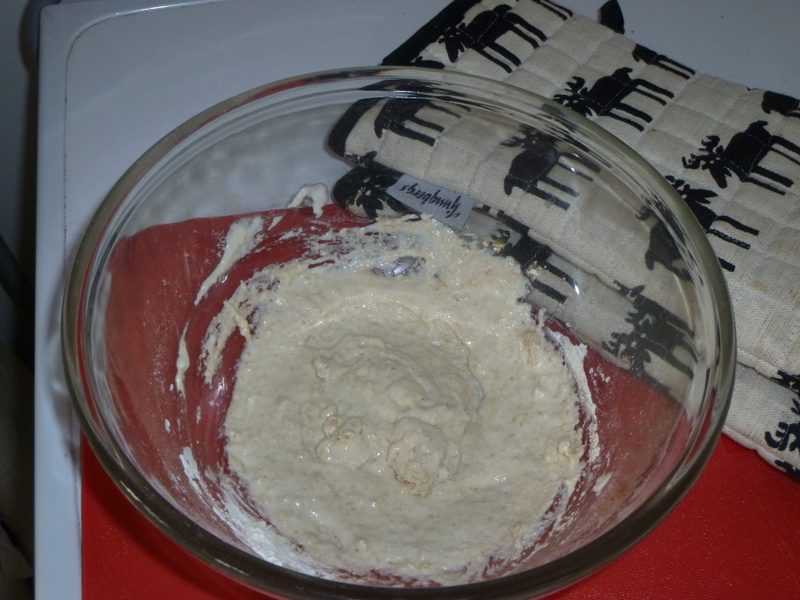
Firstly, make the bun starter. Mix together the flour, water & sugar so the sugar starts to dissolve. Sprinkle in the yeast. and mix well.

Bun dough starter

Starter at the very beginning

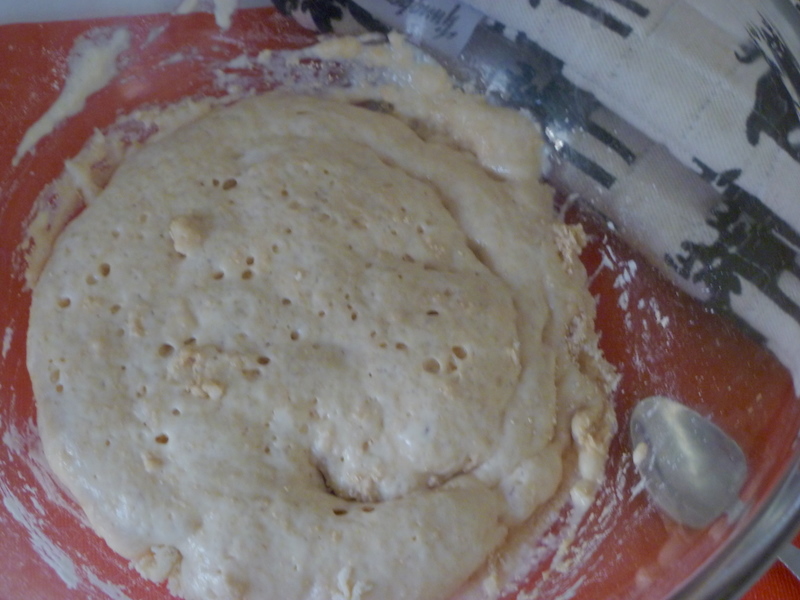
Set it aside for 30 minutes to allow the yeast to start to work.

Bun dough starter after 30 mins

The starter develops bubbles and will rise a little

Add the rest of the dough ingredients, except for the baking powder, and combine well, until it comes together into a dough.

Bun dough

Dough formed

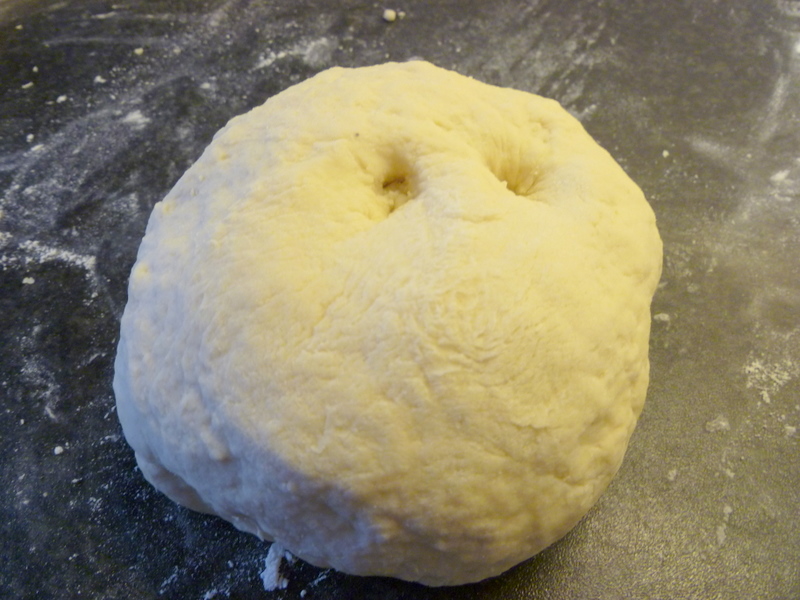
Turn the dough out onto a lightly floured surface and knead, by holding onto the end of the dough with the fingers of one hand, then pushing the top of the dough down and away from you with the other hand. Fold it in half, then make a quarter turn.  Keep repeating the kneading action until the dough becomes smooth and elastic. This should take about 10 minutes. If you over or under knead the dough, it will affect the bread, but it is easy to know when to stop kneading, this will be at the point when a finger jabbed into the dough stays there, and does not disappear.

dough, after first knead

Fingers sticking – good

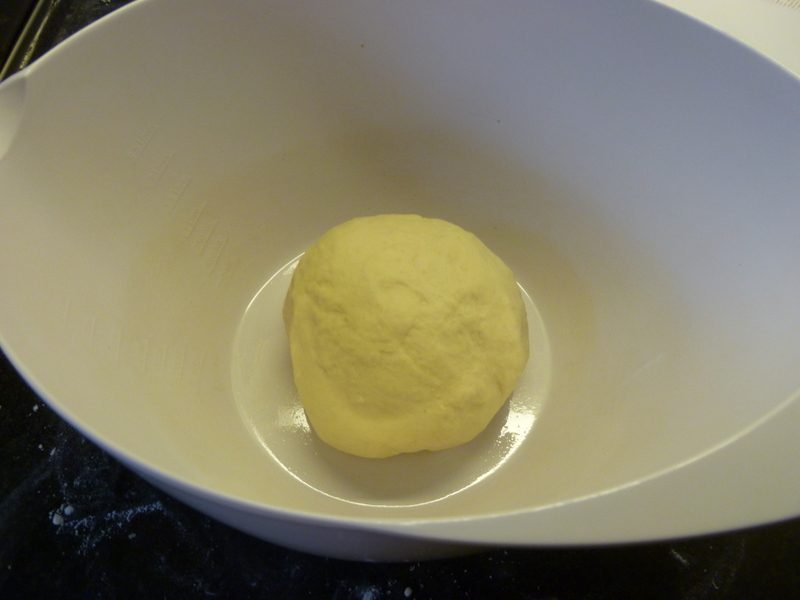
Then put it into a lightly oiled bowl (a large one). The oil should not be strongly flavoured, but you need it to stop the dough from sticking to the bowl.

Dough ball before rising

Dough balls!

Cover the bowl with a clean tea towel, and place it in a warm place. I use the top of my stairs, which is the warmest place in my flat, due to there being a door at the top of them. You can put it in your warmest room, or an airing cupboard if you have one. Don’t put the bowl directly on a radiator, and keep it out of draughts if you can. Leave it to prove for a few hours (maybe 2-3) until the dough has tripled in size

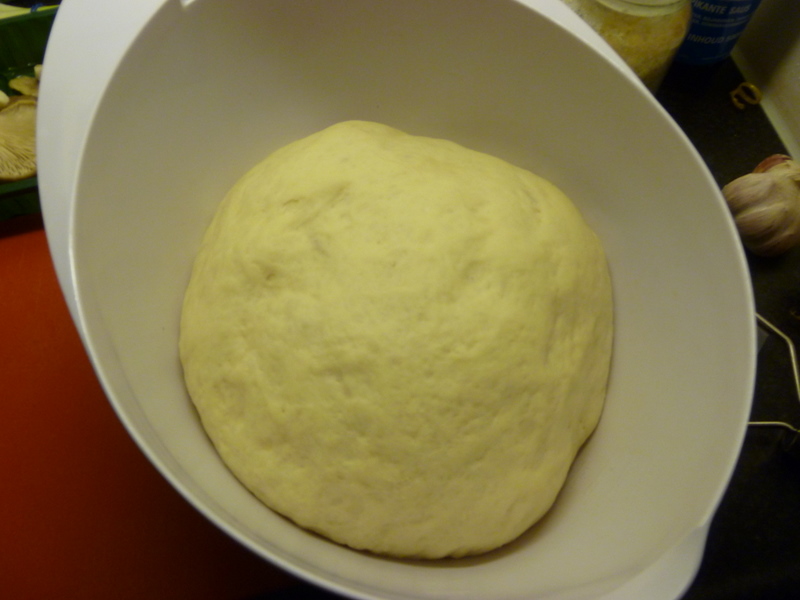
Dough after proving

Proved, you have large dough balls

While the dough is proving, make the fillings, then set them both aside to go cold.

For the chicken filling, gently sweat the onion and the garlic until translucent. Add the rest of the ingredients, and mix thoroughly. The mixture should not be very liquid, so if it is, slake a little bit of cornflour, and stir it in.

Cicken & Soy Filling

Soy Chicken Lickin’

For the mushroom filling, sweat the onion until translucent. Add the garlic and the ginger and cook until you can smell them.

You will have julienned the leek as part of the preparations. the julienne need to be small.

Julienned leek

Fine cuts

Add these and the mushrooms to the pan, and cook down until the leeks are silken. You will need to stir this so that the leeks don’t burn. The observant may notice that I have sliced my mushrooms instead of chopping them. Don’t do this, it makes the buns harder to stuff. Chopped will be better.

Add the rest of the ingredients and stir well. Again, you don’t want it too liquid, so cook it down if it is runny.

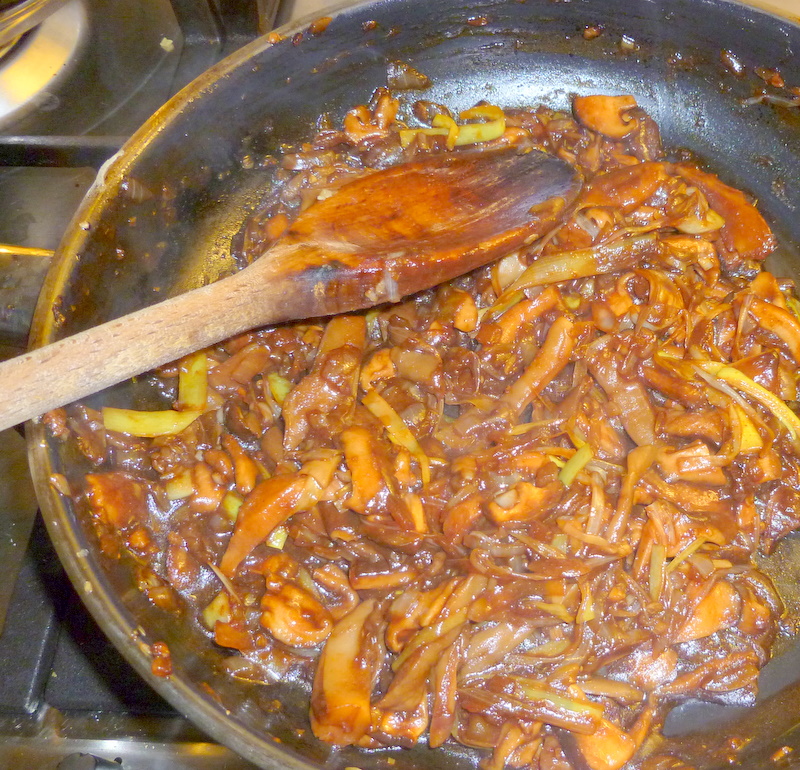
Mushroom Filling

Oyster mushroom filling – much tastier than it looks

When your dough has risen, knock it down (give it a punch until the air goes out of it), then spread it onto a lightly floured surface. Sprinkle evenly with the baking powder, then knead it again for about 5 minutes.

Divide the dough into 2, using a sharp knife. Put one half back into the oiled bowl, and cover it again. Roll the other half into a sausage, then divide it up into 8-12 pieces.

Divide the dough ino bun size

Bun Size Dough Balls

Put any dough that you are not working on back into your bowl and cover it over.

Shape each small dough piece into a round, then flatten with your hands

Flattening the dough

As flat as a Hom Bao

Place about a tablespoon of filling into the centre of the flattened disk.

Buns and filling

Filling

Then draw up the sides of the bun as follows:

Half & pinch

Fold in half over the filling & pinch the dough together

Stretch out sides

Stretch the sides out a bit

Be careful not to stretch the dough too thin,or tear it, because it will split when you cook it.

Pinch together

Pinch the sides together

Then bring the ‘gaps’ to the centre and pinch them all together to form a seal.

Sealed Hom Bao

Sealed Hom Bao

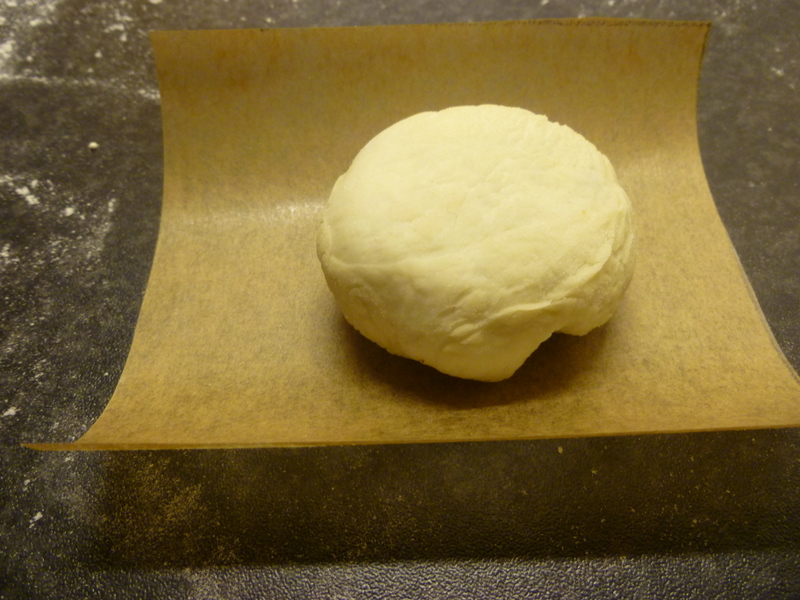
Place, sealed side down, on a 10 cm square of greaseproof paper.

The finished bun

The Finished Bun

Put the bun aside in a warm room, covered with a clean tea towel to prove for a bit more. You should find that you get better as you go along, my last buns were certainly a lot quicker than the first ones.

Repeat until you have finished the dough. You might have a little bit of filling left over, but that’s OK. I used my leftover mushroom mixture up in an omlette, and I intend to have the chicken with a jacket potato.

After about 30 minutes, the buns will have risen a bit more, and should look puffy.

Hom Boa after final proving

Buns – done!

You can then steam the buns over a little water, or brush them with egg wash and bake them in the centre of an oven at 180°C. Either way, they will take about 15-20 minutes, until they are fluffy and hot.

Hom Bao two ways

Hom Bao Two Ways – Golden and Steamed

I split the bao in the front, to show you the filling. Unfortunately, I didn’t capture the steam, but there was a lot.

You cannot freeze the baked bao, but the steamed version freezes beautifully, and they will last a long time. Freeze after steaming, by placing on it’s cooking paper into one of those plastic takeaway cartons. You can fit three or four in each, depending on the size of of your bao.

Steam from frozen, still on the paper. Stick a  knife in to make sure they are warm all the way through before serving.

Leave a comment

Filed under Feast

A Pho for Tết

Vietnamese Pho

Pho what a lovely soup!

Yesterday was the Lunar New Year, which is celebrated by the Chinese, Korean, Bhutanese and Vietnamese cultures. It marks the first new moon of the first  lunar month. There will have been celebrations wherever there are communities of these cultures. They are also traditionally times for family, so there is even more reason to celebrate.

What better way to kick start my own New Year’s Resolutions than to jump right in at Lunar New Year and have a go at some asian food? I have eaten a lot of Chinese and Vietnamese food, so I thought that this is where I shoud start on this quest. Never one to make things easy for myself, I decided to have a go at Hom Bao (steamed buns) from scratch, but that will feature in my next post.

Because the Hom Bao would take up a lot of time, I decided to go simple with the Vietnamese dish. Pho in one kind or another is a staple dish, and it seems that every Vietnamese household has a recipe. I can’t say how authentic this is, but this is my version.

I chose Pho because it has lovely clean flavours, but also because it is a versatile recipe that is easy to adapt to local ingredients. The fact that I was ready to go with some chicken stock may also have helped in the decision, but I can’t say for certain!

Feel free to adapt the recipe below. Obviously, I used a meat stock, which gives the soup a big umami hit.  I have made a version of this soup with different vegetables and with beef stock before. The essential ingredients are the noodles, the chilli, the coriander, the lime and the asian spices and seasonings, to be honest. Use what you have, use stuff from the garden, or from the bottom of the fridge. You will still end up with a really tasty and filling soup. The amounts given here will serve 2.

If you celebrated yesterday, Vietnamese style, chúc mừng năm mới!

Recipe: Vietnamese Pho

Ingredients

500 ml decent chicken stock. Rich, homemade stock if you can – it isn’t hard to do, and the results will be worth it. If you really, absolutely must, use the stock you can buy from the chiller cabinet, don’t try this with a stock cube.

1 cinnamon stick

2 star anise

5 cm root ginger, cut in half lengthways

1 red chilli, cut on a diagonal. Use whatever strength of chilli you can handle. If you really don’t like spicy food, don’t use a whole chilli, but you need at least a little.

Roots or stems of a small bunch of coriander

2 tbsp fish sauce (nước mắm)

3 tbsp Tamari Soy

Juice ½ lime

100g shitake mushrooms

50 g oyster mushrooms

2 servings rice noodles

20 g bean sprouts

½ red pepper (paprika)

2 carrots

A few mange touts

2 Spring onions

Some coriander leaves

Some mint leaves (if you can get vietnamese mint, so much the better), cut into a chiffonade.

Lime juice,  and pepper to season

Method

Add the cinnamon, star anise, ginger, chilli, fish sauce, soy and lime to the stock, and heat it gently. If you have coriander roots, scrape them clean, then press them with the flat of a knife to flatten them before adding to the soup. If you only have coriander stalks, cut them very finely, them add to the soup. Allow to simmer for 5-10 minutes, while you thinly slice the mushrooms. Add these to the soup and continue to simmer.

Meanwhile, julienne the carrot and the red pepper, so that the pieces are all of equal size. if you can get them really thin, you won’t need to cook them later. Halve the mange tout, and thinly slice the spring onion, both on the diagonal.

Cook the noodles according to the packet instructions, then drain and refresh under the cold tap. Divide the noodles between two deep bowls. Add some bean sprouts over the top of the noodles, and the spring onions and mange touts over that.

Remove the spices and ginger from the soup. If you have sliced up the vegetables into fine matchsticks, there is no need to cook them, so add them to the deep bowls. If you have not managed such small vegetables, then add them into the soup and cook for a minute or two.

Season to taste. The most important seasoning here will be the lime juice, which will balance the saltiness of the fish and tamari sauces. You may need a little or a lot, so it is important to tase before and during its addition.

Ladle the soup over the noodles. It is important that it is steaming hot, but not boiling. Sprinkle over the corander and mint, and serve immediately with chopsticks and a spoon.

2 Comments

Filed under Feast

Perusing the Prahran Market, Melbourne

Prahran Market Stalls

Plenty

I do love a good food market. On our recent trip to Australia, we found ourselves in the Prahran market in Melbourne. It is the oldest market in Australia, although, of course, other markets are available.

The stalls heave with fruits and vegetables. There are butchers and fishmongers, organic stalls and delis, cafés and street food. There are specialist stalls for wine, coffee, tea, chocolate, ice cream, pasta, asian products, you name it.

If it weren’t for the Big Guy’s relatively low capacity for putting up with my geekery (well, we did manage to stay here a good couple of hours, so perhaps that is a little harsh…), I could stay in a place like this all day, wandering around, sampling the produce, chatting to people, and planning meals from all the things I found.

Instead, we purchased some items for a good lunch, and some more of the lovely summer fruits that were in season. These included some small pears, the name of which I forgot to note down, but they were delicious. Really sweet, and not at all grainy, like larger pears can sometimes be.

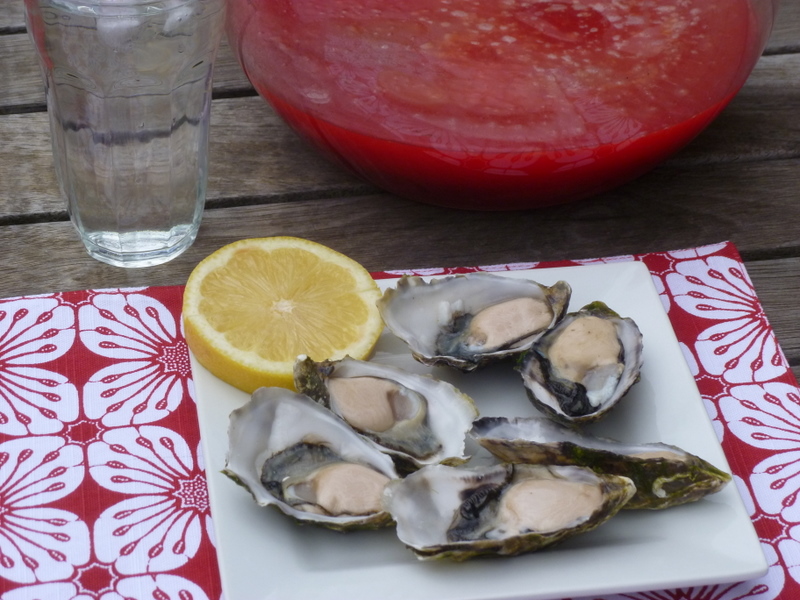
Pacific Oysters from Prahran Markets

A Well-Earned Breakfast

We also picked up a dozen Native Oysters. I first tried oysters about ten years ago, when I shared a dozen with a boy I was trying to impress (this was about a year before I met the Big Guy). My love of oysters has lasted far longer than that particular infatuation!

I enjoy oysters from all over the globe, especially when I happen to find some on a beach forage. But Native Oysters are really the best, as they are creamier and meatier than their North Sea counterpart. I prefer them raw as opposed to grilled with a topping, like in Oysters Rockerfeller, or Kilpatrick. I just feel that this is gilding the lily, and something this good does not really need embellishment further than a squeeze of lemon, or a splash of champagne, if you want to push the boat out!

I have already mentioned the importance of checking out your seafood before you buy it. Our oceans are a precious resource, and currently, they are being exploited horribly, with no real eye to the future of fish stocks, or the fishing industry itself. Damaging catch methods are putting species at risk, as well as destroying the habitat where they live and breed, and catching fish and sea mammals that were not the intended catch, meaning that they are thrown back, often dead or dying. It is so important to make sure that you are not adding to the problem and supporting these practices by eating unsustainably harvested fish.

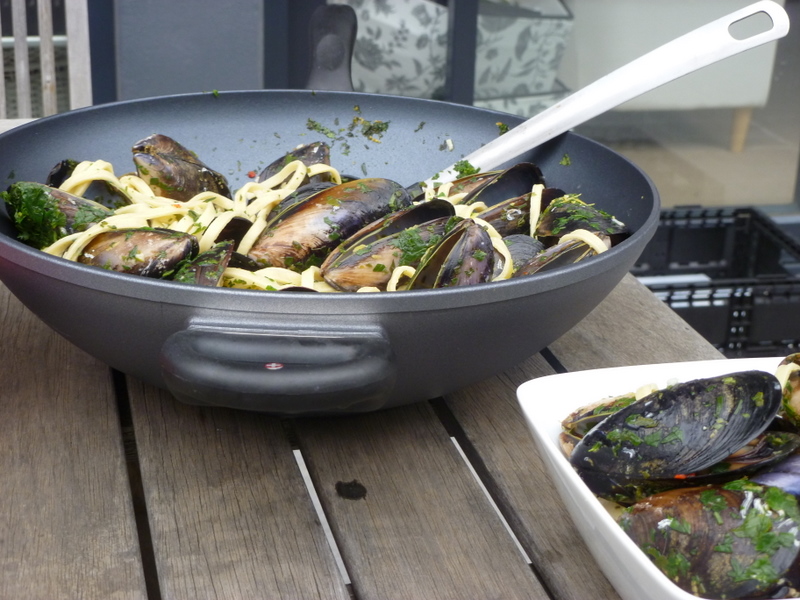
Luckily, like a lot of shellfish (but not all), the oysters are sustainably managed and harvested.  As are the Blue Mussels that we also picked up, along with the rest of the ingredients for this tasty little lunch:

Mussels with Pasta

Market Dinner

Recipe: Mussels Pasta

Ingredients

1 kg mussels

Glass of white wine

1 garlic clove, minced with a little salt

1 red chilli, deseeded and finely chopped

A little oil for frying

Juice and zest of one lemon

Bunch chervil, finely chopped

Bunch tarragon, leaves removed from stalks and finely chopped

Bunch parsley, finely chopped

2 serves linguine, fresh from the Pasta Shop, if you are in Melbourne

Method

Prepare the mussels. Remove the “beard”, which is the green fibrous stuff at the pointy end, it will come away if you tug it. Of course, with any shellfish, you need to be sure that you are getting them alive. If any of the shells are cracked, then discard them. I hate waste, but not even I will mess with this one, because dead mussels decay quickly, and you risk a nasty case of food poisoning. If any of the shells are open, give them a sharp tap on the counter. If they do not close,  then discard them. Give them all a good rinse, to eliminate any grit, but don’t leave them soaking in fresh water, because they may die.

Prepare the herbs, lemon, chilli and garlic. If you have dried pasta, you will need to get this going now, and cook according to packet instructions. Get it to the point where it has five minutes left to cook before you move onto the mussels.

We got fresh pasta from the Pasta Shop in the market, if you are using fresh pasta, just get the pot of salted water on a rolling boil. It is fine to cheat, and boil the water in a kettle beforehand.

Heat a little oil in a large pan, and fry the garlic and chilli in it for a couple of minutes, until the scent fills the air. Add the mussels, wine lemon juice, herbs and zest to the pan. Cover and allow to cook.

If you are using fresh pasta, then add it to the boiling water now.

When the pasta (either variety) is finished, drain, but keep some of the cooking water. Add the pasta to the mussels, which should mostly all be open by now. Give it a good stir around for a minute or two on the hob. If the mixture is dry, add some of the pasta water, although I would try to avoid this if possible. The liquor in the pan is aniseedy and soupy from the herbs, and you risk diluting its delicate flavour.

Have a quick check for any mussels that have not opened. There is  some debate as to whether these are safe to eat, but I really think that the risk is not worth it. I recommend that you discard any unopened mussels.

Serve in deep bowls, making sure that you get a good ladleful of the herby juice in each bowl.

2 Comments

Filed under Feast, Fed

Bill’s Tomato Pasta and So Much More

Bill Grangers Tomato Pasta, Tomato Dressing & a Green Salad

Back to Work Dinner

The thing about coming half way around the world is that the seasons are back to front. We are in full summer right now, with the lovely fruit and vegetables that go with it.

I made this recipe for a friend who had kindly put us up for our wonderful week in Sydney. It is one of her favourites, and so I decided to make it for her to help her ease back to work after Christmas. She likes the dish, because the ingredients are very basic, and simple, but as long as they are chosen (or grown) well, they really are more than the sum of their parts.

The tomatoes take a little preparation. Being the lazy type, I often don’t bother to do this. But, as they are the star in this dish,  it really is worth the effort.

It is a Bill Granger recipe, from his book Sydney Food, published by Murdoch Books. I have reproduced it here, simply because, in my usual no-waste style, there is so much that you can do with what most people would discard from this recipe, which I have given at the end of the pasta recipe.

This is a great summer dish, whether your summer comes in December or in June.

Recipe: Bill’s Tomato Pasta

Ingredients

1 kg vine tomatoes – or really ripe ones from your garden

1 tbsp sea salt

120 ml extra virgin olive oil

2 tbsp red wine vinegar

2 garlic cloves

1 lemon – juice and zest

1 small red chilli, finely chopped

Freshly ground black pepper

400 g spaghetti, 100 g per person

1 bunch basil, leaves removed from stalks

Shaved Parmesan to serve

Method

Firstly, wash the tomato and the vine. Do not discard the vine, as it imparts a lot of flavour, and you know I hate to waste anything!

Then plunge the tomatoes into boiling water for 10 seconds, and refresh in iced water or under a running tap. I prefer the iced water, because you can use it to water plants with, once the ice has melted, and the water is at room temperature. The skin should be splitting from the tomato, and should be quite easy to peel at this stage. If it isn’t plunge it back into the boiling water for a few seconds, and refresh again. As you will not be able to do all of the tomatoes at once, I keep a pan of water boiling on the stove for this recipe. Again, you can use the water afterwards for tea (so you haven’t wasted the energy it took to boil it either!), or put it in your water butt or pot plants.

The only part of the tomato that I haven’t found a use for is the skin,which is normally indigestible, so on its own I don’t really know what to do with it. The skins go in my wormery, so I get some use from them eventually. If anyone has any suggestions, please do leave them in the comments.

Once you have peeled your tomatoes, cut them in half, and remove the seeds and the watery pulp. Please don’t throw this away, as you will be throwing away a lot of useful flavour. Instead, collect it in a bowl, and we’ll come back to it later.

Roughly chop the flesh of the tomato. Then place it in a sieve, and sprinkle with the sea salt. Leave it over a bow for at least half an hour, to draw out more moisture. This will make your dish as flavourful as possible. Don’t discard the liquid run-off either, as this will be used up later, I promise.

Meanwhile, crush and finely chop the garlic. Mix this with the lemon zest and juice, vinegar, chopped chilli, pepper and olive oil. Put the tomatoes in this mixture once they have had a little while to steep in the salt. Mix this well, and then leave aside for 20 minutes to allow the flavours to meld.

Boil the spaghetti in plenty of salted water. Make sure it is still a little al dente. Drain, and then add it to the tomato mixture. Mix it up well, and adjust the seasoning, if necessary. Tear the basil leaves and add them to the pasta.

Serve the pasta with parmesan shavings, best kept large and made with a vegetable peeler. I also served mine with a simple green salad, dressed with a dressing made from the tomato consommé, from the bits that we kept aside earlier.

Mel’s Multitude of Methods with Tomato “Waste”.

As promised, now we get to the bits that you kept aside earlier.

You should have the vine or truss that the tomatoes came on, the juice and seeds from the tomatoes, and the liquid run off from the salted tomato flesh. Good. Firstly, break up the tomato vine into bits a couple of cm long. Then, mix all three tomato “waste” products, and pass them through a sieve. The vine will give this an intense tomato flavour. You can either allow this to drip through on its own for a clear liquid, or you can push this pulpy mixture through with the back of a spoon, whereby the liquid will be red. Congratulations, you have now made  tomato consommé!

Tomato Consommé

Treasure, not trash!

At this stage, fish the vines back out of the sieve, and compost them. Tip the seeds out, and dry them on some kitchen paper. When they are dry, pick off any remaining pulp (which will go mouldy) and then put them in an envelope (write tomato seeds on the envelope, so you know what they are). Next spring, put them in soil, and water it regularly, and you will likely get new tomatoes! If you use organic tomatoes, this is almost certain. Some supermarket tomatoes may not germinate, because they are F1 or hybrids, but you will have lost nothing by giving it a go. Especially if you have reused an old envelope, and written on it in pencil!

The consommé can be used for a million things. It will be intensely flavoured, and slightly acid, like the tomatoes from which it came. I made a dressing for the green salad I served with the pasta dish. I mixed 2 tbsp tomato consommé with salt, pepper, a splash of white balsamic vinegar, and then enough extra virgin olive oil to make a nice emulsion.

If you have enough, chilled consommé makes a delicious soup for a starter, just garnish it with some basil before serving.

The consommé freezes well, and can be added to soups, stews, and other tomato pasta sauces (for which you do not need to freeze it, but it will keep longer). We froze ours in an ice cube tray, and when they are frozen, we will put them into a plastic bag to save space.

Consomme to Freeze, and a Salad Dressing

Many Methods with Consommé

Tomato consommé can be added to cocktails , but it is probably too light for a bloody mary. If you make your own ketchup, add with the sugar to intensify the tomato taste. In fact, pretty much any sauce that has tomatoes in will benefit from its addition.

If you want to be really cheffy, freeze it in a block. Once frozen, scrape it with a fork. The resulting crystals can be used as “tomato snow” on very delicate dishes. This is so easy, but you pay a fortune for it in a restaurant. People will also think you are an aspiring Heston, without you having to go anywhere near liquid nitrogen!

The possibilities to use this flavourful liquid are endless. How will you use yours?

2 Comments

Filed under Feast

A Yuletide Legacy

Ham and Bean Soup

A Legacy of Leftovers

The best legacy of a Christmas dinner has to be the leftovers! Since my mantra is Taste not Waste, I am delighted when I can challenge myself to use up everything, so that nothing is thrown out.

The recent festivities yielded an obvious, yet exciting choice. I had a 2cm slice of the baked ham left, along with some cooked carrots from the christmas dinner. I also had a pot of gelatinous stock that came from the boiling bag that I had kept. I initially thought that it might be too salty to use, but you should never pour fat down the drain, so I tipped it into a container, and put it to one side. It turned out that there was actually very little fat in it, and the stock itself was rich, but definitely not too salty.

For the mince pie and mulled wine party, I had intended to make a couple of dips, so I had soaked some chickpeas and some cannellini beans, but as usual my ambition far exceeded the time I had given myself, and something had to give.I was considering just cooking the pulses up, and freezing them, they would have been fine to add to soups or stews from frozen.

However, beans and ham are an excellent combination. If I had more ham left, I would have made a version of a cassoulet, with the addition of some sausage and a tomato liquor to stew it all in. There are a hundred other types of dish I could have tried, but I settled on a soup, as it would make what little meat I had go the furthest.

The result that I achieved from such humble ingredients was brilliant. The soup was so flavoursome and satisfying, it made me quite proud. It really was the perfect way to end the Netherlands Christmas celebrations.

Recipe: Ham and Bean Soup

Ingredients

1 stick celery, finely chopped

1 onion, finely chopped

1 medium carrot, finely chopped

1 leek, trimmed, washed and sliced into half moons

1 clove garlic, very finely chopped

Bacon fat to sweat the vegetables in

80 g ham, diced, more would be great, if you have it

1 tsp smoked paprika

200 g soaked weight chickpeas

300 g soaked weight cannellini beans

350 g ham stock. I have given a weight here, because the stock was solid when I added it to the soup. I would normally say that you could substitute one stock for another one, but in this soup, especially if you don’t have that much meat, I think that ham stock is integral to the flavour

Boiling water to cover

50 g cooked carrots. If you don’t have any leftover carrots, then use more raw ones

Small bunch chopped parsley

Method

Firstly, if you need to, soak and cook the pulses. You could also use a single tin of cannellini beans if you must, but the dried version will bring an extra dimension to the soup.

Prepare the vegetables, and sweat them off. I never throw away fat (of course) and I had a little fat left over from frying bacon, which I used to sweat off the vegetables, in order to maximise the flavour. This is by no means necessary, you could just as well use olive or sunflower oil.

Once the fat has melted, sweat off the onion, celery and the raw carrots for three or four minutes, before adding the leek. Leek burns easily, and the last thing you want is the bitter taste of burnt leek in this soup. When the leek is translucent, add the garlic and the smoked paprika, and let them cook off for a minute or so.

Stir in the ham and the beans, until they have a light coating of the smoked paprika, then add the stock and a little boiling water. The stock will melt down quickly. Top up the soup with more boiling water, so that the liquid covers the rest of the ingredients.

Simmer for about 10-15 minutes, until the vegetables are tender to your liking. Add the cooked carrots, and simmer for another minute, to warm them through. Before serving, stir through some chopped parsley.

Great the day that you make it. Even better when you reheat the last bowlful for lunch the next day.

1 Comment

Filed under Feast

Aussie Christmas dinner

Moreton Bay Bugs & Thai Salad

Alternative Christmas Dinner

We are in Australia. Posting may be sporadic, but I do want to do my Christmas dinner, and custard based recipes. I may well leave the acceptable way with sprouts post, that I have not really written yet, to next Christmas now!

Anyway, this year we are having Christmas by ourselves in Cairns. An Aussie Christmas has to have seafood, and should also include a barbecue somewhere in the proceedings. We were very lucky indeed, and also had access to a pool and an entire rainforest to ourselves, since no one else was about. All in all, it was a pretty brilliant day.

We were lucky enough to get hold of some Moreton Bay Bugs, which are actually a kind of slipper lobster. Most Moreton Bay Bugs are caught as by-catch from the prawn and scallop fishing industries, both of which are trawled for. Trawling is a highly destructive practice, resulting in a lot of unintended species netted (bycatch) and destruction of the sea bed. The Australian Marine Conservation Society urges you to ‘Think Twice‘ before eating them, largely as a result of the catch method involved. We found a fish market that claimed that they were sustainably caught. It is possible to scuba dive for these, as it is for scallops, but these are very difficult to find.

Moreton Bay Bugs

Green Bugs

Anyway, if you do get them, you need green (uncooked) bugs if you want to barbecue them. They cannot live long out of water, and spoil much quicker than crabs or lobster, so this may not be easy. Never reheat them, so if all you can get is cooked, just eat them cold.

In North Queensland, fresh (and ripe!) tropical fruits are sold all over the place. They are cheap and plentiful. I had been thinking that mango, papaya, chili and lime would be perfect partners for the sweetness of the bugs, which naturally leads you to Thai flavours. They typically use green papaya, and I only had ripe, but I made do with what I had.

I hope that I am not one for boasting, but the result was really good. I was very proud of our tasty little Christmas Dinner.

I have given the recipe below, but if you cannot find Moreton Bay Bugs, you could substitute with scallops, langoustines, or even lobster if you are feeling decadent! Just please check out how they are caught, and try to get sustainably caught and managed fish where you can – the ocean is an important source of food for us, and keeps a lot of communities going, but only if we look after it well. Something which is sadly not happening too much these days.Your local Marine Conservation Society can help  give you an idea of fish stocks and some sustainably managed areas (although their system is not perfect). If you don’t have this, then organisations like Greenpeace can tell you which species to avoid altogether.

If you can’t or won’t get any of these, just have the salad – it is really tasty on its own.

Recipe: Moreton Bay Bugs and Vietnamese Salad

Ingredients

Moreton Bay Bugs – 3 per person

For the salad dressing:

1 small hot chilli (eg bird’s eye)

2 cloves garlic

4 tbsp lime juice

4 tbsp fish sauce (nam pla)

1 tbsp soft brown sugar

1 tbsp coriander stalks

1 tbsp mint leaves

For the salad:

Mixed salad leaves

Asparagus

Cucumber

Beansprouts

Coriander leaves

Mint leaves

Papaya

Chopped, unsalted peanuts

For the noodles:

1 pack noodles

1 spring onion

chopped chilli

lime vinaigrette

Method

Make the salad dressing. Mix the lime, fish sauce and the sugar, until the sugar has dissolved. Mince the garlic using your knife, deseed the chilli (or leave them in if you like things really hot) and chop it finely. Chop the coriander stalks and mint leaves as finely as you can. Add all of these to the lime mix, and taste for balance, you may need to add a touch more lime or chilli, to your taste. Set aside for the flavours to develop.

A short period of time in the freezer should be enough to kill the bugs humanely. Slice the bugs in half, lengthways, with a sharp knife. You will then need to clean the digestive tract and the head.

Make the salad, by mixing up the salad leaves, a good bunch of coriander, a handful of mint leaves, and julienned cucumber and papaya. Wash the beansprouts well, before adding them, and blanch the asparagus, and cut the stalks into 3-4 pieces, on the angle. I would also have added grated carrot, but we managed to lose the carrots somewhere between the shop and home, so no carrots for us.  Mix together well, and set aside.

Oil the flesh of the bugs, with a squeeze of lime, and place on a hot barbecue, flesh side down for about 8 minutes. Then flip them to colour the shells. They are done when the flesh becomes opaque.

Meanwhile, make the noodles according to the manufacturer’s instructions. Thinly slice the spring onion and the chilli and add to the vinaigrette. I had a very simple lime vinaigrette left over from the previous day’s lunch, but you can make up your own with 1 part lime juice to 3 parts olive oil. Leave the chilli and the onion to macerate to take the raw edge off them. When the noodles are cooked, drain, and pour over the vinaigrette, and mix well, so that the noodles don’t stick.

When everything is cooked, dress the salad with the dressing you made earlier, and toss together well. Plate up the noodles and the salad, and sprinkle with chopped, unsalted peanuts. Serve with the warm bugs, and a cold glass of wine. Next to a pool in the tropics, by preference.

4 Comments

Filed under Feast

Swedish Starters

Inlagd Sill

Swedish sill

So, the Sunday after the Mince Pie and Mulled Wine party saw me once again cooking for friends. This time, it was an international Christmas Dinner, at which we had guests from Australia, Germany, the Netherlands, the UK and the USA. However, the dinner itself was an amalgam of British and Swedish traditions, so I guess we had the best of both.

Traditionally, Swedes are pescatarian in nature, particularly when it comes to starters. I am sure that you have heard of the notorious Surströmming, which is the fermented variety, reputedly so smelly that you have to eat it outside. I have never had the pleasure, myself, so I am unable to report what it is like.

They also love all manner of fish eggs from actual caviar, through Löjrom (from the Vendace, or Cisco), to the particularly nasty Kalles Kaviar, which is about as far from caviar as you can get, and is available in an Ikea near you, you lucky people. Can you tell that I am not a fan of fish eggs?

Much more acceptable is their unfermented ways with herring, or sill as it is known. A really traditional starter, especially at Christmas is inlagd sill. You can also get this in various form from Ikea, but it is much, much nicer to make your own. It is basically herring that has been stored in a sweet pickling solution. I made the traditional version, but you can also make it with dill or mustard within the solution, and the Swede in your life would still be happy.

As with most fish dishes, they like to serve this with sour cream and finely chopped red onion. You can choose if you would like to have this with waxy potatoes, cooked with dill in the same way that Brits add mint to the boiling water; or with wholemeal toast or knäckebröd (a hard bread like Ryvita). We used up the last of the pink fir apple potatoes from our garden.

Recipe: Soused Herring

Ingredients

8 herring fillets (I had to cheat and buy Maatjes Herring, because there was no raw herring to be had when I needed it, I gave the fillets a good rinse, and we were good to go)

100 ml ättiksprit (strong pickling vinegar) or cider vinegar

160 g sugar

2 red onions

4 carrots

2 bay leaves

15 peppercorns

Method

Cut one onion in half, and slice thinly. Slice up 2 of the carrots as well.

In a non-reactive saucepan (e.g. ceramic, stainless steel, preserving pan), put the sugar, chopped onion and carrots, bay, peppercorns and the vinegar. Bring to the boil, then set aside to allow it to cool completely.

When it is completely cold, strain it off, reserving the vinegar to use on the herring. Don’t throw away the vegetables, they are really tasty. One of our guests doesn’t eat fish, so we gave him some of these on top of a toasted goat cheese. I have to admit that I scarfed up all the carrots from the sieve, as they were so good. The rest I had as a pickle with the bubble and squeak I made with the Christmas Dinner leftovers.

Chop each herring fillet into 3-4 pieces, depending on the size. Chop the remaining onion and carrots as before. In a sterilised jar, layer the fish pieces, the onion and the carrot, then pour over the vinegar. Seal the jar, and leave for 24 hours or the flavour to develop.

This method of pickling will keep the herring for about 3 weeks. Please keep it in the fridge once opened.

5 Comments

Filed under Feast