Vegan Sweet Shortcrust Pastry

A lot of people (including me before I really thought about it) think that it is difficult to cook for vegans. However, with a little forethought, and some minor adjustments, it isn’t actually that difficult.

If you make it yourself, pastry is one of the easiest recipes to adapt to a vegan diet. When I was younger, and the world hadn’t woken up to the horrors of transfat, my mother used a special kind of margarine that as a solid at room temperature, and as a vivid yellow colour.I have no idea what was in it, and I am probably a bit afraid to find out!  Nowadays you can get a number of olive and vegetable oil-based ones. These are not so yellow either.

The following recipe is enough to give you the base for a large tart, or several smaller ones. I got 24 mince pies using this recipe.

Recipe: Vegan Sweet Shortcrust Pastry

Ingredients

250 g plain flour

125 g block margarine (not the stuff that you spread on your bread – it needs to be more solid)

50 g icing sugar

Zest of a lemon

Method

First, measure the flour and sugar into a mixing bowl, and zest the lemon into a separate container. Take the margarine out of the fridge, and try to work with it as cold as you can. Cut the margarine into cubes and add to the flour. Try to hold as little of it in your hand as possible, to avoid melting.  Rub the flour, sugar and margarine to a fine breadcrumb, by rubbing your hands through the flour and margarine with your thumb over your upturned fingers. When you are done it should look like this:

flour dough as breadcrumbs - before you ad liquid.

The breadcrumb effect

At this point, mix in the lemon zest.

Then get some cold water in a jug – run the tap a little first to make sure that it is as cold as you can. Pour a little at a time into the flour and margarine mix and stir with your hands until it comes together to form a nice dough. At this point cover tightly with either cling film, greaseproof paper or foil. I never use cling film, so I just wrap my dough with whichever of the other two I have to hand. refrigerate for at least half an hour to allow the pastry to relax. If you don’t do this, the pastry will be difficult to work with, and may be too sticky or too short (crumbly).

Roll the pastry out thinly on a well floured surface. To get it even, turn it 90 degrees after each roll, and this should give you an almost circular piece of dough to work with. If you do not need all the dough at once, cut it in half, and put the bit you are not working with back in the fridge,after you have wrapped it up again, until you need it

Use in any recipes that require pastry, but that would be otherwise suitable for vegans. Instead of greasing the tin you are going to bake it in with butter, just use a liberal coating of olive oil.

Wherever you would use an egg/milk wash – i.e. any part of the finished product where the dough will be on display, such as pie crusts; or where you may need to add a liquid filling after a prebake, such as tart bases, then simply brush with water.

The resulting dough is quite short, but a bit denser in texture than all butter dough, and it is paler. My take on it is though, if you have one vegan guest, the other can eat vegetables, whereas your vegan friend cannot eat their food. This dough certainly passes muster for people who are used to eating animal products, so no need to cook special food for one or two.

UPDATE: I have now tested this same pastry with ground almonds, and it makes the pastry richer, and has a lot of flavour. For the amounts given in this recipe, add an additional 75 g ground almonds with the flour, and work with the butter, as above.

5 Comments

Filed under Feast

Sing A Song of Six Quince

Quinces

A bit like large, hairy pears

The quince is an odd fruit. Part of the rose family, with a hard, fuzzy fruit that is easy to overlook if you don’t know what it is. It is often possible to forage the quince, as they do occur in the odd hedgerow, and a few lucky people grow them, or know someone else that does.

This is another of those things that I really hope to find out and about. The flowers are really beautiful, so they are often planted in municipal areas. I have heard rumour of one in a local park, although I have not found it myself. You also have to be pretty quick if you are to get there before the parakeets that live wild here.

However, I have found them on my local market. A basket full caught my eye, and I felt a rush of excitement, as I hurried closer to see whether or not I was in luck, or if they were just large conference pears. Luckily for me, my first glance was right, and I went home happily clutching a bag full of kweepeers, as they are called here.

I have cooked with them before, having baked them in a similar way to apples, but I have always wanted to try my hand at making membrillo. I first had some on a holiday to Barcelona, where it is served with sharp manchego cheese, and its sweetness and texture really are the perfect foil for this cheese. I have also used it with pâté on crackers, where it finds another worthy partnership.

I looked around for a good recipe, and Nigel Slater had a good one on the BBC site. When I read this, my first thought was that I could maximise the quince output by making jelly too. This appeals to the tight-fisted food waste geek in me – I really hate throwing stuff away, so any recipe where I can save scraps or cooking liquor to make something else out of is off to a good start already!

The quince might be an odd-looking fruit, but its perfume  is quite something. As I peeled and cored them, as per the instructions, my kitchen was filled with a gorgeous smell, very similar to ripe raspberries. As they cook, you get hints of their rosaceous origins as well.

One thing that cooked quince is famed for is its beautiful deep red colour, so imagine the panic I had when I cooked the fruit when they were still a pale off white colour, and the cooking liquor was pretty beige.

Part cooked quince

Taste the rainbow?

A while ago, I had promised a friend a session in nostalgia and jam making, so she headed round after work, and we got down to make the jelly. The first lot I made was with the cooking liquor that was drained from the fruit. Since the membrillo recipe says to peel and core the quinces, and this contains a good deal of pectin, this is also perfect for jelly. I boiled these up in some more water, and re-used the vanilla pod in it too. The strained liquor made yet more jelly.

Making jelly is really a question of proportion. For every 600 ml of liquid, you need 400 g of sugar. You can play around with this proportion a little, and I have reduced the amount of sugar for some fruits. However, the quince is a relatively unknown quantity for me, so I stuck with the tried and tested ratio.

We boiled it up to a nice rolling boil, and let it cook off for 10 minutes. These days I have taken the guess-work out of jam making by investing in a sugar thermometer. When the thermometer reaches 104.5°C, you know that you are done. I still like to check, since the first time I used a thermometer, the jelly I was making turned out a bit runny, because I had taken it off the heat the second it reached temperature. Also, it was good to show my friend the low tech way of seeing if your jam has reached setting point.

The Fridge Test is the old-fashioned way to ensure the setting point is reached. You put a plate in the fridge to cool. Drop a little jam on the plate and leave for a minute. If the jam wrinkles when you run your finger through it, then it has reached setting point. If it doesn’t wrinkle, stick the plate back in the fridge, leave the jam to cook, and try again in a few minutes.

When you have reached the setting point, take the jam off the heat and pour into hot, sterilised jars. Fill  them almost to the top, cover with waxed paper discs (wax side down) and seal with a hot, sterilised airtight lid.

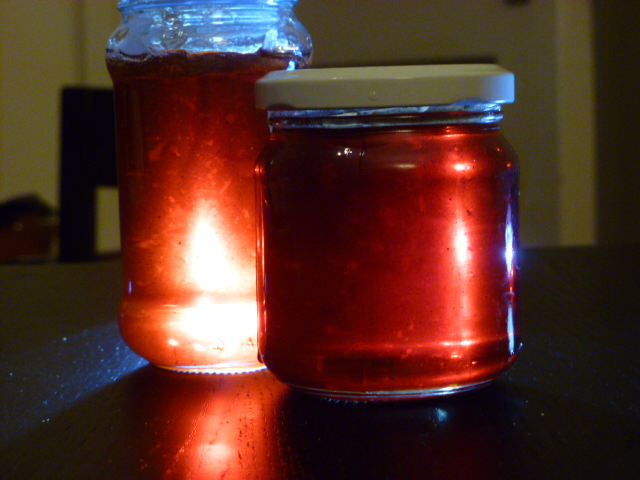
As you can see from the picture, my worry that the final product would be beige was unfounded. They don’t tell you this in the recipes, but the quince does not take on its customary red until quite near the end of  the cooking process.

Quince Jelly

Not beige

Today I made the membrillo, as per the recipe. This too takes its time to reach the right colour, but when it does, it is a really thick paste, and has a grainy texture. I poured it into a roasting tin, but you could also use a swiss roll tin if you like it thinner.

I baked it in a low oven, but I should note that it still wasn’t entirely set, so I put it back in on low for a while.

Membrillo

The membrillo paste before it went in the oven

I cut this into two. The one half I have wrapped in greaseproof paper, and foil, and I will keep it somewhere cool and dark until it is required. The other half, I shall cut into squares, sprinkle in caster sugar and serve as a sweet at my upcoming party.

Leave a comment

Filed under Feast

Pumpkin, Bacon and Swiss Chard Soup

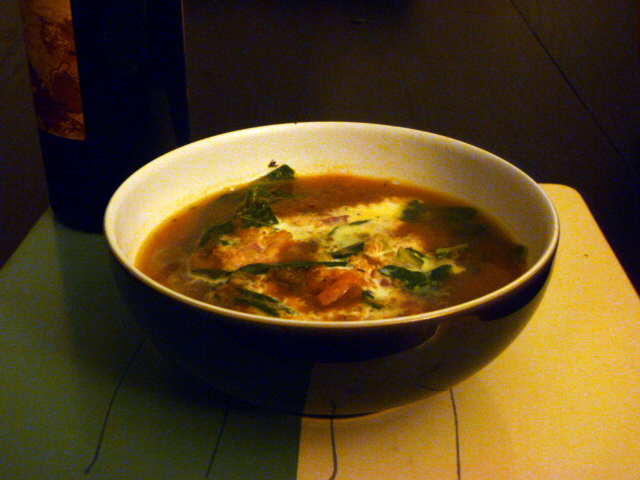
Bacon Pumkin & Swiss Chard Soup

A soup for this season – warm and velvety

It is that time of year when my cooking is populated with soups. They are great for using up slightly too tough or slightly too old vegetables. And in the Netherlands, it is practically compulsory to have soup and a sandwich for lunch, whatever the weather outside. I am likely to be making quite a few more before the winter is out.

This year, I lost my young pumpkin plants to something, most likely slug-shaped. However, the chard has been going strong for a while now. As I would ordinarily be feasting on my own pumpkins, I have decided that it is not really cheating to add this to the ‘Farmed’ category.

I like my soups quite chunky, and my greens slightly underdone – having been subjected to many an overboiled brassica in my youth. You may prefer to pre cook or even use frozen greens in this soup, and chop or blend them a bit finer. This soup keeps very well in the fridge, and should also freeze well, although I have not tried it.

This soup is easily adaptable for vegetarians, just omit the bacon, and fry the onion in olive oil. I would suggest that you add slightly more smoked paprika at the end instead of the bacon.

Recipe: Pumkin, Bacon & Swiss Chard Soup

Ingredients

450 g pumpkin

A pinch dried chilli flakes

2-3 cloves garlic

2 tsp lemon thyme leaves, plus stalks

1 medium onion, finely chopped

500 ml stock (veg or chicken)

200 g Swiss chard (spinach would also work well, or maybe a savoy cabbage – it needs to be an iron-rich green vegetable)

200 g bacon, diced

80 ml white wine (optional)

Nutmeg and smoked paprika to taste

Method

Heat the oven to 180°C. Cut the pumpkin in half or quarters, depending on the size and type of your pumpkin. Essentially, it has to fit in a roasting tin. You should leave the skin on. Sprinkle with a little oil (any type except your best olive oil) and season with salt, pepper, and the dried chilli. Rub the thyme sprigs over the pumpkin, and tuck the stalks into the dish as well. It may seem like a pain, but it will save you having to remove the stalks from the soup later. Put the garlic cloves inside or between the pumpkin. No need to remove the papery cover, this will come off much easier when the garlic has been roasted.

Roast the pumpkin in the oven, until the flesh is dry, and it comes away from the skin easily. The time this takes will depend on which type of pumpkin that you use.

Roasting the pumpkin concentrates the flavour a bit. If you don’t have an oven, like many people who I know, you can still use the pumpkin without roasting. just add the thyme to the pot when you sweat the onion, and the pumpkin and the chilli flakes when you add the (now chopped, not roasted) garlic. You will also need to let the pumpkin simmer for longer, until it is tender. Obviously, peel the pumpkin before you add it. No one likes a soup full of skin.

While the pumpkin is cooking, prepare the other vegetables and the bacon. I like the stalks of the chard, but they take much longer to cook than the leaves, so I cut the stalks out, and kept them separate to the leaves. You may decide not to use them, or use spinach. Up to you. Whatever you use needs to be chopped up. How fine you want it is also up to you. I sliced the stalks thinly and the leaves a bit thicker.

Fry the bacon in a deep saucepan. I don’t bother using oil, as the bacon will render its own fat pretty quickly – just keep it moving so that it doesn’t burn.With a slotted spoon, drain the bacon onto kitchen paper, but be sure to retain the fat.

Sweat the onion in some of the bacon fat (you may not need it all). If you are making this a veggie soup, sweat the onion in a little oil. Either way, don’t let it colour.

Add the garlic from the roasting pan, which should slip easily from their skins now. No need to chop them. Add the wine at this point, if you are using it. A glug is fine. Let it cook off and absorb into the onions.

Add the smoked paprika. I usually use about a teaspoon, but this will depend on your taste, and whether or not you are using bacon. Let it cook off briefly while you remove the skin from the pumpkin. This should come off easily with a spoon. Break it into rough lumps, and add to the pan with the onion. Allow it to cook briefly, and take on a paprika coating.

Add the stock, and bring to the boil. Cover and simmer for 5 minutes.

I blended the soup at this stage, but if you prefer a less chunky soup, then you could also blend it after you have added the chard. After the soup was well blended, and smooth, I brought it back to a simmer, and grated in some nutmeg, until it tasted like there was enough in there.

Then I added the stalks of the chard, covered and let it simmer for about 5 minutes before I added the leaves, and allowed them to wilt. If you use spinach, or just the leaves of chard, then this bit will be shorter. If you are using savoy cabbage, I suggest parboiling it a little first before you add it to the soup.

Add the bacon back to the soup, and adjust seasoning to taste.

I served this with a swirl of double cream. You can leave this out if you like, because it is a smooth and unctuous soup without it.

Leave a comment

Filed under Farmed

Smoky Winter Root Soup

Smoky Winter Root Soup

A Winter’s Tale

I have been making this soup for years – since I was a student. I have made it so often that I stopped even thinking about needing a recipe for it, and now it is just easy and instinctive. I still make it a lot, because it is the Big Guy’s favourite now too.

I thought that originally it was a New Covent Garden Food Company recipe, but I have double checked both the books of theirs that I have, and it is not there. If this was your soup recipe initially, I am sorry that I am unable to credit you properly, but it is a much-loved and much-cooked dish.

As with all my soups, the amounts vary a lot, although I do tend to stick to only the ingredients listed for this particular one. I wrote the following out for a friend, after we had it on our weekend in the countryside. These amounts here should serve 4 people, or you can keep it in the fridge. It is even better warmed up the next day. It is a hearty and filling meal.

Recipe: Smoky Winter Root Soup

Ingredients

200g bacon, cubed. I can buy little lardons over here very easily. If you are using actual bacon, it is better to get streaky/ back bacon for this. Smoked bacon also works really well

1 onion, finely chopped

3 medium carrots, diced

500g potatoes, diced

1 green chilli, deseeded & finely chopped

1 can/jar sweetcorn

Splash of milk/ soy milk

Method

First prepare the vegetables. You want the onion pieces quite small and the chilli pieces as fine as you can get them. The carrot and the onion pieces should be about 2cm square.

Fry the bacon in a large saucepan over a low heat, so that the fat renders but does not burn. When the bacon is cooked, and slightly crisp, remove from the pan with a slotted spoon, so that you keep the fat. Drain on kitchen paper, and set aside. The amount of fat from bacon will depend on the type and quality of bacon used. You want to fry off the vegetables in the fat, so pour off any excess, but keep enough to coat the vegetables.

Add all of the chopped vegetables, except the chilli to the pan, and fry until the onion has turned translucent. You will need to stir the pan occasionally. Meanwhile boil a kettle with about a litre of water. Once the onion has softened, but the vegetables have not coloured, add the chilli, and cook for a minute or so.

Add the boiling water to just cover the vegetables, bring back to the boil, then turn the heat down to a simmer and cook until the potatoes are tender. The amount of time this will take depends on the variety of potato used, and how big your dice are. For me, it usually takes about 10 minutes, because I chop the veg fairly small. Test with a knife, until you are happy. I don’t really mind if the carrots retain some crunch, so I only ever test the potato.

Once the vegetables are cooked, drain the tin of sweetcorn, and add the kernels to the soup, along with the cooked bacon. Season with pepper. You will not need to add salt, as the soup will get plenty of salt from the bacon, and the cheese. Allow to heat through for a few minutes. Add a little milk, and warm through.

You can make it with varying amounts of the ingredients, just make sure that the amount of carrots balances well with the white vegetables, so that it still has some colour.

Serve with crusty bread, and sprinkled with some grated, sharp cheese, such  as Mature Cheddar or Piquant Boerenkaas

The soup keeps well in the fridge for up to 5 days. It will freeze, but if you want to freeze it, then don’t add the milk before you do so, rather, warm the soup through, then add the milk before serving.

I will add a photo of this soon, as we have it frequently, I just have not got one at the time of writing this post!

1 Comment

Filed under Feast

Treasure Chestnuts

Sweet Chestnut jam

The sweetest of chestnuts

I really love sweet chestnuts. Seasonal, run-up-to-christmas, eat-with-game, things-that-help-make-sprouts-bearable, isn’t-it-brilliant-when-you-find-a-tree-of-them-in-a-park-(though-really-infrequent-in-a-country-with-few-hedgerows), lovely chestnuts. I like to find them in the wild for all to take advantage of, I like to cook with them, I like to thicken soups with them, I have never eaten them in marron glacé form, but I expect they are also lovely.

I haven’t found any in any great quantity while foraging over here. You might be much luckier than I am, or just get them at your local market. I bought some very cheap ones, but the reason why they were so cheap was that they were a little past their best, and a number contained insect larvae (probably moths), which is the same as if I had foraged them anyway! I had to go and get some slightly less cheap ones from my local greengrocer’s. Still, it was nice to watch the jays pick through the discarded ones this morning, as I made the jam.

Serve peeled chestnuts at a party, and people think that you have gone to a lot of trouble for them. And the fact is, they would be  right too. I always go into it thinking that it will be a quick job, and always forget how fiddly the damn things are.

Today, I spent a good few hours peeling chestnuts. I suspect this is because I am a little bit too anally retentive about removing the skin from all the folds of the nut.  I also spent a considerable time online trying to find ways to speed up the process. I did come across this video from the people at badgerset.  I think this method has a lot of potential, but it will take practice to recognise how long is enough boiling time. For the record, I found that my chestnuts needed much longer in the boiling water to allow the skin to detach. I guess I need more practice. And possibly a decent pair of pliers. One brilliant thing about this method, is that you get to see the ones that have insect larvae in before you eat them.

After I had done all that peeling, I made Melissa’s Chestnut Jam, from the River Cottage Preserves book, by Pam Corbin. I have had my eye on this jam for a little while, not least because Pam recommends them to be eaten with meringue. I usually have a glut of egg whites around, due to my fondness for egg-based sauces and real custard (As a Brit who loves her puddings, vla does not really cut it for me). We are having are christmas minced pie and mulled wine party soon, so I will make the meringues for these, and I will serve them with this jam. I also gave a jar to my friend, for her recent birthday. She has been hankering for egg-free chocolate mousse for a little while, so I hope this jam will be a fitting accompaniment for the one that I made her.

A few things to note about this jam. Firstly, do not try to blend too many chestnuts at a time – they quickly clog up the food processor, and take quite a lot of mixing in to avoid lumps. I didn’t manage it. It would probably be easier to blend them all together at once, with a little cooking liquor,  in a bowl, using a stick blender. I am a little gadget-averse, and won’t buy one on the grounds that I have a food processor, so why have two things to do the same job? Seems my tight attitude has not paid off in this case. I also used to  whip meringues by hand, until one time I broke my collarbone, so had to ask the Big Guy to whip them for a party we had. The next day, he came home with an electric whisk, saying that it would have saved him a couple of hours of his life, that he will never see again.

The chestnuts and the cooking liquor form quite a thick paste. Being much more used to fruit jams, I was very worried that this would not be liquid enough to form a jam. I was wrong, when it is added to the sugar syrup, it quickly liquefies. Do not be tempted to add more than the recommended 100 ml of the cooking liquor to the chestnuts when blending them.

My top tip for this jam is not to cook it if you have children or animals in the vicinity. Pam mentions that it sputters, but not how much, and it is very, very sticky. I have spent ages trying to remove it from the splashback, random bits of kitchen work top and my utensils pot. I also recommend wearing a long-sleeved top when you cook this. Those little splashes hurt.

The jam also sets quite quickly off the heat, so probably keep it on the lowest simmer when you fill the jars, so that the rest remains liquid enough to pour into the rest of them.

It is very nice, and not too sweet, although I think I will up the amount of brandy in the next batch I try. So, try it with meringues, chocolate mousse, or even on toast with some chocolate spread, if you are feeling lazy.

1 Comment

Filed under Feast, Found

Mareike’s Mayan Egg-Free Mousse

Some people should not eat raw eggs. I am sure if you are one of those people, then you know who you are, but for the record,those people are usually young children, the elderly, pregnant women, and those with certain allergies and medical conditions.

Bet it doesn’t stop you craving a nice chocolate mousse from time to time though does it?

My friend falls into one of the above categories. She had mentioned that she would love some chocolate mousse, but didn’t want to risk the eggs. We discussed using cream instead. As it was her birthday recently, I decided that I would make her some, and also write up the recipe for her, along with some variations she could try.

This is what I wrote for her. It will serve about 5 people.

Recipe: Egg-Free Chocolate Mousse

Ingredients

160 g Green & Black’s Mayan Gold chocolate

400 ml whipping cream

Grated zest of 1 orange

Candied orange peel to garnish

Method

In a saucepan, heat about 100 ml of the cream to just under boiling point. When bubbles appear at the sides of the pan, the cream is warm enough. Try not to boil the cream.

Chop the chocolate into small pieces (or you could use chocolate chips). Pour the warmed cream over the chocolate, and stir until it melts and there are no lumps in it.

Whip the rest of the cream to stiff peaks. fold in the melted chocolate and stir through the orange zest. At this point, you can divide into individual glasses, or just add to one serving bowl. Chill in the fridge for at least 2 hours (or more if you need to make this in advance).

Before serving, garnish with the candied peel, or a couple of fresh twists of orange zest.

Variations

You can use different flavoured chocolate. I just used Mayan Gold here because I like it. Don’t use chocolate bars with nuts or other large lumps – these are better added later. I also know people who melt Mars Bars or Milky Ways (using the microwave and a splash of milk) instead of chocolate.

If you use the really high cocoa chocolate, your mousse may be bitter. You can balance this a little with some sugar (caster or icing) added into the cream for whipping.

You can spice the cream instead of using flavoured chocolate. Add the spices to the cream that you are going to heat up. Bring the cream to almost boiling point, set aside and allow to steep for 20 minutes, then bring it back up to boiling point again. Don’t forget to remove any whole spices before you pour the cream on the chocolate. Use whatever spices you like. Cinnamon, nutmeg, cardamom all go well, but play around a little.

You can use coffee (or some teas might also work, depending on the type of chocolate) instead of the warmed cream to melt the chocolate.

You can add alcohol or flavoured syrups (like you can get to flavour coffee). Add these to the whipping cream and not the chocolate, though. Otherwise you risk setting the chocolate, so you won’t be able to mix it into the cream.

Fold through orange zest, nuts, candied peel, or fruit at the end, before you chill it, if you like.

This chocolate mousse is very good with chestnut jam. I am sorry that it didn’t last long enough for some photos!

5 Comments

Filed under Feast

The Visitors

My garden has seen many visitors.

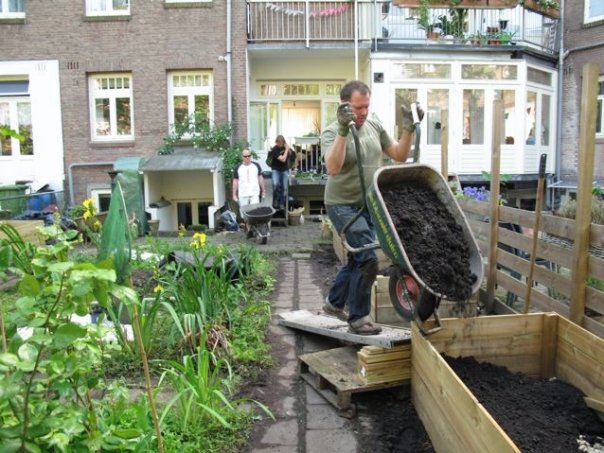
When we first moved here, all the neighbours told us that we couldn’t grow vegetables, because the area used to be industrial, and that there was heavy metal contamination. Our own investigations confirmed this. Plus, we are the lowest of the adjacent gardens, in a wet country, meaning the garden floods. Being stubborn, we decided this wouldn’t put us off, so we built some raised beds and invited some visitors, to come and help us with the large amount of soil we had ordered.

An awful lot of soil

(c) L. Vickers 2009

In towns and cities in the Netherlands, the houses are often built around courtyard gardens. Our visitors helped us to lug this soil through the house and out to the gardens, where they filled our twelve (large) raised beds

Filling the raised beds

(c) L. Vickers 2009

Without these visitors, we would not have been able to build the garden that we now grow from. The garden that (sometimes) looks like this

Our garden - mostly finished

(c) L. Vickers 2009

We have always been sociable people, and the garden has seen many visitors for many barbeques and parties. We have had visitors who have come to stay, for a weekend, and those who stayed a little longer. As far as I know, they have all had fun here.

Just over a year ago, we had an unexpected visitor who turned up in our garden.

Surprise!

I caught him, thinking some poor child would be distraught at having left the cage open, or that the local cats might get him. I put round flyers asking whose he was, since he had to belong to one of our neighbours, as there is no way out of the gardens here. The neighbour came to get him, but 3 days later he turned back up here again, and returning became a habit. Now he lives with us. We also got him a little friend. They seem to be happy here too.

Last weekend, we went away to the Dutch countryside. We had a great weekend in the fresh air, with friends. When we got home, we had another surprise visitor.

Mystery bear

Surprise II!


I have no idea where he came from, or how he got here. He seems to be quite happy in among the raised beds.

The point is that all of these visitors have been very welcome, and I have enjoyed having them here. I am also very grateful to those of them who helped us to lug all that soil, we owe them all a lot!

I have been writing this blog  for a while now, but have never yet dared to publish my writing. I have been too afraid to put myself out there, and to accept visitors if, indeed, there should be any.

I have had a lot of encouragement from a number of people. People that I consider good friends. Some of whom I know in person, some of whom I know only on the internet (Thanks especially to L, J, the Morning Claret and  Nip It In The Bud, who have all been particularly supportive). I have received some very kind words from you all, and I know that I have driven at least one of you mad with my worries and lack of public posts.  I would like to thank you all.

I am not really very good at being bad at stuff. I see food bloggers that I admire, and I think that my stuff is not as good as theirs. But why should it be? They have mostly all been doing it for years, and I have mostly just been thinking about it.

Recently, I also came across this blog post, that pretty much sums a lot of the things that I have been thinking/worrying about.

I have looked back over the blog, and really, I could continue to review and change things. I definitely need to stop taking those ‘plate from above’ shots that have populated the blog so far. Hopefully, tips like those on this page will help me stop that. I also need to get better at shopping for stuff like linens and pots that will help add interest, as well as learn some different camera angles. I am not entirely happy with the template/layout I am using, and will probably change it soon. But, honestly, I could continue to review and edit forever, and not be happy. I need to trust that I will get better, and so I am going to try.

So, thanks to all my lovely friends, and online inspirations, I have decided that now is the time to take the plunge. I am a hospitable person, and I love playing host to all kinds of visitors. It is always a nervous time, waiting for people to turn up. Even if they don’t, I have prepared food for more than I have invited, so no one will go hungry, or I will eat like a party queen for a week or so. I should add that it has never happened so far!

With this, even if no-one turns up, then at least I have a record of what I have attempted; how much better I have (hopefully) become at butchery, or brewing or whatever; and how much fun I had cooking  for all the visitors in my real life. Whatever happens, only time will tell.

So, I am going to spend a while going back over the old posts, and finally pressing publish. This may take me a little while, as there are quite a few of them, but if I don’t do it now, I never will.

In any case, I am proud to declare that Edible Things is open for visitors.

Leave a comment

Filed under Uncategorized

Minestrone Soup

Minestrone Soup

Minestrone with Pumpkin Gnocchi

Despite the changeable weather, it is most definitely autumn. There are no more leaves on the trees, and the clocks will go back this weekend. To me, this means using up beans. We have been eating our borlotti beans for a little while, and I had a few other veg that I had in the ground or in the fridge.

Soup is always a great way to use up veg, and minestrone soup has beans as  the key ingredient for this hearty vegetable soup. As long as you have good base flavours from onion, carrot and celery, there are a million other veggies that you can add.

I used an onion and a half (the half was leftover from something else, and it needed using up), 3 carrots, 2 sticks of celery and a leek, which I chopped finely and sweated off with a few sprigs of thyme, a bay leaf and a sprig of rosemary. I added a  couple of cloves of chopped garlic, and cooked them off a little before adding the stock.

I am a bit of stock obsessive, and always have portions of roughly 500 ml of various stocks in the freezer. At the moment, I have pheasant, and beef. I usually always have vegetable and chicken stock too, but not today. So, I used 500 ml of beef stock and added water to cover the veg.

As this came up to the boil, I shelled the beans – this time a mixture of borlotti and the last of the french beans, whose pods are getting leathery, but the beans inside are large enough to eat on their own. I chucked them in with a few chopped pomodori tomatoes (you can also use tinned). I left the soup to simmer until all the beans were cooked through. You can also use dried (and soaked), or tinned beans if you haven’t any from the garden.

About half way through cooking,  I had a taste, and added a little tomato puree, and seasoning.

I also had half a fennel to use up, which I chopped finely. I love fennel, but wanted to retain some crunch and the fennel flavour as separate from the overall soup, so I didn’t add it until about 5  minutes before the soup was cooked.

I would have added a bit of shredded cabbage, kale or cavolo nero at this point, but we managed to lose the sweetheart cabbage we had bought at the market, so we had to do without that tonight.

Another traditional ingredient in minestrone is pasta. I had some fresh tagliatelle, because the Big Guy often buys it on impulse. I also wanted to try something a little different, so I divided the soup at this point, and chucked in some chopped tagliatelle into one pot, cooked it for a couple of minutes and ate the first night. It is also possible to use smaller pasta shapes, like acini, or ditalini. However, I was using what I had. I think smaller pasta is better in soups, so if I only had dried, I would have cooked it and chopped it before adding at the last minute.You can use rice if that is what you have too – either cook it in the soup or chuck in some cooked rice about 5 mins before serving.

I was recently inspired by a recipe from Niamh Shields, of Eat Like  A Girl, fame to try Pumpkin Gnocchi. I have been following her blog for a few years now, and this really seems to be her year, with new columns, a book, and a truck-load of awards. I have to say I am really pleased for her, I have tried a lot of her recipes and they always turn out well, and she is a real enthusiast on the subject of all things food.

Anyway, back to the gnocchi. As I have pumpkins, and pasta is added to minestrone, I thought that I would combine the two, so I made up a batch of the gnocchi, using Niamh’s recipe. I brought the soup back up to a simmer, and then cooked the gnocchi in the soup. I served it with a good helping of chopped parsley.

I haven’t  given a formal recipe for this, as with most soups, the amount I make largely depends on the ingredients that I have to hand.  As this is an Italian recipe, I am sure that there are many different versions, and this will not be what any Italian mothers would have added, but that is the beauty of such a  versatile soup, where pretty much anything goes.

Leave a comment

Filed under Farmed

It’s Beginning to Look a Lot Like Christmas?

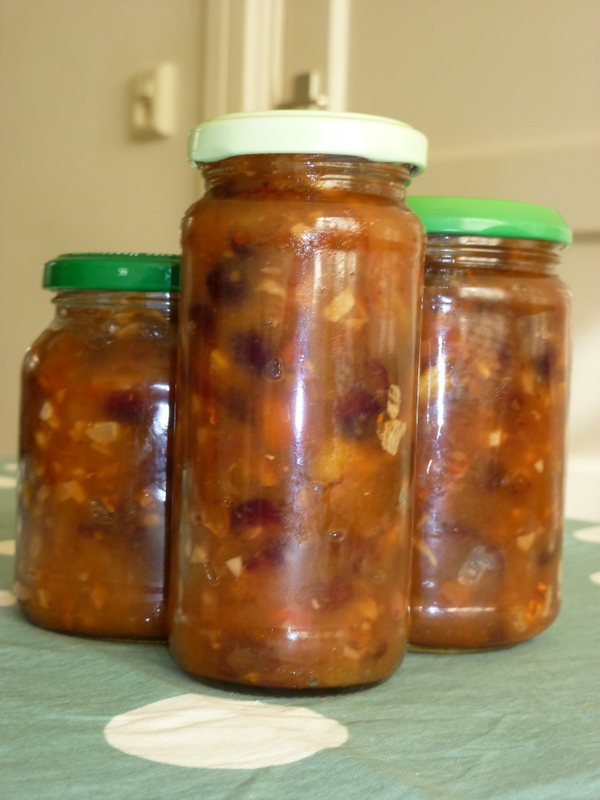
Pear and Ginger Mincemeat

Yup, looks like Christmas to me

Now, don’t get me wrong, I can’t stand the commercial run up to Christmas, which seems to start in about July in some places. I think that all the Christmas stuff should start in December, so that we don’t all get Christmas fatigue by the time schools start back. However, there are a few things that you need to get ready in advance, and homemade mincemeat is one of them, as it needs time to develop and for the flavours to meld.

At a small food fair last weekend, we picked up a bumper load of pears for next to nothing. I poached some, while they were still firm, but there were too many to eat like this, or to have as a fruit on their own. We also had cakes, compote and so on, but what I really wanted to make with them was the Pear and Ginger Mincemeat that I had seen in Pam Corbin’s Preserves book.

I have been making my own mincemeat for a few years now, if only to prove that I can. Here in the Netherlands, it becomes necessary if you don’t want to add it t o the list of Stuff Visitors Have To Bring You. Our list is long enough, with English mustard, Pimms, Salad Cream, veggie suet and so on. The Big Guy also asks for Brown Sauce, despite being Swedish. I think he has assimilated.

This mincemeat ticks a load of boxes for me, since I love pears, I really love ginger, and we regularly host a Mince Pie and Mulled Wine each Christmas, and you can’t have that without sweet mincemeat.

I made a couple of amendments to Pam’s recipe. I have not yet seen cooking apples in the Netherlands, so I only used eaters, but I took half of them and stewed them until they were quite liquid. I think it needs to have some more liquid contents, as this mincemeat does not use suet (which I always substitute with vegetable suet, so that any veggie or vegan friends can also have some), so the stewing will prevent you having dry mince pies.

Secondly, instead of all of the sultanas and raisins she suggests, I added half sultanas and half dried cranberries. There is something great about dried cranberries, and they are traditional Christmas fare, albeit not in the sweet courses!

I also made my own candied peel – much nicer than the tacky shop bought stuff.

I cannot recommend enough trying this version for yourself. Just look how great it looks, and the smell is something else. I could not resist trying a teaspoon, and trust me, this is the best mincemeat ever, even before the flavours have had time to meld and develop.

Sweet, Sweet Mincemeat

Smells amazing, looks pretty, tastes delicious - sweet, sweet mincemeat

1 Comment

Filed under Feast

Candied Camera

Homemade Candied Peel

Candied Peel – the nice kind

Loads of people object to candied peel. I think this is possibly because they have only had the sticky, cheap, pre-made stuff. After all, many of those people don’t object to zest in a lot of other recipes, so what makes it so different when it has a sugar coating?

To get around this, I make my own. It has the advantage of allowing you to put your favourite citrus fruits in, and to play around a little with the proportions. Any citrus will do, but the commercially available ones are more often mostly lemon, I think. A better balance of lemon and orange, or experimenting with grapefruit, blood oranges, or even the more unusual citrus fruit, such as pomelos should also help turn even the most ardent haters of this little treat.

I made some with orange and lemon, because I like it, and I had quite a few that I was going to use for something else.

Recipe: Candied Peel

Ingredients

Citrus fruits of your choice. Try to get unwaxed if possible.

200 g sugar per 3 fruit

Method

Thoroughly wash and scrub the fruits.

Slice the ends off each fruit, then cut off the peel in wide strips. I find it very easy to do this with a vegetable peeler, but a knife is also fine. This is one recipe where you want to retain the pith, which will help the peel stay juicy.

Put each kind of peel in a separate saucepan, and cover with cold water. Boil the peels until they are soft to the point of a knife. The time this takes for each will vary greatly, which is why it is important to do them in separate pans. This can take up to an hour or even more for some of the tougher peels, whereas something like a clementine will take less than 15 minutes. Do not let the peels dry out, so if you need to, top up with the water from a freshly boiled kettle. Drain all the peels as soon as they are soft.

Boiling Peel

Cooking Peel

Make a sugar syrup by dissolving  200 g sugar per 100 ml of water, and multiplying up accordingly. Bring it up to the boil, and carefully add the drained peels. It is important that it covers the peels, so add more syrup if you need to.

Let the peel simmer in the syrup over a low heat, stirring occasionally. When the peel has absorbed almost all of the syrup, then it is done. Towards the end, don’t take your eyes off this, because it can burn, and then tastes really bitter and unpleasant. Err on the side of a bit more syrup in the pan,rather than too little.

Grease a baking sheet or tray, and line it with greaseproof paper. Put the peel on the sheet to dry out. Be careful, they will have scaldingly hot sugar syrup on them. Leave them in a warm place to dry oven the next 3-4 days, and turn them over when you remember them.

They will store well in an airtight container. Cut them into smaller pieces when you need to use them in baking, or as decoration for desserts. You will find that the sugar coating will mostly fall off.

1 Comment

Filed under Feast