Happy Birthday, Big Guy!

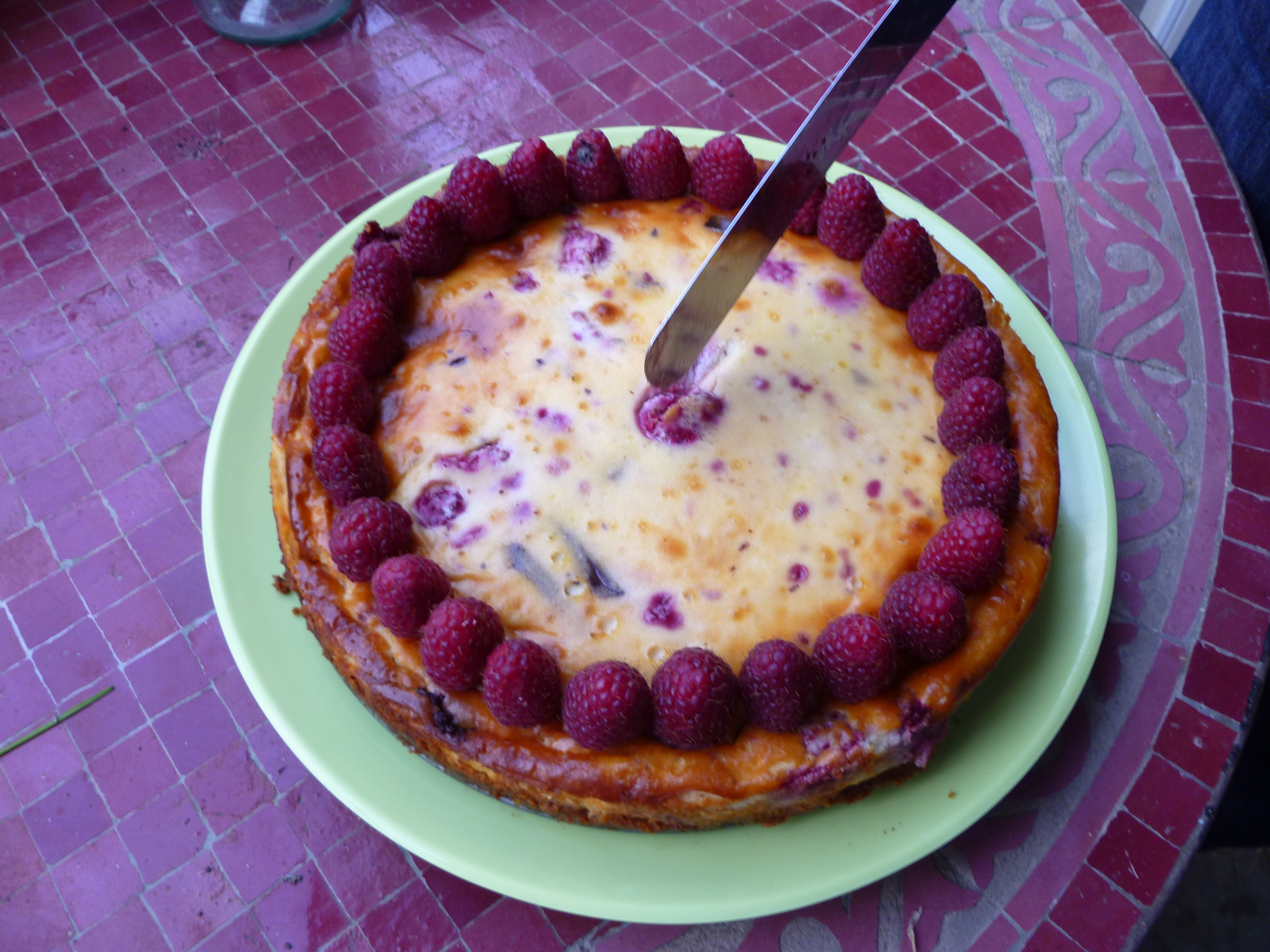
Raspberry and Chocolate Chesecake

Alternative birthday cake

Yesterday was the Big Guy’s birthday. In his native Sweden, it is customary for the rest of the family to get up early, and prepare a pancake cake. Some members of his family also insist on having spaghetti with tomato ketchup for breakfast as well.

Since I am not going to sin against the Flying Spaghetti Monster and neither of us are morning people, these are not a traditions that I intend to uphold. Although you should probably try the pancake cake I linked to on Ted’s blog, they really are very good.

However, he does get to choose whatever he wants for his dinner, and then we usually go for drinks with friends.

This year he asked for a lasagne and a cheesecake.

I am not about to blog a recipe for lasagne. I know from experience that everyone thinks that they make the best one, and this way trouble lies. There are a million different ways to cook it, and most of them were based on lasagnes they had in childhood.

However, the BG did get a baked cheesecake, which is something that I do infrequently, I prefer the ease of the non-baked version, but I have recently stumbled on a formula that seems to work quite well, and is quite easy too.

This version requires little faffing, no fiddly water bath techniques, and looks as though you have gone to a lot of effort.

Recipe: Baked Raspberry and Chocolate Cheesecake

Ingredients

200 g digestive biscuits

80 – 100 g melted butter – I find that the digestives in the Netherlands are a bit more absorbent than the ones in the UK, and so require more butter to glue them together

250 g mascarpone cheese

200 g cream cheese – or make it easy on yourself a tub of each

2 eggs

120 g icing sugar

3 tbsp plain flour

1 tsp vanilla extract – please don’t use vanilla essence, it is horrible

Zest of a lemon (use unwaxed)

200 g raspberries, plus more to decorate

100 g chocolate. I used a really good milk chocolate, because I can’t stand white. You use whichever sort you like.

Method

Firstly, crush up the digestives. This is quickest done in a food processor, but you can also crush them in a bowl with a rolling pin, or wine bottle; or you can stick them in a plastic bag and crush them with the aforementioned wine bottle, or even with your hands. If you choose the latter method, you can do it in front of your favourite soap on the telly. Last Night of the Proms would also be suitable, I guess,  but that is only on once a year.

Once your biscuits are in a fine crumb, then you need to add the melted butter and mix well. The biscuits and butter should form a solid-looking base in the bottom of a spring-form cake tin, when pressed with the back of a spoon. If they don’t then add more butter and mix in again. Keep trying the tin, until you have the desired base. Remember that the butter will harden, so don’t make it rock solid at this stage – the crumbs just need to look as though they are sticking together nicely.

Bung the tin in the freezer to harden off the base while you make the cheesy bit.

In a bowl mix together the cheeses, the sugar and the lemon zest until thoroughly combined. Add the eggs, vanilla extract and the flour, and mix these in well. The mix should be fairly sloppy at this stage. If it isn’t add an egg yolk.

Gently crush the raspberries with the back of a spoon. The idea is that you want to get fewer large raspberry lumps, but not that you have crushed them so much they become a coulis.

Break up the chocolate into manageable sized lumps. I kept my chunks quite big – maybe half the size of the chunks that the chocolate bar comes divided into, but this will depend on the size of the chunks the manufacturer makes. You don’t want them too small or the chocolate will melt when you bake it. Too big, and you risk people getting stabbed in the roof of the mouth by a too-chunky chocolate corner.

Mix the raspberries and the chocolate into the cheese mixture, then pour the lot onto the biscuit base. Bake it in the oven at 180°C for about 40 minutes. You want the cheesecake to be set, but to have a slight wobble in the centre. Don’t bake too much or it will crack, although this is just an aesthetic consideration, because it will still taste just as good.

Leave it in the tin to cool, then decorate with some more raspberries. Great served with lemon cream. Or just a cup of tea.
Leave a comment

Filed under Feast

Fantastic Finger Food Part 2

So, following on from yesterday, a couple more party dishes for you.

A good time was had by all, I think. It is always lovely to share food with friends, especially at a party.

I also made an onion tart, and a few other bits and pieces, but I didn’t take photos of them. The tart, especially, is something that  I do regularly, so I will get the chance to blog about them again.

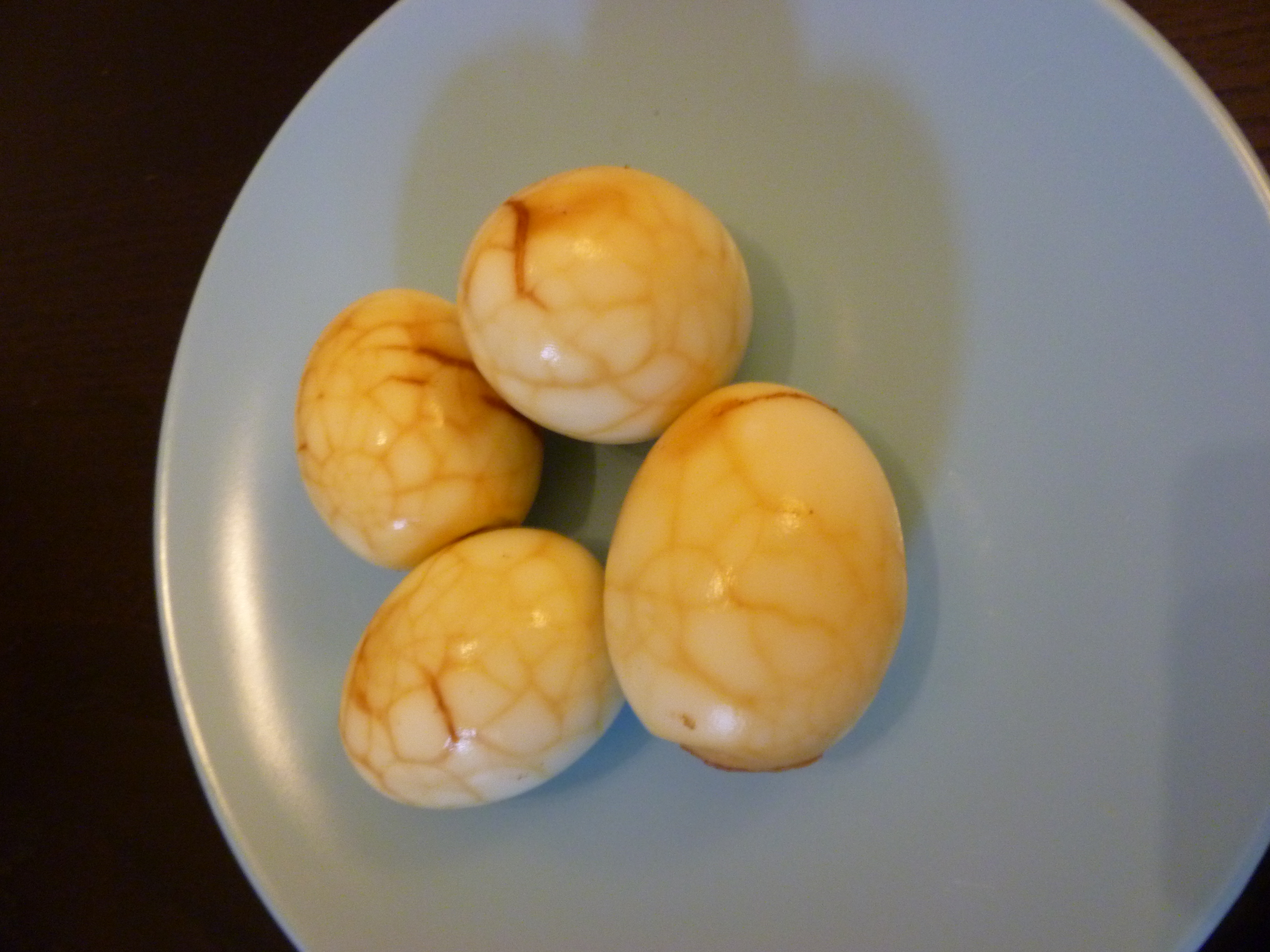
Chinese Tea Eggs

Chinese Tea Eggs

The prettiest finger food

These marbled little beauties are widely available at street vendors in China. I had read that they were supposed to be a sign of prosperity and good fortune, and where often given away at New Year because of this. However, I can’t seem to find that again, so I suspect that it is a bit of a myth, considering how widely used they seem to be. Over here, we seem to be told that so many Chinese things are a sign of prosperity and given out at New Year that they can’t all be exclusively for one festival, no matter how important it is.

I thought that the look of them was really fitting for a party, so I decided to make them for ours.

The spice mix varies from region to region, but this is how I made mine.

Bring a number of eggs to the boil. I did 12, because that I what I had in, and I hadn’t yet tested them on friends over here, so I didn’t want to get carried way. Let them boil for 10 minutes, then take them off the heat and leave to cool in the water. I find doing them this way prevents that grey ring that you sometimes see around the yolk from forming.

Once the eggs are cool enough to handle, gently tap them so that they are cracked all the way around, but so that none of the shell actually comes off. This will create the marbling effect of the final eggs.

In another saucepan put 2 tbsp soy sauce, a black tea bag (or a tbsp of loose leaf), a cinnamon stick, a tbsp chinese five spice powder, and 2-3 strips of citrus peel. Use what you have in, I had a mandarin, so I used that. Put in the cooked, cracked eggs, and enough water to cover them.

Bring this to the boil, and simmer for an hour. Remove from the heat, and allow the eggs to sit in the liquid for as long as you can, overnight if you are organised, but at least a couple of hours.

They look so pretty when they are peeled and arranged nicely on the plate that people find them hard to resist.

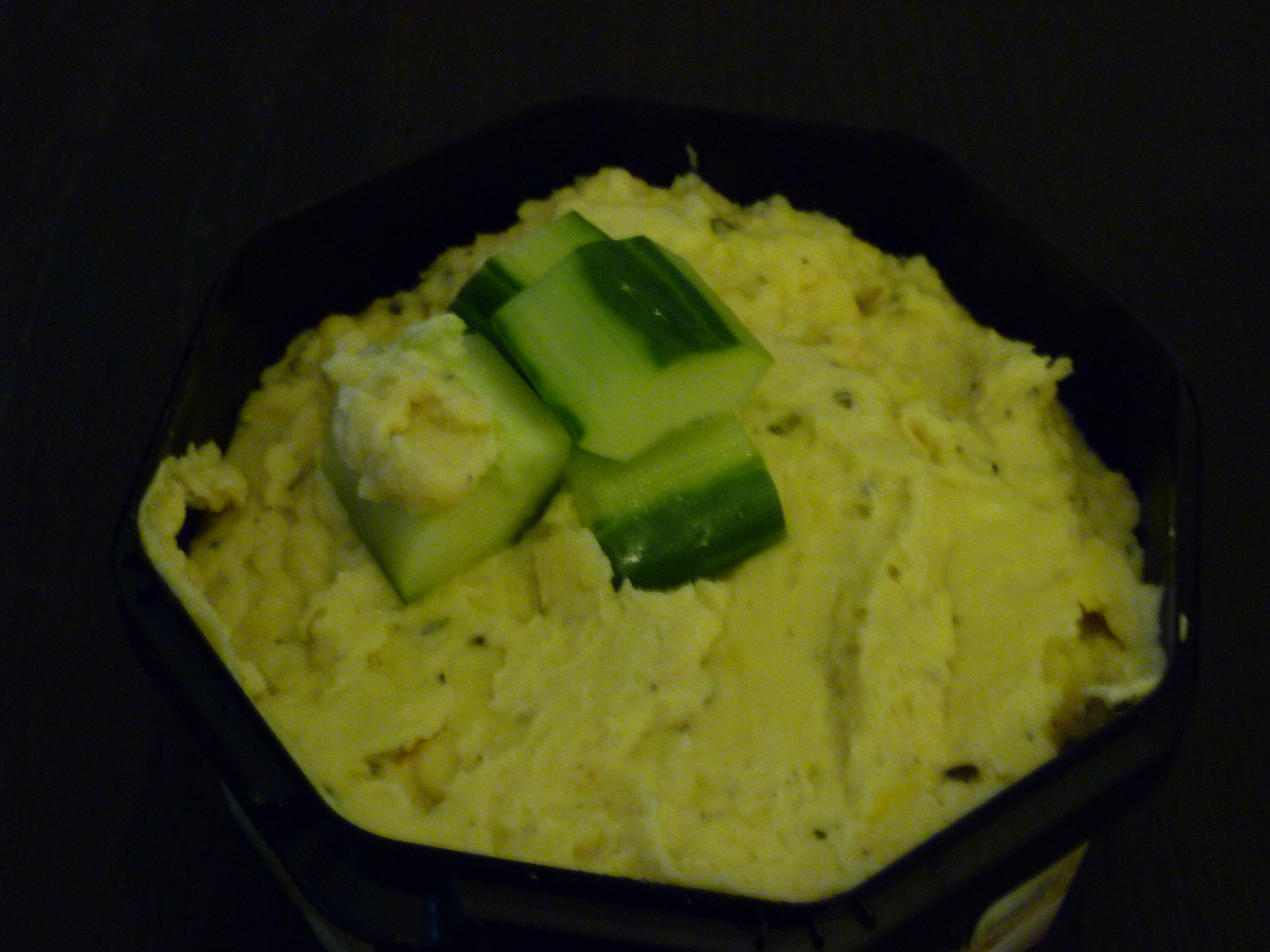
White Bean and Rosemary Dip

White Bean and Rosemary Dip

Makes a change from humus

If you are a vegetarian or a vegan at any party, you will more than likely be pretty bored of humus. It seems to be everywhere. I like it, myself, but if I were to be served it at every single social gathering, and had few alternatives, I would get pretty bored too. In the same way that it took me many years to be able to look a Cornish pasty in the face, after living there for two years and being served cocktail pasties for every single working lunch ‘do’ that I had to attend – and there were very, very many of them!

This dip is a great, and surprising alternative to them. Use dried beans instead of tinned, and it will be even better.It is almost like the humble white bean, rosemary and lemon were made to go together.

Ingredients

200 g dried cannellini beans, or a tin of them

2 sprigs rosemary, removed from stalks and finely chopped

Zest and some juice of 1 lemon

Glug of good extra virgin olive oil

Method

If you are using dried beans, soak them. For cannellini, I find a couple of hours is fine, and that it is not great to soak them for too long, because the skins come off, and they turn to mush when you cook them. About  two hours should be plenty.

Cook them in a large saucepan and in plenty of fresh water. Do not salt the water, it makes the skins tough. Bring the beans up to the boil, then reduce them to a vigorous simmer. the time they take to cook will depend on how old they are, but check after 4o mins. The best way to see if the beans are cooked is to eat one. If it is hard at all, then it is not done. When you can bite through them easily, and the bean is soft, they are ready.

If you are using tinned beans then you can skip this step. I know that tins are easy, and I have definitely used them myself, especially if I have not remembered to soak the beans in time for making the dip, but I do ask that you please try to used dried at least once – it makes such a difference to the texture of the finished dip. Cooked dried beans also freeze easily, so you can just cook one big lot and freeze them in batches if that is easier.

Drain the beans and blend them to a smooth paste using a food processor or a stick blender. Or you can pass them through a food mill or sieve, if you don’t have those. You can also mash them with a fork if you really have nothing else.

Add the rosemary and the lemon zest, and stir them in. Season to taste with salt and a little pepper (white, if you have it). then make the paste more of a dip consistency using the lemon and the olive oil. Keep adding small amounts of each and tasting in between, so that you get a good balance of acidity and the oil.

Serve with breadsticks, crudités, or good old tortill chips, or you can use this to spread in a sandwich too.

Leave a comment

Filed under Feast

Fantastic Finger Food Part 1

I was asked to provide some finger food for a friend’s birthday party. I agreed to do a number of savoury dishes.

Most of my friends and I are what is often referred to as hippies. I hate this term, not jut because it is usually levelled at us as a pejorative, but also because I like to think that my views are a more modern take on the environmental and peaceful aims that a lot of hippies espoused in the 60s.

One thing I guess we do have in common is a reluctance, or downright refusal to eat other animals. Many of my friends are vegetarian, including the birthday girl. So I made a whole range of veggie finger foods for the occasion. Here are a few selected highlights.I even managed to make some of these vegan!

Bloody Mary Tomatoes

Bloody Mary Tomatoes

Boozy Tomatoes – rated 18

This one starts with a confession. This was originally a Delia Smith recipe. I am not a massive fan of the patron saint of the British home cook, if I am honest. This opinion may get me strung up from the nearest pasta tree, but there, I have said it. I know she has done many good things to improve cookery skills and so on, but I find most of her recipes a little staid. Then there was the infamous bean incident that we no longer discuss, but let’s just say that her  (rubbish) cheat for beans left a party of hungry walkers without a stew for several hours too long, and left me beside myself with embarrassment. Luckily, I think they all got a little merry and didn’t notice exactly how late their dinner was.

All that said, this recipe will blow your socks off.

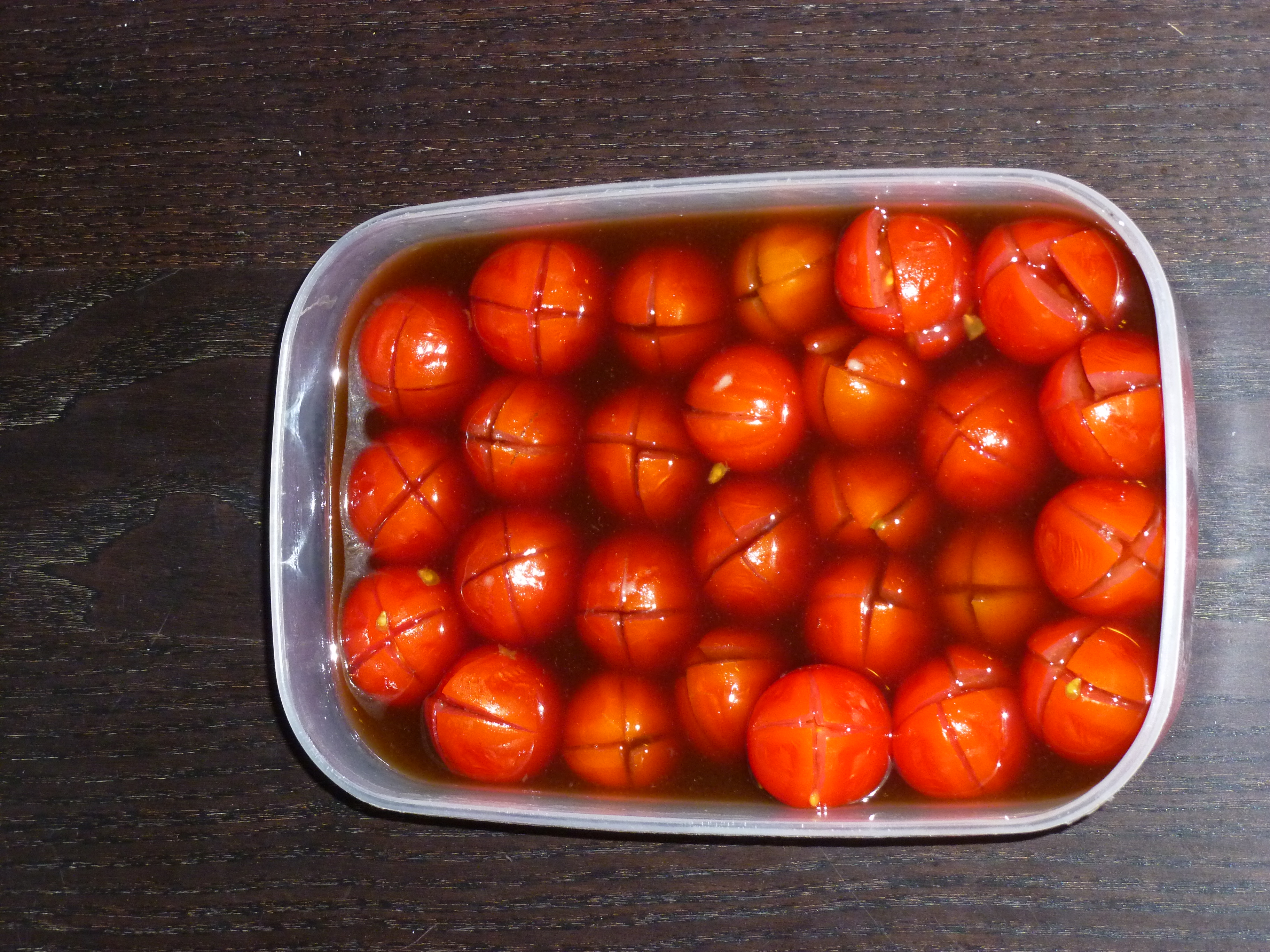
The basic premise is that this is a bloody mary in solid form, which saves on washing up of all those pesky glasses.

Firstly, mix the ingredients for a bloody mary. The following figures are really rough, and you should mix it to your taste anyway.

200 ml vodka

1 tbsp Worcestershire sauce

Dash Tabasco sauce

1/2 tsp celery salt

If you are particularly keen on other things when you make a bloody mary (eg I did know someone who insisted on adding some English Mustard Powder) then add that too. Why not? Give it a good whisk to blend the ingredients as well as you can.

Cut crosses in the bases of a load of cherry or baby plum tomatoes. A mix of red and yellow is also attractive. Place these quite snugly in an airtight container, with the cross facing upwards.

Pour the bloody mary mix over the tomatoes. Seal the container, and marinate in the fridge for as long as you can. Two days is ideal, but I often forget that they should have this long, so often only do one.I also forgot a second bowl in the fridge at a party, and the booze kept them good for a couple of weeks.

Drain them, then arrange on a plate to serve. You can keep the vodka mixture for another batch if you like.

These are really popular, and will go quickly. It will be up to you what excuse you use to make sure any kids at the party eat the undoctored tomatoes, and not these.

Marinated Tofu Skewers

Tofu Skewers

Tofu and Tomato Treats

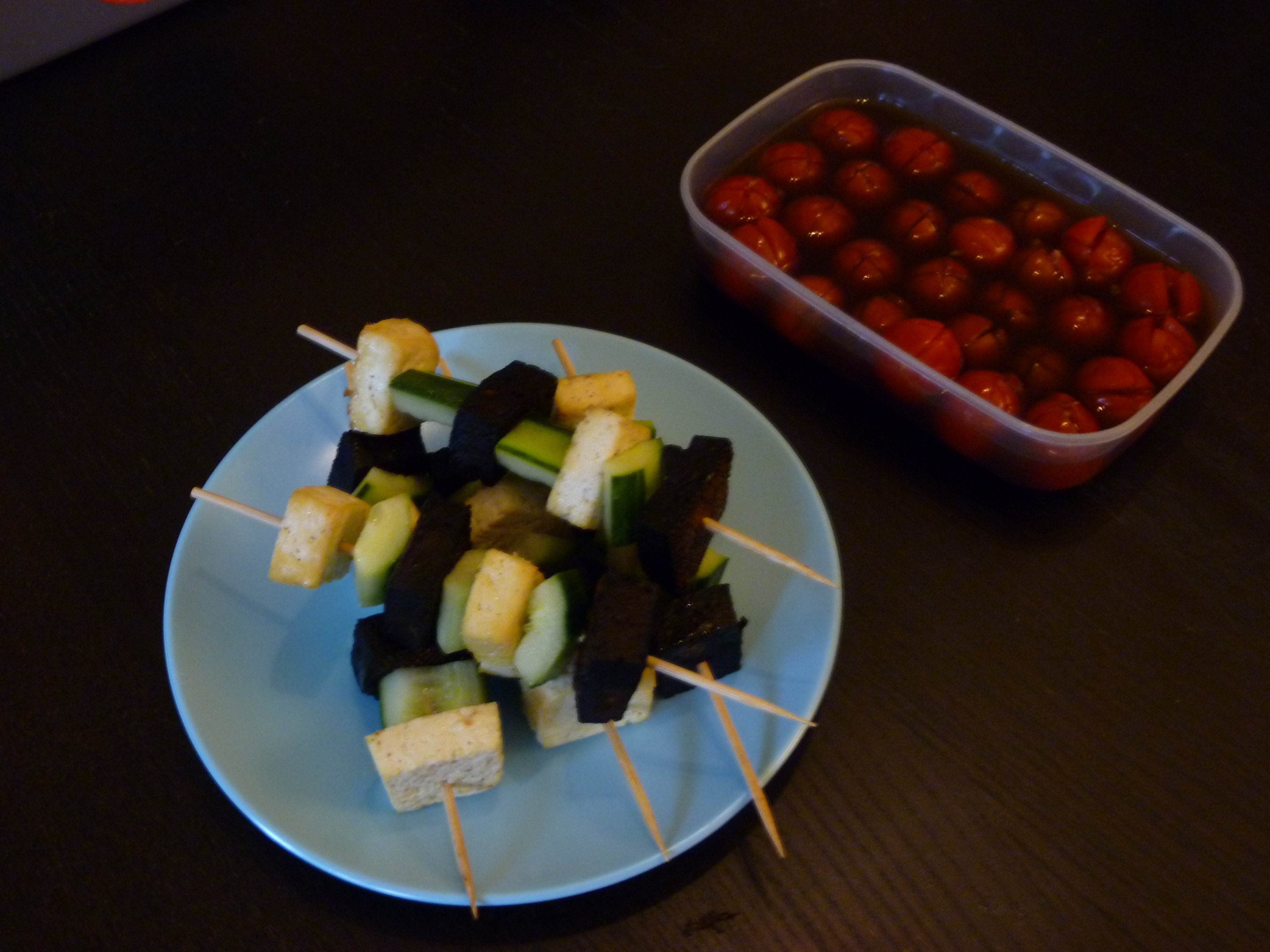
I found this recipe over at raspberry eggplant. I wasn’t able to find ginger soy sauce, so I made my own by using dark soy, and lump of garlic about 2cm thick, which I then grated into the soy. This does the trick, and imparts a lovely flavour to the tofu, but it does leave it much blacker than the ones that Roopa has photographed over there.I have tried water down the soy, but that does not seem to make much difference.

Nevertheless, they went like hot cakes, despite being cold skewers.

Well, I don’t want to bore you with overlong posts, so the next lot of these will appear tomorrow.

Update: I was asked on facebook what was between the tofu on the skewers. It is cucmber, that I peeled to give a stripy effect, deseeded and cut into similar-sized lumps to the tofu. Roopa used them in her original recipe. I also think cherry tomatoes would work just as well.

2 Comments

Filed under Feast

Top Tips

Broad Bean Plants

Better late than never

I got my broad beans in really late this year, through a mixture of snow and laziness. There was snow in both November and February, rendering the soil unworkable. However, since I love broad beans so much, I managed to shake myself, and get them planted, eventually.

Almost all gardeners will tell you to pinch out the tips of the beans once they get the first bean pods. This is to stop them getting taller, meaning that they concentrate their energy into beans. They also say it will help prevent blackfly infestations.

What a lot of them don’t tell you is that they also make a really delicious vegetable in their own right, with a subtle broad bean flavour.  You can have them steamed or quickly boiled. They don’t keep very well though, so they really are the gardener’s treat. This really is the best advert for growing your own, just so that you too can try this treat for yourself. They will even grow along the edge of your balcony in a deep window box – a pretty, edible, and practical windbreak.

Braod Bean Tips

Gardener's Delight, washed free of blackfly

I added mine to a risotto, following the same method as the one I gave in the masterclass the other day. I made the white risotto base, then added the tips, and some cooked, double-podded broad beans along with the last ladleful of stock. I used Crème fraîche instead of the butter at the end, along with some chopped dill. Then I served it all up with a nice green salad, which included some wild garlic leaves.

Risotto and salad

Tip Tops!

So lovely, light and fresh. Will you try to grow some just to see what you are missing out on?

Leave a comment

Filed under Farmed

Foraging: Free Food or Foolish Foray?

Nature’s Larder

I really enjoy rootling about in the countryside to find plants that I can eat. I love nature, and all the things in it, so I have invested time in learning common edible species, and then going out to find them. I often take the Big Guy, but am also happy to go alone, although a dog would be great company.

I do this both because I am concerned about eating local food, and also because I get a bit bored with cabbage in the hungry gap, come early spring. I think it is a useful skill to have, beyond the usual brambling that I am sure almost everyone I know has indulged in at one time or another.

Flowers and Fruit

I have tried a number of plants, some of which I have really liked, and some of which I have not. It is a pleasant way to pass a few hours, and mostly you will be eating weeds, so many gardeners will appreciate your efforts.

I also have a fishing rod and do eat food that people who I know have hunted themselves. I think that this is a sustainable way to eat fish and meat – catch only what you can eat, eat game.  However, this is not the focus of this post. I may get back to this topic at a later date.

When you forage for your own food, you do run risks. There are many plants and fungi that can make you mildly to quite ill, and there are some that will make you quite dead! Some really tasty species are very easy to confuse with some really deadly ones. Common sense and caution are your friends if you decide to go and sample nature’s larder.

There are also a number of laws and bylaws governing foraging, so try to make sure you know what they are in your area, in order to avoid having your collar felt!

I go by the following basic rules, which should help to keep you safe, and largely legal. You may wish to add your own in the comments.

  1. The laws on foraging tend to be fairly complicated, there are differences between countries, and there may also be local bylaws in effect. Please make sure that you know and follow the laws governing foraging where you are. You can generally find out what may apply through your local council, although be aware that this can be time-consuming, and you may get passed onto different departments and agencies.
  2. There may well be more complicated laws, and outright bans in some places, on gathering mushrooms for commercial purposes.  I would not take the risk of attempting to gather mushrooms for sale. Unless you are an expert, I really don’t recommend that you do either.
  3. It is polite, and probably a very good idea, to get permission from the landowner before you gather food from his land.
  4. Don’t remove all of the plants in one area. If greedy people have taken them all before they can reproduce, there will be none left for next year. Besides the conservation aspect, older mushrooms and fruits are likely to be unappetising, either through ‘going over’ or by becoming infested with maggots.
  5. Try not to gather food too near to the roads – the things you find there may look really juicy, but they are likely to be contaminated with all sorts of chemicals that result from burning petrol. I also try not to use plants from areas where there is heavy dog use, or at least I make sure that I have washed everything thoroughly.
  6. Take a good field guide with you. I usually take a few with me, because plants and mushrooms are not uniform, and you need to have a good idea. A good field guide will have photos, classification charts, and will have information on habitat. I also find taking a tree field guide with me to be very useful, to help me double-check the species that I have. Similar looking mushrooms sometimes grow under different trees, or in different habitats.
  7. Careful identification of the plant or mushroom is required. Only by learning its identity can you be sure if it is poisonous or not. The best way to do this is to proceed with caution. Note the habitat, its appearance (if you can, both young and old specimens), the colour of its spores. Again, good field guides will have this information.
  8. People have different tastes and different reactions. Once you have identified an edible species, only try a small amount at first, to gauge if you have any adverse reactions.
  9. MOST IMPORTANTLY if you are in any doubt of the identity of your plant, or if it is easily confused with a similar, but poisonous species please err on the side of caution and do not eat it. You must be aware of what happened to that cat who was a little too curious?

Many mushroom foragers that I know tend to stick to a few patches that they know well, and to two or three species that they are sure of. You could also enlist the help of an expert, and there are many courses that you can go on to improve your knowledge. Whichever way you choose, I am definitely not to blame if you do have ill effects.

Even if I cooked it for you. You shouldn’t suffer, though,  because I am careful to follow these simple rules.

2 Comments

Filed under Found

Risotto “Masterclass”

Versatile flavours

So many flavours from one basic dish

I was talking about risotto the other day, when a few friends persuaded me that I should do a ‘risotto masterclass’. I suspect the fact that I have a larger than average kitchen (not difficult in a city where a ‘kitchen’ constitutes having a microwave on a shelf and a hob in many of the flats in the rental sector!) also had something to do with it, but I was flattered enough to go ahead.

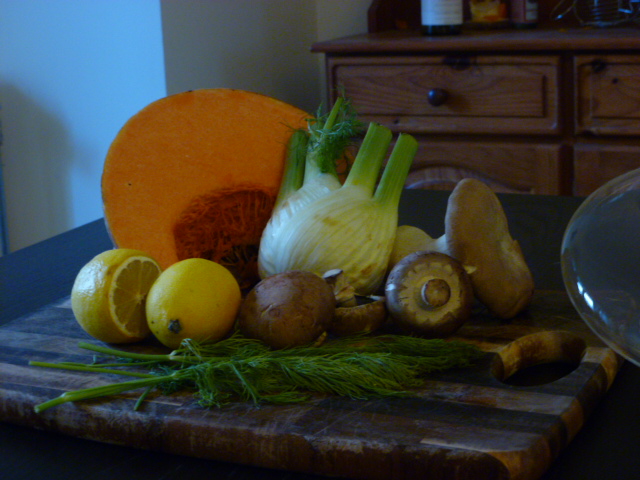
We made three flavours of risotto – fennel, lemon and ricotta; pumpkin; and mushroom.

This is not to say that I made three risottos initially. My friends wanted to have a class so I wanted to show them how versatile risotto is with adding flavour, and how simple it is as a method. So, I started with a simple, white risotto, and we took it from there.

A good time was had by all, and I hope that they went away feeling more confident in making risotto, and experimenting with flavour.

Of course, there are more complex ways of building up flavour within the risotto, but adding ingredients at the end is a good way to get started!

I do most of my cooking by eye – especially as I wanted to make this one large enough to split into three, but the recipe that I give below should be enough to serve 2 people with leftovers. Leftover risotto is so versatile, that it really is worth making the extra.

Recipe: White Risotto

Ingredients

150 g risotto rice (risotto rice comes in a number of varieties, or is probably labelled just ‘risotto rice’ in your local supermarket. We used arborio for this one)

1 medium chopped onion,

1 tbsp olive oil

1 glass white wine (or you can use vermouth or another spirit relevant to your flavouring, such as Pernod, etc)

750 ml – 1 l stock (the stock you use can depend on what you are going to add. On this occasion I used vegetable stock)

Thyme

Knob of butter, or dash of cream or oil

50 g parmesan, freshly grated

Method

Sweat the onion in the olive oil until it is translucent, but not coloured. Add the rice, and stir until the rice is slightly translucent round the edges. Add the thyme at this stage too – the leaves but not the stalks.

Meanwhile, Bring the stock to the boil, and then leave it on a gentle simmer. I always make my own stock and freeze it in roughly  500 ml portions, so I use one of these, then add hot water as I run out. If you want a particularly ‘meaty’ flavour in the risotto, there is no reason why you cannot use all stock. It is important that you are adding warm stock to the rice, so I just leave it on the hob while I am cooking the risotto.

Turn up the heat a little and add the wine. Allow the alcohol to burn off and the rice to absorb the liquid. If you don’t want to have alcohol, this step can also be missed out altogether.

Add your stock, starting with just enough to cover the rice. Allow this to absorb completely before adding more, then add more a ladleful or so at a time. You will need to stir the risotto to stop it catching on the bottom of the pan. Much better chefs  than me (well, chefs, in fact) say that the more that you stir it, the creamier it will be, especially at the end stages. This will reduce the amount of butter or cream that you need to add at the end.

Taste the rice as you go. Before it is ready, it has a chalky quality to the grains. It is ready when this chalkiness is lost, but the grains are still a little al dente (especially important if you don’t want claggy leftovers). At this point, stop adding more stock.

Take it off the heat, ad beat in the butter or cream (which must be cold). Add the parmesan and seasoning. You will need quite a lot of pepper.

This is the basic recipe. Then you can flavour it by adding herbs, veg, meat. Whatever you like really.

The flavours I added for the three risottos were as follows:

Fennel, Ricotta and Lemon

I sliced a fennel bulb thinly, lengthways. Then I braised this gently in olive oil, with 2 garlic cloves, also sliced thinly. I added all the vegetables and the oil to the rice, mixed in a little ricotta, and the grated zest of the lemon. I then added the lemon juice, a little at a time to balance out the other flavours. I added the chopped fronds of the fennel as a garnish.

Pumpkin

I made a large dice of about 1/4 of an orange fleshed pumpkin, and roasted this, with some unpeeled garlic cloves, and some crumbled dried chillies in some olive oil with sprigs of thyme. This took about 3/4 hour at 180 degrees. I stirred these in at the end of cooking the risotto, and served with taleggio. If you wanted you could halve the above pumpkin, and boil half. Adding it with some of the last stock, which will make the risotto orange, and help build up the flavour. Roast and add the rest as above.

Mushroom

I fried a selection of sliced mushrooms in butter and garlic, with a generous amount of thyme leaves. I stirred them in at the end of cooking the risotto, and stirred through some fresh chopped tarragon. To build up the flavour even more, you could use a mushroom stock, or add the soaking liquor from dried porcinis to the stock as you cook it.

The recipes are simple, as I said, but adding your favourite flavours like this is an easy way to make a risotto recipe your own.

5 Comments

Filed under Feast

Handmade Ice Cream

Hi, my name is Mel, and I am a gadget-ophobe.

Well, I guess that is not strictly true, I just don’t see the point of most of them. I suppose this comes partly from the make-do-and-mend attitude I have retained since my uni days, when all I had was a block of knives, a mixing bowl, a wooden spoon and a balloon whisk. Anything else I had to improvise with a wine bottle (useful as a blender and a rolling pin!), or whatever else was to hand.

Obviously, I have got many more of the basics now, which allows me to do much more, but I still have not been suckered by many of the more ‘faddish’ gadgets, such as a breadmaker, or ice cream machine. I enjoy making bread, and take great pleasure from trying to get a tight round, or a nice airy foccacia.

I have never really attempted ice cream before now though, because I was under the impression it was difficult. It was also not easy to find a recipe that did not involve the instructions to “place all of the ingredients into an ice-cream machine”.

Stages of hand made ice cream

Stage 1: an hour in the freezer, before whisking

Anyway, a bit of hunting around, and a lucky episode of Masterchef Australia left me a bit more encouraged try to make my own, especially since they recommend a custard base, and I do like a good custard. Because I wanted something to serve with rhubarb, I chose to flavour this one with ginger.

Here is how I did it:

Ingredients

5 Egg Yolks

100 g Sugar

400 ml Double cream

400 ml Milk

50 g Stem Ginger

1 Tbsp Syrup from the ginger jar

Making Custard

Finely chop the ginger, and add that to the milk and the cream in a pan. heat to just below boiling point.Set aside to steep for 20 minutes. Pass the liquid through a sieve to remove the pieces of ginger, but set them aside though, because you will use some later. Bring the liquid back up to boiling point.

In general, for flavoured custards, you add the flavouring to the milk – you also do this with the vanilla pod if you are making custard to go with your apple pie. So, if you want to make mint ice cream, and the essence to the milk, add cocoa or melted chocolate for chocolate ice cream and so on.

In a separate bowl, beat the egg yolks and the sugar together until they thicken quite a bit. Now for the tricky bit (or so they tell you). Very slowly at first, add the warm milk to the egg mixture. I do this by adding a little, and making sure it is whisked in before I add more. Once you have combined a fair amount, you can add the rest of the liquid much faster.

Once the egg and cream  is combined, returned to the heat and heat gently. Do not allow it to boil, or it will curdle. The custard will thicken, and when it leaves a line on the back of your wooden spoon then it is thick enough. Remove from the heat.

Stages of Ice Cream Making

Stage 2: Not much further than stage 1

The Ice Cream Bit

The custard needs to cool completely before you try to freeze it (not least for energy efficiency of the freezer!). You can either set it aside to cool, or a better way is to put it in a bowl, which is sitting in some ice in another bowl (or the sink) and stir it to dissipate the heat faster.

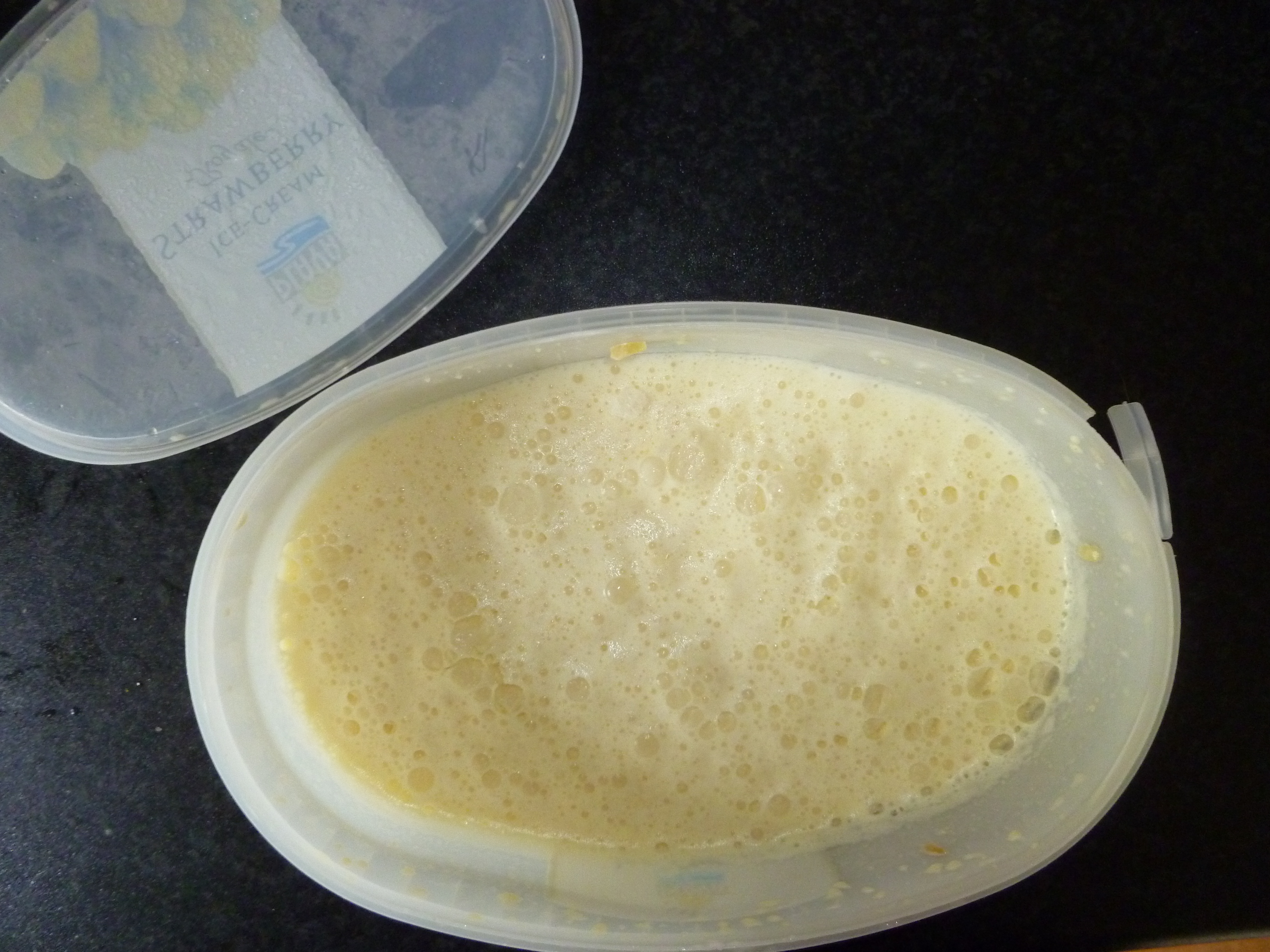
Once the custard is cold, then you need to put it in the freezer. Most sources I read said that you should put it in a bowl for this stage. Unfortunately, I didn’t read that until after I had frozen it, so I put it in an ice cream tub (recycled, of course). As long as the custard does not fill more than 3/4 of the vessel, it will be fine.

In order to make ice cream, er, creamy, you need to try to keep the ice crystals from getting too big. To do this, put it in the freezer for an hour, then take it out and whisk it. Repeat this process until you have a smooth, thick ice cream.For this recipe, I found it took four times to create the smoothness required.

Because I like ginger, I stirred in some of the chopped ginger from the custard making at the last stage of the whisk and freeze cycle. You could also add anything that you like at this stage – nuts, mint chips, chocolate chips, fruit.

Stages of Ice Cram Making

Stage 4: Thick, and after adding the ginger

The ice cream should last a few weeks in the freezer (in theory!), just don’t forget to take it out of the freezer about 10-15 minutes before you want to serve it.

I served mine with the aforementioned poached rhubarb, and some meringue. Well, I needed to use up those egg whites somehow!

Poached rhubarb, stem ginger ice cream & meringue

The finished product

Leave a comment

Filed under Feast

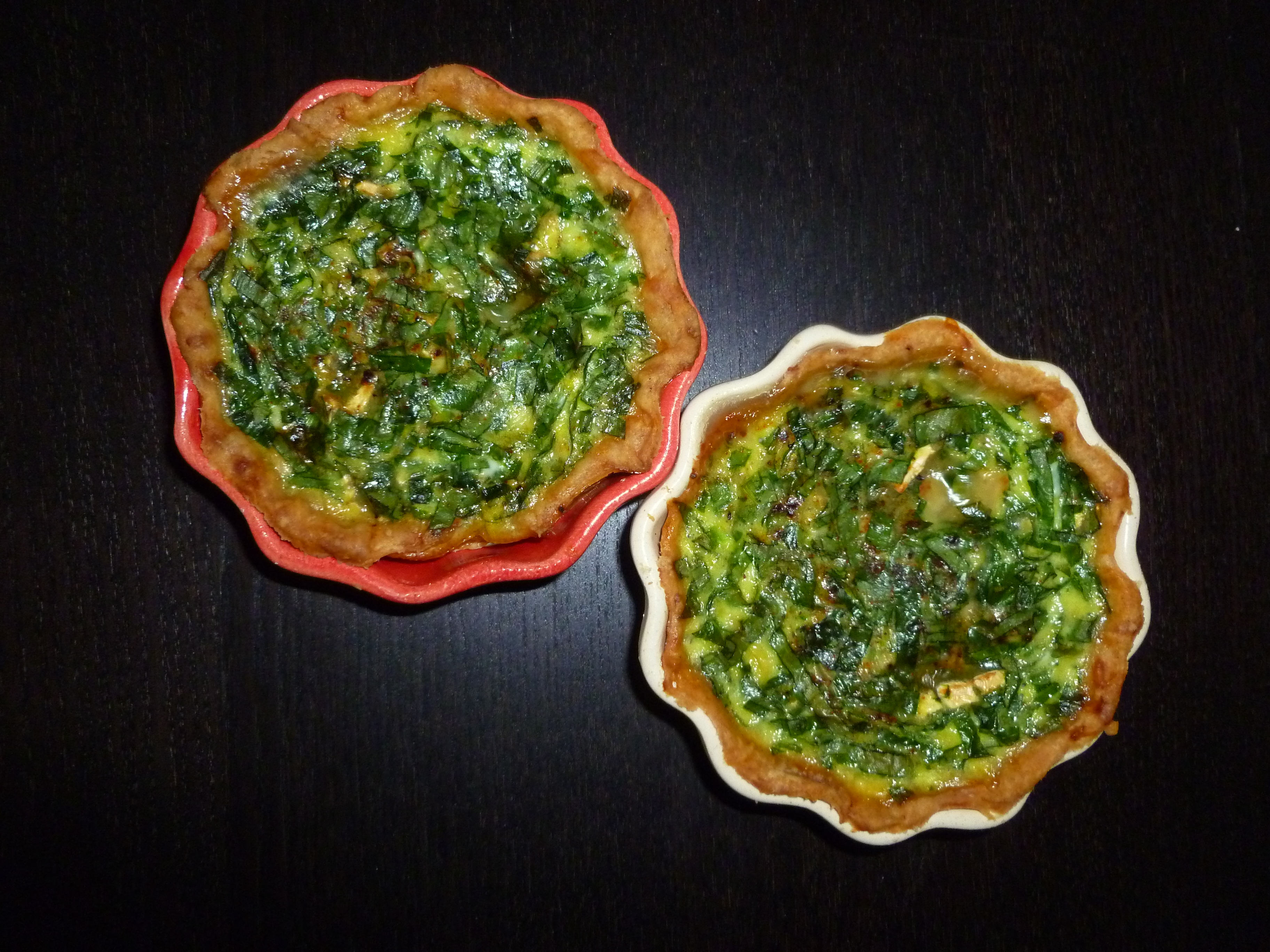
Wild Garlic Tarts

Wild Garlic Tarts

Wild Garlic Tarts  

Wild Garlic – it is more than likely available in a wood near you right now. It looks quite innocuous, and is easy to walk past. However, walk on it, and there will be no mistaking the smell of garlic.

I love the stuff, and have it in soups, salads, as pesto, I use it as a pot herb, and anything else that I can think of. You can eat the leaves, bulbs and the flowers (although it should be noted that in many places digging up the entire plant is illegal, so only use the flowers and leaves), and all of them have that distinctly garlic taste.

Of course, there are a few basic guidelines to stick to when foraging, and don’t take the whole patch. Apart from needing to leave some for next year’s crop, wild garlic does not keep all that well, lasting about a week in the fridge. And it bruises easily, which only speeds up the deterioration.

One word of caution is that it is possible to confuse the leaves with lily of the valley early in the season, but there really can be no confusion once you smell the plant. If it doesn’t smell of garlic, just don’t eat it!

I had invited a couple of friends over to dinner, and happened to have had a foraging session the day before. I also collected nettles and other wild greens, but these can sometimes be a little ‘niche’ for most people. I thought introducing them to the delights of wild garlic would be an easy and very tasty way in.

As  this was to be a starter, I decided that little tartlets were the way to go. Plus, I had been given some beautiful little individual tart dishes that I wanted to try out.

With savoury tarts, I often prefer cheese pastry. Back in Britain, then only a good cheddar would do for this pastry, but now I live in the Netherlands, and I am not prepared to pay a small fortune for cheddar in a country that prides itself on making its own cheese. I have not necessarily bought  into the fact that Dutch cheeses are the best in the World, but there are enough specialty shops that you can find a good, tasty cheese. For a good cheddar substitute I usually use a piquant belegen boerenkaas (literally ‘sharp mature farmer’s cheese’, which is often unpasteurised).

These are great served with a salad (you can even use foraged leaves if you like), and a fruity dressing. I used home-made blackberry vinaigrette, but balsamic or raspberry would do equally well.

The recipe below is enough for 6 tartlets. If you have fewer people, then both the pastry and the filling will keep in the fridge for up to a week (although the pastry must be tightly wrapped, or just freeze it and thaw before use).

Recip: Wild Garlic Tarts

Ingredients

For the pastry

75 g butter

175 g plain flour (or a mix of half white and half wholemeal plain flour)

50 g of a tasty cheese, such as mature cheddar or piquant belegen boerenkaas

1/2 tsp dry mustard powder

Good pinch of cayenne pepper

For the tart filling

50-100 g wild garlic leaves, cut to a chiffonade

100 g good camembert, finely chopped (any well-flavoured rinsed-rind soft cheese would be good in this dish)

3 eggs

100 ml cream or milk

Freshly grated nutmeg

Paprika

Method

Firstly, make the pastry. I have had very little success in getting good results from using a food processor to form the dough. If you find this easy, combine the ingredients in a food processor, then add cold water to form the dough.

I rub the butter, mustard powder and the flour together by hand. For this I use cold butter, and often have cold hands, so I’m not working the dough too much. You can achieve cold hands by dint of poor circulation, or running them under a cold tap for a few minutes before working the dough.

Once the mixture looks like fine breadcrumbs, I add the cheese and the cayenne. I don’t add salt, because the cheese should contain enough. Then I combine the lot with just enough cold water to form a dough.

The pastry needs to rest in the fridge for at least half an hour, but I often go and do something else, then get back to it when I have finished.

Roll out the pastry thinly, and put into the greased tartlet tins. You can also make one large quiche with this recipe. If making individual tarts, I find it easier to cut out smaller discs from the pastry, using a side plate as a template, then gently transfer the thin pastry to the tart tins, and cut to size. Pastry will shrink when you cook it, so it  is better to be generous. You can always trim it later, but you can’t unshrink it.

Blind bake in a hot oven at 180°C. To blind bake, I cover the pastry with rice in greaseproof paper, you can also use beans or ceramic beads. Once rice has been baked in this way, you can no longer cook it normally, so I keep mine in a jar to recycle for every blind bake.

Once the base of the pastry is dry (usually 10 mins) remove the blind bake and put back in the oven until the pastry has browned slightly, and is crisp.

Meanwhile, make the tart filling, by lightly beating the egg and cream, then adding the wild garlic leaves, cheese, paprika nutmeg and mixing well. Season to taste.

When the tart cases are out of the oven, allow to cool slightly, and fill with the filling. Return to the oven, and bake for 15 minutes, or until the topping has just set (could be up to half an hour if making a large quiche).

Serve warm or cold.

1 Comment

Filed under Found

Asparagus Soup

As a child, I didn’t eat many vegetables. As an adult, I eat many more, and I love to eat seasonally. This is why you will probably often hear me saying that such-and-such a vegetable is my favourite. It would probably be more accurate to say that such-and-such a vegetable is my favourite right now.

At the moment we are into the asparagus season, and it is cheap and plentiful. And right now, asparagus is my favourite vegetable.I eat it with eggs, in salads, on its own with butter, in risottos – you name it.

In general, the bottom end of the stalk becomes tough and woody, so it is best to cut, or snap it off. I really hate throwing food away, especially something as tasty as asparagus. So,  I decided to try to use these woody stalky bits up.

Soup is the obvious answer. First, I tried to blend it in a food processor, but this just resulted in smaller woody bits in the soup. I also have a food mill, and one day I tried it through that, and it turned out that the low tech version was the best, since the woody bits are not passed through the mill. I really recommend these – I picked mine up for a tenner back in the UK, and I use it weekly.

This year I planted my own asparagus, and freshly cut asparagus should not have the woody stalky bits. I wonder if this soup will continue to feature in my spring repertoire? I hope so, it really is good!

The following recipe varies in amounts, depending on how many stalks you have been saving in the fridge. The stalks will keep for up to 10 days (depending on age when you bought them, and the width of the stalks), so you can save them up from a couple of bunches to get a good amount, if you like.

Recipe: Asparagus Soup

Ingredients

1 chopped onion

1 tbsp olive oil

Asparagus stalk ends

Chicken or vegetable stock

Thyme

Crème fraiche (cream or milk would also work)

Method

Sweat the onion and thyme in the olive oil, until the onion is fairly soft, but not coloured.

Add the asparagus to the pan, and cook until it has turned a vibrant green

Add the stock. You need to allow enough stock to cover the vegetables in the pot by a couple of cm.

Bring to the boil, then simmer until the stalks are tender to the point of a knife. The time for this can be anything from 5 minutes for the really thin stalks, up to 20 minutes for the later season asparagus.

Take off the heat and allow to cool for 5-10 minutes. Then, pass through the food mill into a clean pan.

Add a little crème fraiche. Again, the amount you add will depend on the amount of soup that you have. Season with salt and pepper.

This soup can be served hot or cold, especially if you are having a really warm spring/ summer, like the one that we are having now.

If you are serving it cold, add a little water to thin it, allow to cool completely, then refrigerate for an hour or two. Garnish it with croutons, cooked asparagus tips, small dice of cucumber (seeded and peeled), or some of all three. A little chervil can be chopped and stirred through, or used as a garnish as well. Check for seasoning before serving, as cold soup can often need more seasoning that its hot counterpart.

If you want to serve it hot, warm the soup gently, without boiling. The soup can be made ahead of time, and warmed through at a convenient time. Garnish with cooked asparagus tips, chervil, or a dollop or swirl of the crème fraiche. Serve with buttered brown, rye or sourdough bread. I prefer bread, as opposed to toast with the hot version of this soup.

Leave a comment

Filed under Feast