Tag Archives: Leftovers

Making the Most of a Marmalade Mistake

Breakfast  Flapjacks

What a Comeback

The clementine marmalade I made caught slightly on the bottom of the pan. This is what comes of trying to cook and blog at the same time! I only took my eye off the ball for a couple of seconds, while I had a spoonful of the golden, orangey preserve waiting for the fridge test.

Most of the marmalade was fine, so I bottled it up. But there was about half a jar on the bottom which had gone too far. As you know, I cannot bear to waste food, and this is no exception. I won’t inflict this on my friends, but there is no reason why I can’t still use it.

Marmalade makes a great glaze for both sweet and savoury food. I did bake a yoghurt cake, and then melted 2 tbsp of the marmalade with a tbsp of water to make a glaze. I poured the glaze over the cake while both were still warm, and then left the lot to cool in the tin. Unfortunately, I have never made a yoghurt cake before, and clearly didn’t beat the egg, yoghurt and oil together enough, so it was too dense, so I haven’t photographed it. It was fine, when splashed with a little Cointreau (or orange juice would also be fine), and served with fresh Greek yoghurt.

I have also kept a little marmalade in reserve, because I have another glaze in mind, but this time for a nice duck, a wild one if I can get hold of it. I shall add shallots and thyme, and make sure I baste the bird as it cooks. I guess you can expect to see it here, if it is a success.

However, I left the lion’s share of the leftover marmalade for the recipe I am about to share with you now. The first thing that came to my mind when it was clear I would have some marmalade was flapjacks. I’m not really sure why, but I knew that I had to try it. I had a feeling that the thick cut, sticky marmalade would be the perfect foil for the oats. Both of them are traditionally associated with breakfast, and I really thought this could fly. I thought about it some more over the next few days, and it became clear that I could substitute the marmalade for the usual golden syrup.

There is a golden ratio for the usual kind of flapjack. As long as you stick with this ratio, then you can’t go far wrong. It also works for metric, imperial, volume, or if you prefer to measure your ingredients by a more eccentric means. The ratio is as follows:

  • 2 Golden Syrup
  • 4 Butter
  • 6 Brown Sugar
  • 8 Oats (or oats & other dry ingredients, such as seeds)

This is the ratio that I was taught as a small kid, and it has never yet done me wrong. You can then add more stuff, like dried or fresh fruits, candied peel or crystallised ginger, spices, chocolate, and so on. I always use a mix of whole rolled oats, and the finer, chopped sort that is best for porridge, because I find this gives it a better texture without falling apart. You can add seeds and other grains as well if you like, but you should adjust the amount of oats, so that you maintain the ratio.

These were unconventional flapjacks, not just in the sense of substituting syrup for marmalade, but I have to admit in this case, I also decided to adjust the proportions of the ratio as well. I wanted the orange to really shine in the mix, and the marmalade has a lot of sugar in it anyway. It may not please your grandmother, but it worked for me in this instance.

After a bit of fiddling, I settled on a 4:4:4:8 ratio, and the results worked really well. The bars are chewy, albeit in a slightly different, stickier way than regular golden syrup ones, but I like it.

I prefer my flapjacks on the chewier side, but if you are one of those people who like crunchier flapjacks, you may need to add some golden syrup, or possibly more butter to prevent the marmalade making the bar too hard in the  (slightly) longer cooking process. It is not something that I experimented with this time, but I would be happy to if others are interested. You don’t have to use up marmalade mistakes – ordinary marmalade from a jar will do just as well here.

The amounts I am going to give were enough for a 20 x 25 cm tin. I tend to line my tins with baking paper, because it makes the finished flapjacks a lot easier to remove from the tin, but you can just grease the tin really well, it is up to you. If I were a more dedicated baker, I would invest in that reuseable silicon parchment stuff, to reduce waste. I have got a birthday coming up, so who knows?

Recipe: Breakfast Flapjacks

Ingredients

160 g marmalade

160 g butter

160 g brown sugar (I used light muscovado and demerara, because it is what I had)

300 g mix of whole and chopped rolled oats

30 g pumpkin seeds

30 g dried cranberries

Method

Put your oven on at 180 °C.

Melt the marmalade, butter, and sugar over a medium heat, stirring so they don’t catch on the bottom of the pan.

Mix the oats, pumpkin seeds, and cranberries in a large bowl.

When the sweet goods and the butter have all melted and combined together well, pour onto the dried ingredients, and mix well to ensure that they are all well coated and no streaks of white oats remain.

Press the flapjack mix into the baking tray. You want to press it in fairly well, to help the mixture set into lovely bars. Then smooth it over with the back of a metal spoon, making the top smooth, and the flapjack layer as even as you can.

Bake it for about 25-30 minutes, depending on how chewy or crunchy you want it. Flapjacks are really forgiving, so they are easy to cook with other things, to maximise your energy use from the oven. They won’t collapse if you open your oven at the wrong time, and don’t really absorb other flavours. I haven’t tried cooking them at the same time as smoked fish, for example, but they are fine t go in with stews, other cakes, roasting meat etc.

When they are nice and golden all over, then remove them from the oven. You will need to mark them into the squares or rectangles that you intend to serve them in fairly soon after coming out of the oven. I got 12 bars from this amount of  mixture. Then they should be allowed to cool completely in the baking tray.

These flapjacks are really tasty, and the pieces of orange and cranberry really do add an interesting texture, as well as the marmalade, giving them a bit more kick than your average flapjack. Marmalade – it’s not just for toast, you know!

5 Comments

Filed under Feast

A Stock From Scraps

Vegetable Stock

The Basis of Many, Many Meals

Today’s recipe was inspired by a request from a friend who reads Edible Things. It is great to hear from people, so if you have any requests, let me know, and I can blog about those too.

If you have a recipe you’d like to see, or something to inspire, please feel free to get in touch or find me on twitter.

Anyway, my friend asked about how to make vegetable stock, particularly in reference to making stock from scraps. Obviously, she has come to exactly the right place. I never throw anything out if I can help it. I was accused of being from the 1950s when I admitted to an acquaintance that I make my own stock. He doesn’t know what flavour he is missing out on!

In my freezer, there is an entire drawer given over to scraps and offcuts of one kind or another.  I keep them separate in bags or freezer containers (for the meat products), ready to be used later. I routinely keep and freeze the stalks and outer leaves of cabbage; the tough outer leaves of fennel; carrot tops and peel; the tops of leeks; and the root and tip of onions that I have chopped for other dishes, and the stalks of any herbs where I have only needed to use the leaves.I would probably also keep the gnarly bits at the bottom of a head of celery too, if it weren’t for the fact that I have guinea pigs that eat them.

Frozen Food Trimmings

Stock Drawer

Currently there are also apple cores, lemon and orange zests, bones from a chicken, pork fat and rind, and a whole load of vegetable offcuts and peels. There will be a use for all of these in various stocks, jellies, sauces, or something.

I actually don’t like the term food waste when talking about unloved offcuts and trimming. There is so much you can do with them, up to and including composting, which I also do, but only when I have got the maximum value from them first.

Obviously, I know that most people do not have the freezer space or the geekiness to save stuff like I do, but if you do nothing else with your “waste”, do give stock a go. I guarantee that it really easy, and will really improve the flavour of soups, stews, sauces and gravies.

I make a number of different stocks, so I bag my veggies separately, because  I don’t want cabbage in a chicken stock, for example. If you have limited space, put them all into the same bag and chop them up a little. If you have no freezer space at all, you can make a quick stock using scraps, and supplementing it with the odd celery stick or whatever. The finished stock will keep in the fridge for a couple of weeks, in an airtight container, so you can still add it to dishes (NB it will be shorter for meat stock), and have great-tasting stock.

You can pretty much use what you want in a stock. I know that some people use potato peelings in stock, although I personally don’t like the flavour it lends. Some people also choose to put the papery onion skins in, although this will mostly impart a yellow colour, so again, I tend not to bother. Similarly, beetroot tops and peel can be used, but it will both colour and flavour the stock.

I have used pumpkin, pea pods, lettuce that looks as though it is going over, the ends of aubergine, tomato skins, mushroom trimmings,asparagus ends, the leaves of celariac,  beets and carrots at different times. As long as you wash the vegetables thoroughly before freezing, or putting straight into the stock pot, it really is up to you, and experimentation is the key for your tastes, and the dishes that you cook with.

There are a few vegetables that you cannot use the leaves from, and this includes rhubarb (which are a vegetable, but used as a fruit), aubergine and parsnip leaves. I have used the vines of tomatoes, but not the leaves.

The basis for most stock is the triumvirate of celery, carrot and onion (or leek – they are the same family).This is the basis of both meat and vegetarian stocks. It is really a question of balance. In the recipe below, I have outlined the rough proportions that I used. For vegetable stock, I try to use a cabbage (or broccoli stalks, or chard or something similar) in my veg stocks, because it gives a depth of flavour.

As you get more used to scrap stock, you will also develop a sense of the proportions of each that you want. I can do it by eye now. It does not take long to gain confidence in this technique. And believe me, you will really be glad that you gave it a go.

Basic Stock Amount, by eye

An Eyeful

You also don’t have to wait until you have the same amounts as I do. You can make stock with the ends of one leek, the peel and tops from one carrot and a single cabbage leaf, if that is all you have. Really, nothing is set in stone for this, the ingredients are down to what you have.

Recipe: Vegetable Stock

Ingredients

250 g leek/onion trimmings(frozen weight)

150 g carrot peel

2 celery stalks, (it weighed about 150 g)

50 g herb stalks, including mint, parsley & thyme (if making meat stock, I would most likely leave out the mint stalks)

50 g cabbage stalks & leaves

100 g fennel leaves

2 dried bay leaves. I have a bay tree, so I usually use fresh bay, if you are doing so, double the amount given in your recipe

10 or so peppercorns

3 cloves

pinch salt

You can also use other spices. It will depend on what you want to use the stock for. I use pepper and cloves for a generic stock, but if I wanted an asian one, I would add cinnamon and star anise. But, when I want to make a pho, or something, I take my generic stock and add the spices at the time. Again, this is a matter of your own taste.

2½ l cold water (or enough to just cover the vegetables that you have, although bear in mind that they will float)

Method

I  use a very large saucepan for making stock (my stockpot), but even if you have an average sized one, you will need a well-fitting lid for it.

Put all of the vegetable trimmings in the pan. I chuck them in from frozen, having washed them before I froze them. You can also put fresh ones in, it doesn’t matter. Cover the vegetables with cold water, and put the lid on the pan.

Stock ingredients with water to cover

Put a Lid On It

Bring the water up to the boil, then turn it down to a gentle simmer. Keep the lid on the pan while it simmers.

A Simmer Plate

My Simmer Plate

I have a simmer plate, which I like to use, because I can turn the hob down to the lowest setting, and it distributes the heat more evenly across the pan. They are not essential though, so  don’t worry if you don’t have one. Let it simmer for about an hour (longer for meat stocks, depending on the size of the bone that you have).

Allow it to cool with the vegetables still in it, then strain the liquid. This is your stock. If you are still reluctant to throw away your vegetables, you can take a little of the stock and the veg, and blend it up, and you have the very tasty basis of a soup that you can either eat like that, or add more things to for bulk. Every aspect of making stock is about taste, not waste. If you are making meat stocks, obviously, you should remove the bones before you do this.

The stock can be used as is. If you have limited freezer space, you can boil the stock to reduce it by half, which will concentrate the flavour. Don’t use a lid on your pan for this stage.

I measure off half litres and put them in into individual containers (usually take away ones are fine, they stack and they have lids), which I label and freeze. I find that this is a convenient amount to use in most recipes.

They are easily defrosted on a worktop, or if you are less organised, you can heat them in a microwave or a pan ready for immediate use.

If you don’t have a lot of space, concentrate the stock, you can freeze them in ice cube trays, then transfer them to a bag once frozen.

Whichever way you freeze it, don’t forget to label, as there is nothing more irritating than forgetting them in the freezer, then scratching your head a few weeks later when you find them again.

So there you go; cheap, practically effortless, and really tasty stock, that you know is right for you. It doesn’t contain any hidden ingredients, so you know it will be suitable for your friends with special dietary requirements or preferences. And you have the basis for many soups, dishes, sauces and whatever you like really. This stock of scraps is really much, much more than the sum of its parts!

Update: I have entered this post into Turquoise Lemon’s No Waste Food Challenge, which is all about fennel for the month of April

Turquioise Lemon's No Waste Food Challenge

14 Comments

Filed under Feast

Tabouleh or not Tabouleh?

That is the question.

Winter Vegetable Tabouleh

Salad as Substantial

The snow caught me out last week. I knew it was coming towards the end of the week, but it arrived a few days early, was preceded by a very hard frost, and caught me on the hop. I hadn’t harvested my salad greens, and they have been under a really good coating of snow ever since. I did manage to get the solitary fennel bulb that I had left, and had that in a risotto, so it didn’t make a salad.

I had also not got round to sowing microgreens, although I have now corrected that. I am waiting on radish, rocket, basil, chervil and beetroot to sprout and grow their first true leaves.

Sprouted Chickpea Bread

Salad as Bread

My poor planning left me with no other choice but to go for sprouted seeds. I put a sprouting mix (which looked like it contained chickpeas, aduki beans and lentils), and some separate chickpeas to work. I followed many of the other bloggers, who have been sprouting seeds for weeks now. Inspired by Joanna, who commented on the blog of Gilly in Ariege, I made bread with the chickpeas, and then added the mix to a sandwich that I made with it. I hope to share the bread recipe, but it needs a bit of work first.

Sprouted Salad Sandwich

Salad as a Sandwich

As last week was all about the sprouts, this week has been filled with thoughts of using flat leaf parsley. I have two pots that I sowed last year, which live on my windowsill, so that I always have access to parsley. The cold weather left me wanting, and with a desire for something more substantial than sprouted seeds.

I kept coming back to the idea of a tabouleh. They should be really leafy, and vibrant with flat leaf parsley, fine bulgur wheat, tomatoes and onions. Most commonly found as part of a mezze, it cleanses the palate, and is a fresh and light dish.

I already knew that I was going to make a lot of changes, because I wanted a more substantial dish, I didn’t have enough parsley to make it the star, and tomatoes are not in season. In addition to all of this, I had some pumpkin and an aubergine to use up, so the focus shifted to a more winter-based dish.

The dish still had the vibrancy from the parsley, but it also had bulk from using larger bulgur wheat, and winter warmth from using cooked vegetables and the spice. But, is it tabouleh?

Ingredients

Half a small pumpkin

Few sprigs of thyme

2 Garlic cloves

Small pinch of chilli flakes

Vegetable oil for roasting and frying

Aubergine

150 g Bulgur wheat

300 ml Vegetable stock

2 tbsp Lemon juice

Zest of ½ a lemon, finely grated

Extra virgin olive oil

½ tsp Sumac

Large bunch of flat leaf parsley, stalks removed & roughly chopped

Peel & deseed the pumpkin, and chop it into small dice. Put it into an oven proof dish, sprinkle with chilli flakes, thyme leaves and salt and pepper, and a splash of oil, along with a garlic clove still in its paper. Give it a good toss around, so that the oil and chilli can coat the pumpkin. Stick it into an oven at 180°C and leave it to roast until the rest of the ingredients are ready.

Chop the aubergine into small dice, of a similar size to the pumpkin. Heat a little oil in a frying pan. When the pan is hot, add the aubergine and cook until it is brown. You may need to add a little oil, as it is quite absorbent, but it will release liquid again as it cooks, so don’t add too much. You want this to fry, not braise. Don’t have the heat too high for this stage, let it fry gently.

Meanwhile, heat up the stock. When it is boiling, pour it over the bulgur wheat. The stock should cover the wheat by about a centimetre. Cover the bowl over, and set aside for about 15 minutes, During which time the bulgur will cook and absorb the stock.

Finely mince the second clove of garlic. You will need this a bit later.

Make a citrus vinaigrette with the lemon juice and the extra virgin olive oil. I always start with the lemon juice, and then slowly pour in the oil, whisking constantly to form an emulsion. I taste it regularly to see when I have a good balance between oil and citrus. Add salt and pepper to taste, and pour some over the bulgur wheat. Set aside for another 10 minutes, so the bulgur can take on the vinaigrette flavour.

Don’t worry if you have a bit of dressing left over, it keeps well in the fridge in a sealed jam jar. You could use it on next week’s salad challenge!

While the bulgur wheat is soaking up the vinaigrette, add the minced garlic to the aubergine, which should be nicely browned by now. The garlic will not take that long to cook, and will give the aubergine flavour.

Stir the aubergine and the pumpkin into the bulgur wheat, with a half teaspoon of sumac, the lemon zest, and the roasted garlic, which you should now be able to squeeze from its papery jacket. Stir through the parsley, and serve immediately.

I served mine with some sautéed mushrooms and leeks. It might not strictly be a salad, and it is definitely not a traditional tabouleh, but it was warm and satisfying, which was just what I needed tonight.

7 Comments

Filed under Farmed

Tiramisu – Another Day Another Trifle

Tiramisu

A Mere Trifle

(c) J. Casper 2011

This is another take on  a trifle, of course, continuing in the spirit of eating well and using up what you have. This also appeared at the international Christmas dinner, but is great for any occasion.

The history of this dessert is uncertain, but it seems to be a lot younger than my family’s sherry trifle. However, purists would argue that my recipe is not a tiramisu, but at the time I served it, I didn’t think that “Coffee and Custard Layer Construction” had quite the same ring to it. Although now I see it written down, I am wavering…

The traditional tiramisu consists of layered sponge, soaked in coffee, and a  mascarpone and Marsala custard. But, I had some more spare panetone and I had made 2 l of custard, so I diverted from the original. I think that you can add a slug of Marsala, or even some Tia Maria if you want. I preferred a big smack from the coffee, and so didn’t want it mellowed in this instance. I certainly don’t think it suffered for it.

If you are an improvisational cook, like I am, you will enjoy getting the most out of what you have, so may well find other, equally good things in your cupboard, or fridge. It is good to know that you don’t have to stick rigidly to the old traditions, but that you can still produce great tasting food. You never know, if it is good enough, you could be starting a tradition for yourself!

Recipe: Tiramisu

Ingredients

180 g panetone

3 espresso coffees

6 egg yolks

100 g sugar

500 ml double cream

500 ml milk

½  vanilla pod

100 ml whipping cream

Cocoa powder to dust

Method

Make the custard, using the usual method, which is here, in case you need a reminder…

Leave to cool overnight in the fridge, if you can, but at least a few hours if you forgot that you are entertaining the next day, or have a pressing appointment.

Cut the panetone into strips of roughly the same size and thickness, and put in a dish, in a single layer if you can. I used a flat baking dish for this, not the final serving dish. Pour the coffee over it in as even a way as you can, you don’t want large portions of the sponge to remain untainted by the coffee.

Set the panetone aside to soak for about half an hour.

Once the panetone is thoroughly soaked, layer it into the serving dish (or individual glasses)  so that you have sponge, custard, sponge custard. I find that this is enough for two layers, but you may get more or fewer, depending on the width and depth of your serving dish.

Leave about 3-5 cm at the top, and refrigerate if you are not going to serve it straight away.

Just before serving, whip up the rest of the cream, and put it in a layer on the top of your trifle. Dust with cocoa powder, and serve it to guests who have already feasted on loads of food, but they won’t be able to resist just a small bit of this too.

2 Comments

Filed under Feast

Sherry Trifle

Sherry Trifle

Sherry Trifle, for all Festive Occasions

(c) J. Casper 2011

In my family, a festive occasion is never complete without a sherry trifle – home-made, of course! We have a family recipe from my aunt’s mother-in-law, who was very particular about her recipe. She never, ever used fruit, and would frown upon versions that had superfluous ingredients. We have them for all manner of get-togethers, and a party wouldn’t be the same without one.

She passed her secret recipe onto my aunt. I have never asked her the exact recipe, but she has given me enough hints and tips that I have been able to come up with a good enough approximation. The exact recipe remains a closely guarded secret. Well, at least I imagine it that way, it seems nice to have a recipe that gets passed on to only a select few!

I have been meaning to post about the one that I made for our international dinner, but I had so much to post from Australia and since then, this is the first opportunity that I have had. I figure that this recipe is good for any party, and what better excuse than on your next snow day? Given the weather at the moment, I’m sure you won’t have to wait that long for the next one!

This version of sherry trifle has a few main differences to my normal one. Firstly, following our mince pie and mulled wine party, we had half a panetone left over that someone brought. I hate to waste things, so it seemed the perfect way to use this was to add it to the trifle instead of the usual sponge.

Secondly, I sent the Big Guy off to buy the sherry, and he came back with Pedro Ximinez. It does fit the brief of a sweet sherry, but it is much more interesting than the usual cream sherry, so beloved of elderly ladies, that is traditional in the family one.

Thirdly, the jam is usually strawberry or raspberry. I didn’t have any of those, and so I used some of the blueberry jam I had left from a trip to Sweden.

I am not sure that these amendments would have met the approval of the originator of the recipe, but it was certainly appreciated by my guests at our international christmas dinner!

Recipe: Sherry Trifle

Ingredients

6 egg yolks

100 g sugar

500 ml double cream

500 ml milk

½  vanilla pod

150 g panetone, cut into strips and spread with jam

100 ml sherry

200 ml whipping cream for the topping

Method

Firstly, you need to make a custard. It also need to be fairly thick, so I use half milk and cream. Normal custards can be made with just milk, but this one needs to hold up when you serve it, and not run everywhere, so the cream is necessary here.

You can make the custard using the step-by-step guide that I posted yesterday.

Set the custard aside to cool completely. If you can chill it overnight, so much the better.

Spread the jam on the panetone, and place it in the bottom of the serving dish. My traditional sherry trifle is served in a large bowl, from which everyone is served, but you can also arrange it into glasses for individual servings. Add the sherry to the sponge, and leave aside to soak in for 20 minutes.

Add the custard on top of the panetone. Spread it so it is as even as possible, but leave about 2-3 cm at the top of the bowl.If you are not going to serve this immediately, chill it again.

Just before serving, whip some cream to stiff peaks, and put it on top of the custard.

This is not a lightweight dessert, but it is a great treat. Especially for a celebration.

2 Comments

Filed under Feast

Bun’s the Word for Chinese New Year

Dragon in China

Lóng Nián Kuài Lè Happy Year of the Dragon

(c) M. Medeiros 2010

Monday was Chinese New Year, so I decided that I would cook Chinese food. The Lunar New Year is the most part of the most important festival in the Chinese calendar, Chūn Jié (Spring Festival). Anyone who has Chinatown in a part of their city will know what a great party it is. It started on Monday, and will go on until the 15th day of the Lunar Calendar, when it will end with the  Festival of Lanterns.

The Chinese have a number of traditional foods for their Lunar New Year celebrations. They like to eat noodles, which must remain uncut for longevity. I cheated a bit and decided that the noodles in the Pho would have to do for this. It was eaten for the same meal, so it counts, right?

They also eat chicken, to represent good fortune, and shiitake mushrooms to fulfill wishes. I had some shredded chicken in the fridge that I had stripped from chicken carcasses that I used for stock, and I had to get some shiitake mushrooms for the pho anyway, so I wanted to use these as the basis for my Chinese meal.

I know that I am going on about it a bit, but we were lucky enough to sample some amazing Chinese food in Sydney. Some of which I blogged about, but a lot of which I didn’t. My recent experience led me to recall the vegan yum cha at Bodhi, where the Hom Bao (steamed buns) were incredible.

Hom Bao would also help me hit some more New Year’s Resolutions;  make more asian food, and bake more bread. Given that I coud also use up leftovers, there were really few other options for my first chinese meal of the year.

So, I threw myself right in at the deep end, and decided to make two fillings for Hom Bao, made two ways.  One was meaty, and used the chicken, and the other was vegetarian. It would have been vegan, but vegetarian oyster sauce has milk protein in it apparently. Who knew?

I am not going to lie, these buns are not a trivial undertaking, and involve several techniques. However, the results are really worth it, with a casing of sweet, soft dough, and rich savoury fillings.

Next time, I will make sure that I have some guests to share them with.

Recipe: Hom Bao

Ingredients

For the bun starter:

1 sachet dry active yeast

4 tbsp plain flour

4 tbsp warm (not hot, you need to be able to comfortably put a finger in it) water

1 tsp caster sugar

For the bun dough:

110 ml lukewarm water – if you can’t measure this accurately in a jug, weigh it (110 g)

200 g plain flour

2 tbsp caster sugar

1 tbsp vegetable oil (not one with a strong flavour)

¼ tsp salt

½ tsp baking Powder

For the Chicken Filling:

100 g cooked chicken, shredded

½ small onion, finely chopped

1 garlic clove, finely chopped

A little vegetable oil for frying

2 spring onions, sliced thinly

1 tbsp soy sauce

½ tsp sugar

For the Mushroom Filling:

½ small onion, finely chopped

1 garlic clove, finely chopped

A little vegetable oil for frying

2 cm lump root ginger

½ leek

100 g shiitake mushrooms, or mix of shiitake & oyster mushrooms, roughly chopped.

1 tsp chinese five spice powder

1 tbsp vegetarian oyster sauce (or make your own, and you can make it vegan)

1 tbsp soy sauce

1 tbsp mirin (rice wine)

Method

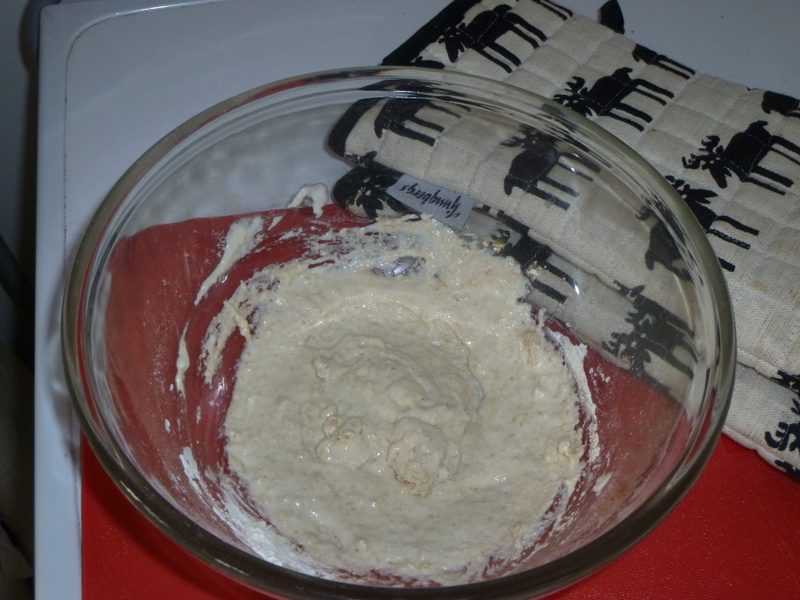
Firstly, make the bun starter. Mix together the flour, water & sugar so the sugar starts to dissolve. Sprinkle in the yeast. and mix well.

Bun dough starter

Starter at the very beginning

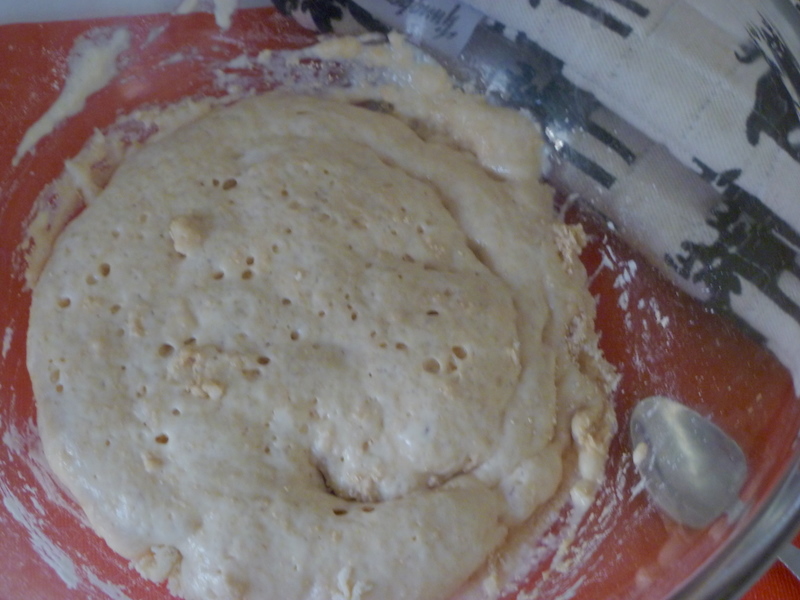
Set it aside for 30 minutes to allow the yeast to start to work.

Bun dough starter after 30 mins

The starter develops bubbles and will rise a little

Add the rest of the dough ingredients, except for the baking powder, and combine well, until it comes together into a dough.

Bun dough

Dough formed

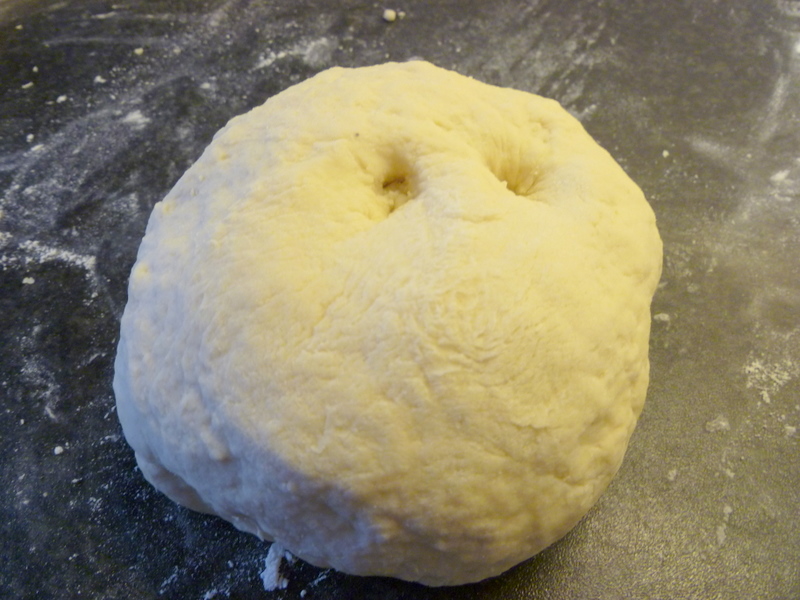
Turn the dough out onto a lightly floured surface and knead, by holding onto the end of the dough with the fingers of one hand, then pushing the top of the dough down and away from you with the other hand. Fold it in half, then make a quarter turn.  Keep repeating the kneading action until the dough becomes smooth and elastic. This should take about 10 minutes. If you over or under knead the dough, it will affect the bread, but it is easy to know when to stop kneading, this will be at the point when a finger jabbed into the dough stays there, and does not disappear.

dough, after first knead

Fingers sticking – good

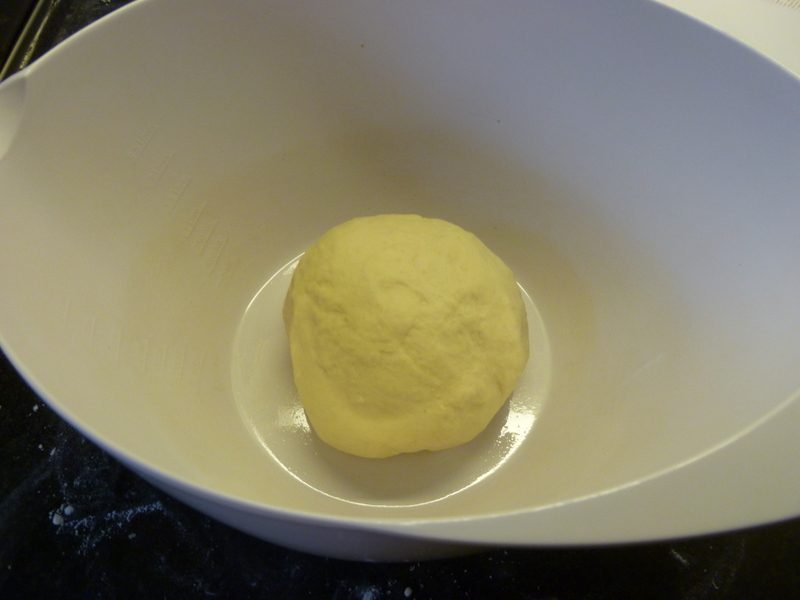
Then put it into a lightly oiled bowl (a large one). The oil should not be strongly flavoured, but you need it to stop the dough from sticking to the bowl.

Dough ball before rising

Dough balls!

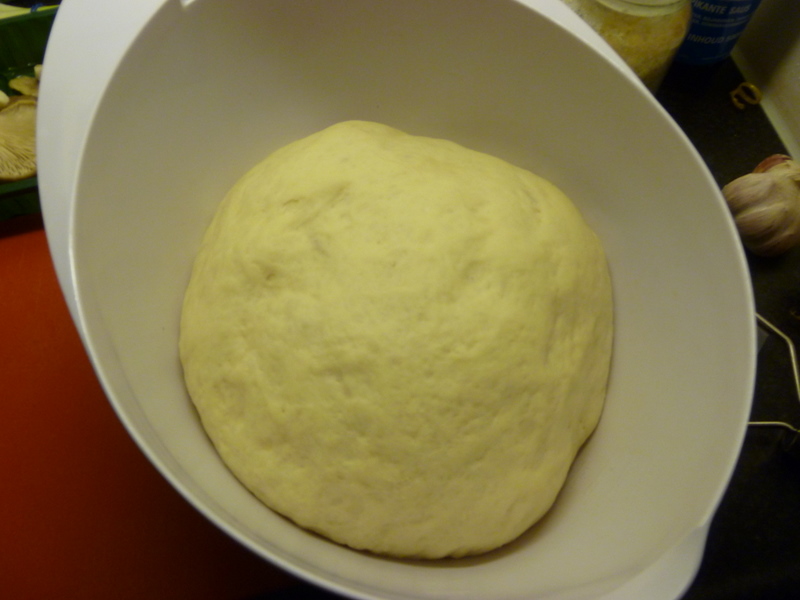
Cover the bowl with a clean tea towel, and place it in a warm place. I use the top of my stairs, which is the warmest place in my flat, due to there being a door at the top of them. You can put it in your warmest room, or an airing cupboard if you have one. Don’t put the bowl directly on a radiator, and keep it out of draughts if you can. Leave it to prove for a few hours (maybe 2-3) until the dough has tripled in size

Dough after proving

Proved, you have large dough balls

While the dough is proving, make the fillings, then set them both aside to go cold.

For the chicken filling, gently sweat the onion and the garlic until translucent. Add the rest of the ingredients, and mix thoroughly. The mixture should not be very liquid, so if it is, slake a little bit of cornflour, and stir it in.

Cicken & Soy Filling

Soy Chicken Lickin’

For the mushroom filling, sweat the onion until translucent. Add the garlic and the ginger and cook until you can smell them.

You will have julienned the leek as part of the preparations. the julienne need to be small.

Julienned leek

Fine cuts

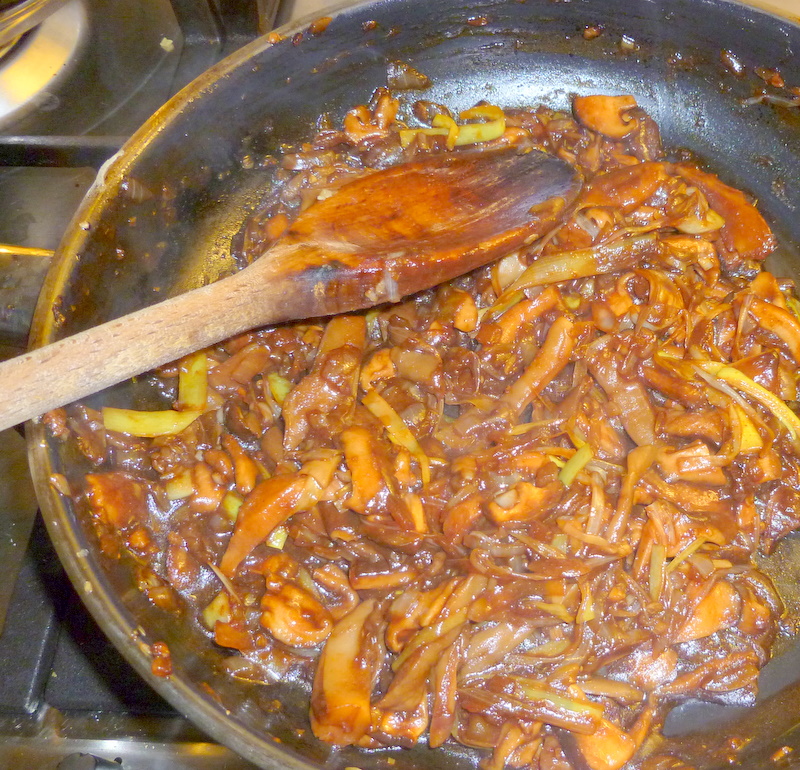
Add these and the mushrooms to the pan, and cook down until the leeks are silken. You will need to stir this so that the leeks don’t burn. The observant may notice that I have sliced my mushrooms instead of chopping them. Don’t do this, it makes the buns harder to stuff. Chopped will be better.

Add the rest of the ingredients and stir well. Again, you don’t want it too liquid, so cook it down if it is runny.

Mushroom Filling

Oyster mushroom filling – much tastier than it looks

When your dough has risen, knock it down (give it a punch until the air goes out of it), then spread it onto a lightly floured surface. Sprinkle evenly with the baking powder, then knead it again for about 5 minutes.

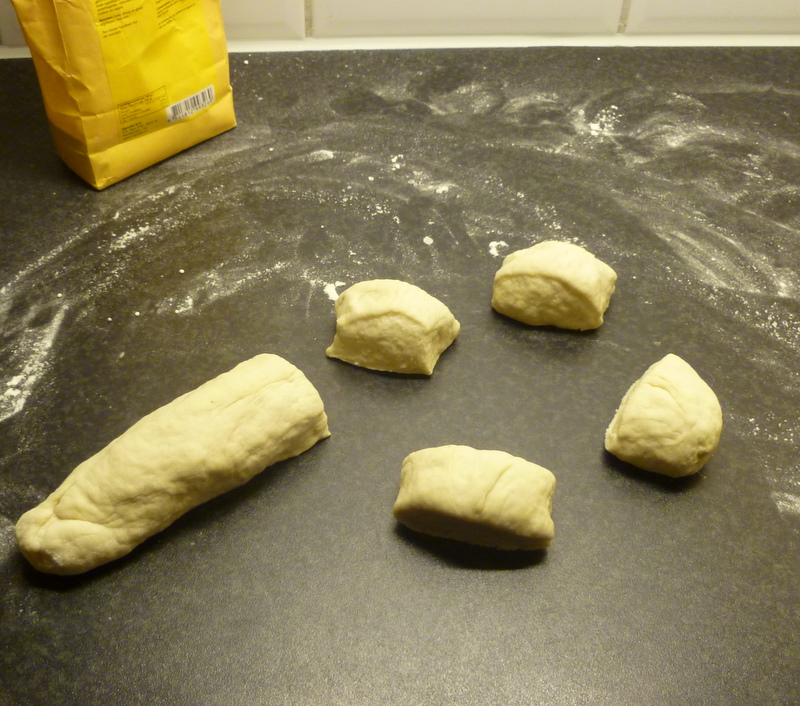
Divide the dough into 2, using a sharp knife. Put one half back into the oiled bowl, and cover it again. Roll the other half into a sausage, then divide it up into 8-12 pieces.

Divide the dough ino bun size

Bun Size Dough Balls

Put any dough that you are not working on back into your bowl and cover it over.

Shape each small dough piece into a round, then flatten with your hands

Flattening the dough

As flat as a Hom Bao

Place about a tablespoon of filling into the centre of the flattened disk.

Buns and filling

Filling

Then draw up the sides of the bun as follows:

Half & pinch

Fold in half over the filling & pinch the dough together

Stretch out sides

Stretch the sides out a bit

Be careful not to stretch the dough too thin,or tear it, because it will split when you cook it.

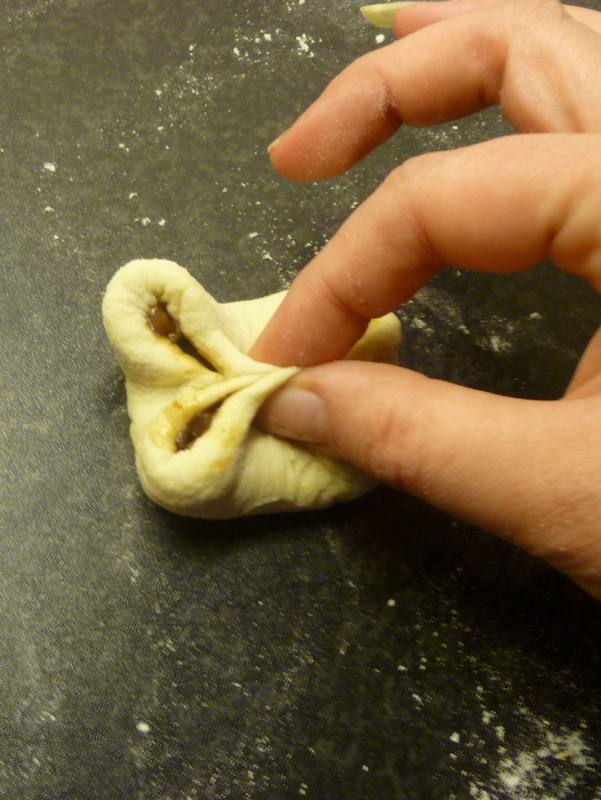
Pinch together

Pinch the sides together

Then bring the ‘gaps’ to the centre and pinch them all together to form a seal.

Sealed Hom Bao

Sealed Hom Bao

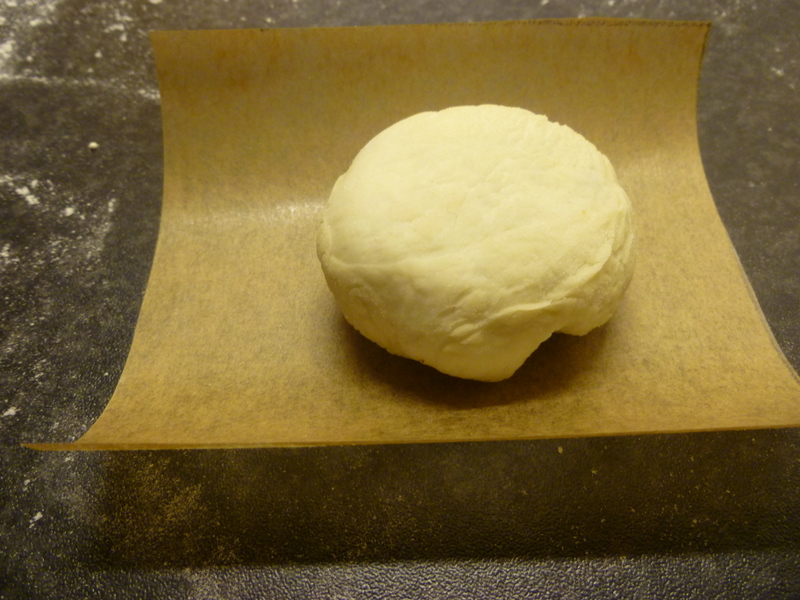
Place, sealed side down, on a 10 cm square of greaseproof paper.

The finished bun

The Finished Bun

Put the bun aside in a warm room, covered with a clean tea towel to prove for a bit more. You should find that you get better as you go along, my last buns were certainly a lot quicker than the first ones.

Repeat until you have finished the dough. You might have a little bit of filling left over, but that’s OK. I used my leftover mushroom mixture up in an omlette, and I intend to have the chicken with a jacket potato.

After about 30 minutes, the buns will have risen a bit more, and should look puffy.

Hom Boa after final proving

Buns – done!

You can then steam the buns over a little water, or brush them with egg wash and bake them in the centre of an oven at 180°C. Either way, they will take about 15-20 minutes, until they are fluffy and hot.

Hom Bao two ways

Hom Bao Two Ways – Golden and Steamed

I split the bao in the front, to show you the filling. Unfortunately, I didn’t capture the steam, but there was a lot.

You cannot freeze the baked bao, but the steamed version freezes beautifully, and they will last a long time. Freeze after steaming, by placing on it’s cooking paper into one of those plastic takeaway cartons. You can fit three or four in each, depending on the size of of your bao.

Steam from frozen, still on the paper. Stick a  knife in to make sure they are warm all the way through before serving.

Leave a comment

Filed under Feast

A Yuletide Legacy

Ham and Bean Soup

A Legacy of Leftovers

The best legacy of a Christmas dinner has to be the leftovers! Since my mantra is Taste not Waste, I am delighted when I can challenge myself to use up everything, so that nothing is thrown out.

The recent festivities yielded an obvious, yet exciting choice. I had a 2cm slice of the baked ham left, along with some cooked carrots from the christmas dinner. I also had a pot of gelatinous stock that came from the boiling bag that I had kept. I initially thought that it might be too salty to use, but you should never pour fat down the drain, so I tipped it into a container, and put it to one side. It turned out that there was actually very little fat in it, and the stock itself was rich, but definitely not too salty.

For the mince pie and mulled wine party, I had intended to make a couple of dips, so I had soaked some chickpeas and some cannellini beans, but as usual my ambition far exceeded the time I had given myself, and something had to give.I was considering just cooking the pulses up, and freezing them, they would have been fine to add to soups or stews from frozen.

However, beans and ham are an excellent combination. If I had more ham left, I would have made a version of a cassoulet, with the addition of some sausage and a tomato liquor to stew it all in. There are a hundred other types of dish I could have tried, but I settled on a soup, as it would make what little meat I had go the furthest.

The result that I achieved from such humble ingredients was brilliant. The soup was so flavoursome and satisfying, it made me quite proud. It really was the perfect way to end the Netherlands Christmas celebrations.

Recipe: Ham and Bean Soup

Ingredients

1 stick celery, finely chopped

1 onion, finely chopped

1 medium carrot, finely chopped

1 leek, trimmed, washed and sliced into half moons

1 clove garlic, very finely chopped

Bacon fat to sweat the vegetables in

80 g ham, diced, more would be great, if you have it

1 tsp smoked paprika

200 g soaked weight chickpeas

300 g soaked weight cannellini beans

350 g ham stock. I have given a weight here, because the stock was solid when I added it to the soup. I would normally say that you could substitute one stock for another one, but in this soup, especially if you don’t have that much meat, I think that ham stock is integral to the flavour

Boiling water to cover

50 g cooked carrots. If you don’t have any leftover carrots, then use more raw ones

Small bunch chopped parsley

Method

Firstly, if you need to, soak and cook the pulses. You could also use a single tin of cannellini beans if you must, but the dried version will bring an extra dimension to the soup.

Prepare the vegetables, and sweat them off. I never throw away fat (of course) and I had a little fat left over from frying bacon, which I used to sweat off the vegetables, in order to maximise the flavour. This is by no means necessary, you could just as well use olive or sunflower oil.

Once the fat has melted, sweat off the onion, celery and the raw carrots for three or four minutes, before adding the leek. Leek burns easily, and the last thing you want is the bitter taste of burnt leek in this soup. When the leek is translucent, add the garlic and the smoked paprika, and let them cook off for a minute or so.

Stir in the ham and the beans, until they have a light coating of the smoked paprika, then add the stock and a little boiling water. The stock will melt down quickly. Top up the soup with more boiling water, so that the liquid covers the rest of the ingredients.

Simmer for about 10-15 minutes, until the vegetables are tender to your liking. Add the cooked carrots, and simmer for another minute, to warm them through. Before serving, stir through some chopped parsley.

Great the day that you make it. Even better when you reheat the last bowlful for lunch the next day.

1 Comment

Filed under Feast

Asparagus Soup

As a child, I didn’t eat many vegetables. As an adult, I eat many more, and I love to eat seasonally. This is why you will probably often hear me saying that such-and-such a vegetable is my favourite. It would probably be more accurate to say that such-and-such a vegetable is my favourite right now.

At the moment we are into the asparagus season, and it is cheap and plentiful. And right now, asparagus is my favourite vegetable.I eat it with eggs, in salads, on its own with butter, in risottos – you name it.

In general, the bottom end of the stalk becomes tough and woody, so it is best to cut, or snap it off. I really hate throwing food away, especially something as tasty as asparagus. So,  I decided to try to use these woody stalky bits up.

Soup is the obvious answer. First, I tried to blend it in a food processor, but this just resulted in smaller woody bits in the soup. I also have a food mill, and one day I tried it through that, and it turned out that the low tech version was the best, since the woody bits are not passed through the mill. I really recommend these – I picked mine up for a tenner back in the UK, and I use it weekly.

This year I planted my own asparagus, and freshly cut asparagus should not have the woody stalky bits. I wonder if this soup will continue to feature in my spring repertoire? I hope so, it really is good!

The following recipe varies in amounts, depending on how many stalks you have been saving in the fridge. The stalks will keep for up to 10 days (depending on age when you bought them, and the width of the stalks), so you can save them up from a couple of bunches to get a good amount, if you like.

Recipe: Asparagus Soup

Ingredients

1 chopped onion

1 tbsp olive oil

Asparagus stalk ends

Chicken or vegetable stock

Thyme

Crème fraiche (cream or milk would also work)

Method

Sweat the onion and thyme in the olive oil, until the onion is fairly soft, but not coloured.

Add the asparagus to the pan, and cook until it has turned a vibrant green

Add the stock. You need to allow enough stock to cover the vegetables in the pot by a couple of cm.

Bring to the boil, then simmer until the stalks are tender to the point of a knife. The time for this can be anything from 5 minutes for the really thin stalks, up to 20 minutes for the later season asparagus.

Take off the heat and allow to cool for 5-10 minutes. Then, pass through the food mill into a clean pan.

Add a little crème fraiche. Again, the amount you add will depend on the amount of soup that you have. Season with salt and pepper.

This soup can be served hot or cold, especially if you are having a really warm spring/ summer, like the one that we are having now.

If you are serving it cold, add a little water to thin it, allow to cool completely, then refrigerate for an hour or two. Garnish it with croutons, cooked asparagus tips, small dice of cucumber (seeded and peeled), or some of all three. A little chervil can be chopped and stirred through, or used as a garnish as well. Check for seasoning before serving, as cold soup can often need more seasoning that its hot counterpart.

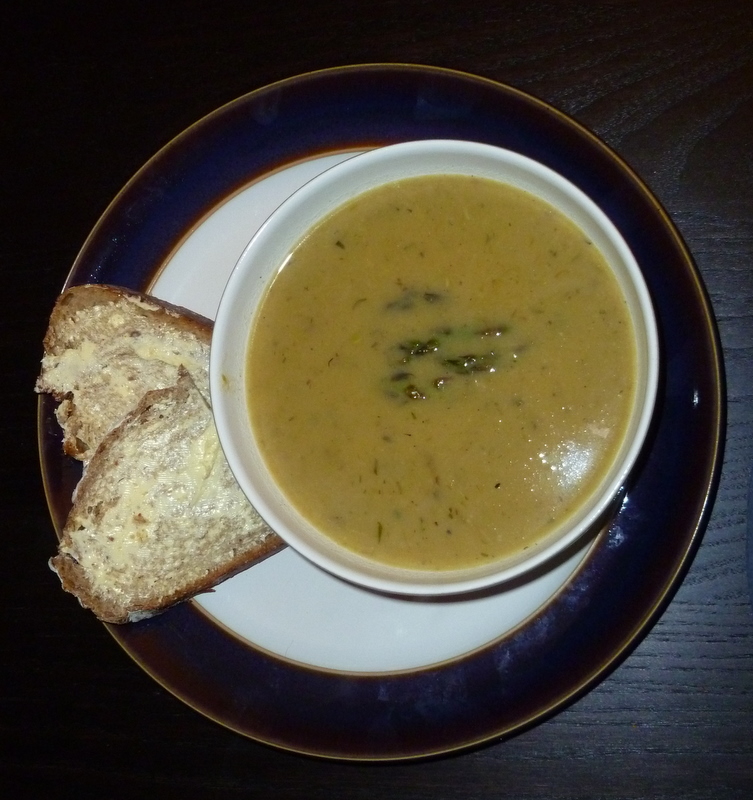
If you want to serve it hot, warm the soup gently, without boiling. The soup can be made ahead of time, and warmed through at a convenient time. Garnish with cooked asparagus tips, chervil, or a dollop or swirl of the crème fraiche. Serve with buttered brown, rye or sourdough bread. I prefer bread, as opposed to toast with the hot version of this soup.

Leave a comment

Filed under Feast