Tag Archives: Recipe

Very Suisse!

Meringue Suisse

A Swedish Childhood Dessert

As you will know when I got my Foodie Parcel last month, I was very excited to receive a broken meringue as part of a lovely package.  I promised Teresa that I would blog the recipe for Meringue Suisse, which I knew I was going to make as soon as I saw the broken meringue.

This is a dessert that the Big Guy had often in his childhood. In Sweden. I am not really sure where the Swiss thing came from, although I could probably surmise something about Swiss chocolate, or the fact that it resembles the Matterhorn or something.

This time, I made the basic recipe, and used good quality vanilla ice cream from the shop. As with most simple recipes, the better quality the ingredients, the better the final dish will be. Teresa’s meringue and chocolate were both of such quality that I didn’t want to mess around with the recipe too much.

The basic recipe I give here is pretty simple, but you can play around with it, if you like. Try adding soft fruits (the Big Guy’s family add bananas, but I’ll be having none of that!). You can make it fancy by making your own ice cream or meringue, or you could even make praline or do a bit of sugar work. Crumbled amaretti biscuits could also be a very good topping.

What other toppings or additions would you choose?

Recipe: Meringue Suisse

Ingredients

Good quality vanilla ice cream

1-2 tsp slivered almonds

60 g dark chocolate, broken into chunks

15o ml whipping cream (to be used in 2 parts)

Knob of butter

1 meringue, broken into pieces

Method

Remove the ice cream from the freezer, so it can soften to a scoopable consistency.

Toast the almonds in a dry frying pan. You will need to watch them carefully, and stir them often, as they catch easily. Once they are a nice golden colour on both sides, remove from the pan, to prevent them from cooking any further.

Combine the chocolate, 50 ml of the cream and the butter in a saucepan. Cook over a very low heat until the chocolate has melted. Don’t stir it at this stage.

Meanwhile, whip up the remaining cream to soft peaks.

Once the chocolate has melted, remove from the heat and stir the sauce well to combine it. It may look a little grainy at first. Don’t worry, keep stirring it and it will become a smooth and glossy sauce. Allow to cool slightly, so that it does not melt the ice cream immediately.

Scoop enough ice cream for two people into a bowl, and combine with the meringue. You will need to have reasonably soft ice cream for this. Put the ice cream and meringue mix into serving bowls and top with the whipped cream.

Pour over the chocolate sauce and sprinkle with the toasted almonds. The chocolate sauce should go a wonderfully fudgey texture when it hits the cold of the ice cream.

This is a very easy dessert, but one that looks and tastes impressive. The only question is how will you top yours?

Leave a comment

Filed under Feast

Sauce Grib-ish

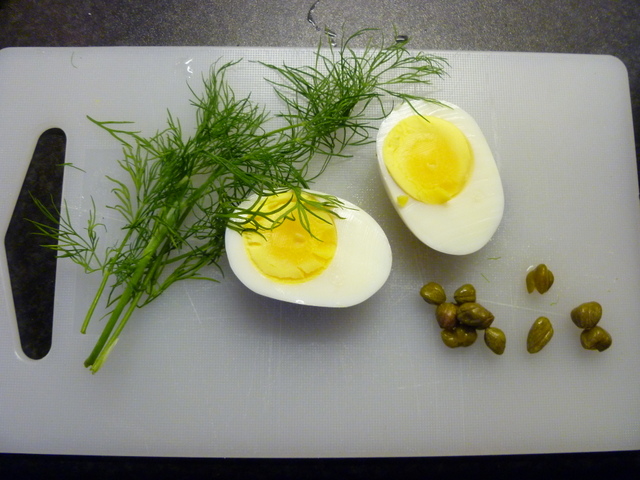
Dill, Boiled Egg & Capers

Ooh, Saucy!

I first had a dish like this whilst having dinner at my friend’s. He writes the excellent Morning Claret wine blog. He really knows his stuff, so if you want some good wines, and great writing, go and give him a visit. Both he and his partner are very accomplished cooks, and it is always a joy to be invited to their house for fine wines, great food and excellent company. His version had anchovies in it, and he served us boiled globe artichokes to dip in it. I loved it, and decided that I would have a go at recreating it.

A bit of research later, and I have found that it was a variation of one of two classic French dishes. Either Sauce Gribiche or Ravigote. Of course, as with any classic dish, there are a lot of variations and the lines are blurred between the two. It seems that ravigote is more like a vinaigrette to which chopped boiled egg has been added, and in gribiche, the yolk is used to make a mayonnaise, and the chopped white is added. This is sauce is not quite either of those things, so I have called it Sauce Grib-ish.

I first made this after an Easter egg hunt left me with quite a few boiled eggs to use up. It also needed to be vegetarian for the friends that I had coming over. It is so versatile, you can serve it as a dip, over asparagus, or with fish and chicken. I’m also going to try to make a potato salad with it, I think it will be a great combination.

I am entering this simple seasonal sauce into Herbs on Saturday at Lavender and Lovage, although I only use dill in the recipe given, it will also be really good with tarragon, chervil or even parsley.

Sauce Grib-ish

Sauce Grib-ish

Recipe: Sauce Grib-ish

Ingredients

This sauce is easy to scale up or down, depending on how many people there are. I have given the amount for two people to have as a sauce to go with vegetables or fish. Taste is the key to this dish, as you need to balance the richness of the egg with the acid of the lemon and/or caper vinegar. The amounts I give here are approximate, so keep testing and adjusting the sauce, according to taste.

1 egg, hard-boiled

2 tbsp capers plus vinegar from the caper pot

Juice of ½ a lemon (or just the vinegar from the capers)

Small bunch dill, finely chopped

Good quality extra virgin olive oil

Method

First, halve the egg, and remove the yolk. Then finely chop the white.

Mash the yolk with a little lemon juice or vinegar. You want the yolk to be a smooth, runny paste, about the same consistency as thick pancake batter.

Roughly chop the capers, and mix together with the dill, egg yolk and egg white. Taste and adjust for acidity, adding caper vinegar if needed.

Add some olive oil and taste and adjust again. The amount of olive oil you need will depend on what you want to use it for. For example, if you are serving it as a dip with crudités, you will want a thick sauce that will stay on bread, tortillas or short lengths of carrot and cucumber. If you want to serve it to accompany artichokes or asparagus, you will want a much thinner consistency, so add more oil. For potato salad, you will want it somewhere in between. The oil will also alter the acidity, so make sure you taste and adjust as you go along.

5 Comments

Filed under Feast

Salad Daze

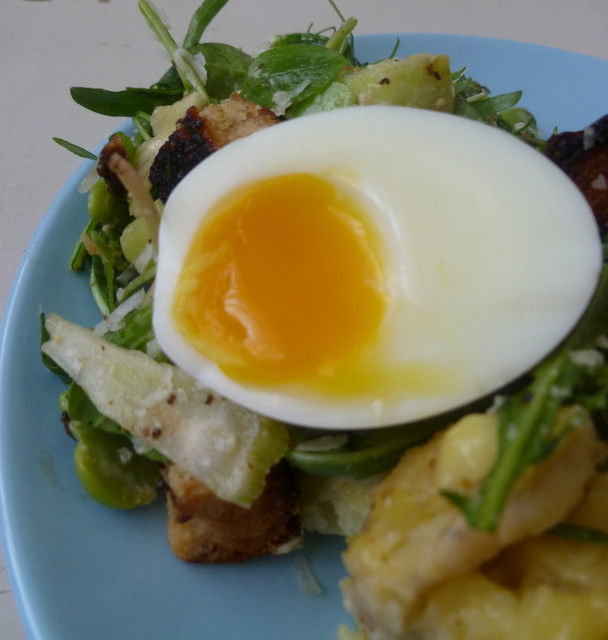
Boiled Egg and Salad

Salad as Protein

Obviously, we are now at the height of the salad season. I have an abundance of rocket, leaf salads, radishes, cress, mustard greens and more. And yet, I am about to do a post that focuses largely on the less usual salads and ingredients that I have been having since last I updated you on the 52 week Salad challenge.

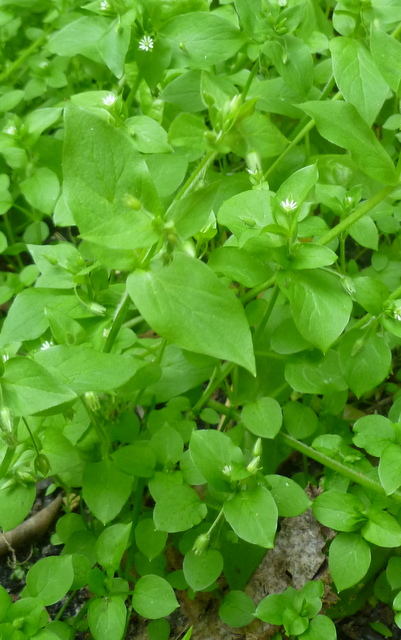
Chickweed Stellaria media

Salad as Easy

I remain loyal to chickweed, and luckily it seems to remain loyal to me. I have been eating it for what seems like months now. I remember that I lamented the lack of chickweed back in the spring, and thought that the conditions in the Netherlands were not suitable. It turns out that I was wrong. Chickweed loves the growing conditions here, but it does appear about 6 weeks after it would in the UK. It has kept me and the guinea pigs happy for quite a while. I have no idea why people write this off as a weed, I think it is delicious.

Mixed Salad with Broad Bean Tips

Salad as a New Kind of Shoot

Back in June, I was also including broad bean tips to my salads. These really are the gardener’s treat, as they don’t keep well, so must be used fresh from the plant. This year, I was also fortuitous in that I hadn’t quite got round to eating my dock and digging it up. I have discovered that blackfly love dock much more than my beans, so they remained pretty free from these sap suckers. Since dock is edible, and has proven to be so effective, I shall probably not be so hasty to remove it all in future, as long as it stays out of my raised beds.

Salmon Fishckes, collaboration salad, Taboulleh & Sauce Grib-ish

Salad as Leftovers

This past month, herbs have also featured heavily. I am finding that herb fennel, dill, mint, basil, and parsley have become a regular addition to my salads, as well as providing me with lots of tabbouleh, and sauces.  I have also been adding herbs to salad dressings. I’ve always used thyme, of course but lately, my oregano has gone crazy, so I have been looking for recipes to use it in. I found this lovely oregano, mint and lime dressing by Laura of How to Cook Good Food. It was an entry in Karen’s Herbs on Saturday Challenge, and has been on heavy rotation in our house since I came across it. It is really a salad dressing for summer.

Mixed Family Salad

Salad as a Family Affair

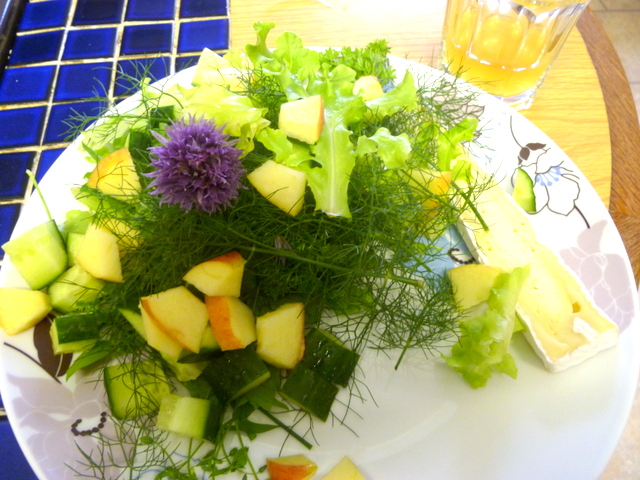
Back when it was my Mum’s birthday, I made a lovely collaborative salad of leaf lettuce from my sister’s garden, fennel, mint and chives from my mum’s garden, and foraged chickweed. I also added carrot and radish leaves, and was very happy when it all went at her birthday barbecue. I also livened up a simple pasta and chive salad, by mixing in a separated chive flower. I think I converted one of Mum’s friends, who was pretty amazed when she found what it was. She didn’t know chive flowers were edible, but said she would try them from now on.

Summer Vegetable Nage

Salad as Soup

Another herb that has been featuring in my cooking of late is chervil. Although you rarely see chervil in the shops it is really easy to grow, and I have many pots and planters with it. I love this delicate little herb, and it makes a great addition to any salad. It goes so well with broad beans and peas too, as you can see from this vegetable nage I made a while ago.

Something else I really love, especially when the weather is a little too cold for salad is to braise lettuce, beans and peas in a good stock. A dish that is made even better by the addition of a little chervil just before serving.

Braised Salad, Beans & Peas

Salad as a Side Dish

(c) P. Caspar 2012

Recipe: Braised Lettuce, Beans and Peas

Ingredients

This will serve four people as a side dish

100 g podded weight broad beans

100 g shelled weight fresh peas

2-3 Little Gem lettuce, depending on size. This dish also works well with Witloof chicory, and other firm hearted salads

400 ml chicken or vegetable stock

Small bunch chervil, finely chopped

Method

Briefly cook the beans and peas in unsalted boiling water. You can use the same pan, but the beans will need 3-5 minutes, depending on size, and the peas will need 1-2, so add the peas to the pan after the beans have had a couple of minutes. Once they are cooked, drain and refresh in cold or iced water.

Double pod the beans.

Halve and rinse the little gems. You need to keep the stalk, so that the lettuce stays together during the cooking.

In a sauté pan, heat a little oil. Once hot, add the lettuce and cook briefly. You want a little colour on the leaves, but be careful, as they will burn easily. Turn them once to get similar colour on each side. If you prefer a thicker sauce, you could stir in about a tbsp. of flour at this point, and cook it out briefly. I don’t often bother with this stage, unless I am going to use this as a soup.

Add the stock, and cover. Bring to the boil then simmer for about five minutes. Add the peas and beans and heat through for another minute or so. Just before you serve, season a little, if needed and stir through the chervil.

This makes a great accompaniment for most main courses, or you can shred the lettuce a little when it is cooked, stir through a little cream, and serve as a light soup.

4 Comments

Filed under Farmed

They Called me the Wild Rose

Wild Rose Jelly

…But my Name was Eliza Dane

I’ve been back collecting rose petals again. As I mentioned in my post about rose cordial, the roses in my favourite spot are probably rosa acicularis. These are quite a long flowering variety, and you don’t need that many for this recipe, so you can still find them now if you try. Don’t forget to leave the bees behind when you pick them, though.

This time I made a really delicately flavoured jelly. My version definitely has all the flavour of rose, but has quite a subtle colour. If you would like a darker coloured jelly, then you can boil the petals up in the water before you add the apples, but I personally don’t think it needs it.

I have never made rose petal jelly before, but once you have the proportions in your head, making jelly is easy. You will need a jelly bag, or muslin and a sieve to strain the liquid. I have a thick piece of muslin that I nail to the frame of a chair with the seat removed, and that works well for me. Whatever method you use, it needs to support a bit of weight.

This makes 3 standard pots of jam, but I actually used smaller jars, as it was a lovely one to give away as gifts. I was also thinking ahead to possible foodie penpals. When I sent my first parcel out, I found to my penpal’s cost that sending jars mean that I can send much less, due to weight limitations. A nice work around is to try to send small jars as testers. I will see if that works.

This jam is a good breakfast preserve, and nice with yoghurt. However, I actually think this has more potential as a glaze for patisserie. I am going to try making a raspberry tart, and use rose petal jam as the glaze, where you would probably ordinarily use apricot jam. Of course, I shall let you know the results when I try it.

Wild Rose petals

Pretty In Pink

Recipe: Rose Petal Jelly

Ingredients

15 g rose petals

500 g apples

400 ml water

Granulated sugar – the exact amount will depend on how much liquid you have

Method

Rinse the rose petals, and remove the claw.

Cut the apples into chunks. There is no need to peel or core them, as this contains pectin, which you need to help the jam set.

Place the apples, petals and water in a pan, and bring to the boil. Reduce to a simmer, and cook for half an hour. At the same time, boil your muslin to sterilise it.

Strain the fruit pulp through your muslin/jelly bag/ whatever set up you use into a large bowl. Leave  it to strain overnight, so you get the maximum amount of juice from your pulp. Don’t be tempted to squeeze the bag, or push the pulp through though, or your beautiful clear jelly will be cloudy.

I usually make fruit butter with the leftovers from jelly making. It is a tasty preserve, but it does have a short shelf life. Unfortunately, I didn’t have enough time to make it or to find homes for the pots where it would not go to waste. As there has been no sugar added, you can still compost the pulp with no adverse effects.

Before you start to make the jelly, sterilise some jars. You can do this in various ways, including washing them in hot water, rinsing well, and putting them in a warm oven; you can steam them in a pressure cooker; or wash them in a dishwasher, being careful to time your cycle with about the right time that the jam is ready. At the same time, boil your muslin to sterilise it.

Measure your juice that was strained from the pulp. This is where the proportions come into play. For every 600 ml of juice that you have, you need 400 g sugar.

In your preserving pan, gently warm the juice and the sugar, stirring while the sugar dissolves. Then bring to a rapid rolling boil. Allow to boil like this for about 10 minutes. Your jelly will have reached setting point at 104.5 °C, or when you get a skin forming on jam dropped on a cold plate and left in the cold  for a minute.

Pour into the sterile jars while both are still hot. Fill to within 3 mm of the top, then put a wax disc over it, wax side down. Seal with a screw lid, or a cellophane cover.

Label them and give them a week for the flavour to develop. Once you have opened a jar, keep it in the fridge.

1 Comment

Filed under Found

Birthday Brownies

Choc and Orange Brownie

A Birthday Treat

The other day was the Big Guy’s birthday. He loves chocolate, and I had some extraordinarily good chocolate with orange pieces that was given to me by my Foodie Penpal. I had been saving that chocolate for a special occasion, and what better than to make a birthday cake?

JD Gross Premium Equador Chocolate

Fit for a Birthday Brownie

I decided that a Brownie would be right up the Big Guy’s street. And that I would use the extraordinarily good chocolate as the chocolate chips inside. I used JD Gross Finest Chocolate Ecuador. It has very good candied orange in it, the pieces are still chewy, and spike the chocolate throughout. I boosted the orangey hit with a tablespoon of marmalade, but you can just use the marmalade if you can’t find the chocolate. Or you could use some chopped candied peel, if you prefer.

The first and last recipe for making brownies that I learned came originally from Nigel Slater. I just adjust the things I add, but always use this method and it has never let me down. If you make this you will understand why I go back to it time after time.

Recipe: Chocolate Orange Brownies

Ingredients

200 g good quality dark chocolate, broken into pieces

300 g golden, unrefined sugar

250 g butter

3 large eggs, beaten

1 tbsp marmalade

60 g plain Flour

60 g cocoa powder

½ tsp baking powder

Pinch of salt

100 g JD Gross Finest chocolate, very roughly chopped

100 g almonds, roughly chopped

Method

Preheat the oven to 180°C, and line a tin with baking paper. I use my roasting tray for this, and it is the perfect size. A largish square cake tin will also be fine.

Make a bain marie from a saucepan, with a little boiling water in the base (not more than 3 cm deep) and a bowl over the top. Don’t let the water touch the bowl. On a low heat, melt the chocolate in the bain marie. Don’t stir it too much, just let it sit, or you risk it going grainy. If there are floaty lumps of chocolate , just push them under the molten bits, and they’ll soon melt.

While the chocolate melts, start beating the butter and sugar together. I have a hand-held electric whisk. The butter & sugar must be softer than a gentle whisper, so I’d recommend this as a minimum, unless you are Geoff Capes.

What the butter & Sugar should look like for the birthday brownie

Pale and interesting

Keep going until the butter and sugar is almost as pale as consumptive Victorian. Please don’t skimp, because you are incorporating air, and it will help produce the most amazing consistency when you eat it later.

As soon as the chocolate has melted, add the marmalade. Once this has just melted, remove the bowl from the bain marie and leave it aside to cool a little.

If your butter and sugar is not quite ready, go back and whisk it some more. You need it to be almost runny, but not actually runny, there won’t be a lot of air in that, but trust me, you’ll know because it gets very creamy.

Sieve together the flour, cocoa, baking powder, and salt. This is also supposed to incorporate air, but I often don’t bother with just flour. I have never tested this, by baking one with and one without sifting, but I also don’t get flat cakes, either. However, when cocoa is involved, I always sift it, because cocoa can get a bit lumpy, and it will make your cake feel gritty, until you bit through a lump and get raw cocoa in your mouth.

Incorporate the beaten egg into the butter and sugar, a little at a time. Make sure that it is well mixed before adding more. You can also increase the speed at which you beat each time you add some egg.

Fold in the melted chocolate, chopped chocolate and nuts, using a metal spoon. You don’t want to knock all the air you took ages adding, so only mix until the moment there is no more pale butter streaks.

Fold in the flour and cocoa, and again, only mix until you see no more flour. Be gentle, this is time spent with your cake batter, not a sprint race.

Pour your batter into the prepared cake tin, and use a spatula to get the sticky bits from the bowl. Or if it is your Big Guy’s birthday, you can also let him take the rest of it with a spoon, or his finger.

Smooth the top of the batter in the tin, and put it in the oven for 30 minutes. The cake will sink slightly in the middle, this is perfectly acceptable (I’m not Mary Berry), and is because of the rich, gooey consistency.

Pierce the centre of the brownies with a skewer. In this recipe, unlike many cakes, you want the skewer to be a bit sticky. It should not have any raw cake mixture on it though. Again, you’ll have to trust me when I tell you that the difference is obvious. If it is not quite done, bung it back in the oven, but beware that the difference between raw cake mix and sticky is small, so it should take less than 5 minutes, check it after 3.

If you are going to eat this warm, and it really is tempting, leave at least an hour after it comes out of the oven, or it will be too liquid. These brownies solidify a bit as they cool. Divide them into 12 brownies after the hour.

Rich Choc & Orange Brownies

Everything a Good Brownie Should Be

The brownies are gooey and rich as a warm dessert, for sure. But they really are very, very good served cold, because they have that perfect combination of the crisp shell and rich, soft centre, studded with the nuts and chunks of that extraordinary chocolate.

Eat them on their own, if you must, but they are better with cream or a good vanilla ice cream.

These brownies also keep well in an airtight container, and remain moist and fudgey.

Leave a comment

Filed under Feast

A Whole Lot of Rosie

Wild rose petal cordial

Entente Cordiale

At the same time as we collected all the elderflower, we were also delighted to find some wild roses. The most common of these is the dog rose, but they have mostly gone over in the more accessible places. I did manage to get a photo, but couldn’t reach the  blooms, as they were on a steep slope, and behind a lot of brambles.

Wild Dog Rose

Dog Rose

Luckily, we also came across a load of what I think is most likely to be prickly rose, or rosa acicularis. This is a really beautiful rose, with abundant, dark pink flowers. They also have a lot of thin thorns on them. I was so excited to find them that I forgot to take pictures, but I’ll try to go back soon to get some. When the sunshine comes back. If the sunshine comes back.

The good news is that all rose petals are edible. The more highly scented, the better they will taste. As well as some basic foraging rules please be careful that the roses that you use have not been sprayed with any pesticides, which can be an issue if you are foraging in a park. Another word of caution; if you are allergic to bee stings, like I am, please check each flower before you pick the petals. Bees love roses, and will spend a lot of time feeding from each one. I very nearly picked one up with some petals, but it warned me by buzzing angrily, and I quickly dropped the petals. Bees are quite polite really, and will warn you before they sting.

You could dry the petals, and use them in cakes and jelly, or even brush them in egg white and dip them in caster sugar to crystallise them and then use them as a cake decoration.

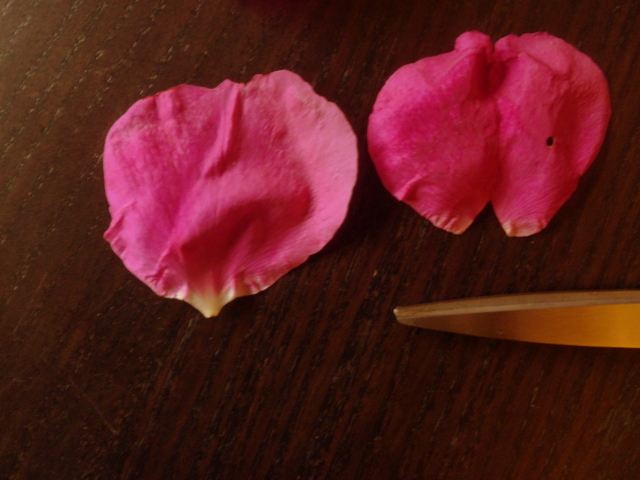
Rose petals with & without claw

The white claw (L) is bitter and must be removed

When you use rose petals, you need to remove the claw, or the part where by which the petal is joined t the rest of the flower. This is bitter and can taint your produce. I usually just snip them off with scissors.

The first thing that I made was a cordial. This recipe is inspired by one that Sandie made at Herb and Wild Food Recipes. Sandie intended to make a jam, but actually made a syrup with dog roses. I used the same technique to prepare the roses, and then made a cordial as I would normally. This is a great blog, full of wild food recipes, so please do go and have a look.

It has also taken on the dark pink of the rose. I have had it as a refreshing drink, but I’m also going to try this in a syllabub, and maybe to cook some gooseberries in. If you have any suggestions for ways to try this cordial, I’d love to hear them in the comments.

Recipe: Rose Cordial

Ingredients

2 large handfuls of rose petals (claws removed as above)

Juice of a lemon

500 ml water

300 g sugar

Method

Sterilise a 500 ml bottle and the lid. You can do this in a number of ways. I find it trickier to get bottles clean in the dishwasher, as I would do for jam jars. You can wash them in hot soapy water, using a bottle brush to get into the nooks and crannies. I give them a good soak in the steriliser I use for brewing before I rinse, and put in them in a w arm oven (150°C). If you have a pressure cooker, you can also hold it in steam.

In a saucepan, add the lemon juice to the flower petals and the water. Simmer for 15 minutes.

Strain through muslin, and return the liquid to the saucepan. As you would expect, I didn’t throw out the rose petals. I have a great recipe for them to come. You can refrigerate or freeze them, if you want to use them later.

Add the sugar to the rose-water, and heat, stirring until the sugar has dissolved. Allow to simmer for five minutes, then hot-fill the sterile bottle.

Keep this little jewel in the fridge.

3 Comments

Filed under Fermented, Found

Flowers and Spice and All Veg – Nice!

Moroccan Vegetable Stew with Cous Cous and Coriander yoghurt

Souk Food

The other day I wrote about going foraging with Liz Knight with Mum on her birthday. What I didn’t mention is that she also had one of the stalls at the Tudor Farmhouse Market. She sells all manner of spice rubs, sauces, and syrups at fairs and some shops, and they are also available online.

We came away with a honeysuckle and tarragon syrup, and a Wild Rose el Hanout, based on the Moroccan spice mix. The original translates as “head of the shop”and is a blend of the best spices that a merchant has on offer, and is therefore supposed to act as both a luxury product and the best marketing tool that the merchant as at his disposal.

As the name suggests, the Forage version uses wild roses and spice, giving a heady blend that is every bit as luxurious as the Moroccan version. Liz also recommends adding it to a fish and tomato stew, which I will definitely be trying. If you haven’t managed to get hold of a pot of this lovely spice rub, you can use Ras el Hanout instead.

You may also remember that I resolved to make more Middle Eastern food back in January. I had a Moroccan spice, although Morocco is not exactly the Middle East, I was thinking of the fragrant dishes and spices that also encompass much North African cuisine. This seemed like a good place to revisit those resolutions, and get the whole commitment to them kicked off again.

I made this for a vegetarian dinner party. Because I used fresh tomatoes, I found that the sauce was quite liquid. I actually liked it that way, but you could thicken this by using tinned tomatoes, or add some tomato puree to the stew about 15 minutes before the end of cooking.

It is traditional to keep the vegetables quite big in Moroccan cooking, which also cuts down on the preparation time, making this a pretty easy evening meal.

I garnished it with some yoghurt with chopped coriander stirred through, although it is perfectly good without it, so you can leave this out if you want a vegan dish.

Recipe: Moroccan Vegetable Stew and Couscous

Ingredients:

For the Stew: 

2 shallots, peeled and quartered

1 red pepper, cut into very large dice

2 cloves garlic, peeled and sliced

2 tsp wild rose el hanout

2 carrots, cut into chunks

1 large courgette, quartered lengthways, then in cut into chunks

1 aubergine, cut into chunks

About 400 ml vegetable stock (enough to come about 2/3 of the way up the pot)

1 tin chickpeas, drained and rinsed

4 tomatoes, quartered

Bunch coriander, including the stalks, chopped

For the Couscous: 

400 g couscous

500 ml vegetable stock

Zest of 1 lemon

1 tsp wild rose el hanout

2 tbsp good olive oil

This recipe serves four people

Method


On a low heat, soften the shallot for about 3-4 minutes in a deep saucepan. Add the pepper, and continue to soften. When you can see changes in the flesh of the pepper, after about another 5 minutes, add the wild rose el hanout, and the garlic, and cook until the fragrance hits you.

Add the carrots, courgettes and aubergine to the pan, and cook down for 5-10 minutes, until the courgettes and aubergines start to give and soften. You will need to stir them well when the veg first go in, to distribute the spice mix, then occasionally as they cook down.

Add the stock, and bring to the boil, cover, then reduce to a simmer. Cook until the vegetables are soft.

While the vegetables are cooking, make the couscous. In a large bowl, stir the wild rose el hanout and the lemon zest through the couscous. Add the warm stock, so that it covers the couscous by bout 1cm. Cover and set aside to allow the couscous to absorb the stock.

Add the chickpeas, tomatoes and the coriander to the stew, and warm through for five minutes.

Add the olive oil to the couscous, and fluff up with a fork.

Serve the stew atop the couscous.

I liked this couscous so much, it s difficult to imagine that I won’t be stirring through some wild rose el hanout every time I make it from now on. At least until the jar runs out.

Leave a comment

Filed under Feast

Beans, Beans are good for your …Burgers!

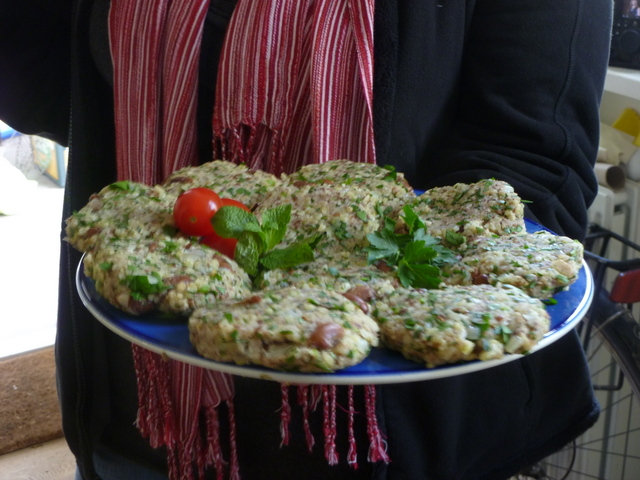
Bulgur & Bean Veggie Burger

Barbecues – Not Just for Carnivores

You may have gathered by now that I like to barbecue. We don’t have a fancy grill or gas burner, and rely on simple charcoal. I don’t really see the point in lighting up a barbie if it is only going to be the two of us, so I tend to supersize mine, and invite loads of people. I’m pretty well-practiced at it now, and can happily cope with 20-30 guests.

We fill a baby bath with ice, for the drinks to chill in, and I set about making the things that will go onto it, with various salads, and dips. There are a few things that must feature – ribs, sausages, vegetable skewers, and of course burgers. I make my own meat burgers, and I don’t leave out veggie friends.

BBQ used as heat for guests

Burn All The Things

Of course, as is tradition, I do all the prep work, and step back to let the Big Guy get the glory, as he (and often a few other grill kings/ queens) ‘caramelises’ my food.

I am not a fan of fake meats. I know that they have saved many a vegetarian at a barbecue, but they just aren’t for me. These vegan burgers are not pretending to be meaty, I think that their flavour and texture is good enough to speak for themselves. And they are great in a bun!

The recipe is a good basis for a veggie burger. From here, you can change the spice mix, substitute coriander for the parsley, use fresh chilli instead of the cayenne pepper, or add nuts or some other vegetables to the mix. I have made a few variations myself. I’d love to hear your variations, and maybe steal them give them a try.

These burgers keep well in the fridge or freezer, and you can cook them in a frying pan too, if you don’t have enough people round light the barbecue.

You may have noticed that a lot of my recipes have been veggie or vegan lately. This is because a friend recently cycled the Dunwich Dynamo, and I agreed to “sponsor” him by signing up to reduce my carbon through Do-Nation. This is a great way of getting people to do a few simple green actions for a short period of time, to see how they get on. It is also a lovely way to help people to feel involved in supporting your event without asking them to donate money, which can be a little awkward in these straightened times. The actions themselves are not too difficult to achieve, and it may get a few people to continue to do them, after all it is supposed to take 30 days to form a habit, so after 2 months it may be second nature.

Peter managed to smash the carbon target that he set himself at the start. I chose the Veg Out option. I really don’t eat all that much meat, so for two months, I have pledged to cut it even further, and also to go vegan a couple of days a week.

The Dunwich Dynamo took place over the weekend, and so far reports are that my friend is very happy, and a little sore, but I expect that there will be no lasting problems. Congratulations Pete, on getting your friends to take some small carbon friendly actions, and for the epic ride!

Bulgur & Bean Burgers Ready to Grill

Grill Ready

Ingredients

200 g dried beans, or one can. I usually use kidney or brown beans here, but the variety is really up to you.

1 onion, finely chopped

2 cloves garlic, finely chopped

1 tsp cumin seeds

½ tsp cayenne pepper

100 g bulgur wheat

400 ml vegetable stock

1 tbsp soy sauce

Good bunch of parsley, finely chopped

Method

If you are using dried beans, soak them for a few hours. Drain then bring them to the boil in fresh, unsalted water. Cook until they are tender. You’ll probably need at least 40 mins for this, but it depends on the age of the beans. Don’t be tempted to salt the beans, or you will make the skins tough.

If you are using tinned beans, drain and rinse them, and heat them in fresh, unsalted water.

It is best to work with warm ingredients, as they bind a bit better, so try to get all the ingredients cooked at roughly the same time. If you are using dried beans, they will need to be started first, if you are using tinned, they should be warmed through as you come to the end of the bulgur preparation.

In a dry pan, toast the cumin seeds until they give off their characteristic scent. Keep them moving, as they will catch quickly. Once they are done, remove immediately to a mortar or a spice grinder.

Add a little oil to the warm pan, and sweat the onion on a gentle heat. You don’t want to colour the onion.

Meanwhile, grind up the cumin, and add the cayenne and garlic, and grind up to a paste. Add to the translucent onion, and fry until the aroma begins to waft.

Add the bulgur and stir to coat all of the grains in the onion and spice and oil. Add the stock, and bring to the boil. Reduce the heat, cover and simmer until the stock has been absorbed.

When the beans are done, drain, but don’t discard the cooking water. If the burger mix is too crumbly, you can add a bit of this to help it to bind.

Mix the soy, beans and parsley into the bulgur mix. Use the stalks of the herb too, as they pack loads of flavour. Set aside about a quarter of the mixture, and then pulse the rest in a blender until it is comes together. You want it to be sticky, but not a paste.

Add the reserved mixture from earlier, for texture and stir well.

Make patties by rolling lumps into balls in your hands, and then flattening on a board to make the burger. They will look surprisingly round. This is normal.

Chill for at least an hour before you grill them, to help them retain their shape. Grill or fry on either side over low coals. Preferably on a summer’s day. You may be able to make great burgers, but you can’t control the weather!

9 Comments

Filed under Feast

The Queen of Tarts

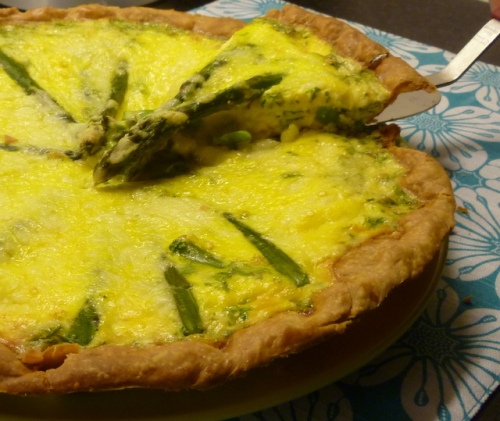
Asparagus & Lancashire Cheese Tart

The Knave of Hearts, He Stole the Tart

When I got some Lancashire Cheese from my foodie penpal, I knew I had the start of a great dish. When the Big Guy brought home what was likely the last bunch of local asparagus that we will see this season, I knew exactly what that dish would be.

Lancashire cheese and asparagus are a marriage made in heaven. The sharp flavour of the cheese would be perfect to go with the chlorophyll hit that you get from seasonal asparagus. Add to this fresh herbs, and put it in a tart, and you really are onto a winner.

Maybe it’s my imagination, but as well as the negative environmental impact, I think that asparagus that has been flown across the world has lost a lot of it’s green flavour. For these reasons, I won’t buy it. Maybe it is also the anticipation of this short-lived season that makes it taste better,  who knows?

I made my own pastry for this. Any offcuts will freeze well, wrapped in greaseproof paper, or you can be economical with the oven, and make a few jam tarts, or even unseasonal mince pies with the offcuts. This is something that I learned from my mother. We would rarely have a pastry dish without her baking some little sweet treat to use it up.

I used chervil and parsley in this recipe, because I grow them both, and I love chervil. If you have difficulty finding chervil, then you can substitute them both for a good bunch of chopped dill.

This quiche was actually better cold, when the cheese really sang out against the asparagus. Making this dish great for a picnic. You know, for when the summer actually arrives…
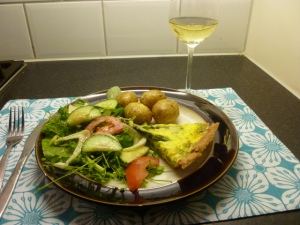
Asparagus & Lancahshire Cheese Tart

Forget the Knave, Watch out for Teddy Bears…

Recipe: Asparagus and Lancashire Cheese Tart

Ingredients

For the Pastry: 

100 g plain flour

50 g cold butter

Pinch of salt (or just use salted butter)

Cold water, less than 30 ml

For the filling: 

1 bunch of asparagus

100 g shelled weight broad beans

8 eggs, beaten

100 ml cream (or milk)

Small bunch chervil, finely chopped

Small bunch parsley, finely chopped

Salt and pepper (to season egg mix)

100 g Lancashire cheese, grated

Method

Rub butter into flour, until it resembles breadcrumbs. Slowly add the water until it forms a dough. You may not need it all.  It must be cold, not tepid, so it’s best not to measure out the water and let it sit while you rub in the butter. When it has formed a dough, you don’t want to work this too hard, so just shape it into a ball.

Wrap the pastry in clingfilm, foil or a plastic bag, and put in the fridge to rest, for about an hour.

Arrange the asparagus. First, snap off the woody bit at the end of the stem. The point at which it breaks naturally will be where the tender, edible part of the stem starts. This will vary according to how long the asparagus has been cut. Don’t discard these  tough ends, they make a great soup.
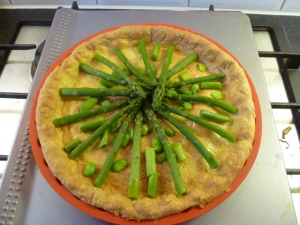
Arranging the asparagus spears

Power Arrangement

Cut the asparagus stems to size so that you can arrange them in a wheel around your flan dish. Cook the asparagus spears in boiling salted water for about 3-6 minutes, depending in the width of the spears. Cook the offcuts of the asparagus with the broad beans, in boiling water for a maximum of 2 minutes, depending on the size of the pieces. Drain all of the cooked vegetables and run under cold water as soon as they are done. you want them slightly underdone for this dish, as they will cook a bit more in the tart later.

Double-pod the beans, which may seem like a pain, but will be worth it later.

Preheat the oven to 200°C.

Grease a flan dish. I have a silicone one, but you may prefer a metal one with a loose bottom, either are good.

Roll out the pastry evenly, to about 1mm thick. Carefully slip it over the rolling pin, and line the flan dish with it. Cut a bit of the excess pastry from over the edge of the dish, and form a ball with it. Use this to gently press the pastry into the corners, and any fluted edges that you may have on the flan dish. This is thin pastry, and  will be using a liquid filling, so you want to avoid  putting holes in it, or the filling will leak, and burn. Using the dough ball, and not your fingers (especially not the nails) will help prevent tears and holes.

You can either trim the pastry to the edge of your flan dish, or leave a bit of an overhang. Pastry will shrink when it cooks, so I prefer to leave an overhang, which I trim off after the blind bake.

I sometimes coat the warm pastry trimmings in a light dusting of icing sugar and serve as a sweet snack. I can’t bear to throw away any of the edible things!

If you choose to trim the pastry, then you will need to gently pinch it up between your thumb and forefinger, to raise it above the sides of the flan dish, thus compensating for shrinkage (difficult to accomplish if your pastry is thin enough).

Now you need to blind bake the pastry case. Gently prick all over the base with a fork, as evenly spaced as you  can, without going through the pastry. Cut some greaseproof paper so that it overlaps the pie dish by about 3 cm each side. Scrunch up the greaseproof, as if you were scrunching up a piece of paper that you were about to put in a wastepaper basket. This will help the paper to line the pastry case and get into the corners and fluting better. Put an even coating of blind baking materials in the pastry case, on top of the spread out grease proof paper. Both the pricking and the blind bake will help prevent the pastry from rising, during the initial baking process.

You can get special ceramic beads for your blind bake, but these are expensive. It is cheaper to use dried beans from your store cupboard,or at a push a thick layer of rice. Beans are better, because you can still cook with them after they have been used as blind bake, and  they are heavier than rice. Once the rice has been used as blind bake, it can’t be cooked, so re-use it as blind bake.

Put the tart shell, with the blind bake into the oven and allow to cook for at least 10 minutes, or until the pastry case is crisp, and does not have any “damp” patches. Remove the blind bake, and put the tart case back into the oven for about 5 minutes, or until it starts to brown.

If you need to, trim your pastry case at this point. Or leave it, if it doesn’t look too scruffy.
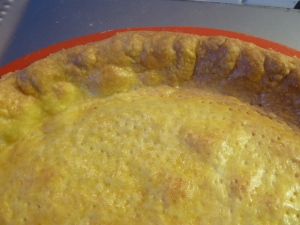
Pastry Case Sealed with Egg Wash

Glazed and Confused

Since you are using a liquid centre, it is a good idea to seal the pastry case, to help prevent leaks. To do this, brush the case with a little of the beaten egg that you are about to use for your filling. Put it back in the oven for a couple of minutes until the egg wash has given the tart case a shiny, browned finish.

Add the cream, chopped herbs and the cheese to the beaten egg, and mix well. Season with a little salt (because the cheese is also salty) and a good grind of pepper.

Sprinkle the beans and asparagus offcuts onto the base of the tart, then arrange your larger spears over the top in your desired design.

Pour over the filling, and give the tart a shake, to make sure that the filling is evenly distributed in the case.

Place back in the centre of the oven, cook for 10 minutes, then reduce the temperature to 160°C. Cook for a further 30 minutes, or until the filling is just cooked, but retains a little wobble.
2 Comments

Filed under Farmed

A Soup for Summer

Summer Vegetable Nage

Summer Soup A-Swimming

For the past two years I have been experimenting with poaching. I have poached chicken, fish and even lamb. I love the tenderness that poaching lends meat, and it makes it really difficult (though not impossible) to  over cook.

The basis of a really good poached dish is the poaching liquid itself. This can be really simple, such as using water and maybe a few drops of vinegar when poaching eggs. More commonly, the poaching liquor, or nage is used to impart flavour and herbal notes to the thing you are poaching.

Nage comes from the French verb nager: to swim. The basis is a really good stock, and probably adding extra vegetables, which are then discarded.

Lately, nage has come to mean a delicate broth that gets served with the dish, but that can hold its own on the plate. The vegetables that were added for flavour are usually still removed. I hate wasting perfectly good food like this, and have been thinking that the basis of a poaching nage would make a delicious soup in its own right.

I had a vegetarian friend coming to dinner, the weather was stuffy, and I had broad beans, peas and herbs reaching their peak in the garden. I decided that I would experiment. The peas and beans should impart their soft sweet taste of summer, and the other vegetables needed a little bite. Unless you have few teeth, soft mushy vegetables are not pleasant, and certainly not what I wanted to represent a light summer soup. I served this dish as a delicate starter.

One of the herbs that I have in my garden is chervil. This delicate herb is often quite difficult to find in shops or markets in the Netherlands and the UK, but it really easy to grow, in the garden or on a windowsill. It has a delicate aniseed flavour but it really can add a lot to a salad, soup, fish or chicken dish, and will add a lot to a herb sauce. I really recommend that you have a go at growing this delightful little herb.

Herbs on a Saturday Challenge badge

Because I have used chervil and parsley in the soup, I am entering it in the June Herbs on Saturday, hosted by Karen Burns Booth at Lavender and Lovage. I really feel that this summery dish really captures the light herbal notes that are perfect for June.

The lemon zest trick was inspired by Nathan Outlaw, I think, but I’m not really sure where it came from. Don’t miss out that step though, it is important.

This soup really needs a good stock. You won’t be able to make it with a powder or a stock cube, it will be far too salty, and will also take away from the light herb flavours. Luckily, using the trimmings from the vegetables from this dish and a cabbage leaf or two, you can make a really good stock to use as the basis of the dish, with no waste. You definitely won’t regret it.

Recipe: Summer Vegetable and Herb Nage

Ingredients

Juice and zest of a lemon

700 ml of good quality vegetable stock (no cubes please)

100 g peas, shelled weight

200 g broad beans, shelled weight

2 shallots, finely chopped

4 summer carrots, finely chopped

1 bulb florence fennel, tough outer leaves removed and finely chopped

4 sprigs chervil, finely chopped (including stalks)

Small bunch curly leaf parsley, finely chopped (including stalks)

Any fronds from the fennel, finely chopped.

Salt to season

Method

Cook the lemon zest in a dry pan until you can smell the essential oils have been released. You will need to keep stirring, to help prevent burning.

Add the stock to the pan, and bring it to boiling point. Then lower the heat and simmer it for five minutes. Take it off the heat, and let it cool.

Cook the beans and the peas in unsalted boiling water. You can use the same pan, if you like, but the peas will need to go in after the beans have been cooking for a couple of minutes. Please take care not to over cook the vegetables. They really only need minutes, although the exact time will depend on their size. You will definitely not need longer than five minutes, even for large beans.

When cooked, drain the vegetables, and run them under a cold tap, or add to an ice bath to stop them cooking any further. Double-pod any broad beans bigger than half a centimetre in length. I know that this can seem like a hassle, but it really is necessary, and will give a much better balance of flavour overall.

When the stock is completely cold, add the lemon juice.

The next stages are very quick, so as not to overcook the vegetables, so please make sure that you have done all the chopping, don’t be tempted to continue chopping stuff while something  else cooks.

Soften the shallots for a minute or two on a low heat. You don’t really want the flavour of your best extra virgin olive oil here, so use a light olive oil, or sunflower oil. Be very careful, shallots can catch quickly, and you don’t want them to even start to colour. Keep stirring them.

Add the carrot and the fennel to the shallot, and sweat them all off for a minute, again, not allowing them to colour.

Add the cold stock, and bring it up to boiling point. Reduce to a simmer, and cook until the vegetables just begin to soften. This will take no longer than five minutes, as the vegetable pieces should be quite small.

Taste and season with a little salt if you need to. You don’t need pepper for this dish, it will totally change the delicate balance of the flavours.

Add the peas and beans, and simmer for about a minute to allow them to warm, but not really cook more.

Finally, stir through the chopped herbs and serve this light, refreshing summer soup immediately.

6 Comments

Filed under Farmed