Tag Archives: Recipe

Charming Cherries

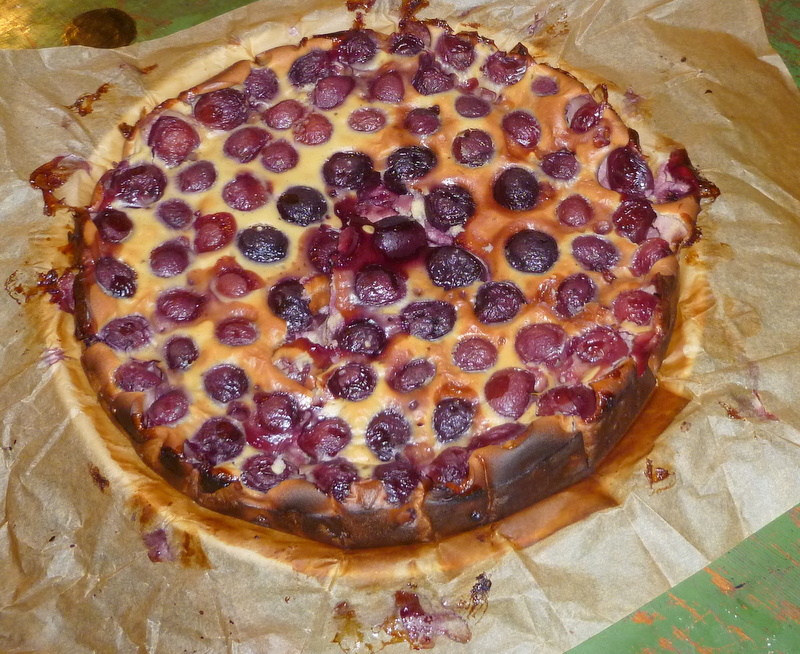
Cherry Clafoutis

Clafoutis

We are back from the lovely land of Australia. We had a fabulous time, and lots of great foodie experiences, leaving me with quite a few posts to catch up on, which will appear here in the next few days.

I have always wanted to have a go at making a clafoutis, and what better opportunity than when you can find large, plump and a deep, deep red cherries? Again, this is a summer dish at it’s best, and the riper you can get the cherries the better.

Clafoutis can also be made with any ripe fresh fruits, although apparently the proper name for those without cherries should be flaugnarde.

Whatever your fruit, and whatever you call it, this is a great way to use up a glut of fruit, as long as they are really ripe.

Traditionally, the clafoutis is served lukewarm, which makes sense when it is the height of summer, as you don’t want a hot pudding for a warm, sticky evening. However, if you want to use winter fruits, like apples or pears, I see no reason that you can’t serve this warm, possibly with a nice custard.

I made this for a friend who is lactose intolerant, so I used soy milk, but you can use whatever you like here.

I hope that you have a go at this dish, it really is so easy, but looks very impressive. Your friends and loved ones will appreciate you for it.

Recipe: Cherry Clafoutis

Ingredients

50 g plain flour

2 eggs

150 ml milk

Pinch of salt

Seeds of half a vanilla pod

Cherries – enough to cover an ovenproof dish or cake tin in a single layer

Method

Heat the oven to 220 °C.

Mix all of the ingredients, except the cherries, into a thinnish batter. Some recipes also call for a little sugar (in the region of a couple of tablespoons). You can add this too, if you want, but I thought that the cherries I was using were quite sweet enough for the whole dish, so I didn’t use any. Leave the batter aside to rest while you prepare the cherries.

The original Limousin dish left the stones in the cherries, which, it is said, impart an almond flavour. I didn’t try this way, because it is a little unseemly to be spitting out cherry pips when you are in company. Instead, I halved and stoned the cherries, then laid them out, flat side down in a baking dish, until the bottom was covered in one layer of cherries.

My friend only had a spring-form cake tin, which I lined with baking parchment as a precaution against spills, which was entirely unnecessary, as it turned out, so just use a cake tin, or any largish baking dish you have to hand.

Tip the batter in and around the cherries. At this stage, it should not cover the cherries over completely, but will almost do so. Don’t worry, they will rise to the top again as the dish cooks.

Put in the oven for about 20 minutes, or until the batter looks cooked across the pudding. You want it light and airy, though, not crispy, although slightly crispy edges are almost inevitable.

Dust with a little icing sugar while still warm, and leave to cool before serving. The Big Guy and I had a little natural yoghurt with ours, but my friend eschewed the yoghurt, and ate it au naturel. It is very good either way.

2 Comments

Filed under Feast

Bill’s Tomato Pasta and So Much More

Bill Grangers Tomato Pasta, Tomato Dressing & a Green Salad

Back to Work Dinner

The thing about coming half way around the world is that the seasons are back to front. We are in full summer right now, with the lovely fruit and vegetables that go with it.

I made this recipe for a friend who had kindly put us up for our wonderful week in Sydney. It is one of her favourites, and so I decided to make it for her to help her ease back to work after Christmas. She likes the dish, because the ingredients are very basic, and simple, but as long as they are chosen (or grown) well, they really are more than the sum of their parts.

The tomatoes take a little preparation. Being the lazy type, I often don’t bother to do this. But, as they are the star in this dish,  it really is worth the effort.

It is a Bill Granger recipe, from his book Sydney Food, published by Murdoch Books. I have reproduced it here, simply because, in my usual no-waste style, there is so much that you can do with what most people would discard from this recipe, which I have given at the end of the pasta recipe.

This is a great summer dish, whether your summer comes in December or in June.

Recipe: Bill’s Tomato Pasta

Ingredients

1 kg vine tomatoes – or really ripe ones from your garden

1 tbsp sea salt

120 ml extra virgin olive oil

2 tbsp red wine vinegar

2 garlic cloves

1 lemon – juice and zest

1 small red chilli, finely chopped

Freshly ground black pepper

400 g spaghetti, 100 g per person

1 bunch basil, leaves removed from stalks

Shaved Parmesan to serve

Method

Firstly, wash the tomato and the vine. Do not discard the vine, as it imparts a lot of flavour, and you know I hate to waste anything!

Then plunge the tomatoes into boiling water for 10 seconds, and refresh in iced water or under a running tap. I prefer the iced water, because you can use it to water plants with, once the ice has melted, and the water is at room temperature. The skin should be splitting from the tomato, and should be quite easy to peel at this stage. If it isn’t plunge it back into the boiling water for a few seconds, and refresh again. As you will not be able to do all of the tomatoes at once, I keep a pan of water boiling on the stove for this recipe. Again, you can use the water afterwards for tea (so you haven’t wasted the energy it took to boil it either!), or put it in your water butt or pot plants.

The only part of the tomato that I haven’t found a use for is the skin,which is normally indigestible, so on its own I don’t really know what to do with it. The skins go in my wormery, so I get some use from them eventually. If anyone has any suggestions, please do leave them in the comments.

Once you have peeled your tomatoes, cut them in half, and remove the seeds and the watery pulp. Please don’t throw this away, as you will be throwing away a lot of useful flavour. Instead, collect it in a bowl, and we’ll come back to it later.

Roughly chop the flesh of the tomato. Then place it in a sieve, and sprinkle with the sea salt. Leave it over a bow for at least half an hour, to draw out more moisture. This will make your dish as flavourful as possible. Don’t discard the liquid run-off either, as this will be used up later, I promise.

Meanwhile, crush and finely chop the garlic. Mix this with the lemon zest and juice, vinegar, chopped chilli, pepper and olive oil. Put the tomatoes in this mixture once they have had a little while to steep in the salt. Mix this well, and then leave aside for 20 minutes to allow the flavours to meld.

Boil the spaghetti in plenty of salted water. Make sure it is still a little al dente. Drain, and then add it to the tomato mixture. Mix it up well, and adjust the seasoning, if necessary. Tear the basil leaves and add them to the pasta.

Serve the pasta with parmesan shavings, best kept large and made with a vegetable peeler. I also served mine with a simple green salad, dressed with a dressing made from the tomato consommé, from the bits that we kept aside earlier.

Mel’s Multitude of Methods with Tomato “Waste”.

As promised, now we get to the bits that you kept aside earlier.

You should have the vine or truss that the tomatoes came on, the juice and seeds from the tomatoes, and the liquid run off from the salted tomato flesh. Good. Firstly, break up the tomato vine into bits a couple of cm long. Then, mix all three tomato “waste” products, and pass them through a sieve. The vine will give this an intense tomato flavour. You can either allow this to drip through on its own for a clear liquid, or you can push this pulpy mixture through with the back of a spoon, whereby the liquid will be red. Congratulations, you have now made  tomato consommé!
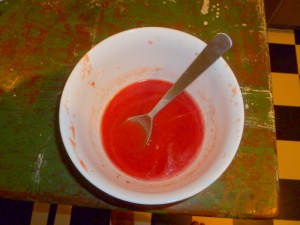
Tomato Consommé

Treasure, not trash!

At this stage, fish the vines back out of the sieve, and compost them. Tip the seeds out, and dry them on some kitchen paper. When they are dry, pick off any remaining pulp (which will go mouldy) and then put them in an envelope (write tomato seeds on the envelope, so you know what they are). Next spring, put them in soil, and water it regularly, and you will likely get new tomatoes! If you use organic tomatoes, this is almost certain. Some supermarket tomatoes may not germinate, because they are F1 or hybrids, but you will have lost nothing by giving it a go. Especially if you have reused an old envelope, and written on it in pencil!

The consommé can be used for a million things. It will be intensely flavoured, and slightly acid, like the tomatoes from which it came. I made a dressing for the green salad I served with the pasta dish. I mixed 2 tbsp tomato consommé with salt, pepper, a splash of white balsamic vinegar, and then enough extra virgin olive oil to make a nice emulsion.

If you have enough, chilled consommé makes a delicious soup for a starter, just garnish it with some basil before serving.

The consommé freezes well, and can be added to soups, stews, and other tomato pasta sauces (for which you do not need to freeze it, but it will keep longer). We froze ours in an ice cube tray, and when they are frozen, we will put them into a plastic bag to save space.

Consomme to Freeze, and a Salad Dressing

Many Methods with Consommé

Tomato consommé can be added to cocktails , but it is probably too light for a bloody mary. If you make your own ketchup, add with the sugar to intensify the tomato taste. In fact, pretty much any sauce that has tomatoes in will benefit from its addition.

If you want to be really cheffy, freeze it in a block. Once frozen, scrape it with a fork. The resulting crystals can be used as “tomato snow” on very delicate dishes. This is so easy, but you pay a fortune for it in a restaurant. People will also think you are an aspiring Heston, without you having to go anywhere near liquid nitrogen!

The possibilities to use this flavourful liquid are endless. How will you use yours?
2 Comments

Filed under Feast

A Yuletide Legacy

Ham and Bean Soup

A Legacy of Leftovers

The best legacy of a Christmas dinner has to be the leftovers! Since my mantra is Taste not Waste, I am delighted when I can challenge myself to use up everything, so that nothing is thrown out.

The recent festivities yielded an obvious, yet exciting choice. I had a 2cm slice of the baked ham left, along with some cooked carrots from the christmas dinner. I also had a pot of gelatinous stock that came from the boiling bag that I had kept. I initially thought that it might be too salty to use, but you should never pour fat down the drain, so I tipped it into a container, and put it to one side. It turned out that there was actually very little fat in it, and the stock itself was rich, but definitely not too salty.

For the mince pie and mulled wine party, I had intended to make a couple of dips, so I had soaked some chickpeas and some cannellini beans, but as usual my ambition far exceeded the time I had given myself, and something had to give.I was considering just cooking the pulses up, and freezing them, they would have been fine to add to soups or stews from frozen.

However, beans and ham are an excellent combination. If I had more ham left, I would have made a version of a cassoulet, with the addition of some sausage and a tomato liquor to stew it all in. There are a hundred other types of dish I could have tried, but I settled on a soup, as it would make what little meat I had go the furthest.

The result that I achieved from such humble ingredients was brilliant. The soup was so flavoursome and satisfying, it made me quite proud. It really was the perfect way to end the Netherlands Christmas celebrations.

Recipe: Ham and Bean Soup

Ingredients

1 stick celery, finely chopped

1 onion, finely chopped

1 medium carrot, finely chopped

1 leek, trimmed, washed and sliced into half moons

1 clove garlic, very finely chopped

Bacon fat to sweat the vegetables in

80 g ham, diced, more would be great, if you have it

1 tsp smoked paprika

200 g soaked weight chickpeas

300 g soaked weight cannellini beans

350 g ham stock. I have given a weight here, because the stock was solid when I added it to the soup. I would normally say that you could substitute one stock for another one, but in this soup, especially if you don’t have that much meat, I think that ham stock is integral to the flavour

Boiling water to cover

50 g cooked carrots. If you don’t have any leftover carrots, then use more raw ones

Small bunch chopped parsley

Method

Firstly, if you need to, soak and cook the pulses. You could also use a single tin of cannellini beans if you must, but the dried version will bring an extra dimension to the soup.

Prepare the vegetables, and sweat them off. I never throw away fat (of course) and I had a little fat left over from frying bacon, which I used to sweat off the vegetables, in order to maximise the flavour. This is by no means necessary, you could just as well use olive or sunflower oil.

Once the fat has melted, sweat off the onion, celery and the raw carrots for three or four minutes, before adding the leek. Leek burns easily, and the last thing you want is the bitter taste of burnt leek in this soup. When the leek is translucent, add the garlic and the smoked paprika, and let them cook off for a minute or so.

Stir in the ham and the beans, until they have a light coating of the smoked paprika, then add the stock and a little boiling water. The stock will melt down quickly. Top up the soup with more boiling water, so that the liquid covers the rest of the ingredients.

Simmer for about 10-15 minutes, until the vegetables are tender to your liking. Add the cooked carrots, and simmer for another minute, to warm them through. Before serving, stir through some chopped parsley.

Great the day that you make it. Even better when you reheat the last bowlful for lunch the next day.

1 Comment

Filed under Feast

Making Meringues

I am sure that you may have noticed by now that I use a lot of egg yolks – in stuff like custards, mayonnaises, pasta, pastry and sauces. This leaves me with a lot of egg whites to use up.  Since I hate waste, I try always to use them, which invariably means making macaroons, and meringues. I need to expand this repertoire, so expect to see consommés and more stir fries appearing here soon. If you have other suggestions for using up egg whites (although not the egg-white omelette, please, some things are a step too far, even for me!) feel free to leave them in the comments.

I had originally intended to make advocaat, in keeping with the Anglo-Dutch theme for my party, but I ran out of time. However, this time, the advocaat was actually the by-product of the intention to make meringues, instead of the usual situation where I have a load of egg whites left over from something else. No one missed the advocaat, anyway!

Since I make them so much, I thought that I would share my technique here. I haven’t given a recipe, as it will depend on how many egg whites you have and to some extent how old they are.

Start by heating the oven to 110°C. Then measure out  45 g sugar for each egg white. I like to use raw cane sugar, but you can also use caster, granulated or icing sugar. I have also seen sugar solution, but that seems to be for Italian or Swiss style meringues, and I tend to stick with French. It is possible to use soft brown sugar, but be aware that this makes it very hard to get a crisp, dry meringue. I think this technique may be best left alone or, if you insist, only use it to top lemon meringue pie.

Put the egg whites in a very clean bowl. There must be no fat or detergent in it. If you are unsure, wipe it with the cut side of a lemon (or other citrus), which will act as a degreaser. If the bowl has any fat, it may affect the ability of the eggs to maintain the air that you are about to whip into them. The same goes if there are any traces of egg yolk, so be careful when separating the egg, too. Note that the fresher the egg, the less likely that the egg yolk is to break when you separate it.

Next, whip the egg whites until they form stiff peaks. This is when the egg whites look drier, the whisk or a spoon will create peaks when you remove it from the mixture, and if you are brave, you can upend the bowl and the egg white will not slide out. I would advise using an electric whisk if you don’t want it to take you hours.

Egg Whites at the Stiff Peak stage

The stiff peak - sadly lacking in many ski resorts this year

Then, a tablespoon at a time, add the sugar and whisk in thoroughly before you add the next spoonful. The egg white will stiffen further, as you add the sugar. At this stage, you are beating to incorporate the sugar, not to add any further air, so it won’t increase in volume.

Egg Whites plus half the required sugar

About half way through - stiffer and peakier, but not more voluminous

Keep adding the sugar, and whipping, a tablespoon at a time. Eventually, the mixture will become really stiff, to the point of being really hard to work,  and will look shiny. This is when you stop adding sugar. Because I use cane sugar, I find I need less than the stated 45 g per egg white. If you are using caster or icing sugar, you may find that you need to use all of it. This is also fine.

Finished Meringue mix

The final product - glossy, thick and much harder to beat

Don’t add more sugar than needed to get to this stiff consistency (or than the 45 g, whichever happens to come first), otherwise your meringues will leach sugar. This does not really affect the taste, but it does give them a rather unattractive look. A bit like a tree that is leaching sap.

Now your meringue is ready to be shaped. You need to line a baking sheet with some greaseproof paper. You can stick it down with oil or by dabbing a bit of the meringue in each corner and the centre of the paper and using this as glue to stick it to the baking sheet. Once the baking sheet is ready, you need to choose what shape and size you are going to have your meringue. You may wish to have it as a pavlova, in which case you need to shape one large disc, with slightly elevated sides, to hold the fruit in. I normally go for individual ones, because these are better for parties or for sharing. Most commonly, I will get two spoons and shape individual quenelles, which can then be stuck together with cream and fruit in a sandwich. However, I wanted to fill these with Chestnut Jam, so I decided that mini versions of the pavlova-style would be better suited to the task.

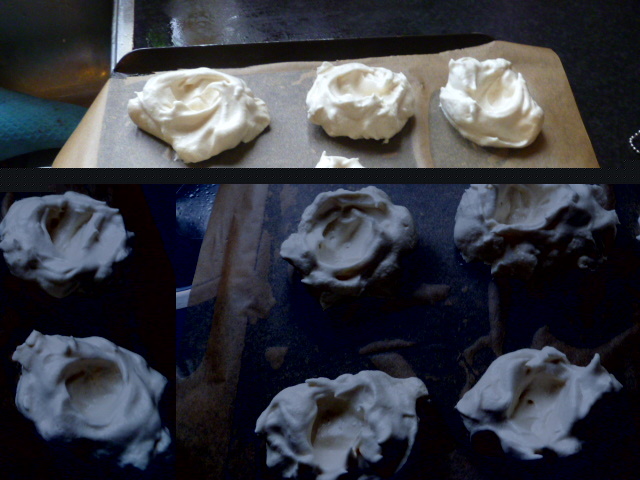
Some people would use a piping bag for that, but I lack the finesse, and the piping bags, so I made do with shaping them with two spoons. You can try either, I think both are just as good. I made them vaguely circular, like a nest.

Meringue nests

Not sure what I did here, but you get the meringue nest picture

Then it is ready to go in the oven. Bake the meringues for up to 1 ½ hours (but check after 1). If you have made one large pavlova style meringue, you will need longer – check after 1 ½, and leave in the oven up to 2 hours.

A Meringue nest

Meringue nest - a better view

The idea is not really that the meringue cooks, more that it dries out. You need to check that it is no longer soggy to the touch, and that it generates a hollow sound when tapped very gently on the base.It will have darkened a little, even if you use icing sugar. Mine are generally more golden than off-white, because the unrefined sugar I use is a light brown.

When you get the hollow sound, it is done. If it is at all possible, turn off the oven, but leave the meringue in there to continue to dry overnight. This will give the best result, but it will be OK if you leave it to cool outside the confines of the oven.

Once it is done, fill it with fruit, cream, fruit and cream, jam, or serve it with ice cream, mash it up with fruit and cream to make Eton Mess – whatever you like, really.

2 Comments

Filed under Feast

World’s Easiest Chocolate Truffles

Easy Chocolate Truffles

Easy and Delicious

I have to start this post with a warning. These truffles will not last. Not because they are made from anything particularly perishable, but because people will not believe that you made them, because they are so good. This is what my party guests said to me the other day. Of course, I liked this so much; I thought I would reproduce their words.

Warnings aside, these little chocolates are at the least difficult end of the chocolatier’s scale. If you watch any TV programmes where they make desserts, the chefs will always tell you that chocolate work is demanding, exact and delicate. The only thing that is true of these very basic truffles is that you have to be exact about the amounts that you use, otherwise you will end up with the basis for a nice chocolate sauce, but it will not be thick enough for the ganache that is required. There is no heating things up to precise temperatures, as you have to when tempering chocolate; no delicate curls or swirling effects; no allowing things to set so you can complete the next stage; really none of the complex stuff that you see the likes of Eric Lanlard or Adriano Zumba would have you believe is part of every pâtissier’s daily life.

So, these little treats would not be elegant enough to grace the shelves of a Belgian chocolatier, or a Parisian Pâtissier, or even your local Thornton’s, now I mention it. But if you make them for guests, or as a present, they will go down a treat. Because they do represent something into which you have invested love, and time, anyone you make these for will be more spoilt than the guests at the ambassador’s party!

Recipe: Chocolate Truffles

Ingredients

225 g of the best chocolate that you can get hold of. I think (although this is, as yet, untested) that this is the secret to these truffles. It doesn’t matter if it is plain, milk or white, just good quality.

175 ml of double cream. It is important that you measure this as accurately as you can. If your measuring jug is not accurate enough, either double the amount you make, so you need 350 ml of cream, or weigh it. Although not precise, you can use 1g to = 1 ml, just dont add all the cream at once.

Cocoa powder / icing sugar/chopped nuts for dusting.

Method

In a pan, slowly bring the cream up to boiling point (where small bubbles form around the edge of the pan) but do not allow it to boil.

Cream at boiling point

Note -bubbles, not boiling

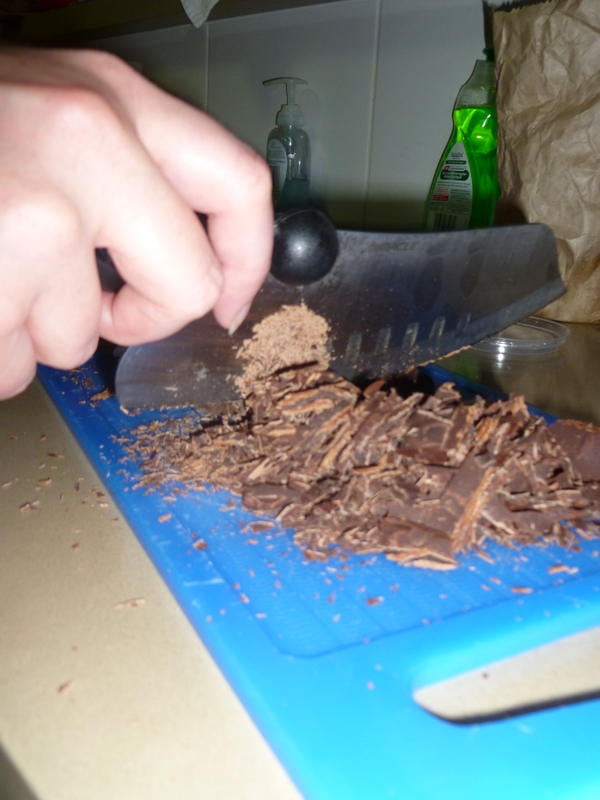
Meanwhile chop the chocolate up into small pieces.

Finely Chopped Chocolate

The finer you can chop it, the smoother the truffles will be

Pour the warm cream into the chocolate. The cream should melt the chocolate, but it should still be pretty thick. Stir the chocolate to make sure there are no lumps. This is your ganache.

Chocolate Ganache

Ganache – cooling

You may need slightly less cream in milk and white chocolate, to form a thick ganache, so pour it in slowly. You can always add a little more cream, but you cannot take it away if you have added too much, so caution here is advisable.

Leave the ganache to cool and thicken. This will take at least 1 ½ hours, but if you wish, you can speed this up slightly by placing the bowl to sit in a sink of cold water. It is very important that you do not allow any water to get into your ganache, as this will affect the thickness and the way it sets. Do not refrigerate to speed up the cooling. This will make your ganache too hard to work with. Plus putting hot things into a fridge is not very efficient, as the fridge then has to work much harder to maintain a constant temperature.

Ganache at the right thickness

This is about the right consistency for shaping

Once you have a thick ganache, spoon out small amounts, and roll gently into balls. Try to keep your hands cold, so that you don’t melt the chocolate too much. You can do this by running them in cold water, between each ball. Alternatively, you can shape them into quenelles, by using two teaspoons to mould them. If you have a little melon baller, you could also shape them with that too.

Once you have your shaped truffles, prepare a saucer with some cocoa powder, icing sugar, or finely chopped nuts. Or have saucers with some of each if you want variety. Gently roll the truffles on the saucer until they have a fine coating of your choice.

These are the finished truffles, which you can either plate up and put out for guests, or put in a pretty box to give out as presents. I promise you, people will be really impressed.

Variations

Just like Mareike’s Mayan Chocolate Mousse, varieties are very easy to make.

Use different flavours of chocolate, although avoid any with large nuts or lumps

Spice or flavour the cream, using spices, flavoured syrups for coffee, extracts (e.g. vanilla or flower extracts – I would not use “essence” which is usually artificial) ginger, vanilla, or a little alcohol of your choice

Once the ganache is made add a little chopped dried fruit or nuts for variety

Roll in flavoured sugars to coat

5 Comments

Filed under Feast

Kruidnoten – Christmas Cookies

Kruidnoten

Kruidnoten – really tasty christmas treats

Dutch and Flemish children do not have to wait for Christmas to celebrate. On the 5th December, the Netherlands celebrate Sinterklaas, when St Nicholas visits them and fills their shoes with sweets and biscuits.

One of the traditional biscuits that are given out at this time of year are Kruidnoten. These are little aniseed – flavoured biscuits, that are given to children, and also appear on your saucer whenever you order a coffee in December.

I really like them, and wanted to try my hand at doing some myself. the recent Mince Pie Party seemed like the perfect place to start, and my guests wouldn’t have to wait until Christmas either. As a bonus, these biscuits are vegan, as they contain no butter. Much older recipes do use honey, but these days stroop is a great alternative.That link is in Dutch, but stroop is basically a viscous sugar syrup, often the by-product of refining sugars. It is widely available in the Netherlands and often used on pancakes.

If you cannot get stroop where you are, golden syrup is also perfectly acceptable.

I got the recipe that I used from here. I have translated it below, and adapted it very slightly, to make it wholly vegan.

Recipe: Kruidnoten

Ingredients

200 g plain flour

1/2 tsp baking powder

Pinch salt

150 g stroop or golden syrup

2 tsp speculaas spice. This is widely available in the Netherlands. If you are not in the Netherlands and fancy trying these, you can mix up your own – I will give the proportions at the end of this recipe.

1 tsp ground aniseed (I grind mine fresh when I need it in a pestle and mortar)

Method

Preheat the oven to 160°C

Mix the flour, baking powder, spices, and salt in a bowl. Then make a well in the centre.

Add the stroop to the well, and stir in the flour. It should form a firm dough, but if it doesn’t, add a little more stroop or some water. I found that I needed a little of both, for this amount of flour.

Brush a baking sheet with oil.

Break off small chunks of dough, and roll them into balls. Press them into the baking tray, so that the base is flat. You will need to have well floured hands, and if the mixture gets a little sticky, roll it in a little flour as well.

Bake for about 15 minutes until the biscuits are browned. They should still be a little soft at this point, because they harden as they cool.

Recipe: Speculaas Spice

According to mijnreceptenbook.com speculaas spices can be made up yourself in the following proportions:

50 g ground cinnamon

15 g ground (or finely grated) nutmeg

10 g ground cloves

10 g ground ginger

5 g ground pepper

5 g ground aniseed

This mix will kep well in an airtight jar. If you want to make this up, you could reduce the amount of  each spice proportionately, or make up the lot, and try it in gingerbread, cakes and other recipes that call for either ground ginger or ground cinnamon to ring the changes.

1 Comment

Filed under Feast

Old-Fashioned Gingerbread

Sticky Gingerbread

Old fashioned gingerbread – sticky, not crunchy

On Friday, we had our annual mince pie and mulled wine party. I have been so busy baking for this that I have not had much time to write these recipes up, nor to publish the older posts. I managed to wipe out all of the photos, and have not taken good records, so it is a little time-consuming to go back through all my archives and find the right pictures. I also had an international Christmas dinner for other friends yesterday. I have a lot to write up.   They will all be up soon, I’m  sure!

This year, I decided to try to make some other nibbles from English and Dutch traditions, most of which will appear here in the next few days.

I wanted to make gingerbread, the old-fashioned kind that is dense and soft – not biscuity, like the sort that you make gingerbread men with.

The basic idea is that you make a syrupy sponge, and then let it sit for a couple of days, so that it acquires the dense, sticky texture that I desired.

Of course, you can’t decorate them like you can with gingerbread men, but since this was an adult party, then I don’t suppose any of my guests minded.

I have been making this recipe for years, but there are many very similar ones that I have seen in cook books.

Recipe: Old-Fashioned Gingerbread

Ingredients

280 g plain flour

1 tsp bicarbonate of soda

1 tsp ground ginger

1 tsp ground cinnamon

Pinch of salt

170 g softened unsalted butter. I use the pat of butter that I keep in a butter dish out of the fridge

90 g lichte basterdsuiker, or soft brown sugar

220 g golden syrup. I get this from home, but if you are in the Netherlands, and cannot get golden syrup, then I am pretty sure the stroop that you can buy to eat with pancakes will be fine instead.

1 egg

200 ml milk

4 balls of preserved stem ginger

2-3 tbsp ginger syrup (from the preserved ginger jar)

Method

Set your oven to 180°C

Mix the dry ingredients together. I don’t often bother to sieve ingredients when baking, although many recipes will call for it. It has never really affected anything that I bake. If you are in the sieving camp, then do so by all means.

In a separate bowl, beat the sugar and the butter together. I used an electric hand whisk, but if you have Popeye arms (or would like them) then a wooden spoon will do just as well. The mixture needs to be fluffy and several shades lighter than when you started.

Beat in the golden syrup, and the ginger syrup until it is thoroughly combined. When trying to get the golden syrup out of the tin, use a hot spoon (just hold it in hot water for a few seconds), if you don’t want to spend way too long waiting as the syrup drips sloooooowly from your spoon to the mixture below. If you are using stroop, then this is a little runnier than golden syrup, and comes in a handy squeezy bottle, so you shouldn’t have this problem.

Add the egg, and a tablespoonful of the flour mix (which should stop the batter from separating) and beat until it is all well combined.

Mix the flour in really well, then beat in the milk. You should get a really thick batter.

Finely chop the ginger, and stir it through the batter.

Pour into a square cake tin, about 20cm across. the bottom must be lined with greaseproof paper, and the sides well buttered (or brushed with oil). If you only have a round one, this is also fine, but I like to serve flat slices, for aesthetic purposes.

Because I hate waste, and don’t have children, I use a spatula to ensure that I get all of the batter into the tin, and scrape the bowl and the remains off the whisk. I did allow myself a tiny bit from the spatula after I had as much in the tin as I could physically get. It was a good job I waited too, the golden syrup makes this batter as moreish as crack.

Bake it in the oven for about 40 mins, or until a skewer pushed into the centre comes out clean. Leave it in the tin until it is cool enough to handle, then put it on a wire cooling rack.

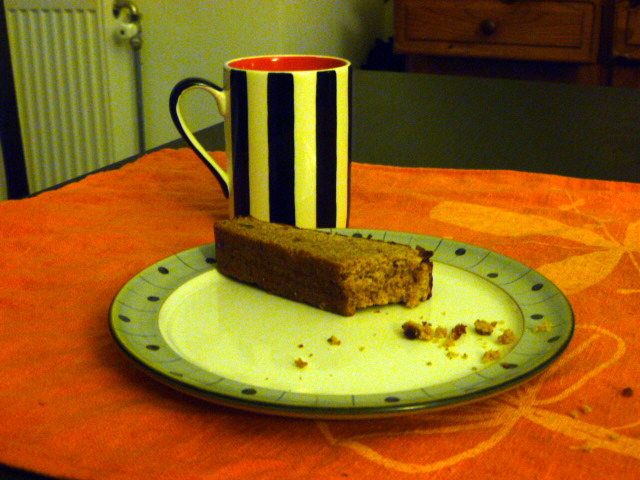
You can eat it like this, when it is spongy and cakey. Better still, wrap it in greasproof paper and store it in an airtight container for 4-5 days, whereupon it will be sticky and dark and lovely. This is really good with a nice, proper cup of tea. People who enjoy Pickwick need not apply!

Leave a comment

Filed under Feast

Vegan Sweet Shortcrust Pastry

A lot of people (including me before I really thought about it) think that it is difficult to cook for vegans. However, with a little forethought, and some minor adjustments, it isn’t actually that difficult.

If you make it yourself, pastry is one of the easiest recipes to adapt to a vegan diet. When I was younger, and the world hadn’t woken up to the horrors of transfat, my mother used a special kind of margarine that as a solid at room temperature, and as a vivid yellow colour.I have no idea what was in it, and I am probably a bit afraid to find out!  Nowadays you can get a number of olive and vegetable oil-based ones. These are not so yellow either.

The following recipe is enough to give you the base for a large tart, or several smaller ones. I got 24 mince pies using this recipe.

Recipe: Vegan Sweet Shortcrust Pastry

Ingredients

250 g plain flour

125 g block margarine (not the stuff that you spread on your bread – it needs to be more solid)

50 g icing sugar

Zest of a lemon

Method

First, measure the flour and sugar into a mixing bowl, and zest the lemon into a separate container. Take the margarine out of the fridge, and try to work with it as cold as you can. Cut the margarine into cubes and add to the flour. Try to hold as little of it in your hand as possible, to avoid melting.  Rub the flour, sugar and margarine to a fine breadcrumb, by rubbing your hands through the flour and margarine with your thumb over your upturned fingers. When you are done it should look like this:

flour dough as breadcrumbs - before you ad liquid.

The breadcrumb effect

At this point, mix in the lemon zest.

Then get some cold water in a jug – run the tap a little first to make sure that it is as cold as you can. Pour a little at a time into the flour and margarine mix and stir with your hands until it comes together to form a nice dough. At this point cover tightly with either cling film, greaseproof paper or foil. I never use cling film, so I just wrap my dough with whichever of the other two I have to hand. refrigerate for at least half an hour to allow the pastry to relax. If you don’t do this, the pastry will be difficult to work with, and may be too sticky or too short (crumbly).

Roll the pastry out thinly on a well floured surface. To get it even, turn it 90 degrees after each roll, and this should give you an almost circular piece of dough to work with. If you do not need all the dough at once, cut it in half, and put the bit you are not working with back in the fridge,after you have wrapped it up again, until you need it

Use in any recipes that require pastry, but that would be otherwise suitable for vegans. Instead of greasing the tin you are going to bake it in with butter, just use a liberal coating of olive oil.

Wherever you would use an egg/milk wash – i.e. any part of the finished product where the dough will be on display, such as pie crusts; or where you may need to add a liquid filling after a prebake, such as tart bases, then simply brush with water.

The resulting dough is quite short, but a bit denser in texture than all butter dough, and it is paler. My take on it is though, if you have one vegan guest, the other can eat vegetables, whereas your vegan friend cannot eat their food. This dough certainly passes muster for people who are used to eating animal products, so no need to cook special food for one or two.

UPDATE: I have now tested this same pastry with ground almonds, and it makes the pastry richer, and has a lot of flavour. For the amounts given in this recipe, add an additional 75 g ground almonds with the flour, and work with the butter, as above.

5 Comments

Filed under Feast

Sing A Song of Six Quince

Quinces

A bit like large, hairy pears

The quince is an odd fruit. Part of the rose family, with a hard, fuzzy fruit that is easy to overlook if you don’t know what it is. It is often possible to forage the quince, as they do occur in the odd hedgerow, and a few lucky people grow them, or know someone else that does.

This is another of those things that I really hope to find out and about. The flowers are really beautiful, so they are often planted in municipal areas. I have heard rumour of one in a local park, although I have not found it myself. You also have to be pretty quick if you are to get there before the parakeets that live wild here.

However, I have found them on my local market. A basket full caught my eye, and I felt a rush of excitement, as I hurried closer to see whether or not I was in luck, or if they were just large conference pears. Luckily for me, my first glance was right, and I went home happily clutching a bag full of kweepeers, as they are called here.

I have cooked with them before, having baked them in a similar way to apples, but I have always wanted to try my hand at making membrillo. I first had some on a holiday to Barcelona, where it is served with sharp manchego cheese, and its sweetness and texture really are the perfect foil for this cheese. I have also used it with pâté on crackers, where it finds another worthy partnership.

I looked around for a good recipe, and Nigel Slater had a good one on the BBC site. When I read this, my first thought was that I could maximise the quince output by making jelly too. This appeals to the tight-fisted food waste geek in me – I really hate throwing stuff away, so any recipe where I can save scraps or cooking liquor to make something else out of is off to a good start already!

The quince might be an odd-looking fruit, but its perfume  is quite something. As I peeled and cored them, as per the instructions, my kitchen was filled with a gorgeous smell, very similar to ripe raspberries. As they cook, you get hints of their rosaceous origins as well.

One thing that cooked quince is famed for is its beautiful deep red colour, so imagine the panic I had when I cooked the fruit when they were still a pale off white colour, and the cooking liquor was pretty beige.

Part cooked quince

Taste the rainbow?

A while ago, I had promised a friend a session in nostalgia and jam making, so she headed round after work, and we got down to make the jelly. The first lot I made was with the cooking liquor that was drained from the fruit. Since the membrillo recipe says to peel and core the quinces, and this contains a good deal of pectin, this is also perfect for jelly. I boiled these up in some more water, and re-used the vanilla pod in it too. The strained liquor made yet more jelly.

Making jelly is really a question of proportion. For every 600 ml of liquid, you need 400 g of sugar. You can play around with this proportion a little, and I have reduced the amount of sugar for some fruits. However, the quince is a relatively unknown quantity for me, so I stuck with the tried and tested ratio.

We boiled it up to a nice rolling boil, and let it cook off for 10 minutes. These days I have taken the guess-work out of jam making by investing in a sugar thermometer. When the thermometer reaches 104.5°C, you know that you are done. I still like to check, since the first time I used a thermometer, the jelly I was making turned out a bit runny, because I had taken it off the heat the second it reached temperature. Also, it was good to show my friend the low tech way of seeing if your jam has reached setting point.

The Fridge Test is the old-fashioned way to ensure the setting point is reached. You put a plate in the fridge to cool. Drop a little jam on the plate and leave for a minute. If the jam wrinkles when you run your finger through it, then it has reached setting point. If it doesn’t wrinkle, stick the plate back in the fridge, leave the jam to cook, and try again in a few minutes.

When you have reached the setting point, take the jam off the heat and pour into hot, sterilised jars. Fill  them almost to the top, cover with waxed paper discs (wax side down) and seal with a hot, sterilised airtight lid.

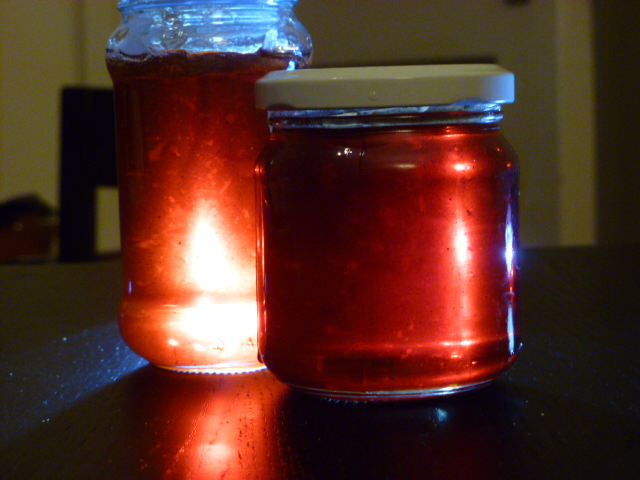
As you can see from the picture, my worry that the final product would be beige was unfounded. They don’t tell you this in the recipes, but the quince does not take on its customary red until quite near the end of  the cooking process.

Quince Jelly

Not beige

Today I made the membrillo, as per the recipe. This too takes its time to reach the right colour, but when it does, it is a really thick paste, and has a grainy texture. I poured it into a roasting tin, but you could also use a swiss roll tin if you like it thinner.

I baked it in a low oven, but I should note that it still wasn’t entirely set, so I put it back in on low for a while.

Membrillo

The membrillo paste before it went in the oven

I cut this into two. The one half I have wrapped in greaseproof paper, and foil, and I will keep it somewhere cool and dark until it is required. The other half, I shall cut into squares, sprinkle in caster sugar and serve as a sweet at my upcoming party.

Leave a comment

Filed under Feast

Pumpkin, Bacon and Swiss Chard Soup

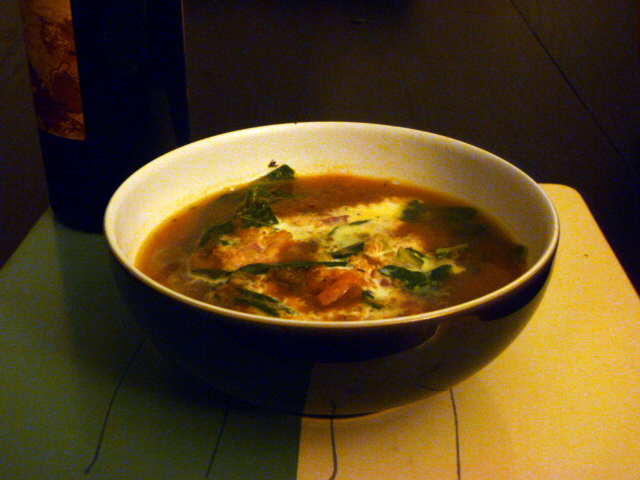
Bacon Pumkin & Swiss Chard Soup

A soup for this season – warm and velvety

It is that time of year when my cooking is populated with soups. They are great for using up slightly too tough or slightly too old vegetables. And in the Netherlands, it is practically compulsory to have soup and a sandwich for lunch, whatever the weather outside. I am likely to be making quite a few more before the winter is out.

This year, I lost my young pumpkin plants to something, most likely slug-shaped. However, the chard has been going strong for a while now. As I would ordinarily be feasting on my own pumpkins, I have decided that it is not really cheating to add this to the ‘Farmed’ category.

I like my soups quite chunky, and my greens slightly underdone – having been subjected to many an overboiled brassica in my youth. You may prefer to pre cook or even use frozen greens in this soup, and chop or blend them a bit finer. This soup keeps very well in the fridge, and should also freeze well, although I have not tried it.

This soup is easily adaptable for vegetarians, just omit the bacon, and fry the onion in olive oil. I would suggest that you add slightly more smoked paprika at the end instead of the bacon.

Recipe: Pumkin, Bacon & Swiss Chard Soup

Ingredients

450 g pumpkin

A pinch dried chilli flakes

2-3 cloves garlic

2 tsp lemon thyme leaves, plus stalks

1 medium onion, finely chopped

500 ml stock (veg or chicken)

200 g Swiss chard (spinach would also work well, or maybe a savoy cabbage – it needs to be an iron-rich green vegetable)

200 g bacon, diced

80 ml white wine (optional)

Nutmeg and smoked paprika to taste

Method

Heat the oven to 180°C. Cut the pumpkin in half or quarters, depending on the size and type of your pumpkin. Essentially, it has to fit in a roasting tin. You should leave the skin on. Sprinkle with a little oil (any type except your best olive oil) and season with salt, pepper, and the dried chilli. Rub the thyme sprigs over the pumpkin, and tuck the stalks into the dish as well. It may seem like a pain, but it will save you having to remove the stalks from the soup later. Put the garlic cloves inside or between the pumpkin. No need to remove the papery cover, this will come off much easier when the garlic has been roasted.

Roast the pumpkin in the oven, until the flesh is dry, and it comes away from the skin easily. The time this takes will depend on which type of pumpkin that you use.

Roasting the pumpkin concentrates the flavour a bit. If you don’t have an oven, like many people who I know, you can still use the pumpkin without roasting. just add the thyme to the pot when you sweat the onion, and the pumpkin and the chilli flakes when you add the (now chopped, not roasted) garlic. You will also need to let the pumpkin simmer for longer, until it is tender. Obviously, peel the pumpkin before you add it. No one likes a soup full of skin.

While the pumpkin is cooking, prepare the other vegetables and the bacon. I like the stalks of the chard, but they take much longer to cook than the leaves, so I cut the stalks out, and kept them separate to the leaves. You may decide not to use them, or use spinach. Up to you. Whatever you use needs to be chopped up. How fine you want it is also up to you. I sliced the stalks thinly and the leaves a bit thicker.

Fry the bacon in a deep saucepan. I don’t bother using oil, as the bacon will render its own fat pretty quickly – just keep it moving so that it doesn’t burn.With a slotted spoon, drain the bacon onto kitchen paper, but be sure to retain the fat.

Sweat the onion in some of the bacon fat (you may not need it all). If you are making this a veggie soup, sweat the onion in a little oil. Either way, don’t let it colour.

Add the garlic from the roasting pan, which should slip easily from their skins now. No need to chop them. Add the wine at this point, if you are using it. A glug is fine. Let it cook off and absorb into the onions.

Add the smoked paprika. I usually use about a teaspoon, but this will depend on your taste, and whether or not you are using bacon. Let it cook off briefly while you remove the skin from the pumpkin. This should come off easily with a spoon. Break it into rough lumps, and add to the pan with the onion. Allow it to cook briefly, and take on a paprika coating.

Add the stock, and bring to the boil. Cover and simmer for 5 minutes.

I blended the soup at this stage, but if you prefer a less chunky soup, then you could also blend it after you have added the chard. After the soup was well blended, and smooth, I brought it back to a simmer, and grated in some nutmeg, until it tasted like there was enough in there.

Then I added the stalks of the chard, covered and let it simmer for about 5 minutes before I added the leaves, and allowed them to wilt. If you use spinach, or just the leaves of chard, then this bit will be shorter. If you are using savoy cabbage, I suggest parboiling it a little first before you add it to the soup.

Add the bacon back to the soup, and adjust seasoning to taste.

I served this with a swirl of double cream. You can leave this out if you like, because it is a smooth and unctuous soup without it.

Leave a comment

Filed under Farmed