A Whole Lot of Rosie

Wild rose petal cordial

Entente Cordiale

At the same time as we collected all the elderflower, we were also delighted to find some wild roses. The most common of these is the dog rose, but they have mostly gone over in the more accessible places. I did manage to get a photo, but couldn’t reach the  blooms, as they were on a steep slope, and behind a lot of brambles.

Wild Dog Rose

Dog Rose

Luckily, we also came across a load of what I think is most likely to be prickly rose, or rosa acicularis. This is a really beautiful rose, with abundant, dark pink flowers. They also have a lot of thin thorns on them. I was so excited to find them that I forgot to take pictures, but I’ll try to go back soon to get some. When the sunshine comes back. If the sunshine comes back.

The good news is that all rose petals are edible. The more highly scented, the better they will taste. As well as some basic foraging rules please be careful that the roses that you use have not been sprayed with any pesticides, which can be an issue if you are foraging in a park. Another word of caution; if you are allergic to bee stings, like I am, please check each flower before you pick the petals. Bees love roses, and will spend a lot of time feeding from each one. I very nearly picked one up with some petals, but it warned me by buzzing angrily, and I quickly dropped the petals. Bees are quite polite really, and will warn you before they sting.

You could dry the petals, and use them in cakes and jelly, or even brush them in egg white and dip them in caster sugar to crystallise them and then use them as a cake decoration.

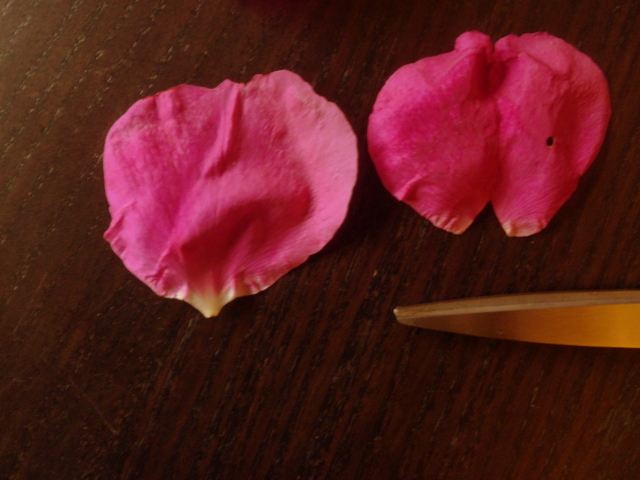
Rose petals with & without claw

The white claw (L) is bitter and must be removed

When you use rose petals, you need to remove the claw, or the part where by which the petal is joined t the rest of the flower. This is bitter and can taint your produce. I usually just snip them off with scissors.

The first thing that I made was a cordial. This recipe is inspired by one that Sandie made at Herb and Wild Food Recipes. Sandie intended to make a jam, but actually made a syrup with dog roses. I used the same technique to prepare the roses, and then made a cordial as I would normally. This is a great blog, full of wild food recipes, so please do go and have a look.

It has also taken on the dark pink of the rose. I have had it as a refreshing drink, but I’m also going to try this in a syllabub, and maybe to cook some gooseberries in. If you have any suggestions for ways to try this cordial, I’d love to hear them in the comments.

Recipe: Rose Cordial

Ingredients

2 large handfuls of rose petals (claws removed as above)

Juice of a lemon

500 ml water

300 g sugar

Method

Sterilise a 500 ml bottle and the lid. You can do this in a number of ways. I find it trickier to get bottles clean in the dishwasher, as I would do for jam jars. You can wash them in hot soapy water, using a bottle brush to get into the nooks and crannies. I give them a good soak in the steriliser I use for brewing before I rinse, and put in them in a w arm oven (150°C). If you have a pressure cooker, you can also hold it in steam.

In a saucepan, add the lemon juice to the flower petals and the water. Simmer for 15 minutes.

Strain through muslin, and return the liquid to the saucepan. As you would expect, I didn’t throw out the rose petals. I have a great recipe for them to come. You can refrigerate or freeze them, if you want to use them later.

Add the sugar to the rose-water, and heat, stirring until the sugar has dissolved. Allow to simmer for five minutes, then hot-fill the sterile bottle.

Keep this little jewel in the fridge.

3 Comments

Filed under Fermented, Found

A Spoonful of Elderflower Sugar

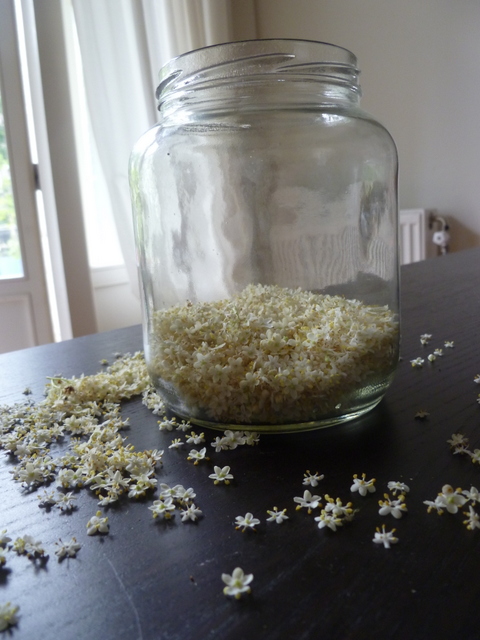
Preparing to infuse sugar

This Will Help the Medicine Go Down

I have been frantically trying to preserve a lot of elderflowers. Last weekend, the Big Guy and I went out picking elderflowers and rose petals.

I greedily decided to try a second champagne recipe, and went off picking without really reading how much I would need. The recipe I chose to use required far less than I had imagined, so I had a lot leftover.  Of course, not being one to waste them, I have lots of recipes to share in the next few days. I’m waiting for some of them to finish brewing.

However, if you are going to be able to take advantage of these this year, you can still find some flower bracts now, but we are definitely coming towards the end of their display, at least here in the Netherlands. Go out and get some, and keep them in the fridge for some of the elderflower recipes to follow.

The simplest thing to do to preserve the flavour of these short-lived but beautiful flowers is to infuse sugar with them, in a similar way to the vanilla sugar that makes the use of high quality vanilla beans worthwhile.

The elderflower sugar keeps well and is a lovely reminder of the early summer when the flowers are in full bloom. You can use it in cakes, biscuits and many other things, and I will be experimenting with some baking in the coming weeks. If you only have enough elderflowers for one more thing, this is the stepping-stone recipe you should probably make.

And this is how you do it:

Get a large glass jar with a lid. The amount of flower bracts that you will need will be determined by the size of the jar.

Pick through elderflower heads, and remove any brown flowers or bits. Remove the flowers from their stalks. This is easily done, by gripping the stalk between your thumb and forefinger, and pushing them down to the flowers. They will pop off with very little pressure.

You need to keep as much of the pollen as possible, because that is where the flavour is, so try to get the blooms in the jar as you strip them from the stalks.

Keep going until you have filled about a quarter of the jar. Top up the rest with the sugar, give it a stir and leave it to infuse for at least 3-4 days.

Sieve out the flowers before use.

9 Comments

Filed under Found

Flowers and Spice and All Veg – Nice!

Moroccan Vegetable Stew with Cous Cous and Coriander yoghurt

Souk Food

The other day I wrote about going foraging with Liz Knight with Mum on her birthday. What I didn’t mention is that she also had one of the stalls at the Tudor Farmhouse Market. She sells all manner of spice rubs, sauces, and syrups at fairs and some shops, and they are also available online.

We came away with a honeysuckle and tarragon syrup, and a Wild Rose el Hanout, based on the Moroccan spice mix. The original translates as “head of the shop”and is a blend of the best spices that a merchant has on offer, and is therefore supposed to act as both a luxury product and the best marketing tool that the merchant as at his disposal.

As the name suggests, the Forage version uses wild roses and spice, giving a heady blend that is every bit as luxurious as the Moroccan version. Liz also recommends adding it to a fish and tomato stew, which I will definitely be trying. If you haven’t managed to get hold of a pot of this lovely spice rub, you can use Ras el Hanout instead.

You may also remember that I resolved to make more Middle Eastern food back in January. I had a Moroccan spice, although Morocco is not exactly the Middle East, I was thinking of the fragrant dishes and spices that also encompass much North African cuisine. This seemed like a good place to revisit those resolutions, and get the whole commitment to them kicked off again.

I made this for a vegetarian dinner party. Because I used fresh tomatoes, I found that the sauce was quite liquid. I actually liked it that way, but you could thicken this by using tinned tomatoes, or add some tomato puree to the stew about 15 minutes before the end of cooking.

It is traditional to keep the vegetables quite big in Moroccan cooking, which also cuts down on the preparation time, making this a pretty easy evening meal.

I garnished it with some yoghurt with chopped coriander stirred through, although it is perfectly good without it, so you can leave this out if you want a vegan dish.

Recipe: Moroccan Vegetable Stew and Couscous

Ingredients:

For the Stew: 

2 shallots, peeled and quartered

1 red pepper, cut into very large dice

2 cloves garlic, peeled and sliced

2 tsp wild rose el hanout

2 carrots, cut into chunks

1 large courgette, quartered lengthways, then in cut into chunks

1 aubergine, cut into chunks

About 400 ml vegetable stock (enough to come about 2/3 of the way up the pot)

1 tin chickpeas, drained and rinsed

4 tomatoes, quartered

Bunch coriander, including the stalks, chopped

For the Couscous: 

400 g couscous

500 ml vegetable stock

Zest of 1 lemon

1 tsp wild rose el hanout

2 tbsp good olive oil

This recipe serves four people

Method


On a low heat, soften the shallot for about 3-4 minutes in a deep saucepan. Add the pepper, and continue to soften. When you can see changes in the flesh of the pepper, after about another 5 minutes, add the wild rose el hanout, and the garlic, and cook until the fragrance hits you.

Add the carrots, courgettes and aubergine to the pan, and cook down for 5-10 minutes, until the courgettes and aubergines start to give and soften. You will need to stir them well when the veg first go in, to distribute the spice mix, then occasionally as they cook down.

Add the stock, and bring to the boil, cover, then reduce to a simmer. Cook until the vegetables are soft.

While the vegetables are cooking, make the couscous. In a large bowl, stir the wild rose el hanout and the lemon zest through the couscous. Add the warm stock, so that it covers the couscous by bout 1cm. Cover and set aside to allow the couscous to absorb the stock.

Add the chickpeas, tomatoes and the coriander to the stew, and warm through for five minutes.

Add the olive oil to the couscous, and fluff up with a fork.

Serve the stew atop the couscous.

I liked this couscous so much, it s difficult to imagine that I won’t be stirring through some wild rose el hanout every time I make it from now on. At least until the jar runs out.

Leave a comment

Filed under Feast

Beans, Beans are good for your …Burgers!

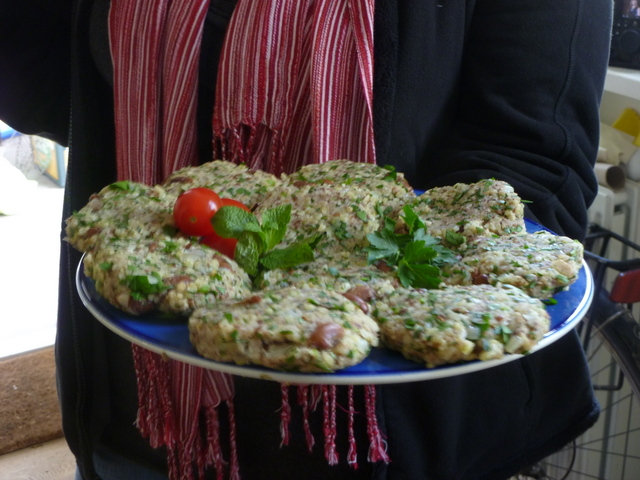
Bulgur & Bean Veggie Burger

Barbecues – Not Just for Carnivores

You may have gathered by now that I like to barbecue. We don’t have a fancy grill or gas burner, and rely on simple charcoal. I don’t really see the point in lighting up a barbie if it is only going to be the two of us, so I tend to supersize mine, and invite loads of people. I’m pretty well-practiced at it now, and can happily cope with 20-30 guests.

We fill a baby bath with ice, for the drinks to chill in, and I set about making the things that will go onto it, with various salads, and dips. There are a few things that must feature – ribs, sausages, vegetable skewers, and of course burgers. I make my own meat burgers, and I don’t leave out veggie friends.

BBQ used as heat for guests

Burn All The Things

Of course, as is tradition, I do all the prep work, and step back to let the Big Guy get the glory, as he (and often a few other grill kings/ queens) ‘caramelises’ my food.

I am not a fan of fake meats. I know that they have saved many a vegetarian at a barbecue, but they just aren’t for me. These vegan burgers are not pretending to be meaty, I think that their flavour and texture is good enough to speak for themselves. And they are great in a bun!

The recipe is a good basis for a veggie burger. From here, you can change the spice mix, substitute coriander for the parsley, use fresh chilli instead of the cayenne pepper, or add nuts or some other vegetables to the mix. I have made a few variations myself. I’d love to hear your variations, and maybe steal them give them a try.

These burgers keep well in the fridge or freezer, and you can cook them in a frying pan too, if you don’t have enough people round light the barbecue.

You may have noticed that a lot of my recipes have been veggie or vegan lately. This is because a friend recently cycled the Dunwich Dynamo, and I agreed to “sponsor” him by signing up to reduce my carbon through Do-Nation. This is a great way of getting people to do a few simple green actions for a short period of time, to see how they get on. It is also a lovely way to help people to feel involved in supporting your event without asking them to donate money, which can be a little awkward in these straightened times. The actions themselves are not too difficult to achieve, and it may get a few people to continue to do them, after all it is supposed to take 30 days to form a habit, so after 2 months it may be second nature.

Peter managed to smash the carbon target that he set himself at the start. I chose the Veg Out option. I really don’t eat all that much meat, so for two months, I have pledged to cut it even further, and also to go vegan a couple of days a week.

The Dunwich Dynamo took place over the weekend, and so far reports are that my friend is very happy, and a little sore, but I expect that there will be no lasting problems. Congratulations Pete, on getting your friends to take some small carbon friendly actions, and for the epic ride!

Bulgur & Bean Burgers Ready to Grill

Grill Ready

Ingredients

200 g dried beans, or one can. I usually use kidney or brown beans here, but the variety is really up to you.

1 onion, finely chopped

2 cloves garlic, finely chopped

1 tsp cumin seeds

½ tsp cayenne pepper

100 g bulgur wheat

400 ml vegetable stock

1 tbsp soy sauce

Good bunch of parsley, finely chopped

Method

If you are using dried beans, soak them for a few hours. Drain then bring them to the boil in fresh, unsalted water. Cook until they are tender. You’ll probably need at least 40 mins for this, but it depends on the age of the beans. Don’t be tempted to salt the beans, or you will make the skins tough.

If you are using tinned beans, drain and rinse them, and heat them in fresh, unsalted water.

It is best to work with warm ingredients, as they bind a bit better, so try to get all the ingredients cooked at roughly the same time. If you are using dried beans, they will need to be started first, if you are using tinned, they should be warmed through as you come to the end of the bulgur preparation.

In a dry pan, toast the cumin seeds until they give off their characteristic scent. Keep them moving, as they will catch quickly. Once they are done, remove immediately to a mortar or a spice grinder.

Add a little oil to the warm pan, and sweat the onion on a gentle heat. You don’t want to colour the onion.

Meanwhile, grind up the cumin, and add the cayenne and garlic, and grind up to a paste. Add to the translucent onion, and fry until the aroma begins to waft.

Add the bulgur and stir to coat all of the grains in the onion and spice and oil. Add the stock, and bring to the boil. Reduce the heat, cover and simmer until the stock has been absorbed.

When the beans are done, drain, but don’t discard the cooking water. If the burger mix is too crumbly, you can add a bit of this to help it to bind.

Mix the soy, beans and parsley into the bulgur mix. Use the stalks of the herb too, as they pack loads of flavour. Set aside about a quarter of the mixture, and then pulse the rest in a blender until it is comes together. You want it to be sticky, but not a paste.

Add the reserved mixture from earlier, for texture and stir well.

Make patties by rolling lumps into balls in your hands, and then flattening on a board to make the burger. They will look surprisingly round. This is normal.

Chill for at least an hour before you grill them, to help them retain their shape. Grill or fry on either side over low coals. Preferably on a summer’s day. You may be able to make great burgers, but you can’t control the weather!

9 Comments

Filed under Feast

The Queen of Tarts

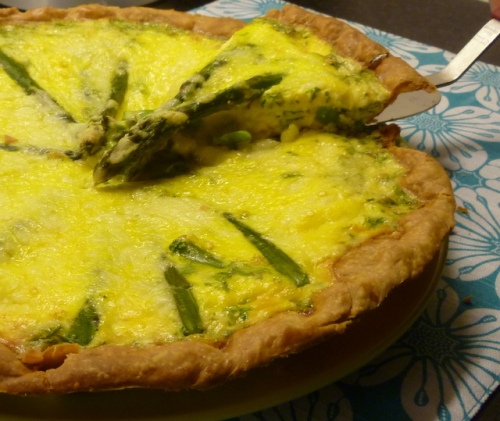
Asparagus & Lancashire Cheese Tart

The Knave of Hearts, He Stole the Tart

When I got some Lancashire Cheese from my foodie penpal, I knew I had the start of a great dish. When the Big Guy brought home what was likely the last bunch of local asparagus that we will see this season, I knew exactly what that dish would be.

Lancashire cheese and asparagus are a marriage made in heaven. The sharp flavour of the cheese would be perfect to go with the chlorophyll hit that you get from seasonal asparagus. Add to this fresh herbs, and put it in a tart, and you really are onto a winner.

Maybe it’s my imagination, but as well as the negative environmental impact, I think that asparagus that has been flown across the world has lost a lot of it’s green flavour. For these reasons, I won’t buy it. Maybe it is also the anticipation of this short-lived season that makes it taste better,  who knows?

I made my own pastry for this. Any offcuts will freeze well, wrapped in greaseproof paper, or you can be economical with the oven, and make a few jam tarts, or even unseasonal mince pies with the offcuts. This is something that I learned from my mother. We would rarely have a pastry dish without her baking some little sweet treat to use it up.

I used chervil and parsley in this recipe, because I grow them both, and I love chervil. If you have difficulty finding chervil, then you can substitute them both for a good bunch of chopped dill.

This quiche was actually better cold, when the cheese really sang out against the asparagus. Making this dish great for a picnic. You know, for when the summer actually arrives…
Asparagus & Lancahshire Cheese Tart

Forget the Knave, Watch out for Teddy Bears…

Recipe: Asparagus and Lancashire Cheese Tart

Ingredients

For the Pastry: 

100 g plain flour

50 g cold butter

Pinch of salt (or just use salted butter)

Cold water, less than 30 ml

For the filling: 

1 bunch of asparagus

100 g shelled weight broad beans

8 eggs, beaten

100 ml cream (or milk)

Small bunch chervil, finely chopped

Small bunch parsley, finely chopped

Salt and pepper (to season egg mix)

100 g Lancashire cheese, grated

Method

Rub butter into flour, until it resembles breadcrumbs. Slowly add the water until it forms a dough. You may not need it all.  It must be cold, not tepid, so it’s best not to measure out the water and let it sit while you rub in the butter. When it has formed a dough, you don’t want to work this too hard, so just shape it into a ball.

Wrap the pastry in clingfilm, foil or a plastic bag, and put in the fridge to rest, for about an hour.

Arrange the asparagus. First, snap off the woody bit at the end of the stem. The point at which it breaks naturally will be where the tender, edible part of the stem starts. This will vary according to how long the asparagus has been cut. Don’t discard these  tough ends, they make a great soup.
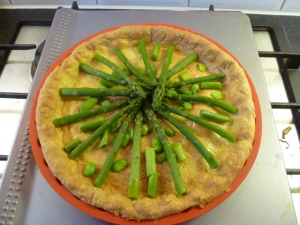
Arranging the asparagus spears

Power Arrangement

Cut the asparagus stems to size so that you can arrange them in a wheel around your flan dish. Cook the asparagus spears in boiling salted water for about 3-6 minutes, depending in the width of the spears. Cook the offcuts of the asparagus with the broad beans, in boiling water for a maximum of 2 minutes, depending on the size of the pieces. Drain all of the cooked vegetables and run under cold water as soon as they are done. you want them slightly underdone for this dish, as they will cook a bit more in the tart later.

Double-pod the beans, which may seem like a pain, but will be worth it later.

Preheat the oven to 200°C.

Grease a flan dish. I have a silicone one, but you may prefer a metal one with a loose bottom, either are good.

Roll out the pastry evenly, to about 1mm thick. Carefully slip it over the rolling pin, and line the flan dish with it. Cut a bit of the excess pastry from over the edge of the dish, and form a ball with it. Use this to gently press the pastry into the corners, and any fluted edges that you may have on the flan dish. This is thin pastry, and  will be using a liquid filling, so you want to avoid  putting holes in it, or the filling will leak, and burn. Using the dough ball, and not your fingers (especially not the nails) will help prevent tears and holes.

You can either trim the pastry to the edge of your flan dish, or leave a bit of an overhang. Pastry will shrink when it cooks, so I prefer to leave an overhang, which I trim off after the blind bake.

I sometimes coat the warm pastry trimmings in a light dusting of icing sugar and serve as a sweet snack. I can’t bear to throw away any of the edible things!

If you choose to trim the pastry, then you will need to gently pinch it up between your thumb and forefinger, to raise it above the sides of the flan dish, thus compensating for shrinkage (difficult to accomplish if your pastry is thin enough).

Now you need to blind bake the pastry case. Gently prick all over the base with a fork, as evenly spaced as you  can, without going through the pastry. Cut some greaseproof paper so that it overlaps the pie dish by about 3 cm each side. Scrunch up the greaseproof, as if you were scrunching up a piece of paper that you were about to put in a wastepaper basket. This will help the paper to line the pastry case and get into the corners and fluting better. Put an even coating of blind baking materials in the pastry case, on top of the spread out grease proof paper. Both the pricking and the blind bake will help prevent the pastry from rising, during the initial baking process.

You can get special ceramic beads for your blind bake, but these are expensive. It is cheaper to use dried beans from your store cupboard,or at a push a thick layer of rice. Beans are better, because you can still cook with them after they have been used as blind bake, and  they are heavier than rice. Once the rice has been used as blind bake, it can’t be cooked, so re-use it as blind bake.

Put the tart shell, with the blind bake into the oven and allow to cook for at least 10 minutes, or until the pastry case is crisp, and does not have any “damp” patches. Remove the blind bake, and put the tart case back into the oven for about 5 minutes, or until it starts to brown.

If you need to, trim your pastry case at this point. Or leave it, if it doesn’t look too scruffy.
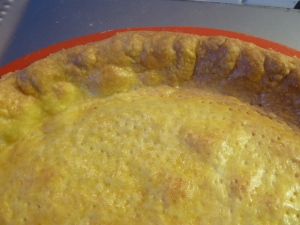
Pastry Case Sealed with Egg Wash

Glazed and Confused

Since you are using a liquid centre, it is a good idea to seal the pastry case, to help prevent leaks. To do this, brush the case with a little of the beaten egg that you are about to use for your filling. Put it back in the oven for a couple of minutes until the egg wash has given the tart case a shiny, browned finish.

Add the cream, chopped herbs and the cheese to the beaten egg, and mix well. Season with a little salt (because the cheese is also salty) and a good grind of pepper.

Sprinkle the beans and asparagus offcuts onto the base of the tart, then arrange your larger spears over the top in your desired design.

Pour over the filling, and give the tart a shake, to make sure that the filling is evenly distributed in the case.

Place back in the centre of the oven, cook for 10 minutes, then reduce the temperature to 160°C. Cook for a further 30 minutes, or until the filling is just cooked, but retains a little wobble.
2 Comments

Filed under Farmed

A Soup for Summer

Summer Vegetable Nage

Summer Soup A-Swimming

For the past two years I have been experimenting with poaching. I have poached chicken, fish and even lamb. I love the tenderness that poaching lends meat, and it makes it really difficult (though not impossible) to  over cook.

The basis of a really good poached dish is the poaching liquid itself. This can be really simple, such as using water and maybe a few drops of vinegar when poaching eggs. More commonly, the poaching liquor, or nage is used to impart flavour and herbal notes to the thing you are poaching.

Nage comes from the French verb nager: to swim. The basis is a really good stock, and probably adding extra vegetables, which are then discarded.

Lately, nage has come to mean a delicate broth that gets served with the dish, but that can hold its own on the plate. The vegetables that were added for flavour are usually still removed. I hate wasting perfectly good food like this, and have been thinking that the basis of a poaching nage would make a delicious soup in its own right.

I had a vegetarian friend coming to dinner, the weather was stuffy, and I had broad beans, peas and herbs reaching their peak in the garden. I decided that I would experiment. The peas and beans should impart their soft sweet taste of summer, and the other vegetables needed a little bite. Unless you have few teeth, soft mushy vegetables are not pleasant, and certainly not what I wanted to represent a light summer soup. I served this dish as a delicate starter.

One of the herbs that I have in my garden is chervil. This delicate herb is often quite difficult to find in shops or markets in the Netherlands and the UK, but it really easy to grow, in the garden or on a windowsill. It has a delicate aniseed flavour but it really can add a lot to a salad, soup, fish or chicken dish, and will add a lot to a herb sauce. I really recommend that you have a go at growing this delightful little herb.

Herbs on a Saturday Challenge badge

Because I have used chervil and parsley in the soup, I am entering it in the June Herbs on Saturday, hosted by Karen Burns Booth at Lavender and Lovage. I really feel that this summery dish really captures the light herbal notes that are perfect for June.

The lemon zest trick was inspired by Nathan Outlaw, I think, but I’m not really sure where it came from. Don’t miss out that step though, it is important.

This soup really needs a good stock. You won’t be able to make it with a powder or a stock cube, it will be far too salty, and will also take away from the light herb flavours. Luckily, using the trimmings from the vegetables from this dish and a cabbage leaf or two, you can make a really good stock to use as the basis of the dish, with no waste. You definitely won’t regret it.

Recipe: Summer Vegetable and Herb Nage

Ingredients

Juice and zest of a lemon

700 ml of good quality vegetable stock (no cubes please)

100 g peas, shelled weight

200 g broad beans, shelled weight

2 shallots, finely chopped

4 summer carrots, finely chopped

1 bulb florence fennel, tough outer leaves removed and finely chopped

4 sprigs chervil, finely chopped (including stalks)

Small bunch curly leaf parsley, finely chopped (including stalks)

Any fronds from the fennel, finely chopped.

Salt to season

Method

Cook the lemon zest in a dry pan until you can smell the essential oils have been released. You will need to keep stirring, to help prevent burning.

Add the stock to the pan, and bring it to boiling point. Then lower the heat and simmer it for five minutes. Take it off the heat, and let it cool.

Cook the beans and the peas in unsalted boiling water. You can use the same pan, if you like, but the peas will need to go in after the beans have been cooking for a couple of minutes. Please take care not to over cook the vegetables. They really only need minutes, although the exact time will depend on their size. You will definitely not need longer than five minutes, even for large beans.

When cooked, drain the vegetables, and run them under a cold tap, or add to an ice bath to stop them cooking any further. Double-pod any broad beans bigger than half a centimetre in length. I know that this can seem like a hassle, but it really is necessary, and will give a much better balance of flavour overall.

When the stock is completely cold, add the lemon juice.

The next stages are very quick, so as not to overcook the vegetables, so please make sure that you have done all the chopping, don’t be tempted to continue chopping stuff while something  else cooks.

Soften the shallots for a minute or two on a low heat. You don’t really want the flavour of your best extra virgin olive oil here, so use a light olive oil, or sunflower oil. Be very careful, shallots can catch quickly, and you don’t want them to even start to colour. Keep stirring them.

Add the carrot and the fennel to the shallot, and sweat them all off for a minute, again, not allowing them to colour.

Add the cold stock, and bring it up to boiling point. Reduce to a simmer, and cook until the vegetables just begin to soften. This will take no longer than five minutes, as the vegetable pieces should be quite small.

Taste and season with a little salt if you need to. You don’t need pepper for this dish, it will totally change the delicate balance of the flavours.

Add the peas and beans, and simmer for about a minute to allow them to warm, but not really cook more.

Finally, stir through the chopped herbs and serve this light, refreshing summer soup immediately.

6 Comments

Filed under Farmed

A Box of Delight

Foodie Pen Pal Parcel

Full of Western Promise

Exactly two Fridays ago, I had to chase the postie down the road for this. My doorbell is broken. He didn’t knock the door, instead shoving one of those really irritating “we-called-when-you-were-out-now-you’ll-have-to-schlep-to-a-post-office-across-town” cards through the door. Luckily for me, I had been waiting in for this, so I was able to spring into action when I heard the letterbox.

This my first Foodie Penpal Parcel. I had been seeing people all over Twitter talk about this, but thought that it was probably only for people in the same country. I was glad to discover that Carol Anne at Rock Salt had taken the idea from Lean Green Bean and was coordinating this blog swap for the whole of Europe. I am really glad it is so inclusive. There are also groups across a lot of the World, so you can probably find one and join in. You don’t even need to have your own blog; readers are welcome too, and many of the penpals will be happy to host a guest post on their site for readers to write about what they got.

I was matched with LoopyLou, and got The Lone Gourmet as the person to send me a parcel. Such a coincidence that both my matches were called Louise, and one also used to live in the Netherlands. I’m not sure if these matches are planned or random, but I enjoyed the synchronicity of it all, anyway.

I got a little carried away with the weight on my parcel, then realised it would have cost a King’s ransom to post from over here (this is a great tip for next time; jars are really heavy). I was heading back to the UK for Mum’s birthday, so I decided to post it over there. Through a series of coincidences and holidays, my parcel ended up being hand-delivered by my sister, and finally ended up in Lou’s greenhouse at the beginning of this week, in good time for the reveal day, but probably not in time for her to have used any of the ingredients. If you want to see what I got for Lou, head over to her blog.

Foodie Pen Pal Parcel Contents

So Many Possibilities!

Louise at the Lone Gourmet was very kind and sent me things that she knows I can’t get over here. It was a real taste of home. A lot of thought went into this, and I’m really grateful to her for taking the time to source some typical English fayre.

Firstly, I got some Earl Grey tea. Of course, you can buy what the Dutch call Earl Grey over here, but every British expat knows that you can’t get a good builder’s-strength cuppa in continental Europe, and so tea is always something on the list of things that you ask other people to bring over when they come. I also love the packaging for this product – it comes in a paper cup which you can use to hold your precious brew. I love this idea. Multiple-use packaging really appeals to the Womble in me.

I also got a sachet of organic tikka masala mix, the most classic of the curry dishes for the British palate. It has a chicken recipe on the back, which I intend to try. But, I do think that this also has potential as a spice rub for white fish. I am going to halve the mixture, and do a little experimentation with this.

Saddleworth Cheese Co. Lancashire Cheese

Coronation Cheese

Louise got me some lovely Lancashire Cheese, which is quite local to her. The eagle-eyed amongst you may notice that it has a picture of a moustachioed Martin Platt from Coronation Street on the front. Apparently, like Blur’s Alex James, this is what he did when he left the Street, although I gather he is much less of a bore about it all. It’s a good cheese – a crumbly texture and slightly sharp.

Snacks from my Penpal

Testing, 1,2..

I had a snack of a little to test it when I opened the box (well, it would have been rude not to really), and then I used it in a tart with probably the last asparagus of the season. I will blog the recipe for this in the next couple of days.

JD Gross Dark Chocolate with Orange Pieces

Testing Will Power

Finally, I got some extraordinarily good chocolate. I have managed to stick to only having eaten a single square so far, since I needed to open it to take a picture (honest, Gov), but I have had to hide it from the Big Guy. I think that this should be saved for a special chocolate mousse or something else that will do it justice.

Thank you so much Louise, for this wonderful box, and to Carol Anne for organising this lovely treat.

It has been so nice to browse through the two penpal blogs, find other new blogs, and get to know my penpals, not to mention the fun I’ve had thinking about the box I was going to send, and the ingredients that I received.

Here’s the rough outline of how it works:

  • All interested parties in the UK and Europe – bloggers and blog readers alike – sign up by the form available at the bottom of this post
  • Participants are matched on the 5th of the month
  • Penpals send thoughtful, food related parcels, on or before the 20th of the month. The parcel must include something hand written – a note explaining the box’s contents, a recipe card, whatever you like. The price limit for the boxes is £10 – this is a limit, the point is not the cost, but the thought (no, really!)
  • Penpals open their boxes and rejoice!
  • At the end of the month, everyone blogs about their box, or writes a guest blog post if they are usually a blog reader and not writer. Everyone reads one another’s posts and rejoices some more. Posts are made available on Lindsay’s blog so we can all find each other easily

7 Comments

Filed under Feast

A Very British Affair

Salmon Fishcakes with tabbouleh, sauce grib-ish and a green salad

A Succulent Summer Plate

This past week, I have been in the UK again, mostly for my Mum’s birthday. We had a lovely weekend, starting with a bracing walk around the old English towns of Burnham on Sea and Weston Super Mare. Unfortunately, we also went on days when almost the entirety of both towns were closed, probably due to the weather. We still managed to have some lovely fish and chips, and an ice cream. And a poke around the end-of-pier arcades, but that really was mostly to get out of the wind for a bit.

Last week, I also noticed that Liz Knight of Forage was going to be doing a family forage at the Tudor Farmhouse Market  in Clearwell in the Forest of Dean. As that is pretty close to where my parents are, and it is a beautiful place to go, I cheekily asked if they would take a family with grown up kids. When they kindly agreed, I had a plan for Sunday too.  We enjoyed a short walk around the grounds of the hotel, and picked up loads of delicious treats, and all of us learned about things that we didn’t know were edible. There were also local food producers and a folk duo playing live.

As you know from yesterday’s post, Liz has been very helpful over Twitter, so it was lovely to meet her in person. She is so enthusiastic and knowledgeable, as well as being great with all the kids that came. She kept everyone engaged on the walk. There were bread and syrup making demonstrations afterwards, using our bounty. Liz runs a number of foraging walks and classes, so you could look out for them, I guarantee that you will learn a lot.

We also had a barbecue for Mum’s friends and family. I was happy to lend a hand with home-made burgers, salads, and dips. Many of them will appear here soon, but I have so many things to post that they may be over the course of a few weeks.

The important thing is that she enjoyed herself, and there were actually few leftovers. This is a good thing, but you do know how I love using up leftovers. My dad had baked a salmon, and there were a few new potatoes that we had cooked up in their skins, in water with a few mint leaves in it. We served these simply in butter. What better way to use these ingredients up than to have fishcakes?

No Waste Food Challenge by Turquoise Lemons

This is also my entry to this Month’s No Waste Food Challenge, hosted by Turquoise Lemons. For June, Kate is challenging us to produce a recipe using leftovers of any kind. This entire meal was to use up the leftovers from the barbecue, with only the addition of freshly cut herbs for the fishcakes, so it definitely qualifies.

I served the fishcakes with tabbouleh, sauce grib-ish, and a fresh salad. A perfect way to round up a birthday weekend. And at last the sun had arrived, so we ate this meal in the garden.

Prepared Salmon Fish Cakes

Pat-a-Fishcake

Recipe: Baked Salmon

Ingredients

1 whole salmon*, gutted and cleaned.

4-5 sprigs tarragon

Small bunch flat leaf parsley

Cucumber, sliced

Butter, softened enough to be able to brush on the delicate fish

Method

Check that the salmon will fit into your oven, on a baking sheet. If you are having problems, then you can remove the head or the tail, or both. I like to leave the head on if I can, the cheek meat is the cook’s treat.

Pre-heat the oven. Dad just says a low oven. I would suggest that this is no higher than 160°C.

Place the herbs and the cucumber in the cavity of the fish, and season to taste.

Brush the fish with butter, then wrap it in foil, as you would for cooking en papillotte (the parcel making starts at 2.16). Place the parcel on the baking sheet, and cook in the oven until the fish is just done. Exact times will depend on the size of your fish. As a guide, our fish was 1.3 kg and took about 40 mins in a low gas oven.

This gives a lovely, moist fish, that is delicious hot or cold, served on the bone.

Recipe: Salmon Fishcakes

As this is intended to use leftovers, this is more a guideline than a recipe, so I have listed the ingredients, but not the amounts, use up what you have.

New potatoes, boiled, or leftover mashed potatoes

Cooked salmon

Cream Cheese

Parsley, finely chopped

Method

The next day, I had about 7-8 new potatoes (not the really tiny ones). I peeled them, then heated them up in the remainder of the butter. New potatoes are not the best kind to use for mash, but when they were warm, they mashed really well. I added a scant tablespoonful of cream cheese to help bind it. Horseradish cream would also have been great, but my Dad won’t eat that.

Remove skin and any bones from the salmon, and flake it into large chunks.

Mix the mashed potato, fish and herbs, until they are well combined. Form into patties by rolling balls in your hands, then flattening and shaping on a chopping board.

I had worried that the new potatoes wouldn’t mash too well, so I was going to coat them in breadcrumbs to help. As this wasn’t needed, I decided just to fry them in a little oil until they were browned on both sides.

These fishcakes will keep in the fridge for a few days, and they also freeze well.

*When sourcing a salmon, due to recent overfishing, it is better to get a farmed  one. Fish farming can have serious environmental issues, particularly where the fish are fed other fish by-products and are routinely fed antibiotics (mostly required in overcrowded nets). In order to avoid this, please look for organic farms, that feed a plant-based diet. This is what the Marine Conservation Society have to say on the issue.

NB: This is not a sponsored post, I mention Forage and the Tudor Farmhouse because I really enjoyed the experience.

2 Comments

Filed under Feast

Respect Your Elders

Elderflower cordial

Extending the seasons

It is that glorious time of the year when lots of delicious produce is in season. In the garden broad beans, the last of the asparagus, courgettes, the very first tomatoes (if you can grow them under glass); and in the hedgerow you will find nettles, dock, sorrel, mallow, and many other delicious treats. It is also your shortish window for the elderflower.

Gathering Elderflowers

Harvest Festival!

The elder has been used and revered for centuries. It has provided stakes, shelter, medicine, fuel and food to animals and man since prehistoric times. There is a lot of folklore and superstition around the elder, and in some places people would leave offerings for the Elder Mother before they picked from the tree.

Harvested elderflowers

An Exuberance of Elderflowers

In early summer, hedgerows froth with white elder flowers at hedge height, and moon daisies at their feet. It is a time of great potential, and great recipes. Although, it is also important to remember that the potential of this tree is not just about summer, but that there are also good things to be had at all stages of fruiting, as well as the berries being a valuable food supply for many bird species, who will be laying down reserves for the coming winter.

Luckily, the elder is ubiquitous in most parts of Europe, and they seed themselves easily, even in places where there is no tradition of a hedgerow (such as the Netherlands). As long as you don’t take all of the blooms from a single tree or shrub, there will be plenty left throughout mid-May to mid-June to allow for your own use of elderberries and for the birds, as well as allowing the tree to reproduce.

This year, I have also learned some other tricks from wise women on Twitter about uses for this wonderful tree.  Cally from Country Gate mentioned that elder leaves make a good pesticide against aphids. I have been plagued by them this year, seemingly more so than in previous years. She says to simmer 500 g of elder leaves in 3.5 l of water (use an old saucepan if you can for this), and replace any water lost as steam. Strain, and bottle. This concoction should keep for 3 months, and is great for aphids.

Elder buds

Bud of Delights

Liz from Forage also mentioned that the buds of elderflowers are delicious in salads and omelettes, and lend a smoky flavour to a dish. I picked a couple of elderflower brackets in bud to test this, and they are really very good in an omelette aux fines herbes. Although it is probably a little late in the year to get the buds now, I am definitely going to play a little more with this next year.

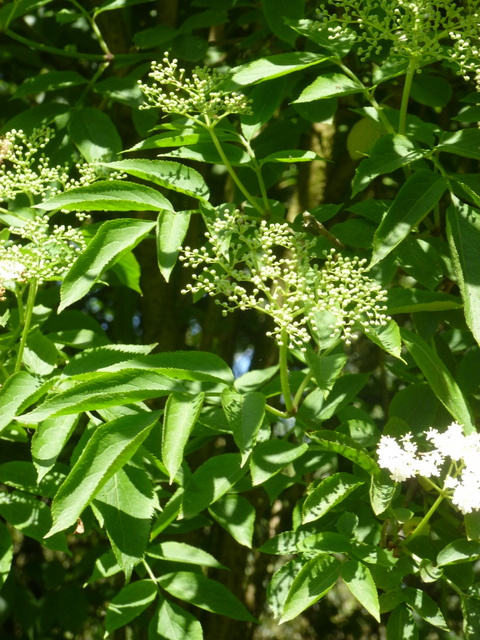
When picking the flowers, try to go in the morning, on a sunny day, when the pollen levels will be at their highest. Try to pick fresh, white brackets with no brown patches or blemishes, as these have the best taste. Elderflowers will keep for a couple of days, but they start to go brown quickly, and will deposit pollen and nectar, which is essential for the flavour, so it is best to try to use them on the day that they are picked.

This is my recipe for elderflower cordial. I originally cut it from a reader’s letter to the Guardian, years ago. Unfortunately, I don’t have that cutting anymore, so I don’t know the name of the person who sent it in. As you will see, the recipe is basically based around the number four, so once you get the amounts, then you will understand why I have misplaced the clipping.

Elderflower cordial is a great way to preserve the delicate taste of summer, and is the basis of many things, from refreshing drinks and summery cocktails, to use with other fruits and in many desserts.

I’m going to be writing about some of my elderflower cordial recipes in the coming months, but I’d really love to hear how you use it in your recipes, in the the comments.

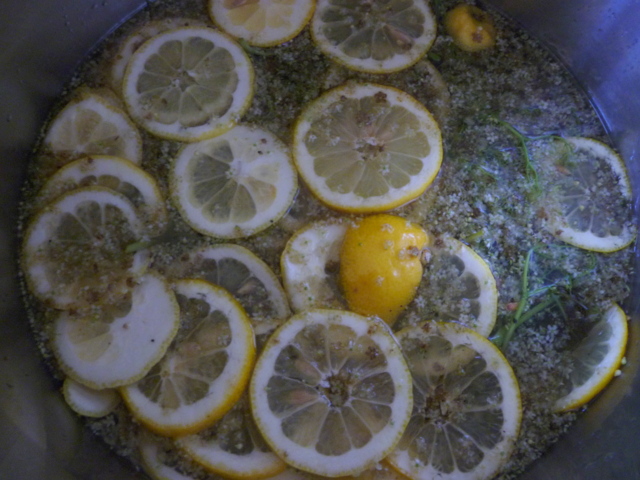
Steeping elderflower cordial

Steeping to Success

Recipe: Elderflower Cordial

Ingredients

40 elderflower bracts

4 pints boiling water

4 lb (1.8 kg) sugar

2 lemons, sliced

4 tsp citric acid.

Method

I often only have raw cane sugar in the house, which makes the cordial slightly darker than you may be used to – it still tastes delicious, but most people use white sugar.

You can get citric acid from home-brew shops and possibly the chemist (in the UK). If you cannot find citric acid, then add the juice of another lemon. If you use this method, I would recommend freezing the cordial once bottled, to make sure that your cordial does not go mouldy.

Method

Steep the blooms in the boiling water in a large, non-corrosive container.

Add the sugar, lemons and citric acid, and stir until the sugar has all dissolved.

Cover with a tea towel, and leave in a place that you will walk past daily. Leave for four days at room temperature, stirring well twice a day.

Sterilise some bottles, and a funnel. You can use new ones, or old oil, vodka or screw-top wine bottles will also be fine. I find that bottles are much less likely to get thoroughly clean in a dish washer, so I clean mine by hand with a long bottle brush, then I sterilise them with campden tablets, which are also available from home-brew suppliers. This recipe makes a little over 4 l, so you will need an appropriate number, plus one for luck.

Strain the elderflower through muslin, then bottle and seal tightly.

This should keep for up to a year. Once it is opened, store the bottle in the fridge.

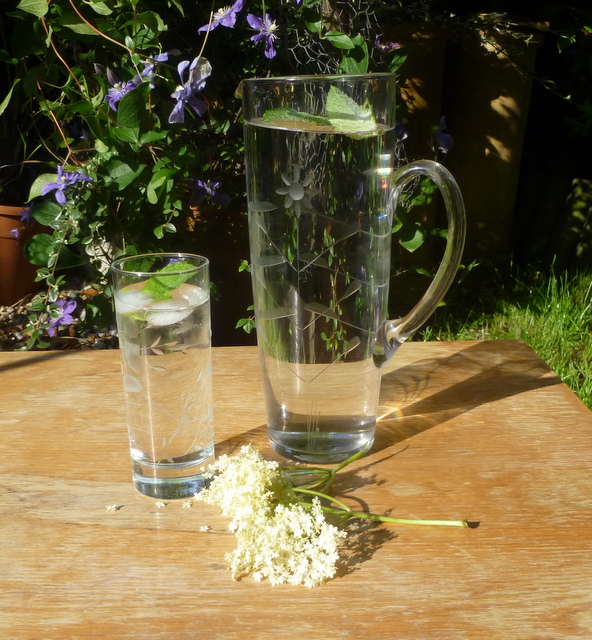
Then pour yourself a nice tall glass of diluted cordial, add mint and some ice, and think about what recipes you could use the cordial in.

13 Comments

Filed under Fermented, Found

A Test of My Nettle!

Edible hedgerow

An Edible Hedgerow

I love nettles – in tea, as plant food, in pesto.My favourite thing to do is to eat them as a vegetable,briefly wilted with chopped shallot that has been softened in butter. One of my favourite foods, made even better that they are in plentiful supply.

There are loads of good things about nettles: they are high in protein, and fibre, and rich in iron and vitamins A and K; they are a brilliant wildlife habitat; you are highly unlikely to get into trouble for picking them (although people might think that you are a little bit mad); and you get a double hit on them (in the wild), as you can pick them in the spring, and again in autumn. They are also really easy to identify.

As well as following some basic foraging rules, you will also need long sleeves and rubber gloves if you don’t want to get stung!

Flowering nettle

Too Late for this Nettle

If you are going for the wild variety, we are drawing towards the end of the first flush for this year. When the flower heads appear, almost like catkins (see above), the nettles will develop calcium carbonate crystals in the leaves, which are unpleasant to eat. However, if you strim back nettles, then they will grow fresh and you can eat them again. If you look carefully, you should still find some that are yet to flower, so just pick those.

Picking the nettle tips

Taking the Tips!

Because of the aforementioned abundance of wildlife, and the fact that even the tallest dog can’t reach, only pick the tips and the first two leaf bracts after them. These leaves won’t be tough, as some of the older leaves might.

I was originally going to enter this recipe into  Simple and in Season, for May, but the recipe needed a bit more testing. The first version I did was a bit mushy, so I didn’t make it. I am entering it for this month instead. Ren Behan at Fabulicious Food runs this challenge, and this month it is being hosted by Laura at How to Cook Good Food.

I love to entertain, and I also love to forage. I don’t often combine the two (unless it is booze) because I often think that people might not like the idea. However, I was having a vegan friend over for dinner, so many of my fall-back staples were off the menu. I had some freshly picked nettles, and I saw that Carl Legge had tweeted a link to his nettle gnocchi recipe. I was inspired, but couldn’t use the recipe, because he uses an egg as a binder. Instead, I have played with this a bit. I have to admit that I did not add enough flour to the first recipe, which was why it didn’t hold its shape. I apologise to my friends who had this as a starter that day, but I have improved on it now, to give the recipe below.

Jo's Version of Mr Potato Head

Soggy Gnocchi Disappointment: an Impressionist View

To make up for the gnocchi, Jo entertained us all with her food faces. This was a stray potato, with her partner as a size comparison.

Nettles go well with tomato sauces, but I decided that I was going to use a really simple pasta sauce (not at all traditional for gnocchi, but it went really well) of oil, chilli flakes and garlic.

This recipe is a good introduction to foraging, if you have always fancied giving it a go, but not dared so far. Nettles are easily accessible, and much tastier than you might think.

Nettle Gnocchi and Salad

Nourishing Nettles

Recipe: Vegan Nettle Gnocchi

Ingredients

200 g nettle tops, washed well in cold water

500 g floury potatoes. You want a variety that makes good mash

300 g plain flour, plus more for dusting

1 tbsp hemp oil (optional)

Salt

Pepper

You can also add spices to the dough, if you like, nutmeg is particularly good.

For the pasta sauce:

4 tbsp extra virgin olive oil

2 cloves of garlic, finely sliced

Pinch of dried pepper flakes

Method

Firstly, remove the nettle stalks and discard.

Put the potatoes, with their skins on, in plenty of cold water and boil until they are just done and you can pierce to the middle. This should help stop them getting waterlogged, but only if they don’t overcook.Allow to cool slightly, then peel and mash them, preferably in a potato ricer or food mill, if you have one.

Add the nettles to boiling water and cook off briefly, the exact time will depend on the age of your nettles. Drain them, but don’t discard the cooking liquid. This is nettle tea, which is refreshing and all sorts of  good for you. You can drink it hot or cold, and it keeps well in the fridge.

Nettles retain more water than spinach, so use the back of a spoon and press them quite hard to get the liquid out of the leaves. Chop them roughly and mix well with the mashed potato, hemp oil, some salt and pepper, and any spices you are using.

An idea of how the  dough should look

The Dough Should Hold its Form Really Well

The exact amount of flour that you need will depend on the nettle and potato mix on the day. Initially, I used way too little, and the gnocchi were soggy. The best way around this is to tip the potato and nettle mix onto a floured surface, then add the flour, a little at a time and mix in well. You want to form a quite stiff dough, then knead it well. If you are unsure if there is enough flour, drop a test piece into some boiling water and cook for a couple of minutes. If it retains its shape, you have enough.

Bite sized gnocchi pieces

Bite Sized

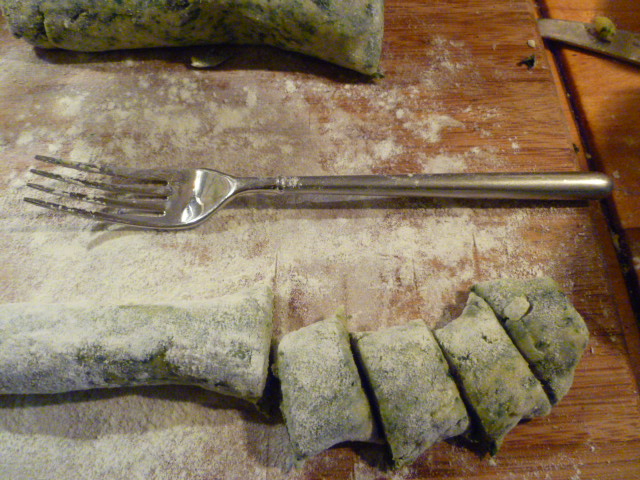
Cut the dough into four. Flour your surface , and roll each piece of dough into a sausage 2-3 cm  in diameter. Cut these into 2-3 cm pieces. It is traditional to press a fork into each small piece to score it. The reason often given for this is so that a sauce can sit in the grooves. This is a great tip for a thicker sauce, like a tomato sauce or a ragù, but not really necessary for the sauce I used. I did it anyway, for aesthetics.

Marking grooves in the gnocchi to hold a sauce

Get Into the Groove

Get a fairly large pan of salted water to a rapid boil, and then drop the gnocchi in. They will take literally minutes to cook, so don’t be tempted to go and check e-mail or something similar.

The Finished Nettle Gnocchi

The Finished Product

For the sauce, gently heat the oil and garlic until the garlic starts to brown. Then add the chilli flakes. This sauce will take about the same time as the gnocchi, which will be cooked when they float. Drain, toss in the sauce, and serve immediately.

13 Comments

Filed under Found