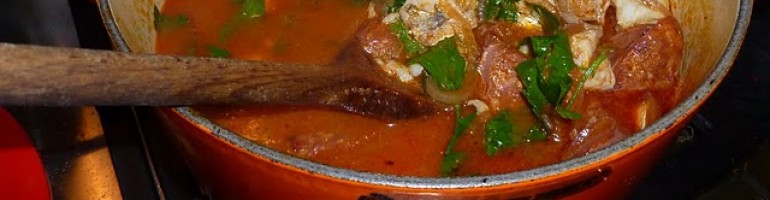
Southern Cross Buns

Southern Cross Buns

One a Dollar, Two a Dollar…

I have been searching around for ingredients for an Easter dinner for my friends. These are mostly the same friends who came for the International Christmas Dinner, so I wanted something that would encompass all of our traditions, as well as a nod to the Dutch. Some of these recipes will appear here in the coming days, as they are much less specific to Easter, but this one couldn’t be delayed.

One of the traditions that I found out about was the Australian one. For friends from the Southern Hemisphere, Easter heralds the start of autumn, and thus is naturally a little less about rebirth and rejuvenation, even though they  do continue to keep many of the same traditions as us in the North (hint: eggs and chocolate feature in all Easter traditions, as far as I can tell).

According to this website, there are a few key differences. Anyone who has seen an episode of Border Security will know that Australians are none too keen on letting in non-native animals, due to the havoc that they wreak. It is no surprise then, that they have replaced the Easter Bunny with the much more native Bilby. However, my chocolate work needs a lot more practice, and it is certainly not up to making small chocolate marsupials without a mould.

So, I was very happy when I saw the fact that the Aussies have taken the hot cross bun, and made their own version. With chocolate.

I had already decided to make traditional Hot Cross Buns for dessert. Strictly speaking, they are served on Good Friday, but as it is my tradition to break the rules for international dinners, I am going to serve them for Easter Sunday itself. And I get to do two kinds. We will serve them toasted, to be smeared with butter moulded in the shape of a lamb, which is a Dutch tradition.

Boterschaap

Aw Look, a Butter Lamb! We Named Him Wonky

I made the British buns using the recipe from the River Cottage Bread Book, by Daniel Stevens. Then, I adapted it to make what I am calling Southern Cross Buns, which I think are good for any occasion, and you can keep the cross, since they are named after the Australian flag.

And I photographed the steps for you.

Recipe: Southern Cross Buns

Ingredients

For the Bun:

250 g strong white bread flour (plus some for dusting)

250 g plain white flour

2 tbsp cocoa powder

125 ml warm water

125 ml warm milk

1 sachet dried yeast (7 g)

10 g salt

50 g caster Sugar

1 egg

70 g plain chocolate chips

30 g candied peel (orange only if possible)

Zest of ½ orange, grated

6 green cardamom pods

For the Cross:

75 g plain white flour

100 ml water

For the Glaze:

1 tbsp apricot jam

1 tbsp water

Method

You may remember that I made my own candied peel. This is not compulsory, but it does make it a lot easier to use only the orange peel for this recipe. If you have (or wish to make) your own candied peel, chop it finely before you start the rest of the steps.

Extracting cardamom seeds from the pods

Remove the Seeds from the Cardamom Pods

Also lightly crush the cardamom pods to release the black seeds inside, and grind these to a coarse powder with a pestle and mortar.

Sieve together the flours and the cocoa. I usually skip the sifting step in a recipe, but this will help prevent the cocoa from forming lumps.Mix together with the sugar, salt and yeast

Make a Well in the Centre of the Dry Ingredients

Make a Well in the Centre of the Dry Ingredients

I found that mixing boiling water from the kettle, and cold milk from the fridge, the resulting liquid was warm, but not too hot for the yeast. You can use a food mixer with a dough hook for this recipe, but I am gadget-averse, so I had to do it with my hands. whichever way you choose, the dough is fairly sticky. Pour the liquid into the well, and mix.

After Mixing in the Milk & Water

After Mixing in the Milk & Water

Once it looks a bit like this, add the butter and the egg. This is when it gets sticky. Mix it well, so that you cannot see lumps of butter in the mixture anymore.
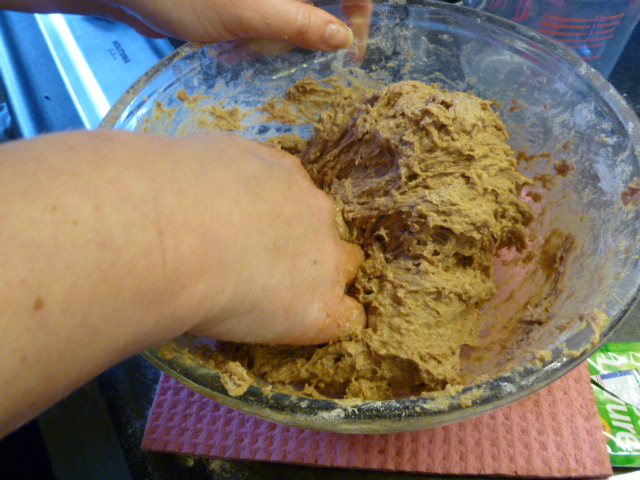
The mixture will get a little smoother

The mixture will get a little smoother

Then add the chocolate, candied peel and the ground cardamom. Knead this in well.
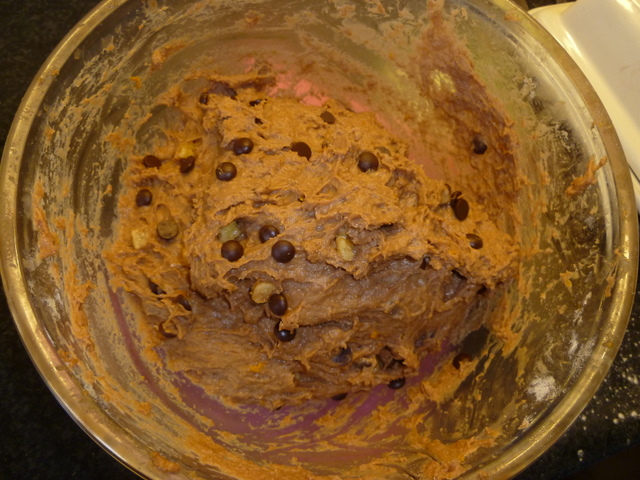
When it loos like this, cover it and leave it to prove

When it looks like this, cover it and leave it to prove

Try and leave it somewhere warm. It should take about an hour. I left it a bit longer, because I was busy with getting a lamb cooked, and other things. It was fine, and still rose nicely. Knock back – by punching the air out of it.
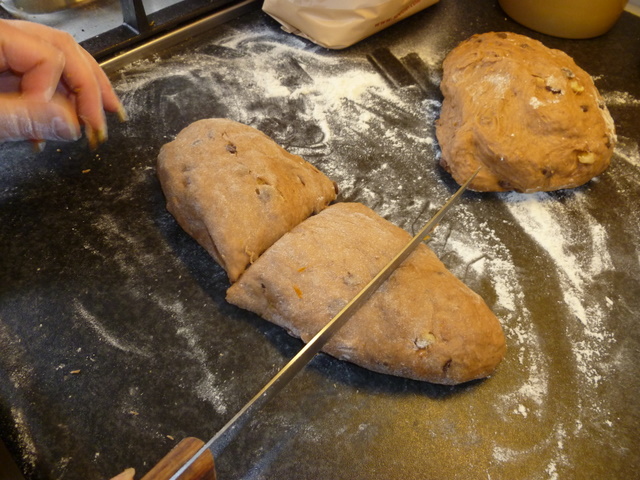
Cut the dough into eight equal(ish) pieces

Cut the dough into eight equal(ish) pieces

I got the proportions mostly right when I cut it. Only one was smaller than the rest. Make it easier on yourself by cutting the dough in half, roughly shaping each half into a thick sausage which you cut in half, then half again. It should be fine, if the sausage doesn’t taper too much.

Shape each piece of dough into a round. The following steps are straight from the River Cottage book, but they work really well, so they are the steps you need. Put the flat side of the dough on a lightly floured counter.

Bring a piece of the dough into the centre and press lightly

Bring a piece of the dough into the centre and press lightly

Each time that you do this, turn the dough a little, then repeat. Do this until all the dough is folded into the middle, and press firmly. Flip it over onto the other side. If you are not that confident in working sticky dough, like me, then you will probably want to flour the work surface again a little bit. More confident bakers work focaccia, which is a much wetter dough, so you will probably be fine. I found that I didn’t need to flour the buns later, because they were fine after I floured the surface.

The next bit is difficult to describe. You need to stretch the top of the bun, while tightening the pinch at the bottom. To do this, you need to flatten your hands, place the heel of one hand against one side of the roll, and the fingers of your other hand on the other side.

Step one of turning the bun

Step 1: flatten your hands at either side of the bun

Next you need to move your hands in opposite directions, and bring them together under the bun, so that it spins. This will stretch the top of the dough.

Step Two: Spin the bun, by moving hands in opposite directions

Step 2: Spin the bun, by moving hands in opposite directions

You will end up with your hands in the opposite configuration to that in which you started.
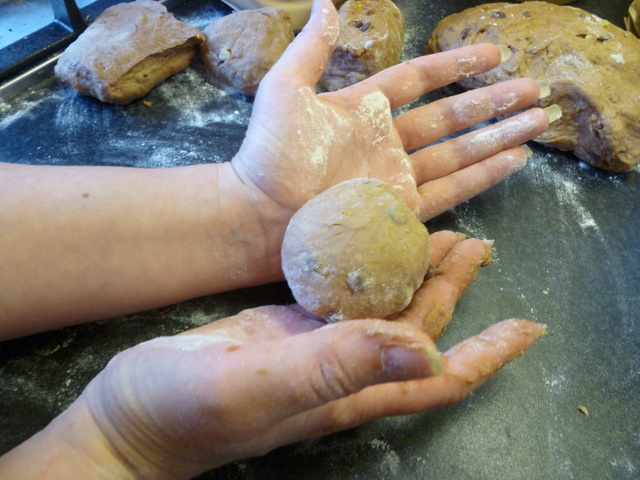
Step Three: how your hands end up

Step 3: how your hands end up

Do this little move three times per bun. Then put it on a board, and dust it lightly with flour, if you didn’t do it on the work surface.
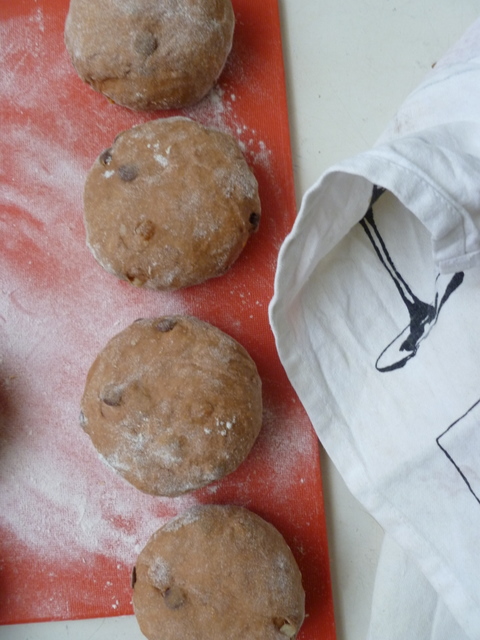
Place them on a lightly floured board and leave to prove for another half an hour

Place them on a lightly floured board and leave to prove for another half an hour

Preheat the oven to 200°C

While the  buns are proving, mix up the flour and water, with a whisk. This will form your cross. I think the paste needs to be fairly thick. If you get the thickness right, I don’t think you need the amount of flour I have given here. I think mine was too thin, because the contrast on the ordinary bun was not good enough, so I didn’t get a cross. The contrast between the chocolate buns was much better, due to their brown colour. However, for you I have upped the ratio of flour to water. My advice would be to start with 50 g flour, and very slowly add the water, until you get a thick batter. it should leave ribbons when you pour it from a spoon, not run off.

Once you have a good consistency for the paste, and the buns have proved, then you need to make the cross. Transfer the buns to a baking sheet. Put the flour paste into a sandwich bag (or piping bag, if you have all the fancy equipment) and snip off a really small corner – be careful, the piped line is much bigger than the hole appears. Pipe the paste over the bun in a straight line, then again, at right angles to the first.

The piping bit is tricky, and needs a fairly steady hand

The piping bit is tricky, and needs a fairly steady hand.

I have to admit to a few drips where there should be none. They wiped off easily enough, but I had a thin paste. It is best to be as careful as you can.

Put the baking tray in the oven, and bake for between 15 and 25 minutes. Mine took nearer 25 minutes, so keep an eye on them. Like most bread-based products, they sound a little hollow when tapped on the bottom, when they are done.

While the buns are in the oven, melt the apricot jam and the water to make a glaze. Glaze them by painting the jammy liquid  over the top of each bun as they come out of the oven.

Leave them to cool on a wire rack.
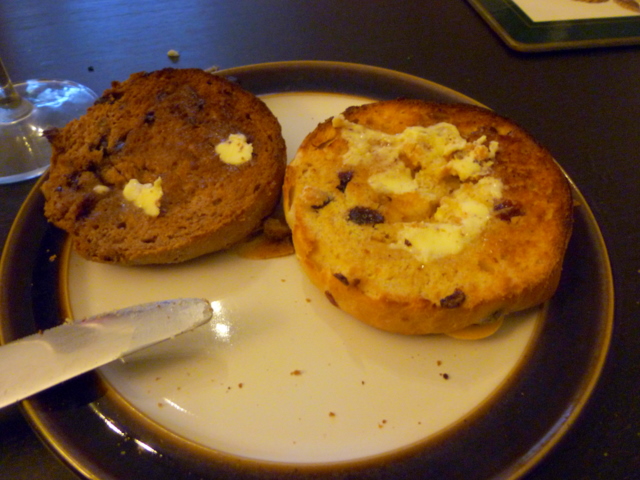
Toasted Hot Cross Buns

Toasty!

Toasted is the correct way to serve these. Possibly slathered with butter from a wonky sheep.

4 Comments

Filed under Feast

Roots and Permaculture

Varzea da Gonçala

Where I Have Been Lately

Hello! I am back from a little sojourn in the Portuguese countryside, where I have been on a fantastic Permaculture Design Course.  I intended to get a load of posts done to be posted over the time that I was away, but as usual, I was behind, and doing them on the journey. I got to the venue to discover that there was no frivolous internet access (due to the tariff system in rural Portugal) and no mobile reception, so things didn’t work out as I had planned (and not planned, in many ways). I am not sorry, it was glorious to be away from it all, and was incredibly good for the soul.

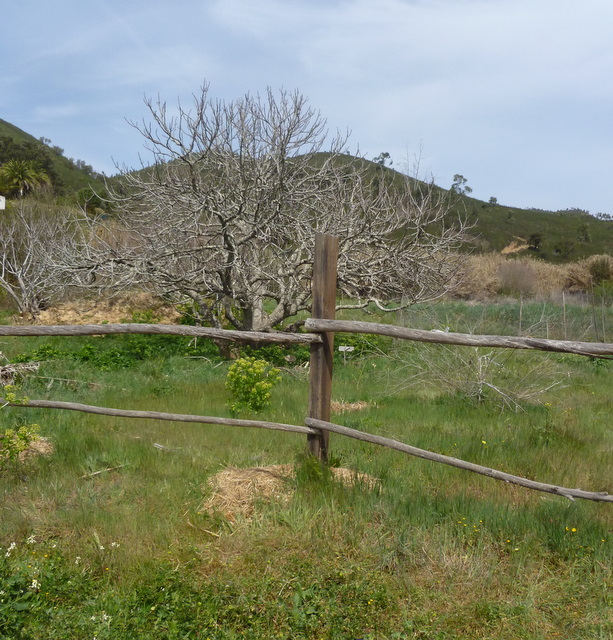
Fig tree at the Varzea, Late March 2012

The View From the Classroom

I will post those other posts over the coming days, along with a few Easter posts, which should probably come first,  but I really want to tell you all about the course and what I got up to first. Partly by way of explanation for the absence, but also because I really want to recommend a permaculture course. This was a birthday present from the Big Guy, so I knew little about it before then. Lucky me!

Me & Permanent Varzea Residents

Me & Permanent Varzea Residents

The course itself was run at Varzea da Gonçala, a lovely small holding just outside Aljezur in the Algarve, and set in a valley (hence the lack of phone reception), not too far from the Atlantic. The Varzea operates on permaculture principles, producing its own fruit, vegetables, and eggs, and they have chickens and pigs to help work and feed the land. It is important to the people who  live and work there to demonstrate that permaculture is effective for everyone, and that it really works. It is why they have called their website ‘I Can Feed Myself’, to underline the point. Chris and Kris, who run it, along with the people who work with them, are excellent hosts and teachers. We also had  amazing food for our stay.

Feast Fit for a King at the Varzea

Feast Fit for a King (Our Last Night)

We ate like kings, with everything from jacket potatoes, to lasagne, to beautiful fresh salads of rocket, mustards, chard, lettuces, fresh herbs, nasturtium leaves and flowers, borage, peppers, you name it. I may not have sown these seeds, but I definitely got my hands dirty to tend to them, so these will form part of the 52 week salad challenge for me, and I don’t feel like it is cheating. The food was fantastic, prepared with love, and was so fresh.

Peter Cow Giving a Lecture

Teacher!

Our main tutor was Peter Cow, who runs Living in Circles, and there were sessions from other permaculturalists, including the people who live on the Varzea.

The Big Guy really couldn’t have chosen a better course. We learned about the principles of permaculture, and the design method, as well as putting it to practical use. I got to play with the compost and do some gardening, and I have learned some valuable skills. Peter is also keen on applying permaculture to the wider world, as well as the personal one. I will admit that I was not really looking forward to this, but I actually found it immensely useful. I have been able to get a different perspective on a couple of things, which have been holding me back in many ways.

The group of people I was on the course with were also brilliant. I have never worked with a group that was so on track, and with no little fighting and falling out, despite being such vastly different people.  Each of them brought a lot of different knowledge to the course, and it was so great to share this with everyone. One guy also lives in the same town as me, so I hope that we can continue to meet and maybe do some digging together!

Making a Wooden Spoon

Spooning!

We even practiced some new skills – both on the course, and in the breaks. As well as learning about swale construction, and building a stackwall. I got an insight into perspective in drawing, which has inspired me to give sketching a go – something I never felt equipped to do before. I helped to teach others how to make pasta. I even know how to make a wooden spoon. I’m just putting the finishing touches to one, albeit that it was produced with a little help from my friends. I really feel like I came away a craftswoman.

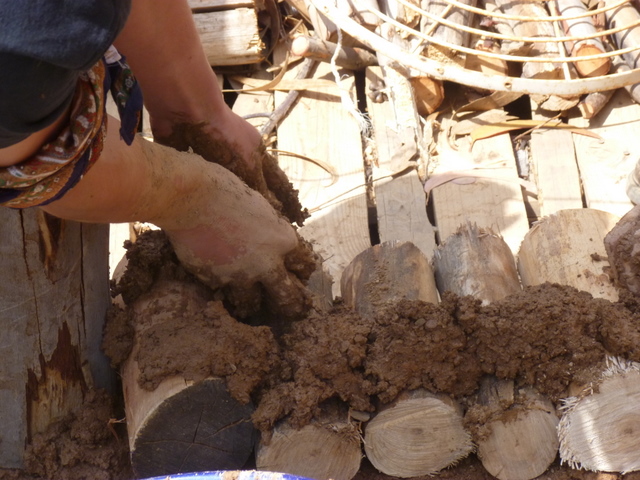
Constructing a Stackwall from Cordwood

Constructing a Stackwall from Cordwood

In fact, I have been so inspired by the course, I am trying to expand my use of permaculture and permaculture design. I have some plans for friends’ balconies – and before any of those said friends start to panic, don’t worry, permaculture has a lot to do with water catchment and no-dig, so you won’t become slaves to your pot plants. I am planning to implement my own polyveg system in my own garden, and I will be blogging about it here. I had intended to start a new blog for the gardening stuff (and had a great name lined up…) but the idea of permaculture is that you should take advantage of and increase beneficial relationships, and to me there is no better relationship than that between food and food production. So I am going to capture it here, and try to expand the communities of interest that could talk to each other. I am even going to try and design myself into a new career and direction, but I need a bit more work on that.

Finished Stackwall

Look What We Made!

Peter runs and collaborates on a number of permaculture courses, all of the details of which are available on his website. He is also really in tune with group dynamics and very skilled at getting very different people to work together and gel. You might like to go along to a course, or ask him to teach at one of yours.

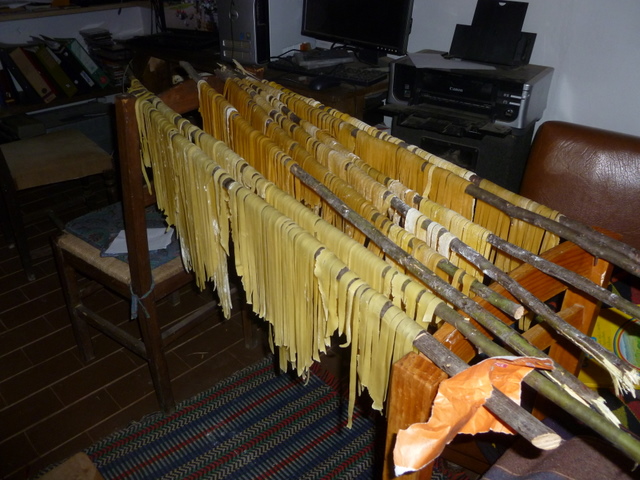
Drying Homemade Pasta (No Pasta Machine)

Look What Else We Made!

The Varzea also offer a range of courses, as well as holiday accommodation and camping, for groups, individuals or families. You can get hands-on experience and teaching in permaculture practice. As well as having access to delicious, organic food from the land that they work. An ideal get away from the petrochemical farming and urban landscapes we have come to know, I really cannot recommend this place enough, not to mention the hospitality and the welcome you will enjoy here.

I hope that you will also come to share my enthusiasm for permaculture, and share the fruits of my labour (and the recipes that they inspire). Thanks for coming this far.

Contacts for Varzea da Gonçala

Contacts for Peter Cow

NB: I do not represent, nor am I being paid to blog about the permaculture course,or the Varzea.  I am just so enthused by the experience, and the people I met that I wanted to blog about it.

4 Comments

Filed under Farmed, Feast, Fed

Taking the Biscuit

Speculoos Refrigerator Biscuits

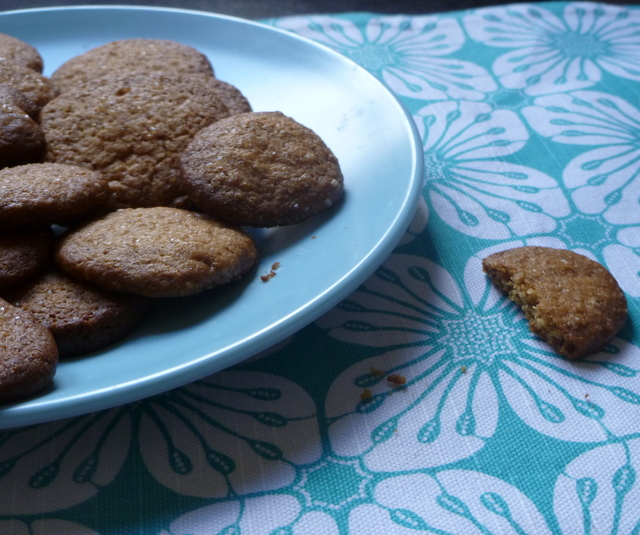
Speculoos Refrigerator Biscuits – Meant for Taking

Yesterday I hosted a meeting for a group of proto-freelancers that I have joined. As is customary, I was going to serve biscuits and tea. Since I prefer to make things from scratch (a tendency that has only got worse since it also gives me something to blog about!) I decided that I was going to make the biscuits. I have not actually attempted to make biscuits for a number of years, since they aren’t really something that I have around the house. In fact, the only time that I really ever think to buy them is if I am going to make a cheesecake, or another dessert with the requisite buttery biscuit base.

The last time I was really into making biscuits was as a fairly young kid (maybe 8ish?). Once the Sunday Dinner had been cleared away, and the washing up done, I would bake things, some sponges cakes and the like, but mostly biscuits, while my parents were either out on the garden, or dozing in front of the Eastenders Omnibus. These baking sessions were always using recipes from the tried and trusted Dairy Book of Home Cookery.

I had been given some Lotus speculoos paste by a good friend who was returning to Australia, and had one too many items from Europe in her case. I have always known that I will make biscuits with it, since these are traditionally served with coffee and tea in every cafe in Holland. And what better opportunity to have a go than for a meeting? So it was to these things that I turned when looking for inspiration.

The Dairy Book has a basic recipe for refrigerator biscuits, which seemed easy enough to adapt, so I used this as a starting point for my treats. They are called refrigerator biscuits because you wrap them up like a sausage, then let them rest in the fridge for at least an hour. I actually made these a while ago, when we were originally going to have the meeting, but we had to postpone due to a particularly nasty flu that several of our people had. You can keep the dough in the fridge for a week. The mixture also freezes well, and the amounts given here will make a lot of biscuits (up to 60 depending on how wide you roll the sausage), so I divided it in two and still have a sausage of dough in my freezer. You can defrost them on the counter, or (if you can cut them) cook them from frozen, allowing a minute or two longer cooking time, but you will need to watch them.

Recipe: Speculoos Refrigerator Biscuits

Ingredients

200 g plain flour

100 g butter

1 tsp baking powder

1 tsp speculaas spice

2 tbsp Lotus speculoos paste

150 g caster Sugar

1 egg, lightly beaten

vanilla sugar for sprinkling

Method

Rub together the flour, baking powder, butter and speculoos paste, like you would for making pastry. Once you have the breadcrumb texture, mix in the sugar.

Add the egg, and bring together to form a dough. I did all of this with my hands, but you can do it with a spoon if you prefer.

At this point, I tasted the dough, and decided that the speculoos didn’t give quite the spicy punch I wanted, so I decided to add some speculaas spice that I still had from making Kruidnoten. I also gave the recipe for the spice mix on that post, if you want to have a go at making these, and you are not in the Low Countries, where it is readily available.

At this juncture I should point out that raw cookie dough has been linked to outbreaks of e. coli infections, and should not be eaten if you are in a vulnerable group, or if you are worried about this sort of thing. In this case, I took the risk for you, so if you choose to make these biscuits, you can also skip the testing, and simply add the spice when you mix in the flour, as I suggest above. If you can’t find any speculoos paste, then you can also just use the spices.

Once the dough has formed, it should be pretty dry, and workable. I found I needed to use a tiny bit of water, to help the dough form, because the only egg I had was on the small side, but I added it splash by splash, because I wanted to get the texture right.

Roll the dough into a sausage. You may need to cut it into two here. I did. Once the sausage is the sort of width you imagine your biscuits to be, wrap it tightly in foil or cling film, making sure the ends are sealed well. It is worth noting that these biscuits will spread a little, during cooking, so you will need to roll the sausage a bit thinner than you want.

Once wrapped, bung the dough in the fridge for at least 3 hours, or overnight if you can. Or you can freeze it immediately.

When you are ready to bake, heat your oven to 190°C.

Meanwhile, grease your baking sheets with some old butter paper, which should have enough butter on it to cover your trays with a thin layer of butter. If not, rub it over a pat of butter before rubbing the tray. Butter paper is also something that I never throw out, until I have got maximum use from it. You can substitute it for tin foil to wrap food (but not for cooking with), you can using for greasing baking utensils, and you can use it as a cartouche to retain moisture or prevent a skin from forming on a liquid. My mum has always done this, and I have also always done this, it was just a habit really.

I have two baking sheets, so I used both in the oven at the same time, to reduce energy consumption. If you do this, be aware that the top biscuits will be ready slightly earlier than those lower down in the oven. They catch really quickly, so take these out first.

Slicing Biscuits from the Dough Log

Slice ’em Up. If you use a sharper knife, then you can get thinner biscuits than I did here

Then, thinly slice your biscuit dough along the length of your dough sausage. Probably thinner than I have here, if you like. One tip is that the sharper the knife you use, the less you will compress your roll, and thus will not have to constantly reshape or have odd-shaped biscuits.

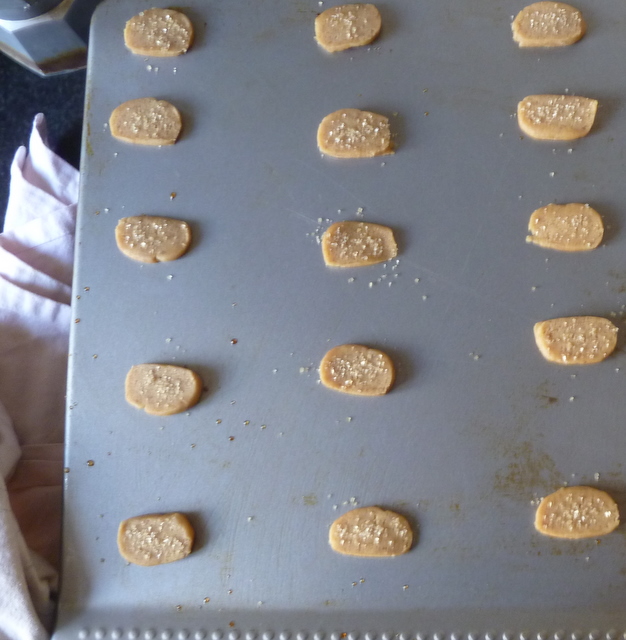
Arrange the biscuits onto the trays, allowing space for them to spread out a little as they cook. I sprinkled mine with a little vanilla sugar, because I always have it to hand as a by-product from custard making. Caster sugar will be just as good. You can also dust it lightly or a little heavier if you would like more of a crisp.

Speculoos refrigerator Biscuits Sprinkled with Sugar

A Sprinkle of Sugar

Stick them in the oven, and check them after 10 minutes. Mine were done then, but you can leave them in for up to 12 minutes.

Allow them to cool a little on the tray before removing, and serving. If you do have any left, put them in an airtight container, where they will keep for a day or two.

The actual time you spend on these biscuits is minimal. I probably spent about 10 minutes in total on preparation. But, I can guarantee that your guests will appreciate the effort that they will think that you have gone to. Unless you have hundreds of guests, you will also have enough for a couple of batches, and what could be handier to have on standby in your fridge or freezer, for meetings, drop in guests, or a visit from the WI?

1 Comment

Filed under Feast

You’ve Neva Had it So Good

Cafe Restaurant Neva reminds me of a Hanna Barbera hero, such as Hong Kong Phooey. By day, it is a mild-mannered cafe that serves the Hermitage museum in Amsterdam,  but by night it is transformed into a modern European fine dining restaurant, fighting hunger and exciting the palates of the well-heeled.

Well, actually, having never eaten there before, I may be understating the lunch fare. It is done by the same company, so the sandwiches could be every bit as magical as the evening dinner.

This was our penultimate venue for restaurant week, and it was a real treat. And after this restaurant week, I have revised my view of Dutch service. Without exception, every place we went to was friendly, helpful and pleasant. No sharp words or blunt answers.Thank you for making me confront my prejudices, waiters of restaurant week, I apologise and I salute you all.

I also have to admit to being a bit too intimidated to use a flash to take the photos, which is the reason for the substandard photos for this post, but the food was so good I didn’t want to avoid writing this up for the sake of the photography. It is hardly as though I am David Bailey everywhere else on this site in any case. If any of you have any tips on overcoming shyness in using flash in the low lighting of a restaurant, please let me know.

Anyway, back to Neva. The food here was both clever and delicious. It had the right amount of a nod to modern cuisine, with some surprising touches, without being too fussy. Although they did like a good foam. I think every dish had some of one variety or another.

Baby Leeks With Trout Eggs and a Buttermilk Dressing

Baby Leeks With Trout Eggs and a Buttermilk Dressing

The Big Guy, being Swedish, loves fish eggs, from Beluga caviar right through to Kalle’s Kaviar. As soon as I saw this on the menu, I knew that there was no way that he would have anything else. He loved it, and wolfed it down really quickly. I may have mentioned that he is not a man of superlatives, but he certainly seemed very happy with it. It was matched with an excellent Czech  Riesling. If you have never tried Czech wines, this is an excellent place to start, it is a light and fresh Riesling, but with all the required fruit.

Mackerel Ceviche with Cucumber Textures

Mackerel Ceviche with Cucumber Textures

This plate was as pretty as a picture, but it wasn’t a small dish. The cucumber textures were foam, sorbet, pickled, a mayonnaise with horseradish, meringue, and tiny cucumber microgreens. The foam worked really well in this context, delivering an intensity of flavour that plain cucumber doesn’t. The microgreens were lovely. I have been getting into microgreens a lot of late, as they are an easy way to do the 52 week salad challenge, especially in the winter months when it is hard to stop legginess. To my knowledge, none of the saladchatters has had a go at growing this one yet, but I have recommended it.

The meringue was savoury, and was salty, which was surprising. I hadn’t thought of making savoury meringues before, but I will play around with this, because I often have leftover egg whites, due to my custard addiction.

The only criticism I have about the dish is that mackerel was really more sashimi than ceviche, it was definitely not marinated in citrus juice. That said, it was very skilfully filleted and presented, so that you only got the most delicate flesh and no blood line. If it were any fresher, I may have had to slap it.

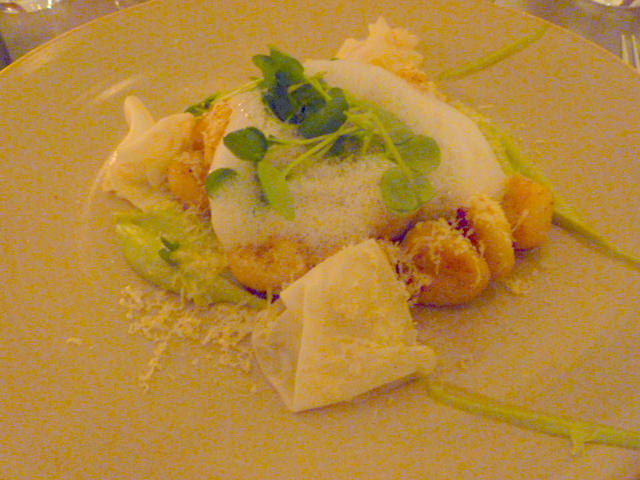
Oxtail Ragout with Celeriac

Oxtail Ragout with Celeriac

This is what the Big Guy had for his main. The celariac was in the gnocchi, the foam and as a pickle. It was a little light on the ragout of oxtail, which served as a background flavour, rather than the star of the dish. Despite this, it was fresh and lovely, with a juiciness being added by the pickle. The Big Guy says he could definitely eat it again.

Grey Mullet with Fennel in Bouillabaise Jus

Grey Mullet with Fennel in Bouillabaisse Jus

More foam on this one, this time it was fennel. I was much more interested in the fennel cream, which was really good; intensely aniseed, but with the lovely fresh greenness of herb fennel. It also cut through the bouillabaisse sauce really well. I loved this dish, it was really well cooked and well-balanced. I love fennel though, and this would definitely be a problem if you didn’t like it.

We both had the caramelised white chocolate cheesecake with chocolate rocks and blood orange sorbet for dessert, but we were far too eager to tuck in to take pictures, which is almost a shame because the presentation was a feast for the eyes. That paled into insignificance when we tasted it. Goodness me was this good. I would not normally choose white chocolate on a menu, but this was more like toffee, or the fudge you get when you boil a tin of condensed milk. The chocolate rocks were dark and crumbly, as I like them. The sorbet sounded odd in the mix, but was a revelation. It wasn’t sharp, but neither was it too sweet, and cut through the rich cheesecake.  For me, this was the highlight of the meal. Utterly delicious.

We rounded off the meal with a coffee and a herbal tea. With this, we also received a complimentary tin of petit fours and biscuits, all of which were very well made. It is touches like this that, for me, demonstrate the care that goes into making a meal out a real experience. And that is what an evening meal at Neva really is, from the extra touches, the friendly staff to the excellent food. Not to mention the beautiful surrounding of the Hermitage museum.

Outside of Restaurant week, they offer a three course theatre menu for €29, and a 4-6 course tasting menu for €42-59.

I think that the theatre menu is a bargain, and would definitely recommend a visit if you are going to the Carré or the Music Theatre. And I think that the tasting menu would be great for a special occasion too.

Cafe Restaurant Neva

Amstel 51

1018 DR Amsterdam

T: +31 (0)20 5307483

Leave a comment

Filed under Fed

This Tum’s For Hire: Last Night We Were Dining in the Dark

Ctaste dining room

View From the Best Table in the House

Apologies for the terrible punnage in the title of today’s post, but since my friend booked us a table for four at Ctaste for restaurant week, I have been unable to get Bruce Springsteen’s earworm out of my head.

Ctaste is one of several restaurants globally in which patrons dine in the dark. In some of these restaurants, the waiters are equipped with night goggles, but the one in Amsterdam employs visually impaired waiting staff. I found the concept really interesting, and was excited to go along, because I thought it would be a good test of my palate.

You start off in a lit conservatory, where you have the concept explained to you, and you get to choose from a meat, fish, meat and fish or vegetarian menu, and whether you would like wine or beer matching. Three of us chose the vegetarian option, and the Big Guy had the meat. Most of the party also had the wine matching, but one of us chose the beer option. The staff were also careful to check for any allergies that diners may have.

From here, we were ushered through several curtains into the very dark main dining room. You hold onto the shoulders of your waiter and fellow diners in a crocodile formation. It is surprisingly disorientating.

Once seated, the waiters check which of the party are having which options for food and wine, so that they can get a handle on the seating. When you think about it , it is pretty obvious that it should be the person who requires the meat or the beer option who says this to the waiter, but actually we all instinctively chimed in and started pointing. I am sure this isn’t helpful, but the waiters are very patient, and allow you to work this out for yourself.

Once that had been sorted, an appetiser quickly appeared. It was obviously a smoked mousse of some kind, but none of us could pinpoint exactly what it was. Our best guesses were either Jerusalem artichoke or aubergine. We would not be allowed to learn exactly what it was until the end of the meal, when we would be back in the lit area. This is so that other diners do not hear what they are about to have, and ruin the concept for them.

Starters came with a nice, really fruity white wine. Unfortunately, I didn’t check what they were at the end of the meal, but my best guess on it was that it was a Riesling of some kind. I didn’t try the beer, but it seemed to be a blonde beer, according to my friend.

The starters themselves were pickled cucumber rolls, stuffed with goats cheese, apple & celery; and the meat one was a beef and beetroot carpaccio. Both were served with a rocket and pak choy salad, with honey and a herb vinaigrette. We thought it was rosemary.

The main was accompanied by an ordinary red, possibly a Cabernet Sauvignon. Beer was seemingly a witbier of some kind.

The Big Guy identified his main as beef. Us veggies found a portabello mushroom stuffed with blue cheese. Again, both courses had a mushroom risotto, haricots verts and roasted parsnips, carrots, onions and pumpkin. As we were finding that it was necessary to use at least one hand, so that you can feel the whereabouts of the food on the plate, it was a good thing that the food was warm, but not too hot. Interestingly, the meat and the vegetable courses came on different shaped plates each time, but I guess that is an adaptation for the waiters rather than the diners.

Then followed a pre dessert. It was an extraordinarily rich chocolate mousse, with flecks of real chocolate on the top. At the bottom there was a chiffonade. At first, the flavour doesn’t come through, but you can feel the texture. I was wondering whether this was desiccated coconut when suddenly a herbal flavour flooded my mouth. I decided that this was mint.

Dessert caused the biggest split in opinion. We all found pineapple and a lemon cheesecake. One of us found butterscotch, I definitely got banana (which I cannot stand), and there was a general disagreement over the ice cream. I thought rum & raisin, and there were also mutterings of strawberry.The wine was a muscat, and the beer was said to be a honeyed variety.

The fact that you are in the dark, and have to rely on your taste more than your sight is really a conversation piece. It is also interesting how the room seems to get larger when there are more people in the room, but somehow seems to shrink when guests leave. It’s a pretty bizarre phenomenon.

The waiting staff here were also great, very friendly, and keen to stay and have a chat. We had a little bit of a cultural exchange, as our waitress wanted to hear us say nine hundred and ninety nine in Dutch (it has a lot of g sounds in it, so is often hard to pronounce correctly for foreigners). In return, she did a pretty good rendition of seven hundred and seventy seven in Swedish, with several similarly hard to pronounce ‘whuo’ sounds. That is two for two on the friendly and helpful staff stakes. Either I have been dining at the wrong establishments all this time, or I am about to come down with a crash in the remaining restaurant week bookings. We shall see.

We rounded the meal off with a liqueur coffee and the remainder of our four glasses of wine, which we were allowed to choose from the previous three; before being escorted gingerly back out to the lit area to learn what we had actually eaten that night.

We got most of it correct. The appetiser was actually smoked carrot. The dressing was balsamic vinaigrette with the starter. The Big Guy failed to identify that his main also came with smoked duck breast and a port sauce. The cheese with the mushroom was actually a camembert, and not a blue cheese as we had suspected. The mushroom in the risotto was chanterelle, and was given as a chanterelle and parmesan risotto. I think this is slightly pedantic, since parmesan is a key ingredient in any risotto anyway, but nevertheless, it was an ingredient which we did not specifically name. The herb in the pre dessert was actually basil. I think I tasted mint because it is the herb that one normally associates with chocolate, so it shows how much tradition and familiarity can influence what you think about food. I find this really fascinating.

The dessert was actually lemon cheesecake, with pineapple pieces, a banana fudge, and a blueberry pie ice cream, which was the most surprising. They had used dried blueberries, which I had thought were raisins, but their flavour was masked by the sweet crumble of the pie crust. I don’t think I would have got that it was blueberry pie if I had nothing else to identify for the whole meal, so there you go.

As it was restaurant week, the 3 course dinner was €27.50, but is normally €39.50. The wine matching was €12.50, which is pretty good value for 4 glasses of wine, although two of the three kinds were pretty standard wines. The beer matching was €8.50.

Overall, it was a fascinating experience, and the food was good. The waiters were excellent – attentive, friendly and helpful, which is to be lauded in any case, but they certainly felt more welcoming than many waiting staff in this city. I can definitely recommend giving this a go to challenge yourself, test your perceptions and to have a good meal.

ctaste
Amsteldijk 55
1074 HX Amsterdam
Tel: +31-(0)6 22335366

2 Comments

Filed under Fed

Fed at Restaurant As

Searching for Utopia, Apollolaan, Amsterdam

Seek, or Stumble Upon, and Ye Shall Find!

This week is restaurant week in the Netherlands. This twice yearly event is a great opportunity to find and try out new restaurants, as well as revisit some classics, without denting your wallet too much.

On Tuesday, I ventured south for some new discoveries. Firstly, I happened across this huge golden turtle being ridden by a man in an Elvis suit (the Vegas years). I only discovered it because I’ve managed to wrench my arm, and I was on the tram. Had I been using my usual form of transport (bike) I would actually have come a different way. A bit of a google later, and I have discovered that this is “Searching for Utopia”, by Jan Fabre, and apparently the man in the Elvis suit is the artist himself. It was a part of the last biennial artzuid sculpture trail. Apparently, the locals love it so much, that they are having a bit of a whip round so that the can purchase it. I really quite like this idea, and I hope they get to keep the sculpture. Sadly, this is quite far off the beaten track for many tourists, but the locals clearly enjoy it.

The second discovery was As, on the border of the Beatrix Park. Set in a circular room, and set up like a wheel, this is a restaurant that trades on its sustainable principles. I went along with a group of friends to take advantage of the restaurant week deal. It also meant that I could eat meat in this restaurant.

I may have mentioned before that I am not a vegetarian, but I do not really eat a lot of meat. There are many reasons for this, which include climate change, waste and welfare concerns, not to mention cost. When I do eat meat (in which I include fish – nothing irritates me more than asking for a veggie option and being offered a tuna sandwich, it brings out the worst in me, and I become really scathing) it has to be sustainable. I often describe myself as a fussitarian, because I hold the principles of local, seasonal, and sustainable food dear. This is not to say that I am difficult to feed, far from it. If I am a guest, I will eat whatever is put in front of me, but when I have a choice, I like to choose wild game, freshwater fish (not farmed), or organic meat. This is because welfare and environmental concerns are important to me. If I can not get this, I will simply eat vegetarian. I mostly eat veggie food at home too.

The set menu at As had a meat or a veggie option, and they were very happy to accommodate one of us who couldn’t eat cheese. There were four courses to choose from, or you could have all four.The waiting staff were also very friendly and patient. I arrived late due to a snarl up with the trams, but this did not really phase the waiter, neither did the fact that we stayed chatting and left long after the other lunch time patrons. Service in Holland can often be abrupt, and pretty blunt, so it was a really pleasant change to be helped through our choices, and not to be snapped at.

We chose to have three courses, and forewent the starter of a red cabbage, beet and red onion salad. Instead we had the fish course, main and dessert. I think this was a great choice, since I am not at all keen on beetroot, and I object to the habit of putting raw onion into lunch time meals. Who wants to go breathing onion fumes on friends and colleagues for the rest of the day?

Crab Ravioli with Lemon Oil

Crab Ravioli with Lemon Oil

(c) A. Dawe 2012

Of course, I managed to forget my camera, but luckily there were no shortage of smart phones, so my friends were happy to help out with shots.

We started with ravioli of crab. This was a good dish, they used the white meat only, and made a stuffing with this and some very finely chopped carrots and fennel. The pasta was thin, and the sliced raw fennel on the top was a great accompaniment. It sat in a very well done bisque, that was not too overpowering  and oily, as some of them can be. It was very well-balanced, the only thing that I could not detect was the lemon oil, but it didn’t matter.

Duck Leg, Braised in Chimay & Mustard

Duck Leg, Braised in Chimay & Mustard

(c) A. Dawe 2012

The main course was just beautiful. It was an excellently braised organic duck leg, which was neither too dry or too fatty. The braise was Chimay beer and mustard, which was subtle, and really brought out an almost smoky quality in the duck. Served on white beans, leeks and delicately cooked cabbage, I could have eaten two of these. A truly excellent dish. And my friend took a great photo of it too, which is no easy task for brown food!

We were talking and enjoying the food so much that we didn’t get a photo of the dessert. Most of us had an Eccles cake served with a wedge of Lancashire cheese. It sounded odd, but actually worked well. The cheese was a very good Lancashire, which was sourced from the UK. A little surprising, considering the Dutch love of their own cheese, but actually the crumbly texture and the sourness was a good foil for the Eccles cake. I have not yet come across a similar Dutch cheese, so this was a good choice.

One friend had a slice of pecan pie, which looked a lot more like a treacle tart to me, as there were more rich, treacley breadcrumbs than pecan nuts. However, I am not American, and not all that familiar with this dessert, so it could be that this is a more normal incarnation of the dish than the one that I tried. In any case, she enjoyed it, and it was good that they were accommodating for her.

With a good atmosphere, even for a lunch time, and lovely waiting staff, we really enjoyed our meal at As, and the food sang for itself. I like the restaurant a lot, and will definitely be back.

As with all restaurants participating in restaurant week, the lunch was €22.50 for three courses, but I will be interested to see what sort of prices they have for à la carte.

At first, I thought s was an odd name for a restaurant, but it turns out that unlike most places you are not left thinking “as if” about any part of the experience!

Restaurant As
Prinses Irenestraat 19
1077 WT Amsterdam

T: 020 6440100

2 Comments

Filed under Fed

Making the Most of a Marmalade Mistake

Breakfast  Flapjacks

What a Comeback

The clementine marmalade I made caught slightly on the bottom of the pan. This is what comes of trying to cook and blog at the same time! I only took my eye off the ball for a couple of seconds, while I had a spoonful of the golden, orangey preserve waiting for the fridge test.

Most of the marmalade was fine, so I bottled it up. But there was about half a jar on the bottom which had gone too far. As you know, I cannot bear to waste food, and this is no exception. I won’t inflict this on my friends, but there is no reason why I can’t still use it.

Marmalade makes a great glaze for both sweet and savoury food. I did bake a yoghurt cake, and then melted 2 tbsp of the marmalade with a tbsp of water to make a glaze. I poured the glaze over the cake while both were still warm, and then left the lot to cool in the tin. Unfortunately, I have never made a yoghurt cake before, and clearly didn’t beat the egg, yoghurt and oil together enough, so it was too dense, so I haven’t photographed it. It was fine, when splashed with a little Cointreau (or orange juice would also be fine), and served with fresh Greek yoghurt.

I have also kept a little marmalade in reserve, because I have another glaze in mind, but this time for a nice duck, a wild one if I can get hold of it. I shall add shallots and thyme, and make sure I baste the bird as it cooks. I guess you can expect to see it here, if it is a success.

However, I left the lion’s share of the leftover marmalade for the recipe I am about to share with you now. The first thing that came to my mind when it was clear I would have some marmalade was flapjacks. I’m not really sure why, but I knew that I had to try it. I had a feeling that the thick cut, sticky marmalade would be the perfect foil for the oats. Both of them are traditionally associated with breakfast, and I really thought this could fly. I thought about it some more over the next few days, and it became clear that I could substitute the marmalade for the usual golden syrup.

There is a golden ratio for the usual kind of flapjack. As long as you stick with this ratio, then you can’t go far wrong. It also works for metric, imperial, volume, or if you prefer to measure your ingredients by a more eccentric means. The ratio is as follows:

  • 2 Golden Syrup
  • 4 Butter
  • 6 Brown Sugar
  • 8 Oats (or oats & other dry ingredients, such as seeds)

This is the ratio that I was taught as a small kid, and it has never yet done me wrong. You can then add more stuff, like dried or fresh fruits, candied peel or crystallised ginger, spices, chocolate, and so on. I always use a mix of whole rolled oats, and the finer, chopped sort that is best for porridge, because I find this gives it a better texture without falling apart. You can add seeds and other grains as well if you like, but you should adjust the amount of oats, so that you maintain the ratio.

These were unconventional flapjacks, not just in the sense of substituting syrup for marmalade, but I have to admit in this case, I also decided to adjust the proportions of the ratio as well. I wanted the orange to really shine in the mix, and the marmalade has a lot of sugar in it anyway. It may not please your grandmother, but it worked for me in this instance.

After a bit of fiddling, I settled on a 4:4:4:8 ratio, and the results worked really well. The bars are chewy, albeit in a slightly different, stickier way than regular golden syrup ones, but I like it.

I prefer my flapjacks on the chewier side, but if you are one of those people who like crunchier flapjacks, you may need to add some golden syrup, or possibly more butter to prevent the marmalade making the bar too hard in the  (slightly) longer cooking process. It is not something that I experimented with this time, but I would be happy to if others are interested. You don’t have to use up marmalade mistakes – ordinary marmalade from a jar will do just as well here.

The amounts I am going to give were enough for a 20 x 25 cm tin. I tend to line my tins with baking paper, because it makes the finished flapjacks a lot easier to remove from the tin, but you can just grease the tin really well, it is up to you. If I were a more dedicated baker, I would invest in that reuseable silicon parchment stuff, to reduce waste. I have got a birthday coming up, so who knows?

Recipe: Breakfast Flapjacks

Ingredients

160 g marmalade

160 g butter

160 g brown sugar (I used light muscovado and demerara, because it is what I had)

300 g mix of whole and chopped rolled oats

30 g pumpkin seeds

30 g dried cranberries

Method

Put your oven on at 180 °C.

Melt the marmalade, butter, and sugar over a medium heat, stirring so they don’t catch on the bottom of the pan.

Mix the oats, pumpkin seeds, and cranberries in a large bowl.

When the sweet goods and the butter have all melted and combined together well, pour onto the dried ingredients, and mix well to ensure that they are all well coated and no streaks of white oats remain.

Press the flapjack mix into the baking tray. You want to press it in fairly well, to help the mixture set into lovely bars. Then smooth it over with the back of a metal spoon, making the top smooth, and the flapjack layer as even as you can.

Bake it for about 25-30 minutes, depending on how chewy or crunchy you want it. Flapjacks are really forgiving, so they are easy to cook with other things, to maximise your energy use from the oven. They won’t collapse if you open your oven at the wrong time, and don’t really absorb other flavours. I haven’t tried cooking them at the same time as smoked fish, for example, but they are fine t go in with stews, other cakes, roasting meat etc.

When they are nice and golden all over, then remove them from the oven. You will need to mark them into the squares or rectangles that you intend to serve them in fairly soon after coming out of the oven. I got 12 bars from this amount of  mixture. Then they should be allowed to cool completely in the baking tray.

These flapjacks are really tasty, and the pieces of orange and cranberry really do add an interesting texture, as well as the marmalade, giving them a bit more kick than your average flapjack. Marmalade – it’s not just for toast, you know!

5 Comments

Filed under Feast

Oh My, Darling Clementine Marmalade

Clementine Maramalade

The Business at Breakfast

Marmalade is pretty British, as far as preserves go. Even then, there is controversy as to whether you should have the zest chunky or fine, and some people even think that you should have no zest at all. They are entitled to their opinion, although I think that is really just a citrus jelly!

I find that it is not until you leave a country that you start to miss the things that you used to take for granted. Marmalade is one of those things, and I enjoy making preserves. However, I have not been able to find reasonably priced marmalade, and neither have I been able to find Seville oranges here either. Seville oranges are much sharper than their normal edible counterpart, and thus make the perfect balance of sweet and sharp that is required in most good preserves. They are also only in season for a short time, December to early February, so most marmalade production happens in the early part of the year, when it is too cold for planting, but the festivities over Christmas are out of the way.

Having resigned myself to the fact that I cannot make traditional orange marmalade, I am currently embarking on a series of experimental marmalades including lime, lemon, and grapefruit.

Heather at Breakfast by the Sea suggested that I try clementine marmalade. If you haven’t already seen it, I really recommend you have a look at her blog, it has great recipes and some really beautiful photography.

I hadn’t thought of clementines, but they are a better replacement for Seville oranges, if you want a sharp, but still distinctly orangey flavoured marmalade. This one is the perfect trial marmalade for a recipe that I am developing, which I hope to blog about later.

I found some lovely clementines on our local market with the glossy leaves still attached. This appeals in the waste-reduction geek in me, because citrus leaves make a really tasty tea. Give them a good wash, and then steep them in boiling water. Add a bit of cinnamon stick if you want to, it will be just as good.

As with many of my preserves, I used Pam Corbin’s Preserves book. I used the cut fruit method for marmalade, but amended the amounts slightly, for what I thought was suitable for the clementines.

Medium Cut Peel for Marmalade

Not as Fine as I Would Like

Recipe: Clementine Marmalade

Ingredients

1.5 kg clementines

3 l water

200 ml lemon juice

2 kg sugar

5 tbsp cointreau.

I probably took this a little too far while trying to get this batch to set, and it had gone from beautifully bright and orangey to having a more caramel flavour. If I had pushed it any further, I would definitely have burnt it. To compensate, and inject a little more orange, I stirred through the Cointreau after the jam was off the heat, but while it was setting before potting up. You can also leave the Cointreau out, if you prefer.

Having done a little reading up, it seems that clementines catch a little easier than Seville oranges. This being the case, you need to watch it like a hawk as it approaches the setting point. I would even take the unusual step of advocating stirring at this point, so that parts of the marmalade cannot catch and burn. As always, the setting point is reached when the jam reaches 104.5°C, or when it wrinkles when you perform the fridge test.

You need to leave it in the pan to set a little, so that the zesty bits don’t all sink to the bottom of the jars when you pot them up. Pot the hot jam into hot, sterile jars and seal immediately. Lovely, tasty orange marmalade. Really great on toast for breakfast. Thanks for the suggestion, Heather.

I left a layer on the bottom, in case I did catch any of it. This will feature in another recipe later on. Well, you didn’t  think I would throw it out, did you?

8 Comments

Filed under Feast

Finding Food in My Own Backyard

Hairy Bittercress

Salad as Penance

I was a bit preoccupied with the market last week, and spent my time testing recipes and searching for good potatoes to bake. Funnily, the Dutch seem to prefer thin-skinned potatoes, which mash well for stamppot, but don’t really understand that a good jacket potato needs a thicker skin. I was surprised at the amount of stall holders that tried to convince me that their thin-skinned potatoes would be perfect for my needs.

Anyway, this leads to a confession. I completely neglected to eat or blog about salads for the salad challenge. Salad as penance seems like a fitting start to lent. To make up for last week, I  am using up the leaves that survived the snow all this week in my food.

After the first Salad Days, I spent a little while following the links at Veg Plotting, and have found a lot of really useful information, and a lot of inspiration. This year, I have been asked to help a few friends to create balcony gardens, as not many people here have gardens, but almost everyone has a balcony of some sort. I have a lot of ideas for vertical gardens, and windbreaks of dwarf beans and soon. Until now, I had been overlooking the salads. Some of these posts have reminded me that salad is a great start for first time gardeners, with quick results setting them up to feel good about their ability rather quickly. Really not sure why I haven’t thought of it sooner.

I also found a lot of inspiration for my own salads by following the #saladchat hashtag on twitter, and the links on Veg Plot’s newsletter, The Salad Bowl .

Jane Perrone mentioned some winter weeds from her garden that she was eating. I already knew about the hairy bittercress, which I had been avoiding weeding even before I knew about the salad challenge, so that I could add it to a salad of some  kind. What  hadn’t realised is that I also have creeping wood sorrel and cat’s ear. I had resolved that the next salad for the challenge would be made up of these.

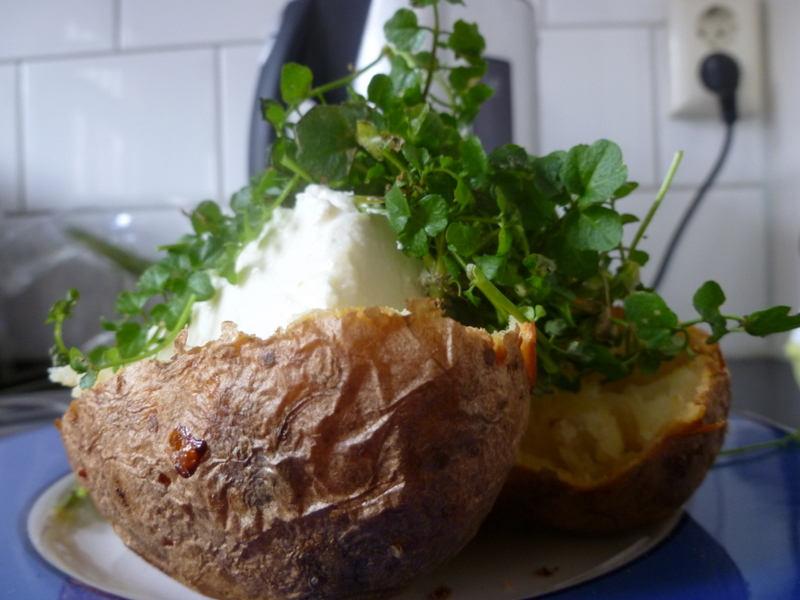
Grden weed salad, Jacket potato and cream cheese

Salad as everyday lunch

However, the snow had done for quite a few things. So, this week, I am left with salads of hairy bittercress, and a few leaves of rocket. I also have a few potatoes and some cream cheese left over from the market. Together, the salad has made a great combination with the soft cheese and the potato. This is mostly what I am having for lunch this week. This is win/win/win/win for me. I am using up the cooked jacket potatoes; I have a quick, yet hearty lunch; I am weeding the garden in preparation for the plants that will soon fill it; and I have a tasty use for the weeds, so I’m reducing waste.  For me, it has more than made up for the fact that last week I took my eye off the challenge!

CAUTION: Wood Sorrel contains oxalic acid. This is the stuff that makes rhubarb leaves inedible. Wood sorrel is fine in small amounts, but can exacerbate rheumatism, arthritis, gout, and kidney stones, so it is best avoided at all if you have these conditions. Additionally, while foraging for weeds in your own back garden may mean that you know more of what has gone onto the plants (and if you use weedkillers in your garden, don’t eat the weeds in it), it is always a good idea to follow some basic foraging rules to keep you safe.

2 Comments

Filed under Found

This Little Blogger Went to Market

Edible Things Stall at Neighbourfood Market

Hot Potato, Hot Potato

Well, I did it!

On Sunday Edible Things stall had its debut at the Neighbourfood Market. It was a good turnout, despite changeable weather, which included both hail and snow at various points throughout the day.

The stall went well, and it was a lot of fun, despite first night nerves at the start of the day. Both kinds of Chilli were really popular. One person was really happy when she realised I could do her a vegan meal with olive oil instead of butter, that she also got all of her friends to come and order. I think offering hot food was just the ticket, considering the weather.

Jacket Potato with Veggie Chili

A Successful Practice Run

There were  couple of things that didn’t work out. Firstly, I couldn’t work out a way to keep the kale for the stamppot warm. I could have used other brassicas, but this would have had the same problem. I am sure we all remember the cabbage of our school dinners, that was over cooked by roughly a week, and unpleasant to eat and smell! I could also have used sauerkraut (zuurkool in Dutch) but I prefer kale. In the end, I decided not to offer it at all. This is the benefit of a test or two!

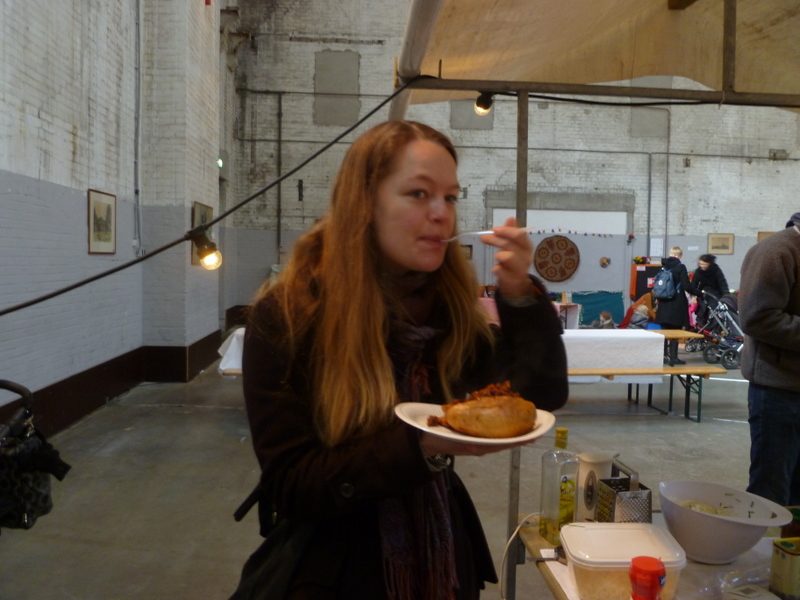
My First Customer

My First Customer (also a friend, which is not cheating)

Unfortunately, the homemade baked beans were not that popular as a choice. People with children appreciated them, because little people will often not like chilli (although one little boy of a friend couldn’t get enough chilli, so it definitely varies), but this is probably not one to offer to this audience in the future. Actually, that’s OK. I usually make tomato sauce from fresh, roasted tomatoes, and then usually have some in the freezer. Last year’s tomatoes got blight, due to us having the wettest summer since the 1920s, so I didn’t have any to hand. This meant I made the tomato sauce with passata, because I prefer not to encourage the use of the out of season greenhouse tomatoes you can get at this time of the year. As you would expect, this was not as tasty as the usual sauce. They are still superior to the tinned versions everyone is familiar with, but not as good as with my fresh tomato sauce.

More Happy Customers

More Happy Customers - also friends, but I had to take photos in the quieter times...

I didn’t get around to as many of the other stalls as I would have liked, but I did get talking to a few people who I hope will be able to give me some much needed advice. I was also the grateful recipient of a lovely cranberry and orange scone from Ben at the Calibakery, who was also doing his first market, as well as a food swap with Nina of Nina’s Kitchen.

All in all, it was a good day, and I had the support of some very good friends. I would consider it doing it again, although definitely not next month, as it falls on my birthday.I really put everything into it, and had to take yesterday to recover. I expect most of this was nerves, so this should be better next time. It is also why I am only posting about it now. I was shattered!

Things I will remember for next time include the white board to advertise my wares (we forgot it twice, then the big guy forgot the car keys before it arrived); to eat myself – I managed on a slice of toast and that scone for the whole day, but it wasn’t pretty; and finally if I buy sweet potatoes, I will remember to take them.

Does anyone have any good recipes for 5 kg of sweet potatoes, that will be good for someone who doesn’t really like sweet potatoes?

4 Comments

Filed under Uncategorized