Category Archives: Feast

Southern Cross Buns

Southern Cross Buns

One a Dollar, Two a Dollar…

I have been searching around for ingredients for an Easter dinner for my friends. These are mostly the same friends who came for the International Christmas Dinner, so I wanted something that would encompass all of our traditions, as well as a nod to the Dutch. Some of these recipes will appear here in the coming days, as they are much less specific to Easter, but this one couldn’t be delayed.

One of the traditions that I found out about was the Australian one. For friends from the Southern Hemisphere, Easter heralds the start of autumn, and thus is naturally a little less about rebirth and rejuvenation, even though they  do continue to keep many of the same traditions as us in the North (hint: eggs and chocolate feature in all Easter traditions, as far as I can tell).

According to this website, there are a few key differences. Anyone who has seen an episode of Border Security will know that Australians are none too keen on letting in non-native animals, due to the havoc that they wreak. It is no surprise then, that they have replaced the Easter Bunny with the much more native Bilby. However, my chocolate work needs a lot more practice, and it is certainly not up to making small chocolate marsupials without a mould.

So, I was very happy when I saw the fact that the Aussies have taken the hot cross bun, and made their own version. With chocolate.

I had already decided to make traditional Hot Cross Buns for dessert. Strictly speaking, they are served on Good Friday, but as it is my tradition to break the rules for international dinners, I am going to serve them for Easter Sunday itself. And I get to do two kinds. We will serve them toasted, to be smeared with butter moulded in the shape of a lamb, which is a Dutch tradition.

Boterschaap

Aw Look, a Butter Lamb! We Named Him Wonky

I made the British buns using the recipe from the River Cottage Bread Book, by Daniel Stevens. Then, I adapted it to make what I am calling Southern Cross Buns, which I think are good for any occasion, and you can keep the cross, since they are named after the Australian flag.

And I photographed the steps for you.

Recipe: Southern Cross Buns

Ingredients

For the Bun:

250 g strong white bread flour (plus some for dusting)

250 g plain white flour

2 tbsp cocoa powder

125 ml warm water

125 ml warm milk

1 sachet dried yeast (7 g)

10 g salt

50 g caster Sugar

1 egg

70 g plain chocolate chips

30 g candied peel (orange only if possible)

Zest of ½ orange, grated

6 green cardamom pods

For the Cross:

75 g plain white flour

100 ml water

For the Glaze:

1 tbsp apricot jam

1 tbsp water

Method

You may remember that I made my own candied peel. This is not compulsory, but it does make it a lot easier to use only the orange peel for this recipe. If you have (or wish to make) your own candied peel, chop it finely before you start the rest of the steps.

Extracting cardamom seeds from the pods

Remove the Seeds from the Cardamom Pods

Also lightly crush the cardamom pods to release the black seeds inside, and grind these to a coarse powder with a pestle and mortar.

Sieve together the flours and the cocoa. I usually skip the sifting step in a recipe, but this will help prevent the cocoa from forming lumps.Mix together with the sugar, salt and yeast

Make a Well in the Centre of the Dry Ingredients

Make a Well in the Centre of the Dry Ingredients

I found that mixing boiling water from the kettle, and cold milk from the fridge, the resulting liquid was warm, but not too hot for the yeast. You can use a food mixer with a dough hook for this recipe, but I am gadget-averse, so I had to do it with my hands. whichever way you choose, the dough is fairly sticky. Pour the liquid into the well, and mix.

After Mixing in the Milk & Water

After Mixing in the Milk & Water

Once it looks a bit like this, add the butter and the egg. This is when it gets sticky. Mix it well, so that you cannot see lumps of butter in the mixture anymore.
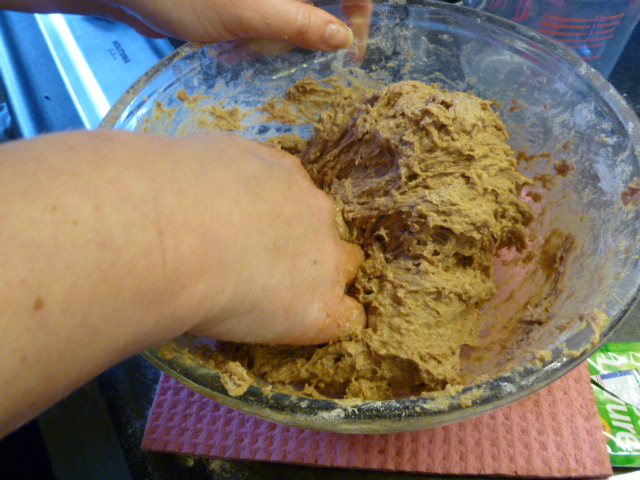
The mixture will get a little smoother

The mixture will get a little smoother

Then add the chocolate, candied peel and the ground cardamom. Knead this in well.
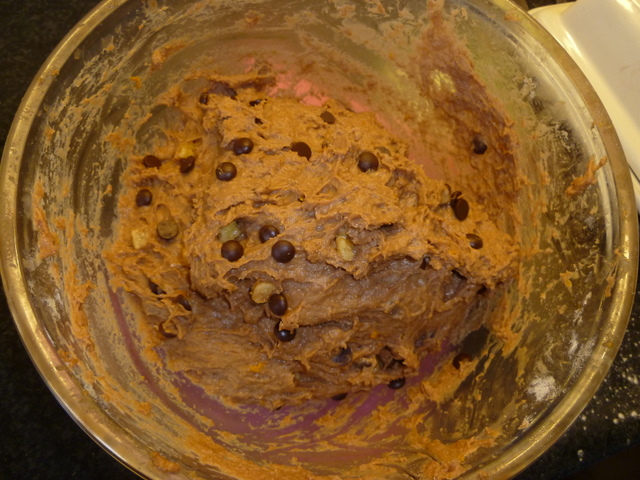
When it loos like this, cover it and leave it to prove

When it looks like this, cover it and leave it to prove

Try and leave it somewhere warm. It should take about an hour. I left it a bit longer, because I was busy with getting a lamb cooked, and other things. It was fine, and still rose nicely. Knock back – by punching the air out of it.
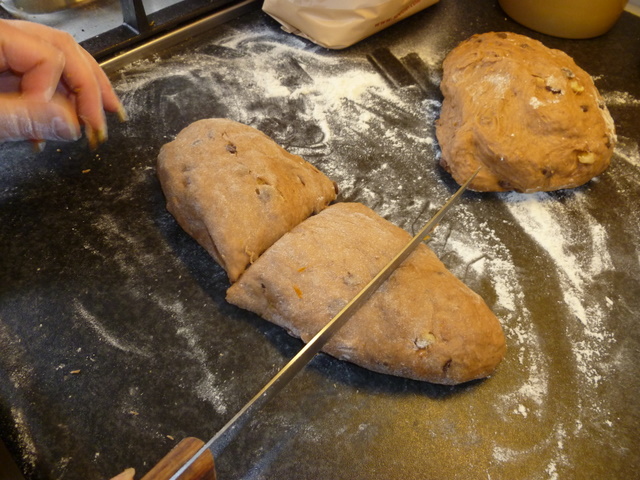
Cut the dough into eight equal(ish) pieces

Cut the dough into eight equal(ish) pieces

I got the proportions mostly right when I cut it. Only one was smaller than the rest. Make it easier on yourself by cutting the dough in half, roughly shaping each half into a thick sausage which you cut in half, then half again. It should be fine, if the sausage doesn’t taper too much.

Shape each piece of dough into a round. The following steps are straight from the River Cottage book, but they work really well, so they are the steps you need. Put the flat side of the dough on a lightly floured counter.

Bring a piece of the dough into the centre and press lightly

Bring a piece of the dough into the centre and press lightly

Each time that you do this, turn the dough a little, then repeat. Do this until all the dough is folded into the middle, and press firmly. Flip it over onto the other side. If you are not that confident in working sticky dough, like me, then you will probably want to flour the work surface again a little bit. More confident bakers work focaccia, which is a much wetter dough, so you will probably be fine. I found that I didn’t need to flour the buns later, because they were fine after I floured the surface.

The next bit is difficult to describe. You need to stretch the top of the bun, while tightening the pinch at the bottom. To do this, you need to flatten your hands, place the heel of one hand against one side of the roll, and the fingers of your other hand on the other side.

Step one of turning the bun

Step 1: flatten your hands at either side of the bun

Next you need to move your hands in opposite directions, and bring them together under the bun, so that it spins. This will stretch the top of the dough.

Step Two: Spin the bun, by moving hands in opposite directions

Step 2: Spin the bun, by moving hands in opposite directions

You will end up with your hands in the opposite configuration to that in which you started.
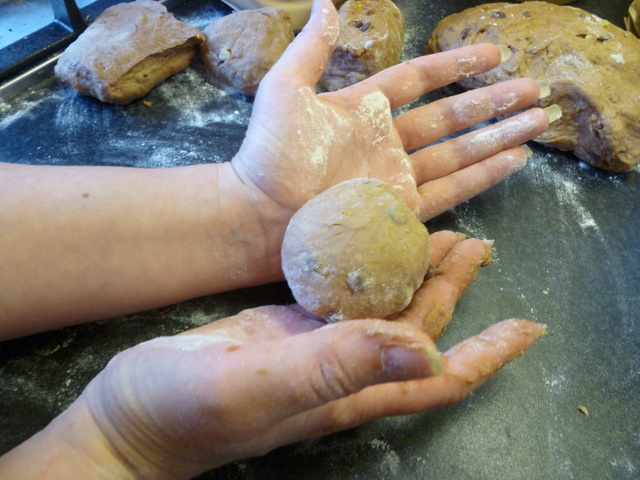
Step Three: how your hands end up

Step 3: how your hands end up

Do this little move three times per bun. Then put it on a board, and dust it lightly with flour, if you didn’t do it on the work surface.
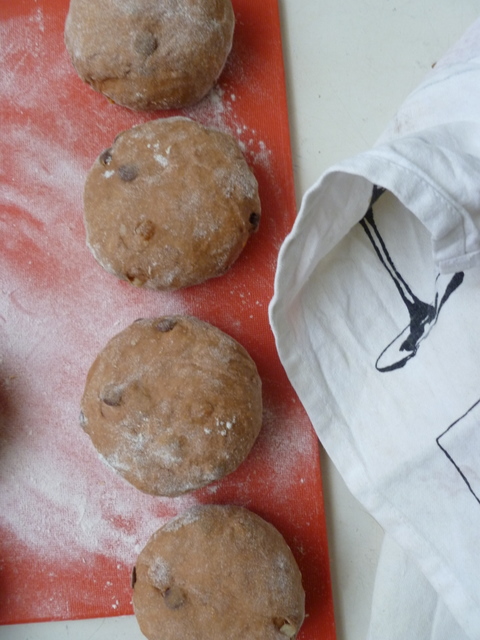
Place them on a lightly floured board and leave to prove for another half an hour

Place them on a lightly floured board and leave to prove for another half an hour

Preheat the oven to 200°C

While the  buns are proving, mix up the flour and water, with a whisk. This will form your cross. I think the paste needs to be fairly thick. If you get the thickness right, I don’t think you need the amount of flour I have given here. I think mine was too thin, because the contrast on the ordinary bun was not good enough, so I didn’t get a cross. The contrast between the chocolate buns was much better, due to their brown colour. However, for you I have upped the ratio of flour to water. My advice would be to start with 50 g flour, and very slowly add the water, until you get a thick batter. it should leave ribbons when you pour it from a spoon, not run off.

Once you have a good consistency for the paste, and the buns have proved, then you need to make the cross. Transfer the buns to a baking sheet. Put the flour paste into a sandwich bag (or piping bag, if you have all the fancy equipment) and snip off a really small corner – be careful, the piped line is much bigger than the hole appears. Pipe the paste over the bun in a straight line, then again, at right angles to the first.

The piping bit is tricky, and needs a fairly steady hand

The piping bit is tricky, and needs a fairly steady hand.

I have to admit to a few drips where there should be none. They wiped off easily enough, but I had a thin paste. It is best to be as careful as you can.

Put the baking tray in the oven, and bake for between 15 and 25 minutes. Mine took nearer 25 minutes, so keep an eye on them. Like most bread-based products, they sound a little hollow when tapped on the bottom, when they are done.

While the buns are in the oven, melt the apricot jam and the water to make a glaze. Glaze them by painting the jammy liquid  over the top of each bun as they come out of the oven.

Leave them to cool on a wire rack.
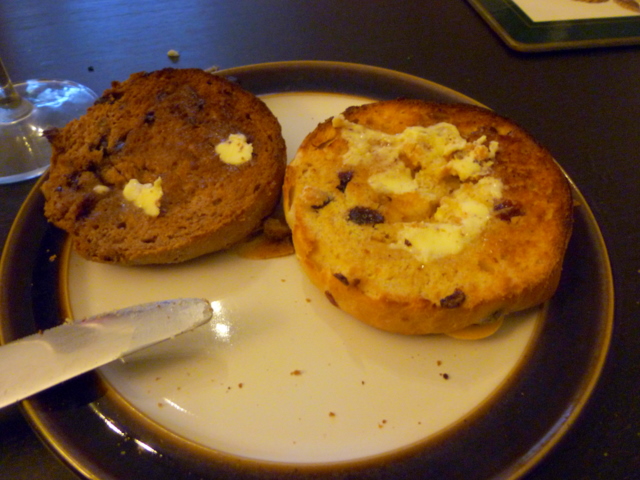
Toasted Hot Cross Buns

Toasty!

Toasted is the correct way to serve these. Possibly slathered with butter from a wonky sheep.

4 Comments

Filed under Feast

Roots and Permaculture

Varzea da Gonçala

Where I Have Been Lately

Hello! I am back from a little sojourn in the Portuguese countryside, where I have been on a fantastic Permaculture Design Course.  I intended to get a load of posts done to be posted over the time that I was away, but as usual, I was behind, and doing them on the journey. I got to the venue to discover that there was no frivolous internet access (due to the tariff system in rural Portugal) and no mobile reception, so things didn’t work out as I had planned (and not planned, in many ways). I am not sorry, it was glorious to be away from it all, and was incredibly good for the soul.

Fig tree at the Varzea, Late March 2012

The View From the Classroom

I will post those other posts over the coming days, along with a few Easter posts, which should probably come first,  but I really want to tell you all about the course and what I got up to first. Partly by way of explanation for the absence, but also because I really want to recommend a permaculture course. This was a birthday present from the Big Guy, so I knew little about it before then. Lucky me!

Me & Permanent Varzea Residents

Me & Permanent Varzea Residents

The course itself was run at Varzea da Gonçala, a lovely small holding just outside Aljezur in the Algarve, and set in a valley (hence the lack of phone reception), not too far from the Atlantic. The Varzea operates on permaculture principles, producing its own fruit, vegetables, and eggs, and they have chickens and pigs to help work and feed the land. It is important to the people who  live and work there to demonstrate that permaculture is effective for everyone, and that it really works. It is why they have called their website ‘I Can Feed Myself’, to underline the point. Chris and Kris, who run it, along with the people who work with them, are excellent hosts and teachers. We also had  amazing food for our stay.

Feast Fit for a King at the Varzea

Feast Fit for a King (Our Last Night)

We ate like kings, with everything from jacket potatoes, to lasagne, to beautiful fresh salads of rocket, mustards, chard, lettuces, fresh herbs, nasturtium leaves and flowers, borage, peppers, you name it. I may not have sown these seeds, but I definitely got my hands dirty to tend to them, so these will form part of the 52 week salad challenge for me, and I don’t feel like it is cheating. The food was fantastic, prepared with love, and was so fresh.

Peter Cow Giving a Lecture

Teacher!

Our main tutor was Peter Cow, who runs Living in Circles, and there were sessions from other permaculturalists, including the people who live on the Varzea.

The Big Guy really couldn’t have chosen a better course. We learned about the principles of permaculture, and the design method, as well as putting it to practical use. I got to play with the compost and do some gardening, and I have learned some valuable skills. Peter is also keen on applying permaculture to the wider world, as well as the personal one. I will admit that I was not really looking forward to this, but I actually found it immensely useful. I have been able to get a different perspective on a couple of things, which have been holding me back in many ways.

The group of people I was on the course with were also brilliant. I have never worked with a group that was so on track, and with no little fighting and falling out, despite being such vastly different people.  Each of them brought a lot of different knowledge to the course, and it was so great to share this with everyone. One guy also lives in the same town as me, so I hope that we can continue to meet and maybe do some digging together!

Making a Wooden Spoon

Spooning!

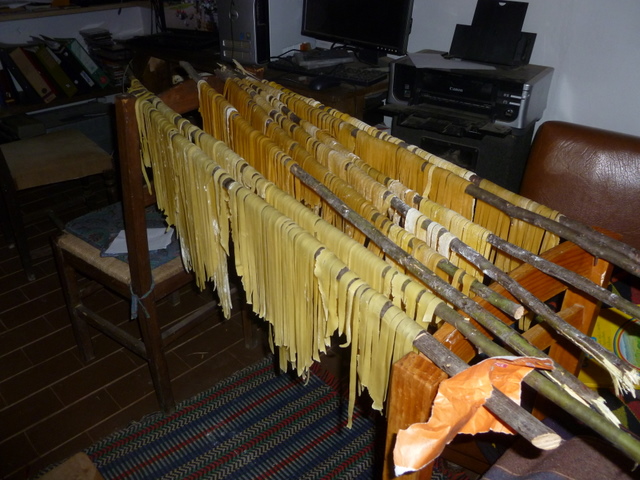
We even practiced some new skills – both on the course, and in the breaks. As well as learning about swale construction, and building a stackwall. I got an insight into perspective in drawing, which has inspired me to give sketching a go – something I never felt equipped to do before. I helped to teach others how to make pasta. I even know how to make a wooden spoon. I’m just putting the finishing touches to one, albeit that it was produced with a little help from my friends. I really feel like I came away a craftswoman.

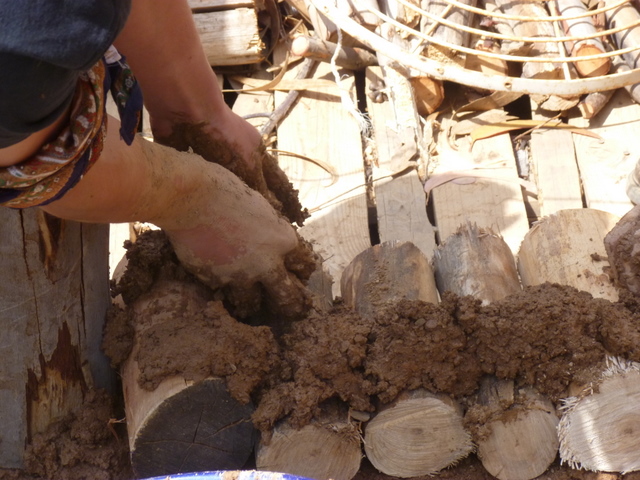
Constructing a Stackwall from Cordwood

Constructing a Stackwall from Cordwood

In fact, I have been so inspired by the course, I am trying to expand my use of permaculture and permaculture design. I have some plans for friends’ balconies – and before any of those said friends start to panic, don’t worry, permaculture has a lot to do with water catchment and no-dig, so you won’t become slaves to your pot plants. I am planning to implement my own polyveg system in my own garden, and I will be blogging about it here. I had intended to start a new blog for the gardening stuff (and had a great name lined up…) but the idea of permaculture is that you should take advantage of and increase beneficial relationships, and to me there is no better relationship than that between food and food production. So I am going to capture it here, and try to expand the communities of interest that could talk to each other. I am even going to try and design myself into a new career and direction, but I need a bit more work on that.

Finished Stackwall

Look What We Made!

Peter runs and collaborates on a number of permaculture courses, all of the details of which are available on his website. He is also really in tune with group dynamics and very skilled at getting very different people to work together and gel. You might like to go along to a course, or ask him to teach at one of yours.

Drying Homemade Pasta (No Pasta Machine)

Look What Else We Made!

The Varzea also offer a range of courses, as well as holiday accommodation and camping, for groups, individuals or families. You can get hands-on experience and teaching in permaculture practice. As well as having access to delicious, organic food from the land that they work. An ideal get away from the petrochemical farming and urban landscapes we have come to know, I really cannot recommend this place enough, not to mention the hospitality and the welcome you will enjoy here.

I hope that you will also come to share my enthusiasm for permaculture, and share the fruits of my labour (and the recipes that they inspire). Thanks for coming this far.

Contacts for Varzea da Gonçala

Contacts for Peter Cow

NB: I do not represent, nor am I being paid to blog about the permaculture course,or the Varzea.  I am just so enthused by the experience, and the people I met that I wanted to blog about it.

4 Comments

Filed under Farmed, Feast, Fed

Taking the Biscuit

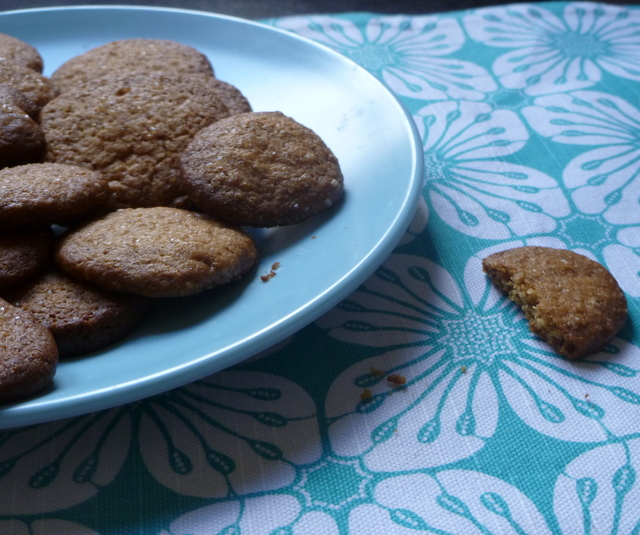
Speculoos Refrigerator Biscuits

Speculoos Refrigerator Biscuits – Meant for Taking

Yesterday I hosted a meeting for a group of proto-freelancers that I have joined. As is customary, I was going to serve biscuits and tea. Since I prefer to make things from scratch (a tendency that has only got worse since it also gives me something to blog about!) I decided that I was going to make the biscuits. I have not actually attempted to make biscuits for a number of years, since they aren’t really something that I have around the house. In fact, the only time that I really ever think to buy them is if I am going to make a cheesecake, or another dessert with the requisite buttery biscuit base.

The last time I was really into making biscuits was as a fairly young kid (maybe 8ish?). Once the Sunday Dinner had been cleared away, and the washing up done, I would bake things, some sponges cakes and the like, but mostly biscuits, while my parents were either out on the garden, or dozing in front of the Eastenders Omnibus. These baking sessions were always using recipes from the tried and trusted Dairy Book of Home Cookery.

I had been given some Lotus speculoos paste by a good friend who was returning to Australia, and had one too many items from Europe in her case. I have always known that I will make biscuits with it, since these are traditionally served with coffee and tea in every cafe in Holland. And what better opportunity to have a go than for a meeting? So it was to these things that I turned when looking for inspiration.

The Dairy Book has a basic recipe for refrigerator biscuits, which seemed easy enough to adapt, so I used this as a starting point for my treats. They are called refrigerator biscuits because you wrap them up like a sausage, then let them rest in the fridge for at least an hour. I actually made these a while ago, when we were originally going to have the meeting, but we had to postpone due to a particularly nasty flu that several of our people had. You can keep the dough in the fridge for a week. The mixture also freezes well, and the amounts given here will make a lot of biscuits (up to 60 depending on how wide you roll the sausage), so I divided it in two and still have a sausage of dough in my freezer. You can defrost them on the counter, or (if you can cut them) cook them from frozen, allowing a minute or two longer cooking time, but you will need to watch them.

Recipe: Speculoos Refrigerator Biscuits

Ingredients

200 g plain flour

100 g butter

1 tsp baking powder

1 tsp speculaas spice

2 tbsp Lotus speculoos paste

150 g caster Sugar

1 egg, lightly beaten

vanilla sugar for sprinkling

Method

Rub together the flour, baking powder, butter and speculoos paste, like you would for making pastry. Once you have the breadcrumb texture, mix in the sugar.

Add the egg, and bring together to form a dough. I did all of this with my hands, but you can do it with a spoon if you prefer.

At this point, I tasted the dough, and decided that the speculoos didn’t give quite the spicy punch I wanted, so I decided to add some speculaas spice that I still had from making Kruidnoten. I also gave the recipe for the spice mix on that post, if you want to have a go at making these, and you are not in the Low Countries, where it is readily available.

At this juncture I should point out that raw cookie dough has been linked to outbreaks of e. coli infections, and should not be eaten if you are in a vulnerable group, or if you are worried about this sort of thing. In this case, I took the risk for you, so if you choose to make these biscuits, you can also skip the testing, and simply add the spice when you mix in the flour, as I suggest above. If you can’t find any speculoos paste, then you can also just use the spices.

Once the dough has formed, it should be pretty dry, and workable. I found I needed to use a tiny bit of water, to help the dough form, because the only egg I had was on the small side, but I added it splash by splash, because I wanted to get the texture right.

Roll the dough into a sausage. You may need to cut it into two here. I did. Once the sausage is the sort of width you imagine your biscuits to be, wrap it tightly in foil or cling film, making sure the ends are sealed well. It is worth noting that these biscuits will spread a little, during cooking, so you will need to roll the sausage a bit thinner than you want.

Once wrapped, bung the dough in the fridge for at least 3 hours, or overnight if you can. Or you can freeze it immediately.

When you are ready to bake, heat your oven to 190°C.

Meanwhile, grease your baking sheets with some old butter paper, which should have enough butter on it to cover your trays with a thin layer of butter. If not, rub it over a pat of butter before rubbing the tray. Butter paper is also something that I never throw out, until I have got maximum use from it. You can substitute it for tin foil to wrap food (but not for cooking with), you can using for greasing baking utensils, and you can use it as a cartouche to retain moisture or prevent a skin from forming on a liquid. My mum has always done this, and I have also always done this, it was just a habit really.

I have two baking sheets, so I used both in the oven at the same time, to reduce energy consumption. If you do this, be aware that the top biscuits will be ready slightly earlier than those lower down in the oven. They catch really quickly, so take these out first.

Slicing Biscuits from the Dough Log

Slice ’em Up. If you use a sharper knife, then you can get thinner biscuits than I did here

Then, thinly slice your biscuit dough along the length of your dough sausage. Probably thinner than I have here, if you like. One tip is that the sharper the knife you use, the less you will compress your roll, and thus will not have to constantly reshape or have odd-shaped biscuits.

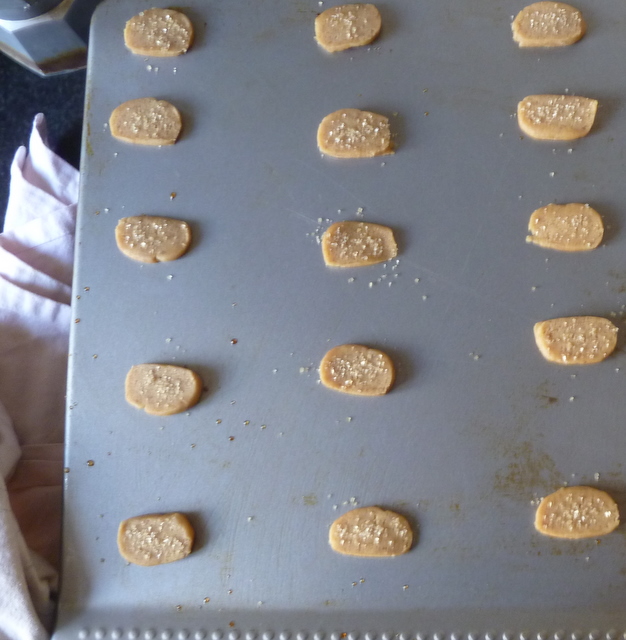
Arrange the biscuits onto the trays, allowing space for them to spread out a little as they cook. I sprinkled mine with a little vanilla sugar, because I always have it to hand as a by-product from custard making. Caster sugar will be just as good. You can also dust it lightly or a little heavier if you would like more of a crisp.

Speculoos refrigerator Biscuits Sprinkled with Sugar

A Sprinkle of Sugar

Stick them in the oven, and check them after 10 minutes. Mine were done then, but you can leave them in for up to 12 minutes.

Allow them to cool a little on the tray before removing, and serving. If you do have any left, put them in an airtight container, where they will keep for a day or two.

The actual time you spend on these biscuits is minimal. I probably spent about 10 minutes in total on preparation. But, I can guarantee that your guests will appreciate the effort that they will think that you have gone to. Unless you have hundreds of guests, you will also have enough for a couple of batches, and what could be handier to have on standby in your fridge or freezer, for meetings, drop in guests, or a visit from the WI?

1 Comment

Filed under Feast

Making the Most of a Marmalade Mistake

Breakfast  Flapjacks

What a Comeback

The clementine marmalade I made caught slightly on the bottom of the pan. This is what comes of trying to cook and blog at the same time! I only took my eye off the ball for a couple of seconds, while I had a spoonful of the golden, orangey preserve waiting for the fridge test.

Most of the marmalade was fine, so I bottled it up. But there was about half a jar on the bottom which had gone too far. As you know, I cannot bear to waste food, and this is no exception. I won’t inflict this on my friends, but there is no reason why I can’t still use it.

Marmalade makes a great glaze for both sweet and savoury food. I did bake a yoghurt cake, and then melted 2 tbsp of the marmalade with a tbsp of water to make a glaze. I poured the glaze over the cake while both were still warm, and then left the lot to cool in the tin. Unfortunately, I have never made a yoghurt cake before, and clearly didn’t beat the egg, yoghurt and oil together enough, so it was too dense, so I haven’t photographed it. It was fine, when splashed with a little Cointreau (or orange juice would also be fine), and served with fresh Greek yoghurt.

I have also kept a little marmalade in reserve, because I have another glaze in mind, but this time for a nice duck, a wild one if I can get hold of it. I shall add shallots and thyme, and make sure I baste the bird as it cooks. I guess you can expect to see it here, if it is a success.

However, I left the lion’s share of the leftover marmalade for the recipe I am about to share with you now. The first thing that came to my mind when it was clear I would have some marmalade was flapjacks. I’m not really sure why, but I knew that I had to try it. I had a feeling that the thick cut, sticky marmalade would be the perfect foil for the oats. Both of them are traditionally associated with breakfast, and I really thought this could fly. I thought about it some more over the next few days, and it became clear that I could substitute the marmalade for the usual golden syrup.

There is a golden ratio for the usual kind of flapjack. As long as you stick with this ratio, then you can’t go far wrong. It also works for metric, imperial, volume, or if you prefer to measure your ingredients by a more eccentric means. The ratio is as follows:

  • 2 Golden Syrup
  • 4 Butter
  • 6 Brown Sugar
  • 8 Oats (or oats & other dry ingredients, such as seeds)

This is the ratio that I was taught as a small kid, and it has never yet done me wrong. You can then add more stuff, like dried or fresh fruits, candied peel or crystallised ginger, spices, chocolate, and so on. I always use a mix of whole rolled oats, and the finer, chopped sort that is best for porridge, because I find this gives it a better texture without falling apart. You can add seeds and other grains as well if you like, but you should adjust the amount of oats, so that you maintain the ratio.

These were unconventional flapjacks, not just in the sense of substituting syrup for marmalade, but I have to admit in this case, I also decided to adjust the proportions of the ratio as well. I wanted the orange to really shine in the mix, and the marmalade has a lot of sugar in it anyway. It may not please your grandmother, but it worked for me in this instance.

After a bit of fiddling, I settled on a 4:4:4:8 ratio, and the results worked really well. The bars are chewy, albeit in a slightly different, stickier way than regular golden syrup ones, but I like it.

I prefer my flapjacks on the chewier side, but if you are one of those people who like crunchier flapjacks, you may need to add some golden syrup, or possibly more butter to prevent the marmalade making the bar too hard in the  (slightly) longer cooking process. It is not something that I experimented with this time, but I would be happy to if others are interested. You don’t have to use up marmalade mistakes – ordinary marmalade from a jar will do just as well here.

The amounts I am going to give were enough for a 20 x 25 cm tin. I tend to line my tins with baking paper, because it makes the finished flapjacks a lot easier to remove from the tin, but you can just grease the tin really well, it is up to you. If I were a more dedicated baker, I would invest in that reuseable silicon parchment stuff, to reduce waste. I have got a birthday coming up, so who knows?

Recipe: Breakfast Flapjacks

Ingredients

160 g marmalade

160 g butter

160 g brown sugar (I used light muscovado and demerara, because it is what I had)

300 g mix of whole and chopped rolled oats

30 g pumpkin seeds

30 g dried cranberries

Method

Put your oven on at 180 °C.

Melt the marmalade, butter, and sugar over a medium heat, stirring so they don’t catch on the bottom of the pan.

Mix the oats, pumpkin seeds, and cranberries in a large bowl.

When the sweet goods and the butter have all melted and combined together well, pour onto the dried ingredients, and mix well to ensure that they are all well coated and no streaks of white oats remain.

Press the flapjack mix into the baking tray. You want to press it in fairly well, to help the mixture set into lovely bars. Then smooth it over with the back of a metal spoon, making the top smooth, and the flapjack layer as even as you can.

Bake it for about 25-30 minutes, depending on how chewy or crunchy you want it. Flapjacks are really forgiving, so they are easy to cook with other things, to maximise your energy use from the oven. They won’t collapse if you open your oven at the wrong time, and don’t really absorb other flavours. I haven’t tried cooking them at the same time as smoked fish, for example, but they are fine t go in with stews, other cakes, roasting meat etc.

When they are nice and golden all over, then remove them from the oven. You will need to mark them into the squares or rectangles that you intend to serve them in fairly soon after coming out of the oven. I got 12 bars from this amount of  mixture. Then they should be allowed to cool completely in the baking tray.

These flapjacks are really tasty, and the pieces of orange and cranberry really do add an interesting texture, as well as the marmalade, giving them a bit more kick than your average flapjack. Marmalade – it’s not just for toast, you know!

5 Comments

Filed under Feast

Oh My, Darling Clementine Marmalade

Clementine Maramalade

The Business at Breakfast

Marmalade is pretty British, as far as preserves go. Even then, there is controversy as to whether you should have the zest chunky or fine, and some people even think that you should have no zest at all. They are entitled to their opinion, although I think that is really just a citrus jelly!

I find that it is not until you leave a country that you start to miss the things that you used to take for granted. Marmalade is one of those things, and I enjoy making preserves. However, I have not been able to find reasonably priced marmalade, and neither have I been able to find Seville oranges here either. Seville oranges are much sharper than their normal edible counterpart, and thus make the perfect balance of sweet and sharp that is required in most good preserves. They are also only in season for a short time, December to early February, so most marmalade production happens in the early part of the year, when it is too cold for planting, but the festivities over Christmas are out of the way.

Having resigned myself to the fact that I cannot make traditional orange marmalade, I am currently embarking on a series of experimental marmalades including lime, lemon, and grapefruit.

Heather at Breakfast by the Sea suggested that I try clementine marmalade. If you haven’t already seen it, I really recommend you have a look at her blog, it has great recipes and some really beautiful photography.

I hadn’t thought of clementines, but they are a better replacement for Seville oranges, if you want a sharp, but still distinctly orangey flavoured marmalade. This one is the perfect trial marmalade for a recipe that I am developing, which I hope to blog about later.

I found some lovely clementines on our local market with the glossy leaves still attached. This appeals in the waste-reduction geek in me, because citrus leaves make a really tasty tea. Give them a good wash, and then steep them in boiling water. Add a bit of cinnamon stick if you want to, it will be just as good.

As with many of my preserves, I used Pam Corbin’s Preserves book. I used the cut fruit method for marmalade, but amended the amounts slightly, for what I thought was suitable for the clementines.

Medium Cut Peel for Marmalade

Not as Fine as I Would Like

Recipe: Clementine Marmalade

Ingredients

1.5 kg clementines

3 l water

200 ml lemon juice

2 kg sugar

5 tbsp cointreau.

I probably took this a little too far while trying to get this batch to set, and it had gone from beautifully bright and orangey to having a more caramel flavour. If I had pushed it any further, I would definitely have burnt it. To compensate, and inject a little more orange, I stirred through the Cointreau after the jam was off the heat, but while it was setting before potting up. You can also leave the Cointreau out, if you prefer.

Having done a little reading up, it seems that clementines catch a little easier than Seville oranges. This being the case, you need to watch it like a hawk as it approaches the setting point. I would even take the unusual step of advocating stirring at this point, so that parts of the marmalade cannot catch and burn. As always, the setting point is reached when the jam reaches 104.5°C, or when it wrinkles when you perform the fridge test.

You need to leave it in the pan to set a little, so that the zesty bits don’t all sink to the bottom of the jars when you pot them up. Pot the hot jam into hot, sterile jars and seal immediately. Lovely, tasty orange marmalade. Really great on toast for breakfast. Thanks for the suggestion, Heather.

I left a layer on the bottom, in case I did catch any of it. This will feature in another recipe later on. Well, you didn’t  think I would throw it out, did you?

8 Comments

Filed under Feast

A Stock From Scraps

Vegetable Stock

The Basis of Many, Many Meals

Today’s recipe was inspired by a request from a friend who reads Edible Things. It is great to hear from people, so if you have any requests, let me know, and I can blog about those too.

If you have a recipe you’d like to see, or something to inspire, please feel free to get in touch or find me on twitter.

Anyway, my friend asked about how to make vegetable stock, particularly in reference to making stock from scraps. Obviously, she has come to exactly the right place. I never throw anything out if I can help it. I was accused of being from the 1950s when I admitted to an acquaintance that I make my own stock. He doesn’t know what flavour he is missing out on!

In my freezer, there is an entire drawer given over to scraps and offcuts of one kind or another.  I keep them separate in bags or freezer containers (for the meat products), ready to be used later. I routinely keep and freeze the stalks and outer leaves of cabbage; the tough outer leaves of fennel; carrot tops and peel; the tops of leeks; and the root and tip of onions that I have chopped for other dishes, and the stalks of any herbs where I have only needed to use the leaves.I would probably also keep the gnarly bits at the bottom of a head of celery too, if it weren’t for the fact that I have guinea pigs that eat them.

Frozen Food Trimmings

Stock Drawer

Currently there are also apple cores, lemon and orange zests, bones from a chicken, pork fat and rind, and a whole load of vegetable offcuts and peels. There will be a use for all of these in various stocks, jellies, sauces, or something.

I actually don’t like the term food waste when talking about unloved offcuts and trimming. There is so much you can do with them, up to and including composting, which I also do, but only when I have got the maximum value from them first.

Obviously, I know that most people do not have the freezer space or the geekiness to save stuff like I do, but if you do nothing else with your “waste”, do give stock a go. I guarantee that it really easy, and will really improve the flavour of soups, stews, sauces and gravies.

I make a number of different stocks, so I bag my veggies separately, because  I don’t want cabbage in a chicken stock, for example. If you have limited space, put them all into the same bag and chop them up a little. If you have no freezer space at all, you can make a quick stock using scraps, and supplementing it with the odd celery stick or whatever. The finished stock will keep in the fridge for a couple of weeks, in an airtight container, so you can still add it to dishes (NB it will be shorter for meat stock), and have great-tasting stock.

You can pretty much use what you want in a stock. I know that some people use potato peelings in stock, although I personally don’t like the flavour it lends. Some people also choose to put the papery onion skins in, although this will mostly impart a yellow colour, so again, I tend not to bother. Similarly, beetroot tops and peel can be used, but it will both colour and flavour the stock.

I have used pumpkin, pea pods, lettuce that looks as though it is going over, the ends of aubergine, tomato skins, mushroom trimmings,asparagus ends, the leaves of celariac,  beets and carrots at different times. As long as you wash the vegetables thoroughly before freezing, or putting straight into the stock pot, it really is up to you, and experimentation is the key for your tastes, and the dishes that you cook with.

There are a few vegetables that you cannot use the leaves from, and this includes rhubarb (which are a vegetable, but used as a fruit), aubergine and parsnip leaves. I have used the vines of tomatoes, but not the leaves.

The basis for most stock is the triumvirate of celery, carrot and onion (or leek – they are the same family).This is the basis of both meat and vegetarian stocks. It is really a question of balance. In the recipe below, I have outlined the rough proportions that I used. For vegetable stock, I try to use a cabbage (or broccoli stalks, or chard or something similar) in my veg stocks, because it gives a depth of flavour.

As you get more used to scrap stock, you will also develop a sense of the proportions of each that you want. I can do it by eye now. It does not take long to gain confidence in this technique. And believe me, you will really be glad that you gave it a go.

Basic Stock Amount, by eye

An Eyeful

You also don’t have to wait until you have the same amounts as I do. You can make stock with the ends of one leek, the peel and tops from one carrot and a single cabbage leaf, if that is all you have. Really, nothing is set in stone for this, the ingredients are down to what you have.

Recipe: Vegetable Stock

Ingredients

250 g leek/onion trimmings(frozen weight)

150 g carrot peel

2 celery stalks, (it weighed about 150 g)

50 g herb stalks, including mint, parsley & thyme (if making meat stock, I would most likely leave out the mint stalks)

50 g cabbage stalks & leaves

100 g fennel leaves

2 dried bay leaves. I have a bay tree, so I usually use fresh bay, if you are doing so, double the amount given in your recipe

10 or so peppercorns

3 cloves

pinch salt

You can also use other spices. It will depend on what you want to use the stock for. I use pepper and cloves for a generic stock, but if I wanted an asian one, I would add cinnamon and star anise. But, when I want to make a pho, or something, I take my generic stock and add the spices at the time. Again, this is a matter of your own taste.

2½ l cold water (or enough to just cover the vegetables that you have, although bear in mind that they will float)

Method

I  use a very large saucepan for making stock (my stockpot), but even if you have an average sized one, you will need a well-fitting lid for it.

Put all of the vegetable trimmings in the pan. I chuck them in from frozen, having washed them before I froze them. You can also put fresh ones in, it doesn’t matter. Cover the vegetables with cold water, and put the lid on the pan.

Stock ingredients with water to cover

Put a Lid On It

Bring the water up to the boil, then turn it down to a gentle simmer. Keep the lid on the pan while it simmers.

A Simmer Plate

My Simmer Plate

I have a simmer plate, which I like to use, because I can turn the hob down to the lowest setting, and it distributes the heat more evenly across the pan. They are not essential though, so  don’t worry if you don’t have one. Let it simmer for about an hour (longer for meat stocks, depending on the size of the bone that you have).

Allow it to cool with the vegetables still in it, then strain the liquid. This is your stock. If you are still reluctant to throw away your vegetables, you can take a little of the stock and the veg, and blend it up, and you have the very tasty basis of a soup that you can either eat like that, or add more things to for bulk. Every aspect of making stock is about taste, not waste. If you are making meat stocks, obviously, you should remove the bones before you do this.

The stock can be used as is. If you have limited freezer space, you can boil the stock to reduce it by half, which will concentrate the flavour. Don’t use a lid on your pan for this stage.

I measure off half litres and put them in into individual containers (usually take away ones are fine, they stack and they have lids), which I label and freeze. I find that this is a convenient amount to use in most recipes.

They are easily defrosted on a worktop, or if you are less organised, you can heat them in a microwave or a pan ready for immediate use.

If you don’t have a lot of space, concentrate the stock, you can freeze them in ice cube trays, then transfer them to a bag once frozen.

Whichever way you freeze it, don’t forget to label, as there is nothing more irritating than forgetting them in the freezer, then scratching your head a few weeks later when you find them again.

So there you go; cheap, practically effortless, and really tasty stock, that you know is right for you. It doesn’t contain any hidden ingredients, so you know it will be suitable for your friends with special dietary requirements or preferences. And you have the basis for many soups, dishes, sauces and whatever you like really. This stock of scraps is really much, much more than the sum of its parts!

Update: I have entered this post into Turquoise Lemon’s No Waste Food Challenge, which is all about fennel for the month of April

Turquioise Lemon's No Waste Food Challenge

14 Comments

Filed under Feast

Random Erwtensoep of Kindness

Busy Shipping Canal near home

So Cold, Even the Gulls are Ice Skating

I first heard about the Random Soup of Kindness Challenge on Vanessa Kimbell’s blog via Twitter. I was immediately drawn to it, because it is a brilliant idea, but also it reminded me of the people  that I used to work with in a former life, when I was an Energy Efficiency Advice Centre manager.

Every year in the UK (and other places, but it is marked in my home country) thousands more vulnerable people (i.e. the elderly and those with certain medical conditions) die in the winter than the summer. This is called Excess Winter Death (EWD), which claimed over 20,000 people in the UK in the winter 2009 -10. The figures are getting better, but it is still a shocking amount of people.

The causes of excess winter deaths are complex, but a good deal of it can be attributed to people in poor housing conditions being unable to  heat their homes, either for practical or economic reasons. This, in turn, exacerbates ailments and medical conditions, making them susceptible.  I have met elderly people who regularly have to decide if they have lunch or if they put their heating on for an hour.

People who cannot afford to adequately heat their homes are said to be in Fuel Poverty. It affects lots of households, not just the elderly, and the situation will only get worse with rising fuel prices and in the current recession. I am priviledged enough to never have been in fuel poverty, but I have live in a very inefficient rented home. I know first hand how miserable it is to be cold. It is not something that I would want for my neighbours, especially those who can’t move around much to keep warm.

Frozen Boat

Frozen In

I loved this challenge, because it is a really practical way that everyone can help someone address the issues associated with being cold. Please have a go at this easy way to reach out to the vulnerable people in our own communities, make sure they are OK, help them out in this desperately cold weather, and offer them internal heating and a good meal.Of course, not all elderly people are in the same position as I describe above, but who would say no to a friendly visit and some hot soup? It really can make a real difference to your neighbours, and won’t take too much effort on your part. And that is the least that you will get from having a go.

Having got the necessary, if somewhat shocking stuff out of the way, I’d like to tell you about my first foray into Neighboursoup. I say my first foray, because I got so much out of it that I am definitely going to do this again.

Frozen Canal View

Frozen Canal - Near my Street

I live in a great street where all the neighbours are pretty friendly, and we all have a chat if we see each other, or help out with the odd pint of milk, or bucket of water or whatever, here and there. I love it, it feels good to know that there are other human beings in your street, instead of just other people, if you see what I mean. It is the first time I have lived somewhere with such a sense of community since I was a little girl.

One such neighbour is an older gentleman, who is the most helpful man. He is always ready to lend a hand by taking you to the garden centre; or helping us find a scrap metal merchant when we discovered someone had dumped a ton of old metal pipes in our pond; or look out for the flat if we are away. He has been invaluable to us as a neighbour. I am always trying to give him something back, but he doesn’t often let me. He has occasionally accepted chutneys and jams from me, which he repays with more jam jars. I really feel that I owe him.

As soon as I heard about this challenge, I knew this would be the way that I could get to repay his kindness, do him a good deed, and one that he would not be too proud to accept. I also knew that I would have to make him a traditional Dutch soup, because he does seem to have traditional Netherlander taste (for example, he refuses to even try my marmalade!).

There is no Dutcher soup than Erwtensoep (pronounced ur-teh soup), which is a thick, stewy blend of split peas, pork and vegetables, served with a smoked sausage. I have to admit that I have never really fancied this soup, given that I hate peas, and I did try a really horrible version when I come here on a trip as a student.  But, I knew that it would be exactly the right soup for my neighbour, so I decided it was the right soup for the challenge.

Since I had no idea what a really traditional erwtensoep should contain, I had to go digging for a recipe. I stumbled across this one, which seemed like it was as good a place as any to start.

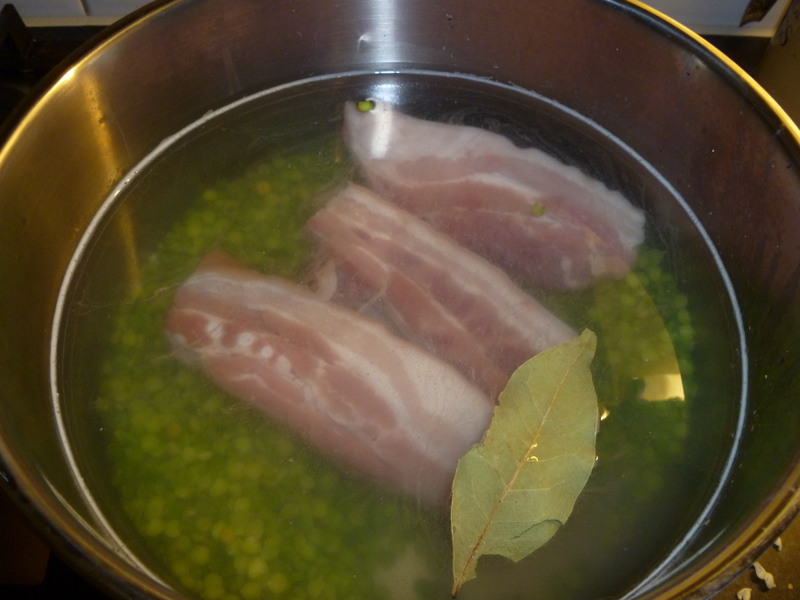
I remained pretty loyal to the proportions given in the recipe, but I had purchased a half kilo of split peas, and couldn’t see any other use for them, so I added all of it, and adjusted up the meat and water accordingly. I stuck with the amounts of the various vegetables, but I used larger ones than suggested too. So the actual proportions were:

500 g Split peas

2.5 l Water

1 Dried bay leaf. I would normally use 2 fresh, but I only have a small bay tree, which I am trying to be really kind to, having lost another one last winter.

500 g belly pork

3 large leeks

1 medium celariac

1 large carrot

4 potatoes

Handful celery leaves. It is common to find ‘leaf celery’ sold as a pot herb in the Netherlands. If you can’t find this, you can use the celeriac leaves, lovage, or flat leaved parsley, as a suitable substitute.

1 smoked sausage.

Because this is a really common dish here, I was able to find this sausage in my organic butcher’s shop. I have never seen it in a butcher’s in the UK, but it is basically the same as the smoked sausages you can get in the chiller cabinet  – e.g. this one from Matteson’s, although I am sure there must be others available.

First Stage of Making Erwtensoep

At this stage, I was still thinking it would not be for me

I followed the recipe, and found that it took about an hour on a low simmer for the pork to be cooked so that you could easily shred the meat. The original recipe does not make that clear, but I guess it depends on the cut of the meat you use (should be fatty meat, that benefits from slow cooking).

I did not want to reintroduce a lot of the fat and the rind back to the soup. Of course, hating waste as I do, that is currently in my freezer to wait until I have a ham bone to make stock with.

I would have put a ham bone in the pot with this lot, to enrich the soup, but it was -14°C this weekend, so I guess many Netherlanders were making the same soup, so the butcher had run out.

This amount made LOADS of soup, and it filled about two thirds of my huge stock pot. It was enough for quite a few batches, so I gave soup out to four elderly neighbours, and still had enough left over for us to have some too. Much to my surprise, I actually really enjoyed it. I hope that my neighbours also decide it is Lekker (tasty)!

Erwtensoep

Erwtensoep - Warming, Kind and Tasty - Who Knew?

It was brilliant to go and chat to people and practice my broken Dutch with them. People were very happy to receive their random soup of kindness. It gave me more of a warm glow than the soup itself did.

Unfortunately, my Dutch is not good enough to explain what a blog is to these elderly neighbours, so I gave up on the idea of trying to ask if they minded me taking a photo of them with said soup. You’ll have to imagine the look of joy on their faces.

So, I hope that you decide to join in the random soup of kindness. You don’t even have to have a blog to write about it on. You needn’t spend much money or time on a soup, but the sense of having contributed something really good to your community will be worth it in spades.

I am certain that you will get much more out of the experience than the time you put in. I have repaid kindness shown to me; met a few new people; been able to practice my Dutch; found out that I have been closed-minded to the delights of a pea soup; and have been glowing brighter than the readybrek kid because I did something nice for other people. I am already thinking about what soup I can do next that will be acceptable to my neighbours. I am thinking a pumpkin one, which I can also give to neighbours for whom pork may not be an option

Like with most voluntary acts, it really was a case of give a little, gain a lot!

Random Soup of Kindness Logo

4 Comments

Filed under Feast

Tiramisu – Another Day Another Trifle

Tiramisu

A Mere Trifle

(c) J. Casper 2011

This is another take on  a trifle, of course, continuing in the spirit of eating well and using up what you have. This also appeared at the international Christmas dinner, but is great for any occasion.

The history of this dessert is uncertain, but it seems to be a lot younger than my family’s sherry trifle. However, purists would argue that my recipe is not a tiramisu, but at the time I served it, I didn’t think that “Coffee and Custard Layer Construction” had quite the same ring to it. Although now I see it written down, I am wavering…

The traditional tiramisu consists of layered sponge, soaked in coffee, and a  mascarpone and Marsala custard. But, I had some more spare panetone and I had made 2 l of custard, so I diverted from the original. I think that you can add a slug of Marsala, or even some Tia Maria if you want. I preferred a big smack from the coffee, and so didn’t want it mellowed in this instance. I certainly don’t think it suffered for it.

If you are an improvisational cook, like I am, you will enjoy getting the most out of what you have, so may well find other, equally good things in your cupboard, or fridge. It is good to know that you don’t have to stick rigidly to the old traditions, but that you can still produce great tasting food. You never know, if it is good enough, you could be starting a tradition for yourself!

Recipe: Tiramisu

Ingredients

180 g panetone

3 espresso coffees

6 egg yolks

100 g sugar

500 ml double cream

500 ml milk

½  vanilla pod

100 ml whipping cream

Cocoa powder to dust

Method

Make the custard, using the usual method, which is here, in case you need a reminder…

Leave to cool overnight in the fridge, if you can, but at least a few hours if you forgot that you are entertaining the next day, or have a pressing appointment.

Cut the panetone into strips of roughly the same size and thickness, and put in a dish, in a single layer if you can. I used a flat baking dish for this, not the final serving dish. Pour the coffee over it in as even a way as you can, you don’t want large portions of the sponge to remain untainted by the coffee.

Set the panetone aside to soak for about half an hour.

Once the panetone is thoroughly soaked, layer it into the serving dish (or individual glasses)  so that you have sponge, custard, sponge custard. I find that this is enough for two layers, but you may get more or fewer, depending on the width and depth of your serving dish.

Leave about 3-5 cm at the top, and refrigerate if you are not going to serve it straight away.

Just before serving, whip up the rest of the cream, and put it in a layer on the top of your trifle. Dust with cocoa powder, and serve it to guests who have already feasted on loads of food, but they won’t be able to resist just a small bit of this too.

2 Comments

Filed under Feast

Sherry Trifle

Sherry Trifle

Sherry Trifle, for all Festive Occasions

(c) J. Casper 2011

In my family, a festive occasion is never complete without a sherry trifle – home-made, of course! We have a family recipe from my aunt’s mother-in-law, who was very particular about her recipe. She never, ever used fruit, and would frown upon versions that had superfluous ingredients. We have them for all manner of get-togethers, and a party wouldn’t be the same without one.

She passed her secret recipe onto my aunt. I have never asked her the exact recipe, but she has given me enough hints and tips that I have been able to come up with a good enough approximation. The exact recipe remains a closely guarded secret. Well, at least I imagine it that way, it seems nice to have a recipe that gets passed on to only a select few!

I have been meaning to post about the one that I made for our international dinner, but I had so much to post from Australia and since then, this is the first opportunity that I have had. I figure that this recipe is good for any party, and what better excuse than on your next snow day? Given the weather at the moment, I’m sure you won’t have to wait that long for the next one!

This version of sherry trifle has a few main differences to my normal one. Firstly, following our mince pie and mulled wine party, we had half a panetone left over that someone brought. I hate to waste things, so it seemed the perfect way to use this was to add it to the trifle instead of the usual sponge.

Secondly, I sent the Big Guy off to buy the sherry, and he came back with Pedro Ximinez. It does fit the brief of a sweet sherry, but it is much more interesting than the usual cream sherry, so beloved of elderly ladies, that is traditional in the family one.

Thirdly, the jam is usually strawberry or raspberry. I didn’t have any of those, and so I used some of the blueberry jam I had left from a trip to Sweden.

I am not sure that these amendments would have met the approval of the originator of the recipe, but it was certainly appreciated by my guests at our international christmas dinner!

Recipe: Sherry Trifle

Ingredients

6 egg yolks

100 g sugar

500 ml double cream

500 ml milk

½  vanilla pod

150 g panetone, cut into strips and spread with jam

100 ml sherry

200 ml whipping cream for the topping

Method

Firstly, you need to make a custard. It also need to be fairly thick, so I use half milk and cream. Normal custards can be made with just milk, but this one needs to hold up when you serve it, and not run everywhere, so the cream is necessary here.

You can make the custard using the step-by-step guide that I posted yesterday.

Set the custard aside to cool completely. If you can chill it overnight, so much the better.

Spread the jam on the panetone, and place it in the bottom of the serving dish. My traditional sherry trifle is served in a large bowl, from which everyone is served, but you can also arrange it into glasses for individual servings. Add the sherry to the sponge, and leave aside to soak in for 20 minutes.

Add the custard on top of the panetone. Spread it so it is as even as possible, but leave about 2-3 cm at the top of the bowl.If you are not going to serve this immediately, chill it again.

Just before serving, whip some cream to stiff peaks, and put it on top of the custard.

This is not a lightweight dessert, but it is a great treat. Especially for a celebration.

2 Comments

Filed under Feast

Custard – a Step by Step Guide

You may have noticed by now that I am rather fond of dishes that involve custard. This is partly because I can only get Vla in the Netherlands, which is too sweet for use on desserts, and has been thickened with flour; but partly because homemade custard is much more tasty than it’s packet counterpart . It would, indeed, be possible to add Bird’s Custard to the list of Stuff Visitors Must Bring From the Motherland, but actually, making custard is relatively easy, so I don’t usually bother.

As it is so easy, and I have a couple of recipes coming up that require custard (and many more to follow, I’m sure) I thought that I would give a quick step-by-step guide, to save me typing out the method all the time.  The recipe calls for the use of vanilla bean. I know they are expensive, but they really are superior to using vanilla extract, so try to get them if you can. There is a good vanilla bean paste on the market too, that would be a better substitute if you really have to. Of course, I have managed to find a way to eke out the most value from a single vanilla bean, and nothing is wasted!

Most of the time, a recipe will call for you to split a vanilla pod in half, then add all of the seeds, and the pod to the warming milk/ milk replacement. I usually only ever scrape half of the bean, and add the seeds to the liquid. The exception to this is when making ice cream, or a LOT of custard, as these will require a whole pod.  I always add the split pod too, but when the milk has warmed through, I remove the pod, rinse, and dry the halves. When they are dry, I put them aside in an airtight container (a small jar with a lid). The next time that I need to make a custard, I still have seeds from half of the pod, and the old pod to add to the milk, so I get double the custard for the price of one.

Still not done, you can then dry the pods for a second time, and snip them into shorter lengths. Add these to an airtight jar filled with sugar. The remaining oils in the pod will infuse, leaving you with vanilla sugar. This is a much more acceptable substitute for vanilla pods in your next batch of custard, than using vanilla extract. There are many other recipes that you can use this in. I find stewing fruit with a little of this sugar is a really great addition. The vanilla pods will continue to be useful in this way for a few weeks. When they are dried up, they have imparted all their flavour to the sugar, and only then should you discard (or better yet, compost) them. That is a lot of value from one lowly bean, making it all a lot more worthwhile!

I have not given proportions here, as this will vary from recipe to recipe, whether you are using milk, cream, soya milk or even coconut milk (which is excellent in custard – I recommend that you give it a go). You can also make savoury custards but the methodology differs, so this is for sweet custards only.

STEP ONE – The Milk

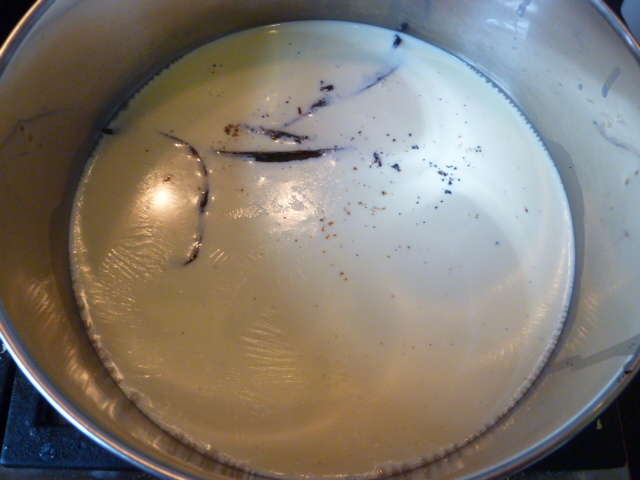
Flavoured milk, just below boilng point

When the milk looks like this, remove from the heat

The milk (or replacement) has to carry the flavour. Usually, this will be vanilla, but could also be cocoa, ginger or fruit syrups. Whatever flavour you are adding needs to get heated with the milk. Some flavours, like the vanilla will infuse sufficiently having been brought up to the boiling point. Others will need to steep for a while before you heat the milk, to intensify their flavour.

Whichever way, you will need to gently bring the milk up to boiling point, but try not to let it boil. You will have reached this point when there are small bubbles at the sides of the pan. Take it off the heat at this point.

STEP TWO – The Eggs

While the milk is slowly coming to the boil, separate your eggs. I have assumed that a picture is not necessary for this part of step two. Be careful not to get yolk in your whites. I advise breaking each egg over a small, separate container before adding the whites and the yolks to the main batches. This way if any do break, you haven’t lost the lot. I have also taken a risk on scooping out some egg yolk when I managed to get a little bit (and I stress it was little) of yolk in my whites once when I didn’t follow my own advice, and it turned out OK, with no discernible effect on the yolks, but it was not great worrying about it.

Don’t throw away the egg whites. They make great meringues and macarons. They also freeze well, if you don’t have time to do something with them straight away. I would love to hear any other suggestions for using up egg whites, particularly in savoury dishes, if you have them. Although egg white omlets need not apply!

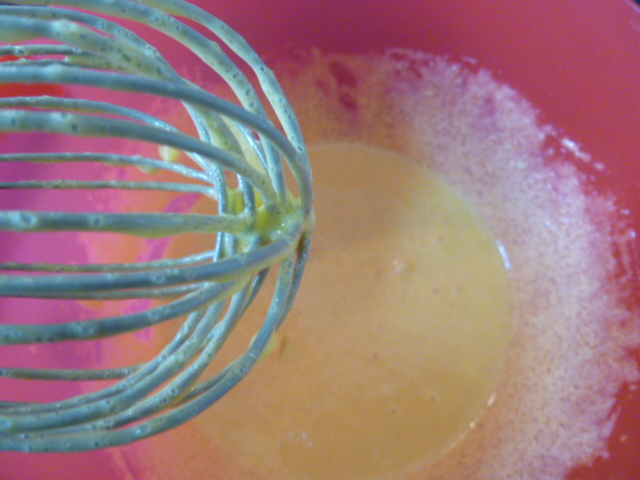
Egg yolks and sugar, whisked until pale

Egg yolks and sugar, whisked until pale

Once you have your egg yolks, you need to combine with the sugar, by whisking them together, until the mixture is pale.

A tip here is not to add the sugar to the egg yolks unless you are going to whisk them straight away. If sugar is left on the yolks, it will change them, and a skin will form, making the end result a little bit lumpy. This would be the time not to answer the phone if anyone rings!

It is the yolks that act as the thickening agent. I have heard that it is possible to make a sort of vegan custard, using soy flour as a thickener, and coconut milk, but I have never tried this method. Anyway, my point in telling you this is that you need the egg yolks – don’t be tempted to cut down on these, unless you also cut down on liquid too.

STEP THREE – Combining Eggs and Milk

Adding milk to eggs to make custard, slowly at first

Add a small amount of milk first

Some people will tell you that this is the hard part of the custard making process. As long as you don’t let it intimidate you, and you have a bit of patience, it need not be difficult. There is a risk that you could scramble the eggs, if you heat them up too quickly in one spot. This only happens if you apply direct heat to them, or if you try to add too much hot liquid at once.

An easy way to get around this is to only add a small amount of milk at first (really, only 20-30 ml), and make sure that you have whisked it in well before adding the next lot of milk.

You will need to put a damp cloth under your bowl, as I have done here, to stop it sliding around as you whisk, which leaves you with both hands for custard, not bowl-stabilisation.

Whisking in the first bit of milk

Thoroughly combine the first bit of milk before adding more

You can gradually increase the amount that you add each time. At some point, the egg will become quite liquid, at which point you have custard – congratulations! You  can add the remaining milk in a continuous stream, as long as you continue to whisk the custard all the time as you do so.

Adding Milk faster, continuing to whisk

You can start to add the milk faster, but continue whisking

I usually continue to whisk the custard for a little while, once all the milk has been added, more from habit than anything else, I think.

Whisking well to make sure the milk & eggs are thoroughly combined

Give the custard a whisk after all the milk is added, to ensure it is all combined well

STEP FOUR – Thickening the Custard

Custard, not yet thickened

When you return the custard to the pan, it will look like this

Next, the custard needs to be thickened. If you are making custard from scratch, you will need to stir it constantly. There is no getting away from this. I like to see it as spending time with the custard rather than getting impatient about it. Making custard can be relaxing, and fairly zen, if you let it.

Return the custard to the pan that you heated your milk in. Put it on a low heat and start to stir. You need to try to stir so that you are  moving the wooden spoon over all of the base of the pan, so that no custard can catch on the bottom, and cause lumps.

As it cooks, the custard will gradually start to thicken. When you draw a line on the back of the spoon, and the line stays there, and does not run, then your custard is done.

Thickened, Warm Custard

You know your custard is done when you get a line on your spoon

Never allow the custard to boil at this stage. If it boils, you will split it, and will end up with lumpy, scrambled custard, which will taste nice, but will look awful and the texture in your mouth will be horrible.

If this does happen, don’t despair too much. It can be salvaged to make it passable again, but it will have lost a little of the rich, silky texture that good custard is known for.

You can let the split custard cool a little, then put it into a food processor. Start it on a low setting, and gradually increase the speed and keep going until it is smooth again. I got this tip from the Accidental Hedonist a very long time ago, when I first started making custards, and one split on me (or rather, I split it, if we are going for full disclosure…). It really works, and the custard will be almost as good as new.

You can pour custard, hot, onto pies and puddings, baked fruits, or fresh ones. You can chill it for use in trifles or flans. Once chilled, you can cover  it with sugar that you burn under a blow torch, or a very hot grill for a créme brulée. You can bake it in the oven. You can even bathe in it to demonstrate how wacky you can be to raise money for charity, if you really must (not recommended, better use Bird’s for this purpose). Whatever you do with it, you will have a lovely homemade treat that will impress your friends, and that you can be very proud of.

4 Comments

Filed under Feast