Tag Archives: Recipe

First in, Best Dressed

Asparagus Salad, Chervil Dressing and Asparagus Mousse-Stuffed Chicken Ballotine

Made for Each Other

I may have already mentioned how inspired I was by the Rollende Keukens (only once or twice…). I ate so many good things there, that I am now experimenting with.

Nestled in amongst the stalls, was the Bar d’Asperge, which sold all manner of brilliant dishes with asparagus; from the Dutch classic – white asparagus with ham, egg and a bechamel sauce, to grilled green asparagus, pasta salad and all manner of other things. I was in search of something on the healthier side to counterbalance all the barbecued goodies that the Big Guy was queueing for. We were both also hungry, so I wanted something substantial, too.

Asparagus Salad with a Delicious sour cream & chervil dressing

A Healthy Option – Fresh Asparagus Salad

I came across this lovely salad, which contained potatoes, white and green asparagus, mushrooms, capers and cornichons. As the lady served it to me, she smothered it in a dressing, casually mentioning it was home-made. It was good – creamy, rich and spiked with chervil. Asparagus and chervil: if ever a herb were meant to go with a vegetable, it would have to be these two.

I tried many things at the Rollende Keukens, but to be honest, I don’t remember much else from the first day that I went there. This salad, and this sauce have consumed the rest of my memories. I knew I had to recreate it, and I knew that I would need to do a bit of research first. A lot of the sauces I looked at were stock based, and thickened with cream. This dressing certainly had sour cream, but was sharper and fresher than that.

I thought that you would need the thickness of a mayonnaise to give the sauce its consistency. I also knew that a shop-bought mayonnaise would make it too claggy. Then I remembered that it was perfectly possible to make mayonnaise yourself, and I could make it at the thickness that I felt appropriate. And so, a homemade mayonnaise with a neutral-tasting oil was my starting point, and it went really well from there.

This salad, and the sauce went perfectly with the chicken ballotines that I stuffed with asparagus mousse. I am not a fan of white asparagus, so I left it out. The original salad also had silverskin onions in. I am not a huge fan of these, either, as I prefer the sharp tang of a home-made pickled onion to the sweetness of these tiny alliums.

I hope that you have a go at this sauce, I know a lot of people are put off by making a mayonnaise, but with this amount of oil, there shouldn’t be a problem, as long as you add the oil in very small amounts, and whisk it well in between so that it all of the oil is incorporated into the emulsion before you add the next lot.
Herbs on Saturday Blog Badge

As this dish makes use of one of my favourite herbs, I’m entering it into Herbs on Saturday, by Karen at Lavender and Lovage, which is being hosted this month by Anneli at Delicieux. You probably won’t come across chervil in the supermarkets, so look out for it at markets and farm shops. Or, even better, get hold of some seeds; it is one of the easiest of all of the herbs to grow from seed, the flavour is more intense, it has beautiful white flowers that are also tasty and will seed itself quite happily – if you don’t eat all the flowers first.

Asparagus Salad and Chervil Dressing

This recipe serves 4 people

For the Dressing:

1 egg yolk

1 tsp Dijon mustard

Lemon juice to taste

100 ml sunflower oil

100 g sour cream

15 g chervil, finely chopped

salt

For the Salad:

The proportions that I mention here are approximate. You can also adjust or add to your taste, things such as silverskin onions, hard-boiled egg, different mushrooms (Morels would be great if you can find them), spring onions, and probably many other things.

250 g small salad potatoes

100 g chestnut mushrooms

400 g asparagus (white, green or both)

2 tbsp capers

50 g cornichons

Chervil leaves to garnish

First make the dressing. Start with an egg yolk in a mixing bowl. Add the Dijon mustard, a pinch of salt and a good squeeze of lemon juice, and whisk together well. I did this by hand, because the heat from a food processor or stick blender is enough to scramble one egg yolk. You need a little lemon juice, because the you are essentially making an emulsion, and the acid helps to stabilise it, and stop it splitting. Don’t worry if you don’t think it is enough, you can add more later.

Then slowly add the oil, a little at a time. Make sure that it is well incorporated into the egg before you add more. Keep doing this until the oil is finished, or you think that you have a fairly thick mayonnaise. The exact amount that you’ll need will depend on the size and the age of the yolk.

Once you have a thick mayonnaise, whisk in the sour cream. Stir in the chervil. Season with salt, and taste to see if it is sharp enough for your tastes. If it isn’t, squeeze some more lemon juice into the mix. Set aside to allow the flavour to develop.

Boil the potatoes until they are just tender. Drain and set aside to cool.

Cut the mushrooms into quarters, grind over some black pepper and salt, and fry in a little oil or butter until the mushrooms have given up their moisture.

Break off the woody ends from the asparagus, and cut into 5 cm chunks. Blanche in boiling water for no more than 3 minutes, you want the asparagus to retain some bite. Refresh in iced water, or by running the pieces under a cold tap. Drain, and add to a salad bowl.

Cut the potatoes in half. I did mine on the diagonal for interestingly shaped salad. Add to the salad bowl, along with the mushrooms, capers and asparagus. If the cornichons are really tiny, add them whole. If they are slightly larger cut them in half lengthways, or into large chunks. Stir well.

Serve garnished with chervil leaves and with a generous helping of the dressing.

5 Comments

Filed under Feast

A Mousse Ate In a Windmill (In Old Amsterdam)

Asparagus Mousse and soft poached egg on sourdough toast

Twist on a Breakfast Classic

This year is the first year that I have been able to harvest my own asparagus. As you must, I planted four crowns two years ago, and it has been an agonising wait. I also thought that I’d been a little over zealous with the first harvest. I waited until I had a good few stalks, and before they got too long, then I plucked them all with the eagerness of a beaver who had just been presented with his own river that runs through a hardwood forest. I had the first batch simply steamed, and accompanied by a soft-boiled egg.

And then I waited. And waited. And the anxiety rose. And I started to worry that, having waited so long to crop them, I had been too impatient or greedy and that I would have to plant more crowns and wait another 2 years.

Asparagus Shoots Coming Anew in My Garden

Hope Springs Eternal

And then I went into the garden this morning, and was delighted to find this stalk poking its way through the soil and mulch. I will have more home-grown asparagus again this year, after all.

I had a few friends round to dinner at the weekend, which coincided with my panicky dearth of my own asparagus. But, I really wanted to  make asparagus the star of my main course, given that it is only with us for such a short time. So I dreamed up a main course that consisted of an asparagus salad, and a ballotine of chicken, stuffed with asparagus mousse. I have to admit, the food was lovely, seasonal and fresh, but my ballotine-making skills definitely require honing. They were not the most beautiful, and one or two lost some of the stuffing. But my guests enjoyed them, so I guess that is what matters.

Chicken Breast Stuffed with Asparagus Mousse

A Total Farce!

I also made far too much mouse for the number of chicken breasts (and, indeed, guests) I had. So, the next morning, I cooked up the rest in a water bath, and had it for breakfast on some sourdough toast and topped with a poached egg. It was a great breakfast. I can also imagine this mousse served as a starter, with crayfish, or maybe even lobster, if you want to push the boat out.

Simple and in Season Blog BadgeOne Ingredient, Asparagus How To Cook Good Food Blog Badge

I can’t get enough asparagus at this time of the year, and of course, there is never any waste, because I always use the woodier ends to make soup. I can eat them simply, or in recipes. But I’m always looking out for new recipes to make and to inspire. We have a few more weeks of the season left, so if you have some great asparagus recipes, link them up in the comment section. I’m also entering this into Ren Behan’s Simple and in Season, since there is nothing more seasonal than asparagus right now; and into One Ingredient, hosted this month by Laura at How To Cook Good Food since it is really appropriate right now.

Recipe: Asparagus Mousse

Ingredients

700 g asparagus

2 small shallots, finely chopped

1 clove garlic, sliced thinly

1 tbsp oil

100 ml cream

2 eggs

20 g chervil

Plenty of salt and pepper

Method

Remove any woody ends from the asparagus, by gently snapping them. As I have mentioned, no need to waste this bit, it may not be good to chew in a dish, but makes a great soup, or you can add it to vegetable stock, for an additional chlorophyl hit.

Cut the asparagus spears into 3-5 cm lengths, and blanch in boiling water for about 2-3 minutes, depending on the width of the stalks. Refresh immediately under a running tap, or in iced water. You don’t want them to continue cooking, as they do cook for longer later in the process.

Soften the shallots and the garlic in the oil, until they are translucent. Keep them moving, so they do not catch. I always find that shallots will burn much quicker than onions. Once they are done, blend up with the asparagus, and the roughly chopped chervil. If you want to be really cheffy, you’d blend them then pass them through a drum sieve or something similarly fine. I am less cheffy, and was perfectly happy to have a bit of texture in my mousse, so I blended it up as fine as I could get it in my food processor.

Asparagus mousse of the right consistency for stuffing

Stuffing Thick

Beat the eggs and cream together, and stir in the asparagus mixture. The mixture should be pretty thick for a stuffing, but you could thin it with a little more cream if you intend to make a mousse. Season it really well. It will need it.

Then you can either use it to stuff meat, which should be poached gently in water or stock; or you can put it into greased ramekins or dariole moulds, and cook it in a bain marie until it is just set. The time you need will depend on the size of your mould. It took me about 20 minutes, but I was using pretty large ramekins.

If you have greased your dish well enough, you should be able to turn it out. I did this, but decided that I wanted to serve it on toast, and you’ll find it also spreads nicely.

10 Comments

Filed under Feast

Young and Foolish

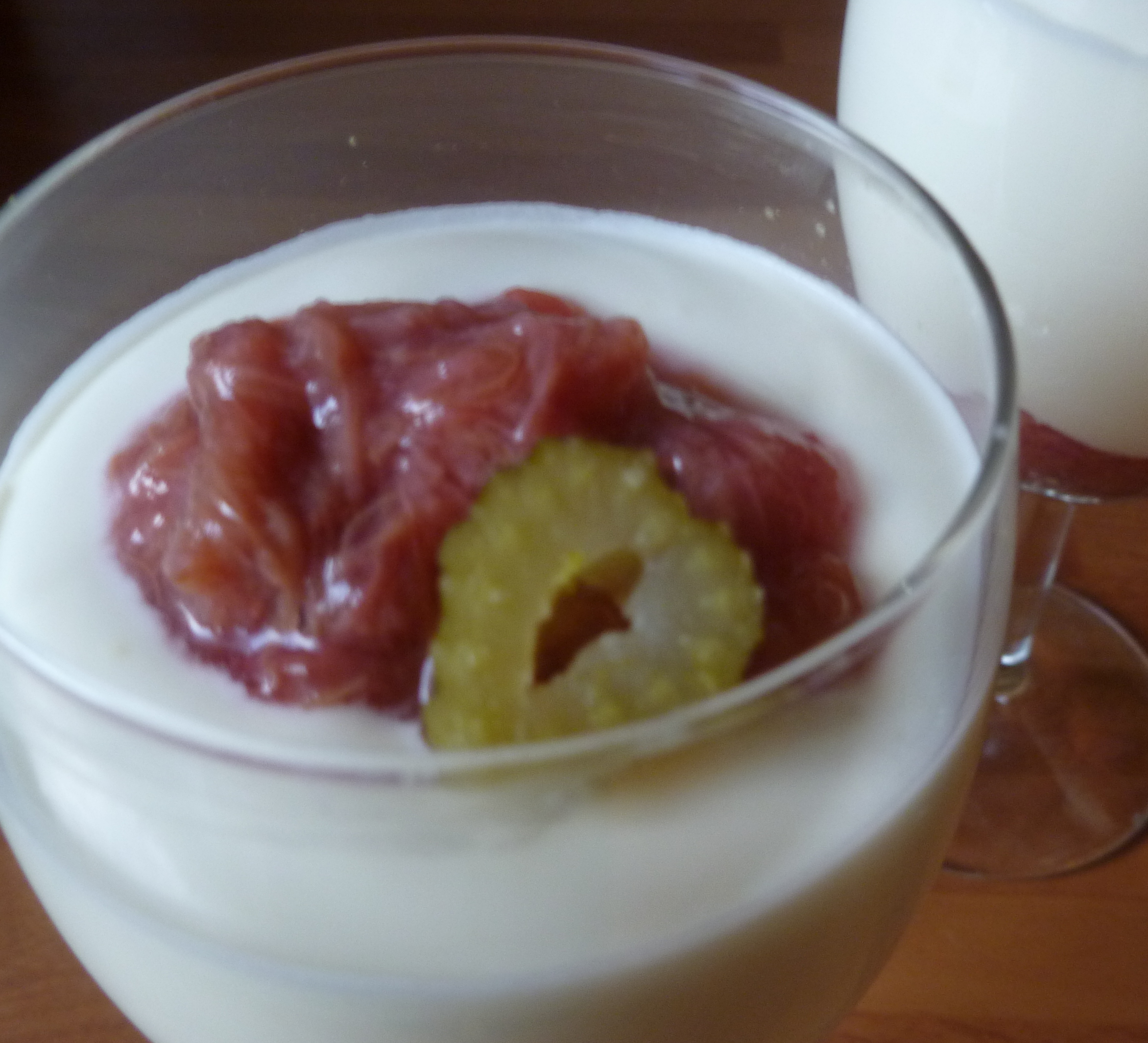
Fennel Rhubarb Foolish

Going Foolish Over Spiced Rhubarb

Today’s inspiration has come from two places. During the rhubarb tasting menu at Mister Kitchen at the Rollende Keukens, I had a bit of a revelation. As part of the main, they had roasted a few chunks of rhubarb and served them with pork, and a slice of their very good sausage. The sausage had fennel seed in it, and I tried this with a bit of the rhubarb, and the combination is incredible.

I came back from the tasting with a head full of experiments with rhubarb, both sweet and savoury, and if they work, you’ll see some of them on edible things soon.

But, I knew I needed to do something with the fennel and rhubarb as soon as possible. I am still playing with this, but one of the first things that I did was to stew some up with a few fennel seeds. This really is amazing. And surprisingly, the fennel seems to sweeten the rhubarb, so you need a lot less sugar. I had this with some plain yoghurt for breakfast.

swallow-recipes-for-life

Then, I saw this Month’s Recipe for Life, held by Vanesther over at Bangers and Mash. This is in aid of Swallows, a charity that supports adults with learning difficulties. Vanesther is much more eloquent than I could be on the subject, so please do check out her site to read more about it.

This month, she has chosen rhubarb, spice and lemon as the three key ingredients this month, and I knew this was the challenge for me. It will be good to share the brilliant combination of rhubarb and fennel as, really, more people should know about this.

I deliberated for a few days as to how I could best bring some lemon into the mix. Then I got invited round to a friend’s with some other fabulous ladies, and it prompted me to come up with the dish I am entering. The dish needed to be simple, mobile (because I was going to take it round to my friend’s) and most of all the lemon needed to balance with the subtle fennel.

The obvious choice would have been a classic rhubarb fool. Fools are pretty nice, but there is also something to be said for a syllabub, which is essentially cream and alcohol, and what’s not to like about that? Some kind souls had left a bottle of Pernod, and one of Limoncello following a party sometime, and then I had the basis for a few experiments in syllabub. Turns out that both of these are pretty good, but the Limoncello just about had the edge.

Whilst thinking about this, I decided to try to add some texture with some candied fennel, which I’ve also been thinking of having a go at for a while. It really does add interest and an additional subtle fennel taste, but it would also work without it. And now you know what the suspense was all about from my last post.

So, here is the recipe for my Fennel Rhubarb Foolish. Not quite a fool, and not quite a syllabub, and there’s not a lot that’s foolish about that.

Fennel Rhubarb Foolish

Not Fool, Not Foolish

Recipe: Fennel Rhubarb Foolish 

This recipe is enough for 5 people if you serve it from a wine glass

Ingredients

300 g rhubarb, chopped into chunks

1/2 tsp fennel seed

Juice of half a lemon

splash water

2 tbsp sugar

250 ml cream

50 g sugar

250 ml greek yoghurt

25 ml Limoncello

Grated zest of 1 lemon

Juice of half a lemon

Candied Fennel

Method

Firstly, lightly stew the rhubarb with the fennel seed, lemon juice, and sugar. Add a splash of water, to prevent the rhubarb from burning as you apply the heat, but be aware that it will give off liquid itself, so don’t add too much, you don’t want it swimming. As I said, the fennel takes the sharpness off the fruit, so don’t add too much sugar, you can always add more towards the end of the cooking process if you need to. Cover the pan, and stew it on a low heat until the fruit just starts to break down. Taste for sweetness and fennel, and add more sugar or fennel seeds (not a lot) if necessary.

If there is a lot of liquid, strain it off. Don’t throw it away, it is great to macerate strawberries and raspberries in, or to use instead of a simple syrup in some cocktails.

Set the stewed rhubarb aside to cool. Meanwhile, whip up the cream, sugar and lemon zest until the cream forms soft peaks. Add in the yoghurt, and fold it through. A classic syllabub is usually just cream and wine, but I wanted this to be slightly more substantial, hence the yoghurt.

Once the cream and yoghurt is well combined, add the lemon juice and the limoncello. Taste to make sure it tastes lemony enough for you, but not so lemony that your face puckers like a disapproving octogenarian. Add more lemon juice or limoncello to taste.

Finally, layer up in wine glasses, with rhubarb, candied fennel, the syllabub, a dollop more rhubarb and the candied fennel stalk to finish. Then bore your friends while you take photos and they wait hungrily for a lovely tagine (that was made by my friend, not me at our dinner party).

7 Comments

Filed under Feast

I Want (Fennel) Candy

Candied Fennel

Sweet and Fresh

Having been inspired to start blogging again, I have been making the most of recent inspiration for the next few Feast posts. The cooking and recipes, as always, are my own, but credit for the dishes are definitely due elsewhere. I take a magpie approach to food, often finding shiny little pieces here and there. Maybe one day I’ll enter the 21st century and get myself a smart phone, but for now, I forage for ideas, as well as edibles, and record them all in a series of notebooks, which I have to go digging through in order to remember the inspirations. Does anyone else do this? Please tell me that I am not the only one scribbling things down furtively in restaurants, shops and even the street. For me, it is like foraging and farming in note form, and as much of an obsession as they are for me in real life.

I’m sure we are all familiar with candied peel, and even crystalised angelica, if you are fond of cake decoration. These days , it seems that candied vegetables of all nature are appearing on both sweet and savoury dishes in restaurants and pop ups up and down the country. One of the first, and the one that instantly caught my magpie eye was candied fennel. I have also seen candied celery and beets (especially chioggia beets) among other things on menus, although I find the idea of them much less appealing.

Fennel is one of my favourite vegetables, and I love it in risotto, soup, and salad, braised, roasted and raw. This is a great way to use the tougher outer leaves and stalky bits if you are not keeping them for stock, too.

This version is really simple, despite my fears that it may require multiple exposures to sugar syrups of varying strengths, it isn’t the case. I kept mine plain, but they are also good served as sweets, and sprinkled with sugar.

Today’s recipe was inspired by Simon Rogan, who is a far better forager and cook than I could ever hope to be. I can’t remember where I first heard about it, but I suspect it was on a cookery programme, because  I have written down “candied fennel, Rogan. V. interesting, possibly for strawberry tarts? Experiment”. I finally got round to making this, as part of an even wider experiment, that does not involve strawberries or tarts of any kind, but you’ll have to wait until my next Feast post to find out more about what I wanted them for. This cliffhanger is not quite of Eastenders Duff Duff proportions, but hopefully, you’ll want to keep reading.

Recipe: Candied fennel

Ingredients

50 g sugar

50 ml water

1 tbsp lemon juice

Half a fennel bulb diced

Method

Make a simple sugar with the water, sugar and lemon juice. Heat gently until the sugar has dissolved.

Add the fennel. Bring to the boil then reduce to a simmer until the fennel is translucent, but retains some texture. It took me about 15 minutes, but it depends on the size of the dice,  and how much bite you want them to have.

Remove from the heat, and strain off the cooking syrup. Don’t discard this, it is perfectly good for other uses, and you know it’s a shame to waste such a tasty sauce.

Put some greaseproof paper, wax side up on a baking tray, and spread the fennel dice out into a single layer. Allow to cool on the tray, then store in an airtight container before use.

Enjoy them on their own, with sugar or as part of something delicious.

2 Comments

Filed under Feast

Making Plans with Nigel

Vegetable, Bean & Citrus Stew

Stew, Changed

(c) I. Nemes 2013

A couple of weeks ago, I found out that a few fellow bloggers had, like me, received Nigel Slater’s Kitchen Diaries II. Like me, they had also read it cover to cover, and enjoyed it as much as his first diary (which I have also read; I’m afraid my shelf life is too short for 50 shades, when I can fill my head with the sights, sounds and smells of food). Unlike me, Janice and Susan decided to pay him homage by hosting the Dish of the Month in his honour. Obviously, I was keen to join in, whilst cursing the fact that I hadn’t thought of it first!

I decided to cook from both books, on alternate months. Originally, I had intended to cook things I haven’t tried before from each of the books in turn. However, I was cooking stew for my new team, because I could make it the night before. One of them professed a love for beans and chickens. And just like laid plans, and mice; my intentions gang aft agley.

Once I knew of these preferences, I had to cook the humbly-named Chicken Stew and Mash from Kitchen Diaries (p.79). It has become a favourite. Although it uses winter seasonal vegetables, it tastes a bit like summer.

Two of my team are vegetarian. And you know me, I had to make them  feel as welcome as the others. So I needed a veggie stew. But couldn’t get away from the thought that this stew was the one I wanted to make. So, I had to come up with a vegetable version that would still hit the citrus and savoury spot, but with the same depth of flavour as the meat version.

The depth came from caramelised onions. The bulk came from pumpkin, as being in season, and good with orange. And a few chickpeas, because I had some that I’d cooked and frozen previously.

What I ended up was reminiscent of the original stew, with the savoury, citrus, and sweet tones from the orange, herbs and balsamic vinegar; but by necessity was pretty different. Since Nigel himself says in the introduction to Kitchen Diaries II “neither am I someone who tries to dictate how something should be done, and I am never happier than when a reader simply uses my recipes as inspiration for their own”, I think he won’t mind too much, do you?

If you’d like to enter Dish of the Month, then you can find the full details over at Farmersgirl Kitchen or at a Little Bit Of Heaven On A Plate. Add your post to the linky there, so that we can all see what dish you’ve chosen.

Dish of the Month

Recipe: A Bright Vegetable Stew

Ingredients

100 g white beans,

100 g chickpeas

1 1/2 onions, sliced

2 tsp herbs de Provence

2 bay leaves

3 cloves garlic

Pared rind and juice of an orange

2 leeks, sliced into coins

3 tbsp balsamic vinegar

2-3 tbsp plain flour

1/2 butternut squash, diced

Vegetable stock 

Method

If you are using dried beans and chickpeas, soak them in plenty of cold water overnight. Cook them in fresh, unsalted water. They will cook further in the stew, so make sure they are not soft when you drain them. Nigel and I agree on about 40 minutes.

Some of the depth of flavour in Nigel’s version of this stew comes from the Maillard reaction that occurs as the meat browns. I had to replace this somehow, and probably the best way is to allow onions to caramelise really slowly until they are brown. As they started to turn golden, I added the herbs and the bay leaves.

As the onion reaches a deep brown, add the garlic cloves and the orange rind, and cook for a further minute. Add the flour, and mix it in well, followed by the juice of half an orange once you’ve cooked the flour through.

Add the squash and the beans to the a deep casserole dish with a lid, then add the cooked onion and flour mixture.

In the same pan as you browned the onion in, soften the leeks, being careful not to burn them. When you can separate the concentric rings, they are about ready. Add the juice from the rest of the orange, balsamic, and about 500 ml of veg stock to the softened leeks. You can also add a pinch more of the herbs de Provence too, if you feel it needs it. I did. Bring all of this to the boil, season generously with salt and pepper, and then pour this over the vegetables in the casserole dish. 

You want the liquid in the pan to come about three-quarters of the way up the vegetables, bearing in mind that the veg themselves will give off extra liquid as they cook. If you need more liquid, add more vegetable stock.

Cook for 40 mins to an hour at 180°C, until the butternut is tender, but still holds its shape. The flour that you have added should have thickened the sauce somewhat, but if you want to thicken it further, slake a little cornflour in a few drops of cold water, and mix that in. Return it to the oven for 5-10 minutes, until it has thickened up. If you are gluten intolerant, skip the flour at the beginning, and just do this step instead (you’ll need about a tablespoon if you are not using flour, then slake and add as instructed)

I return to Nigel’s instructions, and recommend that this is also served with a big pile of creamy mash  – potatoes, or a mix of potato and celariac – so that the juices can form little puddles in the mash.

5 Comments

Filed under Feast

A Fruity Little Snifter

Japanese quince brandy

There’s Brandy in the Jar – Oh!

As you will probably have gathered if you have read more than this post, I do like to get the maximum use from my produce, especially if I have grown or gathered it myself. In this, the last of my Japanese quince posts, I am getting even more out of my harvest. I’m also starting right in on my resolutions, by blogging about booze. And I assure you, this one couldn’t be easier.

I have read a lot about quince liqueurs with vodka and honey. I have also read a fair bit about quince brandy, which sounded a lot better to me. Especially after I was given a copy of Salt, Sugar, Smoke by Diana Henry for Christmas, and she gives some really tempting takes on Kir Royale using quince brandy and either French cider or English sparkling white wine. I am also thinking of taking the best of both ideas and making something with the brandy and this very special cider from Sussex, Gospel Green Champagne Method Cider (look out for them, they are from West Sussex, but don’t have a website. This is truly remarkable “bubbly” style cider) if I can get hold of some.

Fruit brandies of this kind, and those distilled from scratch used to be pretty popular. You may know them as eau de vie, rakia, or brandywine, and they are still popular across Europe, but especially in the Eastern countries – Bulgaria, Serbia, Macedonia, and as far down as Turkey.

Of course, these are meant for quince or Cydonia oblonga, but I see no reason why they shouldn’t translate into Japanese quinces too. I selected some of the nicest fruit, and set them aside.

Then the next dilemma was whether or not to go with sugar.  For advice on this, I turned to Twitter. Luckily for me, preserving queen, Vivien Lloyd and beekeeper extroadinaire, Zoë Lynch were listening, and they both said sugar was wise, so sugar it was. Thank you both, if you are reading, although I didn’t go with that much, because I figured that I can always add sugar, but I can’t take it away if the brandy is too sweet.

The brandy needs to steep  for anything up to a year, so I haven’t tried this yet, but when I do, I’ll let you know how it goes.

Recipe: Japanese Quince Brandy

Ingredients

5-6 Japanese Quince

50 g muscuvado sugar

2 star anise

Brandy

Sterilised jar wide enough to get the fruit into

Method

Slice the quince, but leave the seeds in. Layer the quince into the jar, and sprinkle the sugar and the star anise between the layers.

Top the jar up with brandy. The fruit will be fine in here, as long as the jar is full, and the fruit doesn’t get exposed to air. I used a 700 ml jar, so needed a fair bit of brandy.

Leave it in a cool, dark place for up to 12 months, taking it out to shake it when you remember.

Strain off the brandy, and pour into a sterilised bottle, where it will keep until you have tracked down some of that excellent cider. Top up with more brandy, if necessary.

Oh, and I’m also thinking that there will be a good use for the fruit, possibly added to apples. I’m sure I’ll think of something tasty to do with them.

6 Comments

Filed under Fermented

Sugar and Spice


Spiced Japanese Quince Jam

…Makes This Jam Nice!

Following on from yesterday’s jelly making escapades, I had a load of fruit pulp from the Japanese quince to use up. I always try to use up the fruit pulp leftover from making jelly, and frequently make fruit butters, or even add them into a pie.

Japanese quince is perfect for this kind of repurposing, and you can make all manner of things, like pies, crumbles, stewed fruit, and many other things. Had I found these earlier on in the year, I may have been tempted to use the pulped fruit in a mincemeat of some kind, but I will probably experiment with that later. I could also have made a sweetmeat, like the membrillo I made last year.

However, this quince needed to be transportable, so I decided upon jam, since it had to get lugged all the way back to the Netherlands and needed not to leak into our luggage.

In keeping with the Persian theme, I wanted to spice the quince with flavours from the Middle East. I decided upon cardamom and cloves, to give it heat. A lapse of concentration also meant that a teaspoon or so of cinnamon also found its way in there, but it’s none the worse for it.

This jam is sweet, although not as sweet as it could be. I used a bit less sugar than the standard 1:1 ratio of the traditional set jam. I had the pectin from the fruit, and the bag of seeds in any case, and I wanted it to be more spicy than sweet. I think the spice mix would also have worked well had I decided to make a membrillo with it.

The only unfortunate thing is that Japanese quince do not turn the beautiful red that ordinary quince become after a long cooking time, so this is a rather brown jam, but it is no less tasty for it. Like the jelly, this will also be good in stews and gravies, but this will work better with lamb, and chickpeas.

Recipe: Spiced Japanese Quince Jam

Ingredients

Jam jars with lids

Boiled Japanese quince pulp, once drained of liquid

Seeds from the quince, tied up in muslin

Sugar (in the ratio 3:4 with the pulp)

Water (equal weight to the fruit pulp)

5 cardamom pods

6-8 cloves

1 ½ tsp ground cinnamon or one cinnamon stick

Waxed discs

Method

While the fruit is still warm, after boiling, pass it through a sieve, so that any skin and remaining pips are retained by the sieve, and you only have fruit pulp left. You will probably need to push it through with a wooden spoon.

Sterilise the jam jars and lids, in a dishwasher, in a low oven or in a pressure cooker.

Weigh your pulp. I got 400 g of fruit pulp from mine. Then you need 3 parts granulated sugar to four parts fruit, so I measured out 300 g of sugar.

Put the seeds in muslin that you used to produce the jelly into the pan with the fruit pulp, sugar, and equal weight of water. Tie the spices up in more muslin, or in the same piece of muslin as the seeds if it is big enough. If you are using ground cinnamon, add this straight into the pulp and mix in well.

Heat gently until the sugar has dissolved completely and then bring it up to a rolling boil. Again, the jam will set when it reaches 104.5°C, or passes the fridge test.

As soon as the jam reaches setting point, sterilise any ladles, jugs or jam funnels you are going to use with boiling water.

Pour the jam into the jars, and fill it to within 2mm of the top. This jam is quite thick, so give it a bang if you can to dispel any air bubbles. Put wax discs on the top, with the wax side down, and seal with the lids while the jam is still hot.


5 Comments

Filed under Found

Jam and Japonica

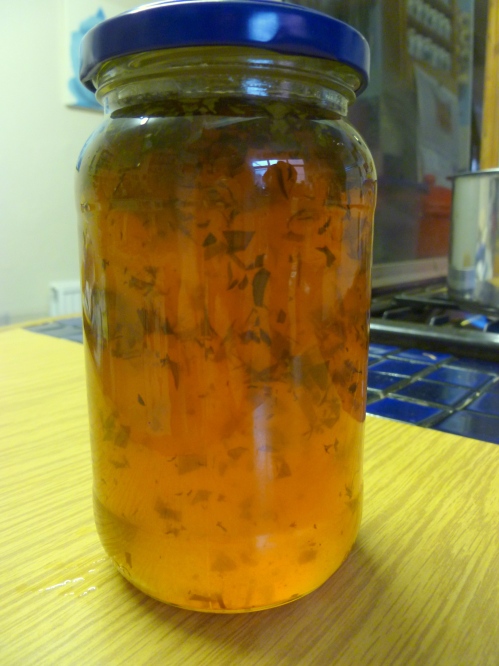
Japanese Quince and Tarragon Jelly

A Persian Twist

Most Fridays, I go foraging with a small group of great people. You may remember that I met one of them back when I did the seed workshop. One of them, Jennie is a herbalist, and we are learning a lot about the medicinal and culinary uses of wild plants from each other, and we all share good spots to find useful ‘weeds’.

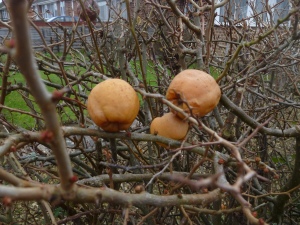
On the last forage of last year, we hit gold, despite the cold. We found a huge stash of Japanese quince, or Chaelenomeles Japonica fruit. The Japonica is usually grown for its beautiful flowers, as many people have no idea that the fruits are so delicious, or so beautifully scented.  At this time of the year, the fruit are pretty obvious, although I used to assume that they were ordinary bushes that some kindly person had studded with apples for the benefit of the birds in winter.

Japanese Quince on the bush

Hedge Decoration

Of course, this is a valuable winter fruit for the birds too, so if you do come across some yourself, then make sure you don’t take them all, as the birds will appreciate them, especially after they have bletted well. In fact, you will also think that they are better for a good bletting. Like their rosaceous namesakes, they are not at all good when you eat them raw, but they are delicious when cooked in pies, baked or as preserves, and they are really high in pectin, so great for this purpose.

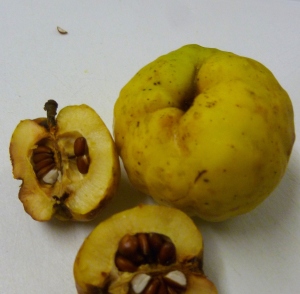
Japanese quince , halved

Seedy!

The Japanese quince is thin skinned, and has a lot of small seeds. I removed all of the seeds, and put half in a muslin bag for two types of jam, for the pectin. The other half I kept, and some of these may well find itself wending its way around in the next round of Seedy Penpals, which will be coming up shortly.

The fruits are also beautifully scented, and they have been brought into homes to simply sit in a room and lend it a lovely, delicate fragrance. As I cycled around, my foraged fruit was filling my nostrils, and my living room smelled lovely for a few days before I was off to spend Christmas at my parents, when they were unceremoniously stuffed into a bag, so we could make things with them.

Both quinces and Japanese quinces are used extensively in Persian and Moroccan cookery, and although I knew I was going to make jelly and jam, I wanted this to influence what I paired with them. Inspired by this recipe, I decided that I was going to make a quince jelly with tarragon, and then I could use the fruit pulp to make a different jam. I always try to use up the pulp from making jelly, and quinces make it really easy, due to the pectin.

I’m pretty pleased with this jelly; it is tasty and unusual on toast or yoghurt in the morning, as well as being good with meat. This year, Christmas dinner was a gammon, which was prepared in the same way as this baked ham. I added a tablespoonful of this jelly to the gravy, which made it rich and unusual, bringing a slight taste of the Middle East to a Western meal.

Recipe: Quince and Tarragon Jelly

Ingredients

3 jam jars

750 g Japanese quince

Water to cover

3 large stalks of tarragon, plus another 3 sprigs for chopping

Caster Sugar (400 g per 600 ml juice)

Wax discs

Method

Sterilise your jam jars and lids, by running them through a cycle in the dishwasher, cleaning them in hot soapy water and placing them in a low oven, or by steaming them in a pressure cooker.

Quarter the quince, and remove the seeds. Take about half of the seeds and wrap them in muslin for cooking with. Place the fruit and seeds in a large pan, and cover with water. Bring the fruit to a boil, then simmer them until the fruit is tender, and the perfume fills your kitchen. This will be between 40 minutes to an hour and a half, depending on how well bletted they were when you started.

Drain off the water through a piece of muslin, but keep the cooking liquid, as this will form your jelly. Set aside the fruit pulp, because this will be the basis of your jam. Measure out the liquid, as this will determine how much sugar you will need. For making jelly, you take 400 g sugar for every 600 ml juice. My fruits yielded 1.3 l, so I used 860 g sugar.

In a large, clean pan, add the liquid, sugar, tarragon stalks and the rinsed off muslin with the seeds in it. Heat gently, stirring while the sugar dissolves. Once the sugar has dissolved completely, bring the jelly up to a rolling boil. Don’t stir it after this. It needs to reach 104.5°C to set. You can measure this with a jam thermometer, or you can do the fridge test. I often do both.

Meanwhile, chop the rest of the tarragon finely, and set aside for later. Once the jam has reached setting point, take it off the heat; remove the muslin with the seeds, and the tarragon stalks. Don’t throw the seeds away, they are useful for more jam making later. Add the chopped tarragon, and leave the jam to cool for 10-15 minutes, so that the tarragon will be more evenly distributed through the jam in the jar.

Meanwhile sterilise any jugs, ladles and jam funnels that you will need to transfer the jelly into the jam jars, by covering them with boiling water. You’ll need to dry them off before use.

Pour the jelly into the sterilised jars, making sure that the jam is within a couple of mm from the top of the jar. Put the wax discs on the top, wax side down. Put the lids on and tighten them well while the jam is still hot.

12 Comments

Filed under Found

Acceptable Ways With Sprouts

A Stalk of Sprouts

From Bleurgh to Bogies

“What’s the difference between Brussels sprouts and bogies?”, goes the old joke, (You can’t get kids to eat Brussels sprouts!), and for many years these particular little green balls have divided households, especially during the festive season.

In my house, tradition called for sprouts on the plate, even if the kids left them there. Every other year it was the subject of a running battle between  my grandmother and me. As a small child, I would absolutely refuse to eat them; boiled, as they were back then, with the mystifying cross cut in the base. A bit like I do now, my Gran abhorred food waste, and loathed the fact that the sprouts would sit, untouched, on my plate. Unlike me, Gran did not do creative things with leftovers. She would threaten to give me those emerald cannon balls for the next meal, and the next, thinking that I would capitulate at some point and eat them. I was made of much stubboner stuff, and we would grumble and mutter at each other, while the sprouts festered somewhere (usually in the dog).

Nowadays, boiling sprouts is no longer compulsory. I am still not going to plant these in favour of kale, cavalo nero, or purple sprouting broccoli; but if I am presented with a stalk, I will no longer stamp my feet and dig in my heels in a resolve not to get them down my gullet more steadfast than that shown by Gandalf when he faced down the Balrog.

Instead, I have learned that sprouts are better if they see minimal water during the cooking process, and that they should definitely never be allowed to boil in water for any length of time. Indeed, unless you are making a soup of leftovers (of which more later), it is probably best to keep them out of water altogether, after they’ve been washed.

Sprouts are actually delicious, delicate and tender when eaten raw, so they make lovely salads and coleslaws. I think I got this from Nigel Slater, but pomegranate and sprouts are a lovely match in a salad. The sprout tops are also great for this, as they are tender and not as powerful as their smaller, tighter offspring down the stalk.

Cooking them in fat – bacon fat or duck fat is always a winner. I have done a sort of confit with halved sprouts cooked slowly in duck fat, and plenty of  thyme, which is pretty good, but not for those looking after their cholesterol.

I also like covering halved sprouts with a cartouche and letting them steam in a cm or so of stock in the bottom of a pan, until the liquid is absorbed. Again, meat stock is better, I often use chicken or ham stock, but vegetable stock is also good for this, if you are a vegetarian. This will take about 5-10 minutes on a medium heat, providing the stock is at simmering point when you add it to the sprouts.

The recipe that I’m about to share is an obvious combination, but  it works so well. And you can make a great soup with the leftovers (which I’ll be sharing here soon).

I hope that you have a go with some of these ways to eat Brussels Sprouts. I hope that together we can banish emerald green christmas bombs forever and move towards many more acceptable ways. The only question is, how do you eat yours?

Stir Fried Sprouts

More Than Acceptable

Recipe: Stir Fried Sprouts

Ingredients

10 sweet chestnuts

100 g streaky bacon cut into lardons

400 g Brussels sprouts

A splash of water

Method

If you are using fresh chestnuts, then you will need to peel them, and take off the hairy coating. This is the best method that I have found for peeling them. Once they are peeled, chop them roughly.

In a large frying pan, gently fry the bacon on a low heat, to render off some of the fat, and until the lardons are crispy. Remove to a piece of kitchen towel. Unless your bacon has given off more fat than a duck might, try to retain as much of the fat as you can.

Meanwhile, halve the sprouts, then shred them thinly.

Fry off the chopped chestnuts, until they start to brown. Add the shredded sprouts, and stir until the green brightens a little. Do not let them catch, burnt cabbage is not pleasant. Add a splash of water, and allow it to steam off.

Return the bacon to the pan, and mix well. Serve immediately with a big roast. This year we had a gammon. Don’t worry about the leftovers; soup is always a post Christmas winner.

2 Comments

Filed under Feast

Merry Christmas and Tarted Up Mince Pies

P1040219

Merry Christmas

Hello!

Well, It’s been a long time since I fired up the old blog. I haven’t gone away, but things have changed a little. Not least, WordPress have been messing about with the software, and the photos upload differently, so sorry if they look a little bit weird, until I can get used to the new  way.

Anyway, since I posted last I had a bit of computer trouble, so I know that I may owe a few of you e-mails, and I have some catching up to do for Seedy Penpals.

I also have a little news, that is probably exciting for me, and not for many others, but I’m going to tell you anyway. After a lot of deliberation, I decided to take a role as the Campaign Manager for the Land of Promise Campaign to get better working conditions and the use of fewer pesticides in the pineapple industry in the Philippines, and three weeks ago I signed a contract with Fairfood International. I am excited because it is combining my skills of campaigning, and food, and I’m helping Fairfood plan and deliver a new campaigning strategy.

I have dived right in, with planning for the campaign, which has taken all of my head space, but now I have done the background reading, I am hoping to get back to blogging regularly. It does mean that I need to settle into a different posting pattern, but for the time being I have a bit of a backlog of posts to catch up with, which I’ll schedule in the coming days and weeks.

But that’s enough about me. I am with my family, and have just finished the preparations for tomorrow’s food. I have also managed to squeeze in some jam making. I haven’t had as much time this year as I normally would to make all the preserves ready for Christmas, so I haven’t made my own mincemeat. The mincemeat that I picked up on Saturday is at the more mediocre end of the spectrum, and I am not one to compromise on quality that much, so I thought that I would also share my tarted up mincemeat recipe.

And of course, I wanted to wish you all a very merry Christmas, Great Yuletide, and a Happy Winter Solstice, whichever you celebrate.

Mince pie with tarted up mincemeat

Tarted up!

Recipe: Tarted Up Mincemeat

Ingredients

50 g dried fruit, I used a mix of cranberries, raisins and golden sultanas

Port to cover the fruit

1 jar mincemeat

Zest of a lemon

50 g of almonds and hazelnuts, chopped

Sweet shortcrust pastry I added lemon zest to this

Milk or egg wash

Method

Soak the dried fruit in the port until the fruit is plump. This will take at least an hour. Stir in the mincemeat, and lemon zest, and allow to soak together with the fruit.

If you are making your own pastry, make it now using the method here. Wrap it up and let it rest in the fridge for about an hour.

Tarted up mincemeat

Mincemeat Plus

Add the chopped nuts to the mincemeat just before rolling out your pastry. By using shop bought mincemeat, you are taking advantage of the pulped fruit (usually apple) and the spices. Normally mincemeat has to mature for at least a month before use, so this is a shortcut to tasty, fruity mincepies, without compromising on flavour.

Heat the oven to 160°C.

Roll out your pastry to about 3mm thick. Use two cutter sizes, one slightly larger for the base, cut an even number of bases and tops. Grease some tart tins. Cover with the bases, then press down gently with some dough offcuts.

Add a heaped tsp of the mincemeat to each base.

Brush the rim of one side of the top with milk or egg wash, cover the tart, wash side down, and either crimp or press gently with a shot glass to seal the pie.

Mince pies

Cheating Tarts

Brush the pies with more milk or egg wash. Put in the oven for about 15 minutes, or until they are golden brown.

Serve them to your friends and guests and no-one will tell that you cheated a little bit.

3 Comments

Filed under Feast